


Zirconium carbide (ZrC) is an ultra-high-temperature ceramic known for its high melting point, hardness, electrical conductivity and thermal stability. These properties make it an important material for advanced ceramics, refractory components, wear-resistant coatings and high-temperature composite systems.
However, the performance of zirconium carbide depends strongly on how the material is synthesised and processed. Powder purity, particle size, carbon-to-zirconium ratio and sintering conditions all influence the microstructure and properties of the final ceramic.
Several synthesis and sintering techniques have been developed to produce ZrC powders and dense ceramic components. Understanding their characteristics and limitations is essential for selecting suitable materials and processing routes.
1. Zirconium Carbide Synthesis Methods
Zirconium carbide can be synthesised through solid-state reactions, carbothermal reduction and precursor-based chemical processes. Each method offers different advantages in terms of powder purity, particle size, processing temperature and production complexity.
1.1 Carbothermal Reduction
Carbothermal reduction is one of the established methods for producing zirconium carbide powder. It involves reacting zirconium dioxide (ZrO₂) with a carbon source, typically graphite or carbon black, at elevated temperatures.
The overall reaction can be expressed as:
ZrO₂ + 3C → ZrC + 2CO↑
During the reaction, carbon reduces zirconium oxide while zirconium carbide forms as the final ceramic phase. The process is generally carried out under vacuum or a controlled atmosphere to support the reduction reaction and limit unwanted oxidation.
Carbothermal reduction offers several advantages, including relatively accessible raw materials and a straightforward synthesis route. It is particularly relevant to the production of ZrC powders for ceramic manufacturing.
However, powder quality depends on the homogeneity of the starting mixture, reaction temperature, carbon content and processing time. Incomplete reduction can leave residual zirconium oxide, while excess carbon may remain in the final powder.
Careful control of these parameters is necessary to obtain consistent phase composition and purity.
1.2 Direct Synthesis
Direct synthesis produces zirconium carbide through the reaction of elemental zirconium and carbon.
The reaction is represented by:
Zr + C → ZrC
This method provides a direct route to carbide formation without requiring the reduction of zirconium oxide.
Depending on the starting materials and processing conditions, the reaction may be initiated through conventional heating or other high-energy processing techniques.
Direct synthesis can produce ZrC with controlled chemical composition when the starting materials are sufficiently pure and the reaction proceeds to completion.
However, the process can require high temperatures, and particle growth or incomplete reactions may affect the final powder characteristics.
1.3 Self-Propagating High-Temperature Synthesis (SHS)
Self-propagating high-temperature synthesis uses the heat released by an exothermic reaction to sustain the formation of zirconium carbide.
Once the reaction is initiated, a combustion front can propagate through the reactive powder mixture, converting the starting materials into the carbide phase.
The main advantage of SHS is its short reaction time and reduced need for continuous external heating.
However, the rapid reaction can make temperature control, phase uniformity and particle morphology difficult to manage. Additional processing may be required to obtain powders suitable for demanding ceramic applications.
1.4 Sol-Gel Synthesis
Sol-gel synthesis is a precursor-based method that enables relatively homogeneous mixing of zirconium- and carbon-containing components.
The process typically involves preparing a liquid precursor system, followed by gel formation, drying and thermal treatment.
During subsequent heat treatment, the precursor undergoes chemical transformations that can lead to zirconium carbide formation through carbothermal reduction.
One advantage of sol-gel processing is the potential to produce fine ZrC powders with a relatively uniform distribution of the starting components.
This makes the method particularly interesting for nanostructured materials and research applications requiring controlled powder characteristics.
Nevertheless, precursor chemistry, drying conditions, residual carbon and processing complexity must be carefully managed.
1.5 Mechanical Alloying
Mechanical alloying uses high-energy ball milling to promote intimate mixing and mechanical activation of zirconium- and carbon-containing powders.
Repeated deformation, fracture and particle refinement increase contact between the starting materials and can improve their reactivity during subsequent heat treatment.
Mechanical activation may also assist carbothermal synthesis by reducing particle size and improving powder homogeneity.
However, extended milling can introduce contamination from the milling equipment and promote powder agglomeration.
The final powder characteristics depend on milling duration, milling media, atmosphere and heat-treatment conditions.
2. Comparison of Zirconium Carbide Synthesis Methods
Different synthesis methods are suitable for different material requirements. The choice depends on the desired powder characteristics, available equipment and processing considerations.
| Synthesis Method | Main Advantages | Main Limitations |
|---|---|---|
| Carbothermal Reduction | Accessible raw materials; established processing route | High reaction temperatures; possible residual oxides or carbon |
| Direct Synthesis | Direct carbide formation; relatively simple reaction chemistry | High-temperature requirements; particle growth |
| Self-Propagating High-Temperature Synthesis (SHS) | Rapid reaction; limited continuous external heating | Difficult reaction control; possible phase and particle-size variation |
| Sol-Gel Synthesis | Homogeneous precursors; potential for fine powders | Complex precursor preparation; multiple processing stages |
| Mechanical Alloying | Particle refinement; improved mixing and reactivity | Milling contamination; agglomeration; additional heat treatment may be required |
No single synthesis method is optimal for every application. For example, fine powders may be desirable for ceramic densification, while other processes may require controlled particle morphology or specific chemical purity.
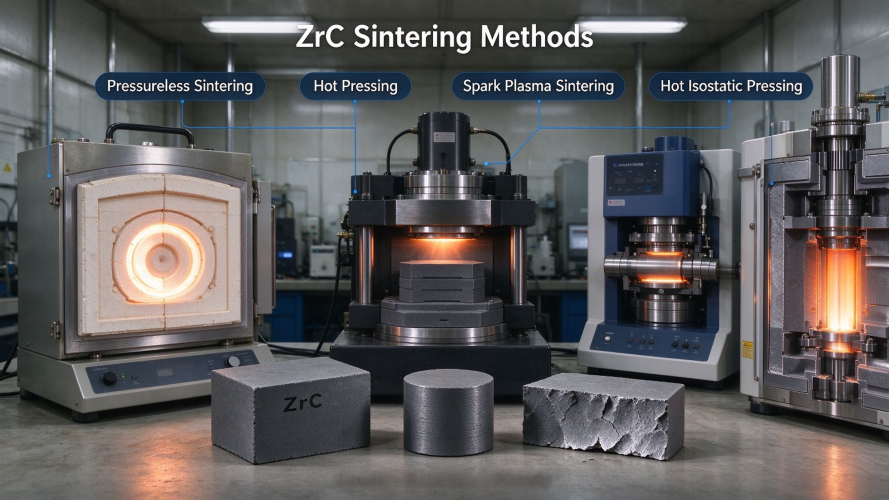
3. Zirconium Carbide Sintering Methods
After synthesis, zirconium carbide powder can be consolidated into dense ceramic components through sintering.
Sintering promotes bonding and material transport between powder particles at elevated temperatures, reducing porosity and improving the mechanical integrity of the ceramic.
ZrC is relatively difficult to densify because of its strong chemical bonding, high melting point and limited atomic diffusion at conventional ceramic processing temperatures.
Several sintering methods are therefore used to improve densification.
3.1 Pressureless Sintering
Pressureless sintering involves heating compacted zirconium carbide powder without applying external mechanical pressure during the sintering stage.
The process generally begins with powder preparation and forming, followed by high-temperature treatment in a controlled atmosphere.
Its main advantages include relatively simple equipment requirements and the ability to process components with complex geometries.
However, achieving high density can be challenging. High temperatures, suitable powder characteristics and carefully selected sintering additives may be necessary.
Residual porosity can reduce mechanical strength and affect the thermal and electrical properties of the final ceramic.
3.2 Hot Pressing
Hot pressing combines elevated temperature with externally applied uniaxial pressure.
The applied pressure assists particle rearrangement and densification, allowing the production of ceramic bodies with relatively low residual porosity.
Compared with conventional pressureless sintering, hot pressing can improve densification and microstructural uniformity under suitable conditions.
It is widely investigated for producing dense ZrC ceramics and composite materials.
However, the process requires specialised equipment, and component geometry is generally constrained by the pressing arrangement and tooling.
3.3 Spark Plasma Sintering (SPS)
Spark plasma sintering, also known as field-assisted sintering technology (FAST), combines uniaxial pressure with rapid electrical heating.
In a typical SPS system, pulsed or controlled direct current passes through conductive tooling and, depending on the material and configuration, may also pass through the sample.
This enables rapid heating and relatively short processing cycles.
For zirconium carbide, SPS can promote densification while limiting excessive grain growth under suitable processing conditions.
Its advantages include:
- Rapid heating rates
- Shorter sintering cycles
- Effective densification of fine powders
- Potential for improved microstructural control
However, SPS requires specialised equipment, and temperature gradients, tooling interactions and component-size limitations must be considered.
The final density and microstructure depend on the applied pressure, temperature, holding time, powder characteristics and tooling configuration.
3.4 Hot Isostatic Pressing (HIP)
Hot isostatic pressing uses elevated temperature and isostatic gas pressure to consolidate materials or reduce residual porosity.
Unlike uniaxial hot pressing, HIP applies pressure from multiple directions.
It can be used for the densification of suitable powder compacts or as a post-processing treatment for previously consolidated ceramic components.
For ZrC, successful HIP processing depends on the initial material condition, porosity, encapsulation requirements and processing parameters.
Although HIP can improve density and material uniformity, its equipment and processing costs are relatively high.
4. Comparison of Zirconium Carbide Sintering Techniques
| Sintering Method | Main Advantages | Main Limitations |
|---|---|---|
| Pressureless Sintering | Simpler forming options; suitable for complex shapes | High temperatures; difficult densification |
| Hot Pressing | Pressure-assisted densification; low residual porosity | Shape and tooling limitations |
| Spark Plasma Sintering (SPS) | Rapid heating; short processing cycles; effective densification | Specialised equipment; component-size limitations |
| Hot Isostatic Pressing (HIP) | Isostatic pressure; potential reduction of residual porosity | High cost; possible encapsulation requirements |
The most suitable method depends on the required density, component dimensions, microstructure and production conditions.
5. Factors Affecting ZrC Sintering Performance
The densification of zirconium carbide is influenced by both powder characteristics and processing parameters.
5.1 Particle Size and Distribution
Fine ZrC powders generally provide shorter diffusion distances and increased surface area, which can support sintering.
However, very fine particles may agglomerate, producing non-uniform packing and residual pores.
A controlled particle size distribution is therefore important for obtaining a homogeneous ceramic microstructure.
5.2 Powder Purity and Surface Oxides
Powder impurities and surface oxide layers can affect particle bonding, chemical reactions and densification.
Oxygen-containing phases may remain in the final ceramic or interact with sintering additives.
The purity and surface condition of the starting powder should therefore be considered when developing a sintering process.
5.3 Carbon-to-Zirconium Ratio
Zirconium carbide can exhibit non-stoichiometric compositions, commonly represented as ZrCₓ.
Variations in carbon content influence crystal defects, phase composition and material transport during sintering.
Depending on the composition and processing route, these changes can affect densification behaviour and the resulting ceramic properties.
5.4 Sintering Temperature and Holding Time
Temperature and holding time influence the rate of diffusion, pore elimination and grain growth.
Higher temperatures can improve densification, but excessive thermal exposure may cause undesirable grain coarsening.
The processing conditions should therefore balance density development with microstructural control.
5.5 Sintering Additives
Selected additives can promote densification by modifying interparticle reactions, diffusion behaviour or grain-boundary processes.
Boron-containing additives and silicon-containing systems have been investigated for improving the sintering behaviour of ZrC-based ceramics.
However, additives may also alter phase composition and final material properties.
Their suitability should be evaluated according to the intended application, particularly where high purity or specific high-temperature properties are required.
6. Characterisation of Synthesised and Sintered ZrC
Characterisation is essential for assessing the quality and consistency of zirconium carbide powders and ceramic components.
Common analytical methods include:
X-ray Diffraction (XRD)
Used to identify crystalline phases and evaluate the presence of residual zirconium oxide or other crystalline impurities.
Scanning Electron Microscopy (SEM)
Used to examine particle morphology, grain structure, agglomeration and the microstructure of sintered ceramics.
Particle Size Analysis
Used to determine powder size distribution, including parameters such as D10, D50 and D90.
Chemical Composition Analysis
Techniques such as ICP-based analysis, oxygen and nitrogen analysis, and carbon determination can provide information about material purity and composition.
Density and Porosity Measurement
Used to evaluate the extent of densification and the remaining porosity in sintered components.
Together, these methods provide information about how synthesis and sintering conditions influence the resulting material.
7. Selecting Zirconium Carbide Powder for Sintering
The selection of suitable zirconium carbide powder is an important starting point for ceramic processing.
Depending on the application, the following parameters should be considered:
- Purity: Impurity levels can influence phase composition and final ceramic performance.
- Particle Size: Fine powders may improve sintering activity but can increase agglomeration.
- Particle Size Distribution: A controlled distribution supports consistent powder packing.
- Carbon Content: The carbon-to-zirconium ratio can influence phase stability and densification.
- Oxygen Content: Surface oxides may affect sintering behaviour and material properties.
- Particle Morphology: Particle shape influences packing, flowability and forming characteristics.
For research and industrial applications, powder selection should be based on the intended processing method and required properties of the final ceramic.
VIMATERIAL supplies Zirconium Carbide (ZrC) Powder for advanced materials research and industrial applications. Material specifications can be discussed according to individual project requirements.
8. Conclusion
Zirconium carbide synthesis and sintering play an important role in determining the performance of ZrC-based ceramic materials.
Carbothermal reduction, direct synthesis, SHS, sol-gel processing and mechanical alloying offer different approaches to powder preparation. Pressureless sintering, hot pressing, spark plasma sintering and hot isostatic pressing provide options for consolidating ZrC into ceramic components.
The effectiveness of each method depends on powder purity, particle size, carbon content, processing conditions and the required final microstructure.
For researchers and manufacturers, understanding these relationships is essential when selecting zirconium carbide materials and developing reliable ceramic processing routes.
Frequently Asked Questions (FAQ)
1. What is the most common method for synthesising zirconium carbide?
Carbothermal reduction is an established method for ZrC powder synthesis. It involves reacting zirconium oxide with carbon at elevated temperatures under controlled conditions.
2. Why is zirconium carbide difficult to sinter?
ZrC has a high melting point and strong chemical bonding, which limit atomic diffusion during conventional sintering. High temperatures or pressure-assisted techniques are often required to achieve high density.
3. What is the difference between hot pressing and spark plasma sintering?
Hot pressing uses external heating and uniaxial pressure. Spark plasma sintering combines pressure with rapid electrical heating, often enabling shorter processing cycles.
4. Can zirconium carbide be sintered without pressure?
Yes. Pressureless sintering is possible, although achieving high density may require carefully controlled powder characteristics, composition and sintering conditions.
5. How does particle size affect ZrC sintering?
Fine particles generally increase surface area and support densification. However, excessive agglomeration can cause uneven packing and residual porosity.
6. What properties should be considered when selecting ZrC powder?
Important parameters include purity, particle size distribution, carbon-to-zirconium ratio, oxygen content and particle morphology.
References
- [1] Zhan, F., et al. (2022). Review on preparation of zirconium carbide and boride ceramic powders. Journal of Ceramic Processing Research, 23(5), 694–708.
- [2] Ang, C., et al. (2013). Synthesis and Evolution of Zirconium Carbide via Sol–Gel Route: Features of Nanoparticle Oxide–Carbon Reactions. Journal of the American Ceramic Society, 96(4), 1099–1106.
- [3] Wei, X., et al. (2016). Zirconium Carbide Produced by Spark Plasma Sintering and Hot Pressing: Densification Kinetics, Grain Growth, and Thermal Properties. Materials, 9(7), 577.
- [4] Pressureless Sintering of ZrC with Variable Stoichiometry (2017). Journal of Advanced Ceramics, 6, 165–175.
- [5] Dollé, M., et al. (2007). Synthesis of Nanosized Zirconium Carbide by a Sol–Gel Route. Journal of the European Ceramic Society, 27(4), 2061–2067.
Further Reading
- Zirconium Carbide (ZrC): Properties, Synthesis and Applications
- Ultra-High Temperature Ceramics (UHTCs): Materials for Extreme High-Temperature Applications
- Hafnium Diboride vs Zirconium Diboride: Properties and High-Temperature Applications
- Zirconia Powder Specifications: Purity, Particle Size and Crystal Phase
- High Purity Titanium Carbide: The “Ultra-Hard Pioneer” Powering Advanced Technologies
Looking for Zirconium Carbide Materials?
VIMATERIAL supplies zirconium carbide materials for advanced ceramics, industrial processing and scientific research.
Our available product forms include Zirconium Carbide Powder, Zirconium Carbide Granules and Zirconium Carbide Sputtering Targets.
If your project requires specific purity levels, particle sizes or other material specifications, contact VIMATERIAL to discuss available options.
Contact VIMATERIAL to request a quotation or discuss your technical requirements.