


Selecting zirconia powder for advanced ceramics requires more than checking its chemical formula or nominal purity. Particle-size distribution, crystal phase, stabilizer content, impurity levels and powder characteristics can all influence how the material behaves during forming, sintering and subsequent use.
For engineers, material developers and procurement teams, understanding these specifications helps narrow down suitable grades, compare suppliers and establish appropriate quality requirements before production.
This guide explains the key zirconia powder specifications, what they mean in practice and what to check when selecting a grade for a specific application.
Key Zirconia Powder Specifications at a Glance
Zirconia powder is zirconium dioxide (ZrO₂). Depending on its composition, crystal structure and intended application, it may be supplied as unstabilized zirconia or as stabilized zirconia containing additives such as yttria, magnesia or calcia.
The most relevant specifications depend on the intended process and final product.
| Specification | What It Describes | Why It Matters |
|---|---|---|
| Chemical composition | The main chemical compound and any stabilizing additives | Helps confirm that the grade is suitable for the intended application |
| Purity | The specified zirconia content or purity grade, according to the supplier’s definition | Indicates the overall level of impurities |
| Stabilizer content | The type and amount of stabilizer, such as Y₂O₃ | Influences phase stability and material properties |
| Particle size | The characteristic size of the powder particles | Affects dispersion, packing and processing |
| Particle-size distribution | The range and distribution of particle sizes, often described using D10, D50 and D90 | Helps assess consistency and process suitability |
| Crystal phase | The proportions or presence of monoclinic, tetragonal and cubic zirconia phases | Influences the behaviour of the material during processing and use |
| Specific surface area | The surface area per unit mass, often measured by the BET method | Can help assess powder reactivity and sintering behaviour |
| Moisture and loss on ignition | Moisture or mass loss under specified test conditions | Helps identify handling and processing requirements |
| Impurity profile | The levels of relevant metallic or other impurities | Important where composition control and batch consistency are critical |
Not every application requires every parameter. A suitable specification should reflect the requirements of the manufacturing process and the performance expected from the finished material.
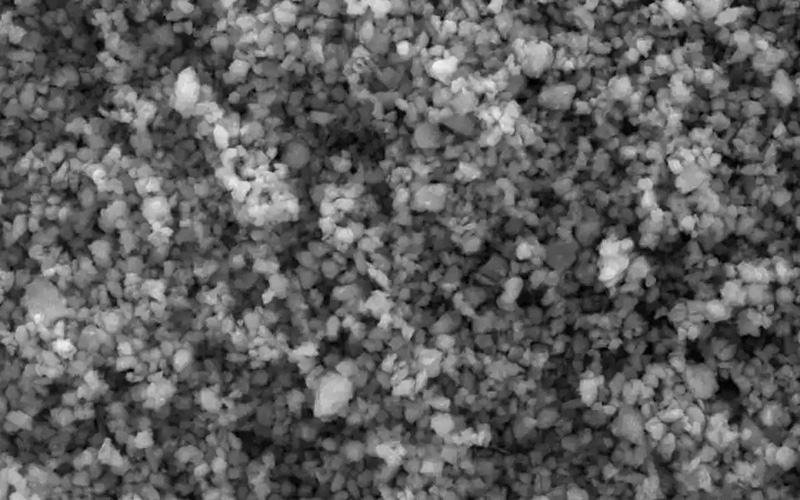
Zirconia Powder Purity: What Should You Check?
Purity is often one of the first parameters considered when comparing zirconia powders. However, a headline purity value does not always provide enough information to assess whether a material is suitable for a particular process.
The meaning of a stated purity depends on the supplier’s specification, the analytical method and how the composition is reported.
For example, a stabilized zirconia grade contains both ZrO₂ and a stabilizing additive. Its composition should therefore be evaluated in the context of the complete material specification rather than by treating the stabilizer as an unwanted impurity.
Why impurity limits matter?
Depending on the application, relevant impurities may include iron, sodium, silicon and other metallic or process-related contaminants. The elements that need to be controlled will vary with the intended use.
For applications with strict composition requirements, confirm:
- The stated purity and its calculation basis.
- Whether the stabilizer is included in the reported composition.
- Which individual impurities are measured.
- The specified limits for relevant impurities.
- Whether the analytical method and reporting units are clearly identified.
- Whether batch-specific test results are available.
A higher nominal purity does not automatically guarantee better performance in every application. The appropriate grade is the one that meets the chemical and processing requirements of the final product.
Particle Size and Particle-Size Distribution
Particle size is an important factor in zirconia powder selection because it can affect powder handling, dispersion, packing and sintering.
However, particle size should not be evaluated in isolation. Two powders with the same nominal particle size may behave differently if their particle-size distributions, agglomeration levels or surface characteristics differ.
What do D10, D50 and D90 mean?
Particle-size distribution is commonly described using percentile values.
| Parameter | Definition | How to Interpret It |
|---|---|---|
| D10 | The particle diameter below which 10% of the measured particle volume falls. | Indicates the finer end of the particle-size distribution. |
| D50 | The particle diameter below which 50% of the measured particle volume falls. | Represents the median particle size, commonly used to describe a powder’s typical particle size. |
| D90 | The particle diameter below which 90% of the measured particle volume falls. | Indicates the coarser end of the particle-size distribution and helps identify larger particles or agglomerates. |
These values help describe the distribution rather than relying on a single nominal particle size.
For example, D50 alone does not show whether a powder contains a relatively narrow size distribution or a substantial proportion of both fine and coarse particles. D10 and D90 provide additional context.
Why particle size matters during processing?
Fine powders: Smaller particles generally provide a greater surface area per unit mass. This can support sintering in suitable processes, but fine powders may also be more prone to agglomeration and may require careful dispersion.
Coarser powders: Larger particles may be more appropriate for certain granulation, filling or processing requirements. Their suitability depends on the forming method and the target microstructure.
Broad particle-size distributions: A broader distribution can influence particle packing and flow, but the result depends on particle shape, the proportions of different size fractions and the process being used.
When comparing grades, confirm the measurement method and whether the reported values refer to primary particles, agglomerates or another defined particle-size measurement. This helps avoid misleading comparisons between supplier specifications.
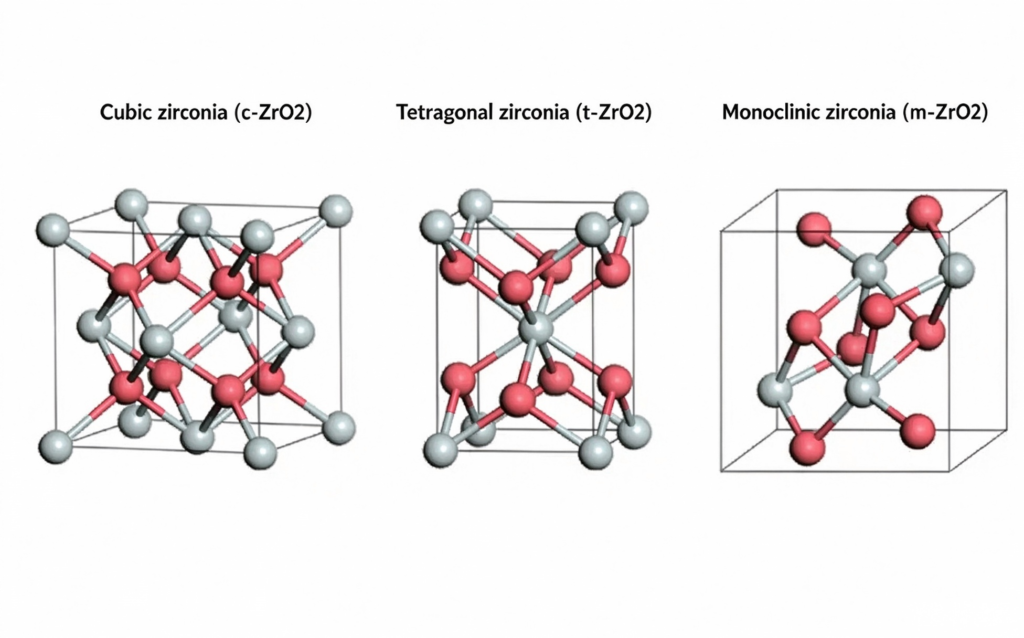
Crystal Phase: Monoclinic, Tetragonal and Cubic Zirconia
Zirconia can exist in three principal crystal structures: monoclinic, tetragonal and cubic. The phase present depends on factors such as temperature, composition and stabilizer content.
The crystal phase is important because different phases have different structural characteristics and can influence the behaviour of zirconia during processing and service.
| Crystal Phase | General Characteristics | Selection Considerations |
|---|---|---|
| Monoclinic | The stable form of pure zirconia at room temperature under normal conditions | Relevant when evaluating unstabilized zirconia and phase changes |
| Tetragonal | Can be retained under suitable conditions, including in appropriately stabilised zirconia | Important in zirconia grades designed to use transformation-related toughening |
| Cubic | Can be stabilised by suitable composition and processing conditions | Relevant to applications where the properties associated with cubic zirconia are required |
These descriptions are general. The actual phase composition of a powder depends on its formulation and manufacturing history.
Why phase composition should be confirmed?
The chemical formula alone does not establish which crystal phases are present in a particular powder. Where phase composition matters, X-ray diffraction (XRD) can be used to identify crystalline phases and assess their relative presence using an appropriate analytical approach.
When requesting technical data, check whether the specification reports:
The principal crystalline phase.
The presence of secondary phases, where relevant.
The method used for phase identification.
Any phase-composition requirements associated with the intended application.
For zirconia grades designed for specific mechanical or functional properties, phase information should be considered together with stabilizer content and the processing route.
Stabilizer Content: Why the Zirconia Grade Matters?
Pure zirconia undergoes temperature-dependent phase transformations. Stabilizing additives are used to control phase stability and obtain material characteristics suited to different applications.
Yttria-stabilized zirconia (YSZ) is one of the most widely used zirconia material families. Other stabilizers, including magnesia and calcia, may be used for particular formulations.
For yttria-stabilized grades, designations such as 3Y, 5Y and 8Y commonly refer to nominal yttria content in mol%. The exact composition should always be confirmed in the product specification.
| Grade Designation | General Meaning | What to Confirm |
|---|---|---|
| 3Y-YSZ | Nominally 3 mol% yttria-stabilized zirconia | Actual yttria content, phase composition and application requirements |
| 5Y-YSZ | Nominally 5 mol% yttria-stabilized zirconia | Phase balance and the properties required by the application |
| 8Y-YSZ | Nominally 8 mol% yttria-stabilized zirconia | Composition, ionic-conductivity requirements where relevant, and intended use |
These designations are not interchangeable, and the yttria content alone does not fully define the material’s performance. Powder characteristics, processing conditions and the final microstructure also matter.
It is also important to distinguish mol% from wt%. These are different ways of expressing composition and should not be compared as if they were equivalent.
For more detail on the selection of stabilised grades, see VIMATERIAL’s article on what YSZ material is and the guide to stabilized zirconia and phase stability.
Specific Surface Area, Moisture and Other Powder Characteristics
Some zirconia powder specifications include additional parameters that help describe the material beyond purity, particle size and phase composition.
Specific surface area
Specific surface area is commonly measured using the BET method. It describes the surface area available per unit mass of powder.
A higher specific surface area can be associated with finer particles or more complex surface structures. It may influence powder reactivity and sintering behaviour, but it should not be used as a direct substitute for particle-size data.
If surface area is important to the process, compare it alongside particle-size distribution, powder preparation and the intended sintering conditions.
Moisture content and loss on ignition
Moisture content and loss on ignition (LOI) are related but distinct parameters.
Moisture content measures water according to a specified method. LOI measures the mass lost under defined heating conditions and may include moisture and other volatile components, depending on the material and test method.
These values should therefore be interpreted according to the relevant test conditions rather than assumed to be equivalent.
For processes sensitive to moisture or volatile components, confirm the specified limits, test method and recommended storage conditions.
Agglomeration and morphology
Particle morphology describes particle shape, while agglomeration refers to particles gathered into larger clusters.
Both can affect dispersion, flow, packing and the reproducibility of subsequent processing. Where these factors are important, microscopy or other appropriate characterisation methods may provide useful additional information.
A powder described as fine or uniform should still be evaluated against measurable acceptance criteria if those characteristics are critical to the process.
How to Read a Zirconia Powder TDS or COA?
A technical data sheet (TDS) describes a material grade and its specified or typical characteristics. A certificate of analysis (COA) reports test results for a particular batch, according to the supplier’s quality system.
These documents serve different purposes and should not be treated as interchangeable.
When reviewing a zirconia powder specification, use the following checklist.
| Check | Questions to Ask |
|---|---|
| Chemical composition | Is the material pure ZrO₂ or stabilized zirconia? |
| Purity | Is the basis of the stated purity clear? |
| Stabilizer content | Is the stabilizer identified, with its concentration and reporting unit? |
| Particle size | Are D10, D50 and D90 available where required? |
| Measurement method | Is the particle-size measurement method stated? |
| Crystal phase | Is phase identification or phase composition specified where relevant? |
| Impurities | Are application-critical impurity limits defined? |
| Additional properties | Are surface area, moisture or LOI required for the process? |
| Batch control | Can the supplier provide batch-specific results where needed? |
| Packaging and storage | Are the recommended storage conditions suitable for the intended handling and production environment? |
For repeat manufacturing, it is useful to agree on acceptance limits before ordering. This creates a consistent basis for comparing incoming batches and evaluating changes in material performance.
How to Choose Zirconia Powder for Your Application?
The right zirconia powder depends on the intended application and manufacturing route. Rather than selecting a grade based on a single specification, assess the parameters together.
For structural ceramics
Prioritise stabilizer content, crystal phase, particle-size distribution and the characteristics required for the final microstructure. Also consider the forming and sintering processes used by the manufacturer.
For thermal barrier coatings
Consider the stabilised zirconia composition, phase requirements, particle characteristics and compatibility with the coating process. The appropriate specification depends on the deposition method and service conditions.
For solid oxide fuel cells and oxygen sensors
For applications that rely on oxygen-ion conduction, stabilizer composition and the required electrical properties are important. Powder specifications should be assessed alongside the processing route and the properties of the final ceramic component.
For ceramic formulations and research
Purity, particle-size distribution, phase composition and batch consistency may be important, depending on the formulation and experimental objectives. Defining the required parameters in advance makes it easier to compare grades and reproduce results.
Before finalising a specification, identify the critical-to-quality parameters for the application. Some characteristics may be essential acceptance criteria, while others may be useful supporting information.
Frequently Asked Questions
1. What are the most important zirconia powder specifications?
The main specifications are chemical composition, purity, stabilizer content, particle-size distribution and crystal phase. Specific surface area, moisture, LOI and individual impurity limits may also be important, depending on the application.
2. What does D50 mean in zirconia powder specifications?
D50 is the median particle diameter: 50% of the measured particle population falls below this value. It is useful for comparing powders, but it does not describe the full particle-size distribution. D10 and D90 provide additional information.
3. Is higher-purity zirconia powder always better?
No. Higher purity can be important for demanding applications, but suitability depends on the complete composition and process requirements. For stabilized zirconia, the intended stabilizer is part of the material formulation, not simply an unwanted impurity.
4. What is the difference between zirconia and YSZ?
Zirconia is zirconium dioxide (ZrO₂). Yttria-stabilized zirconia (YSZ) is a zirconia-based material containing yttria (Y₂O₃) to control phase stability and obtain properties suited to particular applications.
5. Why is crystal phase important when selecting zirconia powder?
Monoclinic, tetragonal and cubic zirconia have different structural characteristics. The phase composition can influence material behaviour, so it may need to be verified when selecting a grade for a specific application.
6. Is particle size the same as particle-size distribution?
No. Particle size may be represented by a nominal value or a percentile such as D50. Particle-size distribution describes the range of sizes in the measured population. D10, D50 and D90 together provide a more informative description than D50 alone.
7. What is the difference between a TDS and a COA?
A TDS describes the specified or typical properties of a material grade. A COA provides analytical results for a specific batch. When batch-level compliance is important, confirm the relevant COA requirements with the supplier.
8. Which zirconia powder grade should I choose?
The appropriate grade depends on the intended application, stabilizer content, required crystal phase, particle-size distribution, purity and processing conditions. Define the critical specifications first, then compare available grades against those requirements.
Conclusion
Zirconia powder selection should be based on the complete specification rather than a single headline value. Purity, stabilizer content, particle-size distribution and crystal phase describe different aspects of the material, while surface area, moisture and impurity limits provide additional information where required.
For a reliable comparison, confirm how each parameter is defined and measured, and establish acceptance criteria that reflect the intended manufacturing process.
References
- [1] International Organization for Standardization (ISO). ISO 13320:2020 — Particle size analysis — Laser diffraction methods.
- [2] International Organization for Standardization (ISO). ISO 9276-2:2014 — Representation of results of particle size analysis — Part 2: Calculation of average particle sizes/diameters and moments from particle size distributions.
- [3] HORIBA. Understanding & Interpreting Particle Size Distribution Calculations.
- [4] Cheong, A. C. H., & Sivanesan, S. (2023). Perspective Chapter: The Application of Yttria-Stabilized Zirconia (YSZ). IntechOpen.
- [5] Kelly, J. R., & Denry, I. (2008). Stabilized zirconia as a structural ceramic: An overview. Dental Materials, 24(3), 289–298.
Further Reading
- Everything You Need to Know About Zirconium Powder: Uses, Risks, and Strength vs Titanium
- What Is Niobium Oxide? Properties, Uses, and How to Store It
- Hafnium Oxide (HfO₂): A High-Performance High-k Material for Advanced Electronics and Beyond
- High-Purity Yttrium Oxide: A Rare Earth Gem from Advanced Technology to Wide-Ranging Applications
- Hafnium Diboride Powder: Purity, Particle Size, Properties and Quality Control
Need a Zirconia Powder Specification for Your Application?
VIMATERIAL supplies advanced materials for industrial, research and technical applications. If you have specific requirements for zirconia powder, contact our team to discuss the required composition, stabilizer content, particle size, purity and documentation.