

Stabilized Zirconia: “Stability Is the Key to Longevity”

View Our Products

Contact Us Now !

Zirconia (ZrO₂) is a high-melting-point metal oxide with excellent chemical stability. It offers outstanding wear resistance, high-temperature resistance, and corrosion resistance. Thanks to its superior mechanical properties—such as excellent thermal shock resistance, high refractive index, and strong thermal stability—zirconia has become an important material for advanced structural and functional ceramics across a wide range of applications. Its use in the form of Stabilized Zirconia further enhances its capabilities.

Why Emphasize “Stability”?

ZrO₂ exhibits polymorphism, meaning it exists in different crystal structures depending on temperature. At low temperatures, it adopts a monoclinic structure (m-ZrO₂); at higher temperatures, it transforms into a tetragonal structure (t-ZrO₂); and at even higher temperatures, it becomes cubic (c-ZrO₂).

ZrO2 crystal phase structure - VIMATERIAL

During these phase transformations—particularly the reversible transition between monoclinic and tetragonal phases—a volume change of about 7%–9% occurs. This significant volume expansion can lead to cracking during firing, making pure zirconia unsuitable for environments with large temperature fluctuations.

In addition, certain industrial applications require zirconia to possess specific properties, such as high ionic conductivity and strong resistance to high-temperature aging. To address these challenges, stabilizing oxides containing metal ions with ionic radii similar to Zr⁴⁺ (such as CaO, MgO, and Y₂O₃) are added. After high-temperature treatment, these additives enable high-temperature crystal phases to remain stable at room temperature, preventing volume changes caused by phase transitions and significantly improving overall material performance.

Stabilization Mechanism and Common Stabilizers

To stabilize zirconia, oxides containing cations with ionic radii similar to Zr⁴⁺ (approximately 0.082 nm) are introduced into the crystal lattice. These dopants substitute for zirconium ions and create oxygen vacancies to maintain charge neutrality. The resulting solid solution stabilizes the tetragonal or cubic phases at lower temperatures, effectively suppressing phase transformations.

Common Stabilizers:

Common doped cations

1. Single Dopant Systems

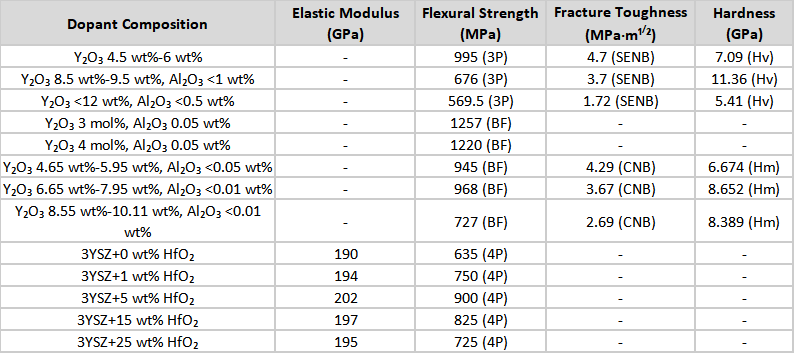
Yttria is the most widely used stabilizer due to its excellent performance and reliability. Typical doping levels include 3 mol%, 5 mol%, and 8 mol%. At lower concentrations (e.g., 3 mol%), zirconia is partially stabilized, primarily retaining the tetragonal phase, which provides transformation toughening and high fracture resistance. At higher concentrations (e.g., 8 mol%), the cubic phase becomes fully stabilized, offering high ionic conductivity but lower mechanical strength. Compared with other stabilizers, Y₂O₃ allows for lower sintering temperatures, better densification, and improved overall performance.

Comparative Study of Mechanical Properties of Zirconia Ceramics with Different Yttrium Contents

YSZ is extensively used in applications such as thermal barrier coatings, oxygen sensors, and solid oxide fuel cells (SOFCs), thanks to its combination of mechanical strength, thermal stability, and oxygen ion conductivity.

CaO (Calcia-Stabilized Zirconia, CSZ)

Stabilized Zirconia is essential in many industries due to its superior characteristics.

Calcia-stabilized zirconia is cost-effective, and the grain size remains relatively stable as CaO content increases. It also requires lower sintering temperatures and readily forms the cubic phase, which enhances electrical conductivity.

MgO (Magnesia-Stabilized Zirconia, MSZ)

Magnesia stabilized zirconia offers good mechanical properties at room and intermediate temperatures, along with excellent resistance to wear and low-temperature degradation. It is often used in refractory and wear-resistant applications.

Al₂O₃ (Alumina-Modified Zirconia)

Although not a stabilizer in the traditional sense, alumina is frequently added to zirconia systems to improve microstructural control. It helps refine grain size, suppress undesirable phase transformations, and enhance densification during sintering. As a result, it significantly improves hardness, strength, and overall durability.

2. Multi-Dopant Systems

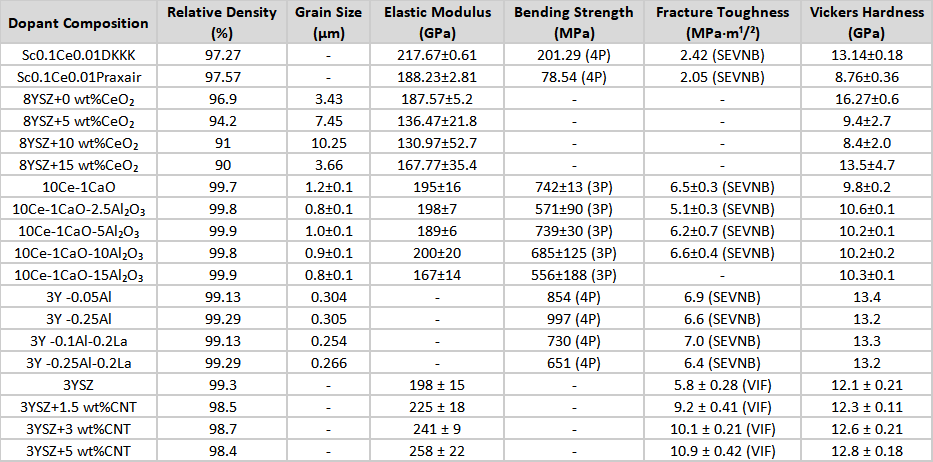
Co-doping with multiple elements can further optimize relative density, grain size, and mechanical properties, offering enhanced performance compared to single-dopant systems.

Relative Density, Grain Size, and Mechanical Properties of Zirconia Ceramics with Different Element Doping Amounts
Relative Density Grain Size and Mechanical Properties of Zirconia Ceramics with Different Element Doping Amounts

Powder Preparation and Post-Treatment

1. Powder Synthesis Methods

The properties of ceramic powders play a key role in determining the final performance of ceramics. Factors such as the preparation method, calcination temperature, and milling time affect the powder’s crystal structure, particle size, and specific surface area, which in turn influence the overall properties of the ceramic.Yttria-Stabilized Zirconia YSZ Powder - VIMATERIAL
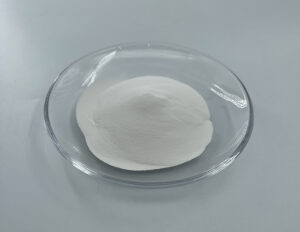
There are various methods for preparing stabilized zirconia powders. For example, yttria-stabilized zirconia (YSZ) is commonly produced using hydrothermal synthesis, co-precipitation, or sol-gel methods. Each method is affected by multiple factors. In hydrothermal synthesis, the dopant content is a key factor in determining the crystal phase of zirconia, while parameters such as temperature, pH value, mineralizer concentration, and dopant concentration also significantly impact the final powder properties.
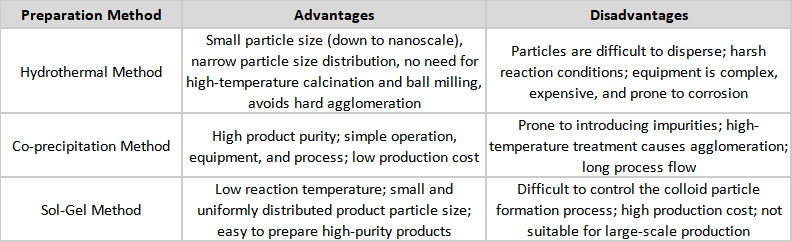
Advantages and Disadvantages of Yttrium Stabilized Zirconia Preparation Methods

2. Powder Processing

Before forming, powders must be properly treated based on the chosen forming method. Particle size distribution and post-processing significantly influence sintering behavior and densification.

Powders often tend to agglomerate, but the addition of organic additives can improve dispersion. For example:

  • Dry pressing typically requires granulation
  • Wet forming requires high-solid-loading, low-viscosity slurries

Understanding the properties of Stabilized Zirconia is crucial for optimizing its performance in various applications.

Forming Techniques

Forming methods play a crucial role in determining the density and grain size of ceramics, as they affect particle packing and contact area. Common forming techniques for stabilized zirconia include:

  • Dry pressing
  • Hot pressing
  • Isostatic pressing
  • Tape casting
  • Injection molding
  • Gel casting
  • Additive manufacturing

Each forming method is influenced by several factors. For example, dry pressing depends on the powder properties, forming pressure, holding time, pressing method, type and amount of additives, and pressing speed. Tape casting, on the other hand, is mainly affected by the powder, pH value, and the type and amount of dispersants, plasticizers, and binders.

Sintering

1.Sintering Techniques

Sintering methods can be broadly classified into:
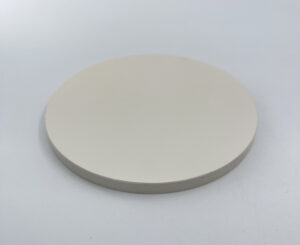
Yttria-Stabilized Zirconia YSZ Target - VIMATERIAL

Conventional sintering: pressureless sintering, hot pressing

Advanced/rapid sintering: microwave sintering, spark plasma sintering (SPS), self-propagating high-temperature synthesis (SHS), flash sintering, cold sintering, and oscillatory pressure sintering

Among these, pressureless sintering remains the most widely used due to its simplicity and low cost, although it may result in lower density and less uniform microstructures.

2.Sintering Regimes

To achieve high-density zirconia ceramics, researchers have explored various sintering temperatures and strategies, including two-step sintering.

A high heating rate can lead to temperature gradients within the material, resulting in uneven grain growth and potential defects such as cracks and pores. Therefore, a controlled, lower heating rate is generally preferred.

Research findings include:

  • Mechanical properties such as flexural strength, fracture toughness, and elastic modulus increase with temperature up to a point, then decline. Optimal fracture toughness is typically observed between 1400°C and 1500°C.
  • In microwave sintering of 8YSZ, increasing holding time improves density, elastic modulus, and hardness.
  • Two-step sintering can enhance hardness by promoting grain boundary diffusion while suppressing grain growth.

Conclusion

The mechanical performance of zirconia ceramics is influenced by multiple interrelated factors, including powder synthesis, forming processes, sintering techniques, and low-temperature aging. These factors do not act independently but interact in complex ways.

Therefore, developing advanced powder synthesis methods, optimizing multi-dopant systems, improving forming techniques, and refining sintering strategies remain critical priorities for advancing zirconia ceramic technology.

Frequently Asked Questions (FAQs)

Q1: What is yttria-stabilized zirconia used for?

A: Yttria-stabilized zirconia is used in applications that require high strength, wear resistance, and stability at high temperatures. Common uses include:

  • Wear-resistant ceramic parts (e.g., tools and bearings)
  • Thermal barrier coatings in aerospace and turbines
  • Solid oxide fuel cells (SOFCs)
  • Dental restorations such as crowns and implants
  • Grinding media for milling and dispersion

Its combination of mechanical strength and thermal stability makes it a versatile advanced ceramic material.

Q2: What is the difference between fully stabilized zirconium oxide and semi-stabilized zirconium oxide?

A: The main difference is in structure and performance:

Fully stabilized zirconia (FSZ)

  • Higher yttria content (~8 mol%)
  • Cubic structure
  • High ionic conductivity, lower strength
  • Used in fuel cells and sensors

Partially stabilized zirconia (PSZ)

  • Lower yttria content (3–5 mol%)
  • Mainly tetragonal structure
  • Higher strength and fracture toughness
  • Used in structural and wear-resistant applications

In short, FSZ is used for conductivity, while PSZ is used for strength.

Q3: What types of yttria-stabilized zirconia grinding media are available?

A: YSZ grinding media are mainly classified by yttria content:

  • 3Y – High strength and toughness, for high-wear applications
  • 5Y – Balanced performance, for general use
  • 8Y – Higher stability, lower toughness, for specialized uses

They are available in different sizes and shapes (such as beads and balls) for various grinding and dispersion processes.

Contact Us

Contact Us