


Hafnium diboride powder (HfB₂ powder) is a high-temperature ceramic powder used as a starting material for ultra-high-temperature ceramics, ceramic composites, protective coatings and advanced materials research. Its performance is influenced not only by chemical composition, but also by powder purity, particle size, particle-size distribution, morphology and phase composition.
For researchers and engineers working with HfB₂ ceramics, selecting the appropriate powder specification is therefore an important step before sintering, coating or composite processing.
What Is Hafnium Diboride Powder?
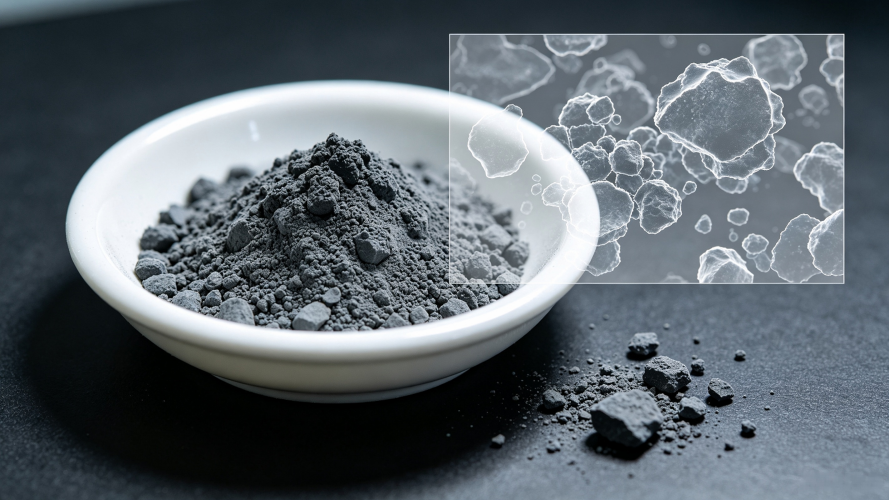
Hafnium diboride, with the chemical formula HfB₂, is a transition-metal diboride with a hexagonal AlB₂-type crystal structure. It is commonly supplied as a grey to black powder and is known for its high hardness, high-temperature stability, thermal conductivity and electrical conductivity.
HfB₂ is considered an ultra-high-temperature ceramic (UHTC), and transition-metal diborides are widely investigated for applications requiring high melting temperature, thermal conductivity, hardness and chemical stability.
HfB₂ powder can be supplied in nano- and micron-scale particle sizes. Different grades can be selected according to purity, particle size, particle-size distribution and downstream processing requirements.
For a broader introduction to HfB₂ structure, properties and applications, see our related article: Hafnium Diboride (HfB₂): Properties, Structure and Applications.
Key Specifications of HfB₂ Powder
When selecting HfB₂ powder, several parameters should be considered rather than relying on the nominal chemical formula or purity alone.
| Parameter | Why It Matters |
|---|---|
| HfB₂ purity | Determines the overall HfB₂ content and impurity level |
| Particle size | Influences surface area, reactivity and processing behaviour |
| Particle-size distribution | Affects packing, dispersion and sintering |
| Particle morphology | Influences flowability, packing and dispersion |
| Phase composition | Helps confirm HfB₂ as the primary crystalline phase |
| Oxygen and carbon content | Can affect high-temperature behaviour and secondary phases |
| Specific surface area | Important for fine and nano-scale powders |
| Packaging | Helps maintain powder quality during storage and transport |
For advanced ceramic processing, purity, particle size, particle-size distribution, crystal structure, density and hardness are all relevant quality considerations.
Hafnium Diboride Powder Purity
Purity is an important parameter when selecting hafnium diboride powder, particularly for ceramic synthesis, composite preparation and high-temperature materials research.
VIMATERIAL currently supplies HfB₂ powder with a purity of 99%. The suitability of this grade depends on the intended application, processing conditions and impurity requirements of the final material.
The nominal purity value describes the overall HfB₂ content, while detailed material specifications can provide additional information about individual impurities and their concentrations.
Potential impurities in HfB₂ powder may originate from:
- Starting materials
- Synthesis reagents
- Carbon-containing reducing agents
- Oxygen exposure
- Processing equipment
- Washing and purification processes
For HfB₂ ceramics, oxygen and carbon can be particularly relevant because they may influence phase composition, sintering behaviour, microstructure and high-temperature performance.
What Does 99% HfB₂ Purity Mean?
A 99% HfB₂ purity specification means that the material contains approximately 99% hafnium diboride, with the remaining fraction consisting of other components or impurities.
For general advanced-material research, ceramic processing and material development, 99% HfB₂ powder can provide a practical starting material for subsequent processing.
For applications with strict impurity-control requirements, it is important to evaluate not only the nominal purity but also the specific impurity profile, analytical method and requirements of the final application.
Therefore, when selecting HfB₂ powder, the following parameters should be considered together:
- HfB₂ purity
- Oxygen content
- Carbon content
- Metallic impurities
- Particle size
- Particle-size distribution
- Phase composition
- Specific surface area
HfB₂ Powder Purity Specification
VIMATERIAL currently supplies hafnium diboride powder with a 99% purity specification.
| Parameter | Typical Specification |
|---|---|
| Material | Hafnium Diboride Powder |
| Chemical Formula | HfB₂ |
| Purity | 99% |
| Particle Size | Nano- and micron-scale options |
| Crystal Structure | Hexagonal, AlB₂-type |
| Appearance | Grey to black powder |
For applications requiring specific impurity limits or different powder characteristics, requirements can be discussed according to the intended processing route and application.
Hafnium Diboride Powder Particle Size
Particle size is another key parameter when selecting HfB₂ powder.
HfB₂ powders can range from nano-scale to micron-scale materials. Different particle sizes can produce different surface areas, packing behaviour, reactivity and processing characteristics.
Nano-scale hafnium diboride powder can have a nominal particle size of approximately 50 nm, depending on the specific grade and production process.
Why Does Particle Size Matter?
Fine HfB₂ powder can provide a larger specific surface area and more intimate contact between particles. This can be beneficial for some synthesis and sintering processes.
However, smaller particles are not automatically better.
Very fine powders can also have:
- Higher surface activity
- Greater tendency to agglomerate
- More difficult powder handling
- Greater sensitivity to moisture or surface contamination
- Different packing behaviour
Therefore, the appropriate particle size should be selected according to the downstream process.
D50 and D90 Particle-Size Distribution
For technical powder specifications, particle-size distribution can be more informative than a single nominal particle size.
Two commonly used parameters are:
D50: the particle diameter below which approximately 50% of the measured particle population lies.
D90: the particle diameter below which approximately 90% of the measured particle population lies.
A controlled particle-size distribution can help improve reproducibility in powder mixing, pressing and sintering.
For HfB₂ powder, D50 and D90 can therefore be useful parameters when defining particle-size requirements for a specific process.
Particle Morphology
Particle morphology describes the shape and surface characteristics of individual particles.
HfB₂ powder may exhibit different morphologies depending on the synthesis and post-processing route, including irregular, approximately spherical or other controlled forms.
Morphology can influence:
- Powder flowability
- Packing density
- Dispersion
- Mixing behaviour
- Sintering response
- Surface area
For this reason, two HfB₂ powders with the same nominal particle size may still behave differently during processing.
Phase Composition and XRD Analysis
Particle size and chemical purity do not provide a complete description of HfB₂ powder.
The crystalline phase should also be considered.
X-ray diffraction (XRD) can be used to identify the primary HfB₂ phase and detect possible secondary phases.
Depending on the synthesis route, analysis may need to consider the presence of compounds such as:
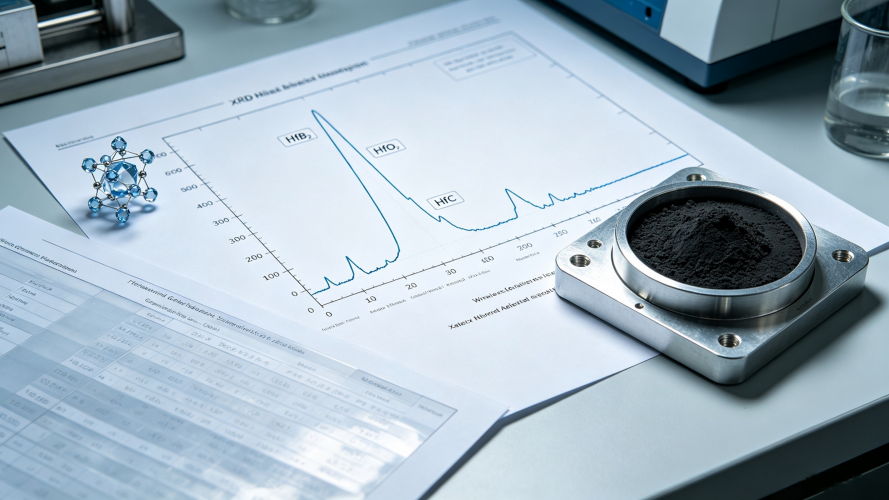
For research applications where phase purity is important, an XRD pattern or phase-analysis report can therefore be more informative than a nominal purity value alone.
Specific Surface Area
Specific surface area becomes increasingly important as HfB₂ particle size decreases.
Fine and nano-scale powders generally have a higher surface area per unit mass. This can improve contact between powder particles during certain processing routes, but it can also increase surface reactivity and agglomeration.
For this reason, BET surface area can be considered as a supplementary specification when working with fine or nano-scale HfB₂ powders.
Hafnium Diboride Powder and Sintering
One of the challenges associated with transition-metal diboride ceramics is densification.
The strong bonding and low self-diffusion characteristic of these materials can make conventional sintering difficult. Reviews of UHTC processing identify poor sinterability and the need for advanced densification approaches as important considerations in the processing of diboride ceramics.
Conventional solid-state sintering can require very high temperatures and, depending on the process, pressure-assisted densification. Powder size distribution and morphology can also influence sintering activity.
For this reason, powder selection should be considered together with the intended densification method.
Common HfB₂ Powder Processing Routes
Several synthesis routes can be used to produce hafnium diboride powder. The selected route can influence powder purity, morphology, particle size and phase composition.
Carbothermal Reduction
Carbothermal reduction uses hafnium-containing and boron-containing precursors together with carbon at elevated temperature.
A representative route uses HfO₂, B₂O₃ and carbon, followed by high-temperature treatment under an inert atmosphere. This approach can produce relatively fine HfB₂ particles when the precursor composition and processing conditions are appropriately controlled.
Precursor-Based Synthesis
Another approach uses hafnium and boron precursors to form a gel or precursor material, followed by drying and high-temperature treatment.
This type of route can provide additional control over precursor structure before conversion into HfB₂ powder.
Other Synthesis Routes
Other approaches include reduction, molten-salt synthesis and precursor pyrolysis. Each method can produce different combinations of particle size, morphology, phase composition and purity.
The choice of synthesis route should therefore be matched to the required powder characteristics and downstream application.
Quality Control for Hafnium Diboride Powder
A practical HfB₂ powder quality-control programme can include several analytical parameters.
Chemical Composition
The elemental composition of hafnium and boron should be checked against the specified composition.
Purity and Impurity Analysis
The total purity and relevant individual impurities should be evaluated according to the application. Oxygen, carbon and metallic impurities may require particular attention for high-temperature ceramic applications.
Particle-Size Analysis
Particle size and distribution should be measured using an appropriate analytical method. Depending on the powder grade, parameters such as D50 and D90 may be specified.
XRD Phase Analysis
XRD can be used to confirm the HfB₂ crystal phase and identify secondary phases.
Morphology
SEM or other suitable microscopy methods can be used to evaluate particle morphology, particle size and agglomeration.
Physical Properties
Depending on the application, additional measurements may include:
- Apparent density
- Specific surface area
- Moisture content
- Oxygen content
- Carbon content
A comprehensive specification can therefore provide a more reliable basis for material selection than purity alone.
How Should HfB₂ Powder Be Stored?
Fine HfB₂ powder should be kept sealed in a dry and cool environment.
Protection from moisture and unnecessary prolonged exposure to air is recommended. Contact with oxidising agents should also be avoided.
For fine powders, appropriate packaging is particularly important because moisture exposure can contribute to agglomeration and affect dispersion during subsequent processing.
HfB₂ Powder Packaging
HfB₂ powder can be supplied in sealed packaging, including inert-gas-protected plastic bags for applications requiring additional protection from environmental exposure.
Packaging quantities can be specified according to customer requirements, including smaller research quantities and larger quantities for development or production trials.
HfB₂ Powder from VIMATERIAL
VIMATERIAL supplies hafnium diboride powder for advanced ceramics, high-temperature materials and research applications.
The material can be discussed and specified according to:
- Purity
- Particle size
- Particle-size distribution
- Powder morphology
- Packaging quantity
- Application requirements
The current standard purity specification for HfB₂ powder is 99%. Particle-size and packaging requirements can be discussed according to the intended processing route and application.
For specific applications, customized material requirements can also be evaluated.
FAQs
1. What is hafnium diboride powder used for?
HfB₂ powder is used as a raw material for ultra-high-temperature ceramics, ceramic composites, protective coatings, refractory materials and advanced materials research.
2. What purity is available for hafnium diboride powder?
VIMATERIAL currently supplies HfB₂ powder with a 99% purity specification. Specific impurity requirements can be discussed according to the intended application.
3. What particle sizes are available?
HfB₂ powder can be supplied in nano- and micron-scale particle sizes. A nano-scale grade can have a nominal particle size of approximately <200 nm, depending on the specific specification.
4. How is hafnium diboride powder characterized?
Common characterization parameters include chemical purity, particle-size distribution, morphology, crystal structure, phase composition, oxygen and carbon content, specific surface area and density.
5. Why is powder purity important for HfB₂ ceramics?
Impurities can affect phase composition, sintering behaviour, microstructure and high-temperature performance. For demanding applications, individual impurity limits may therefore be more informative than total purity alone.
6. How should HfB₂ powder be stored?
Keep the powder sealed in a dry, cool environment and protect it from moisture and unnecessary prolonged exposure to air. Contact with oxidising agents should also be avoided.
Conclusion
HfB₂ powder is more than a high-temperature ceramic raw material. Its performance in subsequent ceramic processing depends on a combination of chemical purity, particle size, particle-size distribution, morphology and phase composition.
VIMATERIAL currently supplies HfB₂ powder with a 99% purity specification, with nano- and micron-scale particle-size options available according to material requirements.
For research and industrial development, the appropriate HfB₂ powder should therefore be selected according to the complete processing route rather than by purity or particle size alone.
References
- [1] Fahrenholtz, W. G., Hilmas, G. E., Talmy, I. G., & Zaykoski, J. A. (2007). Refractory Diborides of Zirconium and Hafnium. Journal of the American Ceramic Society, 90(5), 1347–1364. DOI: 10.1111/j.1551-2916.2007.01583.x
- [2] Fahrenholtz, W. G., Hilmas, G. E., & Li, R. (2020). Densification of Ultra-Refractory Transition Metal Diboride Ceramics. Science of Sintering, 52(1), 1–14. DOI: 10.2298/SOS2001001F
- [3] Sonber, J. K., Murthy, T. S. R. Ch., Majumdar, S., & Kain, V. (2021). Processing of ZrB₂- and HfB₂-Based Ultra-High Temperature Ceramic Materials: A Review. Materials Performance and Characterization, 10(2), 89–121. DOI: 10.1520/MPC20200133
- [4] Wyatt, B. C., Nemani, S. K., Hilmas, G. E., Opila, E. J., & Anasori, B. (2024). Ultra-high temperature ceramics for extreme environments. Nature Reviews Materials, 9, 773–789. DOI: 10.1038/s41578-023-00619-0
- [5] Wang, Z., et al. (2023). Synthesis and formation mechanism of HfB₂ ultrafine powders with low oxygen via flocculating settling assisted process and carbo/borothermal reduction. Journal of Materials Science & Technology, 164, 229–239.
Further Reading
- Hafnium Diboride (HfB₂): Properties, Structure and Applications
- Ultra-High Temperature Ceramics (UHTCs): Materials for Extreme High-Temperature Applications
- High-Temperature Materials: Top 10 Heat-Resistant Materials for Extreme Environments
- Niobium boride (NbB₂) for Grain Refinement of Aluminum Alloys: Mechanism, Advantages and Selection Guide
- Hafnium Oxide (HfO₂): A High-Performance High-k Material for Advanced Electronics and Beyond
Need a Custom Material Solution?
Contact VIMATERIAL to discuss Hafnium diboride powder purity, particle size, phase requirements, packaging and application-specific material specifications.