


Niobium boride (NbB₂) is a high-melting-point boride with a hexagonal AlB₂-type crystal structure. In aluminum alloy processing, NbB₂ can act as an effective heterogeneous nucleation substrate and promote the formation of fine, equiaxed α-Al grains during solidification.
Its most important advantage is found in high-silicon Al-Si alloys, where conventional TiB₂-based grain refiners may lose effectiveness because of silicon poisoning. NbB₂ offers better resistance to this effect, making it a promising grain-refining material for high-silicon casting and die-casting alloys.
How Does NbB₂ Refine Aluminum Grains?
The grain-refining effect of NbB₂ mainly involves four mechanisms: heterogeneous nucleation, resistance to silicon poisoning, grain-boundary pinning, and synergy with NbAl₃ in Al-Nb-B master alloys.
1. Heterogeneous Nucleation of α-Al
The primary function of niobium boride is to provide active surfaces for the heterogeneous nucleation of α-Al.
Aluminum has a face-centered cubic crystal structure, while niobium boride has a hexagonal AlB₂-type structure. The crystallographic relationship between the (0001) basal plane of NbB₂ and the {111} plane of α-Al provides favorable conditions for nucleation.
As the aluminum melt approaches its liquidus temperature, aluminum atoms can preferentially arrange themselves on niobium boride particle surfaces, allowing α-Al nuclei to form with relatively low undercooling.
A well-dispersed population of NbB₂ particles can therefore generate a large number of α-Al nuclei:
More nucleation sites → more α-Al nuclei → reduced grain growth → finer equiaxed grains
Particle size is important. A D50 of approximately 0.5–3 μm can provide a practical balance between nucleation-site density and dispersion. Larger particles provide fewer potential nucleation sites per unit mass, while very fine nanoparticles can agglomerate and reduce the number of effectively active particles.
2. Resistance to Silicon Poisoning
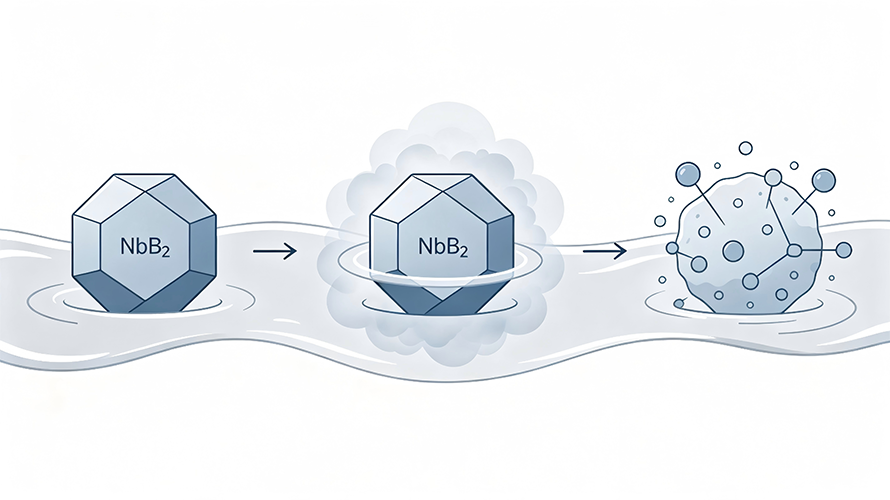
The resistance to silicon poisoning is the key advantage of niobium boride over conventional TiB₂-based grain-refining systems.
TiB₂ is an effective nucleation substrate and is widely used in Al-Ti-B grain refiners. However, in high-silicon aluminum melts, silicon can interact with active sites on TiB₂ surfaces and form a Ti-Si interfacial layer. This can cover or block nucleation sites and reduce the grain-refining efficiency of TiB₂.
NbB₂ has different interfacial chemistry. The driving force for Nb-Si reactions is lower than that for Ti-Si reactions under relevant aluminum-melt conditions. Silicon is therefore less likely to form a continuous reaction layer on the NbB₂ (0001) basal plane.
As a result, more active nucleation sites can remain available for α-Al formation in silicon-rich melts.
This makes NbB₂ particularly attractive for high-silicon Al-Si casting and die-casting alloys, including compositions in the range commonly associated with A383- and A413-type alloys.
NbB₂ should not be considered completely immune to silicon. Its advantage is its higher resistance to silicon poisoning compared with TiB₂, rather than complete immunity under all conditions.
3. Grain-Boundary Pinning
Niobium boride can also contribute to grain stability after solidification.
Fine niobium boride particles remaining in the aluminum matrix can interact with grain boundaries and produce a Zener pinning effect, which restricts grain-boundary movement and helps suppress grain growth.
This can help:
- Maintain a finer grain structure during cooling
- Reduce grain coarsening
- Improve microstructural stability during subsequent heat treatment
- Preserve the benefits of a fine-grained structure at elevated temperatures
Therefore, niobium boride can contribute both to grain nucleation during solidification and grain-growth suppression afterward.
4. Synergy with NbAl₃ in Al-Nb-B Master Alloys
When niobium boride is introduced through an Al-Nb-B master alloy, the grain-refining effect may involve NbAl₃ in addition to NbB₂.
NbAl₃ can provide additional nucleation sites and contribute to local constitutional undercooling during solidification. It may also interact with the melt chemistry and influence the silicon environment around NbB₂ particles.
This creates a potential synergistic effect between NbB₂ and NbAl₃.
However, this distinction is important when comparing NbB₂ powder with Al-Nb-B master alloys. Direct addition of pure NbB₂ powder does not automatically generate the same NbAl₃-containing system. Therefore, the two approaches should not be considered completely equivalent.
Why Is Niobium Boride Attractive for High-Silicon Al-Si Alloys?
The main difference between NbB₂ and TiB₂ is not their ability to nucleate α-Al. Both are hexagonal diborides and can act as heterogeneous nucleation substrates.
The key difference is their behavior in silicon-rich aluminum melts.
| Feature | NbB₂ | TiB₂ |
|---|---|---|
| Crystal structure | Hexagonal AlB₂-type | Hexagonal AlB₂-type |
| α-Al nucleation | Effective | Effective |
| Resistance to Si poisoning | Higher | More susceptible |
| High-Si Al-Si alloys | Particularly attractive | Grain-refining efficiency may decrease |
| Low-Si aluminum alloys | Useful, but limited additional advantage | Well-established and economical |
| Grain-boundary pinning | Yes | Yes |
For conventional low-silicon aluminum alloys, TiB₂-based grain refiners remain highly competitive. The technical value of NbB₂ becomes more significant as the silicon content increases and the risk of TiB₂ silicon poisoning becomes more important.
Niobium Boride Selection Considerations
The practical performance of niobium boride depends not only on its nominal chemical composition but also on particle characteristics and melt processing.
Particle Size
A D50 of approximately 0.5–3 μm can provide a useful balance between nucleation-site density and dispersion.
Extremely fine particles are not automatically better because agglomeration can reduce their effective nucleation activity.
Chemical and Phase Purity
High niobium boride content and controlled secondary phases are important for consistent grain-refining performance. Undesirable phases such as excessive free boron or NbB should be controlled.
Oxygen Content
Low oxygen content and limited surface oxidation are important because the niobium boride surface directly participates in heterogeneous nucleation. Significant surface oxidation can reduce the availability of effective nucleation sites.
Dispersion
Good dispersion is essential. A powder with a suitable particle-size distribution but poor dispersion may provide less effective grain refinement than expected.
For this reason, particle size, purity, oxygen content, phase composition, and dispersion behavior should be evaluated together.
Processing Limitation: Particle Sedimentation
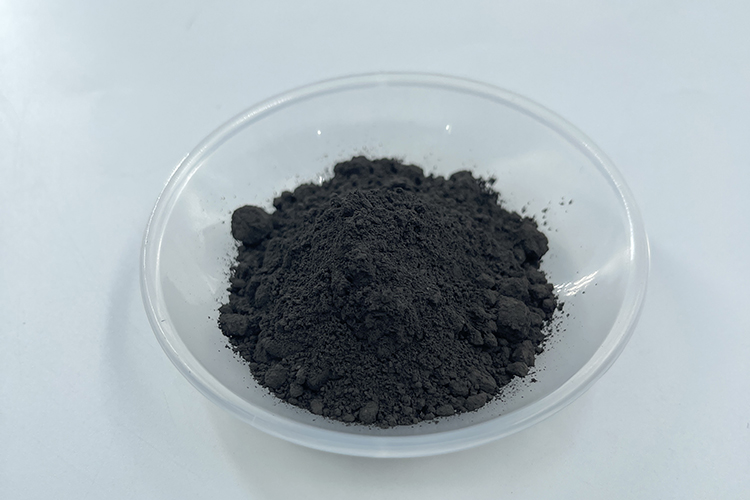
Niobium boride has a density of approximately 6.97 g/cm³, considerably higher than aluminum at approximately 2.7 g/cm³.
This density difference creates a tendency for niobium boride particles to settle in molten aluminum.
If mixing is insufficient or the holding time is too long, particles may accumulate at the bottom of the crucible. The upper portion of the melt can then contain fewer active nucleation particles, reducing grain-refining efficiency.
Important processing factors include:
- Melt stirring and mixing
- Particle dispersion
- Holding time
- Melt temperature
- Addition method
- Transfer and casting conditions
Good dispersion and appropriate melt handling are therefore essential for maintaining a uniform distribution of NbB₂.
Effects on Aluminum Alloy Properties
The main function of niobium boride is grain refinement, while improvements in material properties are mainly related to the resulting fine and uniform microstructure.
Fine grains can contribute to:
- Higher yield and tensile strength
- Improved ductility
- Reduced tendency toward brittle fracture
- Better microstructural uniformity
- Reduced columnar grain formation
- Potentially lower hot-cracking and shrinkage-related defects
The actual effect depends on alloy composition, NbB2 addition level, particle dispersion, cooling conditions, casting process, and subsequent heat treatment.
When Is Nionium Boride a Good Choice?
Niobium boride is particularly attractive when the application involves:
- High-silicon Al-Si alloys
- Aluminum die-casting alloys
- A383- or A413-type alloy compositions
- A need for stable grain refinement in silicon-rich melts
- Fine and uniform equiaxed grain structures
- Reduced sensitivity to TiB₂ silicon poisoning
For low-silicon aluminum alloys, the advantage of NbB₂ may be less pronounced, and conventional TiB₂-based grain refiners can remain a more economical choice.
Key Takeaways
NbB₂ can be used as a grain-refining material for aluminum alloys through several complementary mechanisms:
- Heterogeneous nucleation: The NbB₂ (0001) surface provides active sites for α-Al nucleation.
- Resistance to silicon poisoning: NbB₂ is less susceptible to Si-related surface poisoning than TiB₂, making it particularly suitable for high-silicon Al-Si alloys.
- Grain-boundary pinning: Dispersed NbB₂ particles can help restrict grain growth after solidification.
- NbAl₃ synergy: Al-Nb-B master alloys can provide additional grain-refining effects through NbAl₃.
- Processing sensitivity: Particle size, dispersion, oxygen content, phase purity, and sedimentation can strongly influence practical performance.
Overall, Niobium boride is best viewed as a specialized grain-refining material for silicon-rich aluminum alloys, rather than a universal replacement for TiB₂.
Frequently Asked Questions
Q1. Why is niobium boride used for grain refinement of aluminum alloys?
Niobium boride provides heterogeneous nucleation sites for α-Al and promotes the formation of finer, more equiaxed aluminum grains during solidification.
Q2. Why is niobium boride suitable for high-silicon aluminum alloys?
Niobium boride is more resistant to silicon poisoning than TiB₂, allowing more nucleation sites to remain active in silicon-rich Al-Si melts.
Q3. What NbB₂ particle size is suitable for aluminum grain refinement?
A D50 of approximately 0.5–3 μm is a useful range for balancing nucleation-site density and particle dispersion, although the optimum size depends on the alloy and processing conditions.
Q4. Is NbB₂ better than TiB₂ for all aluminum alloys?
No. TiB₂ remains highly effective for many conventional low-silicon aluminum alloys. NbB₂ offers its greatest advantage in high-silicon Al-Si systems where TiB₂ can suffer from silicon poisoning.
Q5. What can reduce the grain-refining efficiency of niobium boride?
Particle agglomeration, sedimentation, high oxygen or surface oxidation, and unwanted secondary phases can reduce the number of effective NbB₂ nucleation sites.
References
- [1] Bolzoni, L., & Hari Babu, N. (2016). Heterogeneous Nb-Based Nuclei for the Grain Refinement of Al-Si Alloys. JOM, 68, 1301–1306.
- [2] Bolzoni, L., & Hari Babu, N. (2016). Engineering the heterogeneous nuclei in Al-Si alloys for solidification control. Applied Materials Today, 5, 255–259.
- [3] Li, Y., Jiang, Y., Liu, B., Luo, Q., Hu, B., & Li, Q. (2021). Understanding grain refining and anti Si-poisoning effect in Al-10Si/Al-5Nb-B system. Journal of Materials Science & Technology, 65, 190–201.
- [4] Density functional theory study of Al/NbB₂ heterogeneous nucleation interface.
- [5] A mechanism for the poisoning effect of silicon on the grain refinement of Al-Si alloys. (2007). Acta Materialia, 55(4), 1447–1456.
Further Reading
- What Is Niobium Diboride (NbB₂)? Properties, Preparation, Applications and Advantages
- What Are the Uses of Nano Niobium Pentoxide (Nb₂O₅)?An In-Depth Overview
- Spherical C103 Alloy Powder: Analysis and Application
- What Is Niobium Oxide? Properties, Uses, and How to Store It
- Niobium: A Key Element in High-Tech Industries
Need a Custom Niobium Boride?
VIMATERIAL supplies high-purity niobium diboride (NbB₂) powder for advanced ceramic, metallurgical, and aluminum alloy applications.
For aluminum alloy grain refinement, the appropriate NbB₂ grade can be selected based on purity, particle size, particle morphology, chemical composition, and required addition level to achieve consistent nucleation and grain-refining performance.
Contact VIMATERIAL to discuss NbB₂ powder specifications for your aluminum alloy application.