


Hafnium diboride (HfB₂) and zirconium diboride (ZrB₂) are two important transition-metal diboride ceramics for ultra-high-temperature applications. Both combine high melting temperatures, hardness, thermal conductivity and electrical conductivity, making them suitable for demanding refractory, ceramic and thermal-protection systems.
Although HfB₂ and ZrB₂ share the same general AlB₂-type crystal structure, their physical properties, density, material availability and processing characteristics are not identical. The most suitable material depends on the required service temperature, oxidation environment, mechanical performance, processing route and overall project cost.
This article examines hafnium diboride vs zirconium diboride from a materials-engineering perspective, highlighting their key differences and the factors to consider when selecting between them.
What Are HfB₂ and ZrB₂?
Hafnium diboride is a refractory ceramic composed of hafnium and boron. It has a hexagonal AlB₂-type crystal structure and is known for its high melting temperature, hardness, thermal conductivity, electrical conductivity and chemical stability.
These properties make HfB₂ particularly relevant to ultra-high-temperature ceramics (UHTCs), advanced coatings, aerospace thermal-protection systems and high-temperature structural components.
Zirconium diboride is another transition-metal diboride with a hexagonal AlB₂-type structure. Like HfB₂, it combines high-temperature stability with good thermal and electrical conductivity.
ZrB₂ is widely considered for UHTC systems, protective coatings, aerospace components and other applications where conventional ceramics may not provide sufficient temperature resistance.
HfB₂ vs ZrB₂: Quick Comparison - Hafnium Diboride vs Zirconium Diboride
| Property | Hafnium Boride | Zirconium Boride |
|---|---|---|
| Chemical formula | HfB₂ | ZrB₂ |
| Material family | Transition-metal diboride | Transition-metal diboride |
| Crystal structure | Hexagonal, AlB₂-type | Hexagonal, AlB₂-type |
| Melting temperature | Very high; reported around 3250°C | Very high; commonly reported around 3000°C |
| Hardness | High | High |
| Thermal conductivity | High | High |
| Electrical conductivity | Good | Good |
| Thermal expansion | Relatively low | Relatively low |
| UHTC classification | Yes | Yes |
| Typical applications | UHTCs, aerospace, coatings, advanced ceramics | UHTCs, aerospace, coatings, advanced ceramics |
| Key selection factors | Temperature, purity, density, processing and cost | Temperature, purity, density, processing and cost |
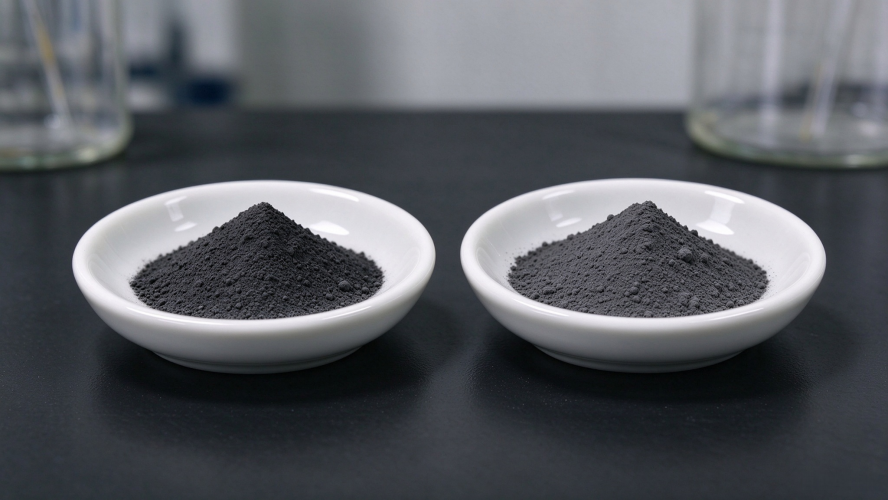
Exact thermal and physical-property values can vary with purity, density, grain size, porosity, processing method and measurement conditions. For engineering applications, the properties of the actual grade and processed component should be considered rather than relying on a single literature value.
Melting Point and High-Temperature Stability
Both HfB₂ and ZrB₂ are classified as ultra-high-temperature ceramics because of their exceptionally high melting temperatures.
HfB₂ is generally associated with a higher melting temperature than ZrB₂, with reported values for HfB₂ typically in the range of approximately 3250–3380°C, depending on the reference and measurement conditions. ZrB₂ is commonly reported at approximately 3000°C, although values can vary between sources.
The difference in melting temperature is relevant when a component must operate under extremely high-temperature conditions. However, melting point alone does not determine actual service performance.
Important factors include:
- Operating temperature
- Oxidation atmosphere
- Heating and cooling rate
- Thermal cycling
- Density and porosity
- Grain size
- Composite formulation
- Surface protection
- Manufacturing and sintering method
For this reason, HfB₂ and ZrB₂ should be evaluated according to the complete operating environment rather than by melting temperature alone.
Thermal Conductivity
Both HfB₂ and ZrB₂ have relatively high thermal conductivity compared with many conventional ceramic materials.
High thermal conductivity allows heat to be distributed through the material and can help reduce local temperature gradients. This characteristic is particularly relevant to components exposed to intense and uneven heat flux.
Reported thermal conductivity values for transition-metal diborides can vary significantly depending on composition, density, porosity, grain structure and testing temperature. Values in the range of approximately 60–120 W/m·K are commonly encountered for high-quality materials within this material family.
For thermal-protection applications, thermal conductivity should be considered together with component geometry, heat flux, surface temperature and the overall thermal-management strategy.
Hardness and Mechanical Properties
HfB₂ and ZrB₂ are hard refractory ceramics with high elastic modulus and good resistance to wear and deformation at elevated temperatures.
Their strong atomic bonding contributes to their hardness and high-temperature structural stability. However, high hardness does not necessarily translate into high fracture toughness.
Like many UHTCs, HfB₂ and ZrB₂ can exhibit limited fracture toughness compared with ductile engineering materials. Their densification can also be challenging because of strong bonding and relatively slow diffusion during conventional sintering.
Material design therefore plays an important role in practical performance. Grain-size control, sintering additives, reinforcement and composite structures can be used to improve density and mechanical reliability.
Thermal Expansion and Thermal Shock
Both HfB₂ and ZrB₂ have relatively low thermal expansion compared with many other high-temperature materials.
Lower thermal expansion can help limit dimensional changes and thermal stresses during temperature fluctuations. However, thermal-shock resistance cannot be predicted from the coefficient of thermal expansion alone.
It also depends on:
| Factor | Influence on thermal-shock behaviour |
|---|---|
| Thermal conductivity | Determines how quickly heat is distributed |
| Elastic modulus | Influences thermal stress development |
| Strength | Determines resistance to thermal-stress failure |
| Fracture toughness | Influences crack propagation resistance |
| Porosity | Affects mechanical and thermal behaviour |
| Grain structure | Influences crack development and propagation |
| Component geometry | Determines the distribution of thermal stress |
Therefore, thermal-shock performance should ultimately be evaluated using the actual processed ceramic and component geometry.
Oxidation Behaviour
Oxidation resistance is a critical consideration when HfB₂ or ZrB₂ is exposed to air at high temperatures.
Both materials can form oxide-containing surface layers during oxidation. The resulting behaviour depends on temperature, exposure time, atmosphere, material composition, density and microstructure.
For demanding aerospace and UHTC applications, HfB₂ and ZrB₂ are often considered as part of a broader material system rather than as unprotected monolithic ceramics.
Composite formulations containing SiC and other secondary phases can improve oxidation resistance and help maintain structural integrity under high-temperature oxidative conditions.
It is therefore more accurate to describe HfB₂ and ZrB₂ as high-temperature ceramics with oxidation resistance under defined conditions rather than as completely oxidation-proof materials.
HfB₂ vs ZrB₂ for Aerospace Applications
HfB₂ and ZrB₂ are both relevant to high-temperature aerospace and thermal-protection technologies.
Potential applications include:
- Hypersonic vehicle leading edges
- Nose tips
- Re-entry vehicle components
- Rocket and propulsion components
- High-temperature protective coatings
- Thermal-protection structures
These applications require materials that can withstand high temperatures, thermal gradients, mechanical loads and, in many cases, oxidative environments.
For actual aerospace components, however, the ceramic is only one part of the system. Composite design, surface protection, joining technology, processing quality and component geometry can have a major influence on final performance.
Hafnium Diboride vs Zirconium Diboride for Ceramic Processing
Processing behaviour is an important consideration when selecting between HfB₂ and ZrB₂.
Both materials can be difficult to densify because of their strong bonding and relatively low self-diffusion rates. High-temperature processing is therefore often required to obtain dense ceramics.
Common processing approaches include:
- Hot pressing
- Spark plasma sintering (SPS)
- Sintering with additives
- Grain-size engineering
- Composite reinforcement
- Advanced joining techniques
The powder itself also has a significant influence on processing performance. Particle size distribution, morphology, purity, oxygen content and agglomeration can affect powder packing, densification and final microstructure.
For HfB₂ powder specifications, see:
Hafnium Diboride Powder: Purity, Particle Size, Properties and Quality Control
HfB₂ vs ZrB₂: Cost and Material Availability
Material availability and cost can influence the practical selection of HfB₂ and ZrB₂.
Hafnium is generally less abundant and more specialized than zirconium. As a result, HfB₂ may have a higher material cost depending on purity, particle size, order quantity and supply conditions.
However, the powder price is only one part of the total cost.
For a specific application, the overall evaluation may include:
| Cost factor | What to consider |
|---|---|
| Powder price | Cost per kg at the required purity |
| Purity | Higher-purity grades may increase cost |
| Particle size | Nano or micron-scale powders may have different pricing |
| Processing | Required sintering temperature and equipment |
| Component lifetime | Expected service life under operating conditions |
| Composite requirements | Need for SiC or other secondary phases |
| Replacement frequency | Cost associated with component replacement |
The final choice should therefore consider both technical requirements and total processing economics.
Which Material Should You Choose?
There is no single material that is suitable for every HfB₂ or ZrB₂ application.
A practical comparison can focus on the following factors:
| Requirement | Selection consideration |
|---|---|
| Extremely high-temperature stability | Compare the required service temperature with material-specific data |
| High thermal conductivity | Compare measured values under relevant conditions |
| Thermal shock | Consider thermal expansion, conductivity, strength and fracture toughness together |
| Oxidizing environment | Evaluate oxidation behaviour and protective composite design |
| High hardness | Both HfB₂ and ZrB₂ are suitable candidates |
| Powder processing | Compare particle size, purity, morphology and sintering behaviour |
| Cost sensitivity | Consider material availability and total processing cost |
| Aerospace UHTC | Evaluate the complete ceramic or composite system |
| Research ceramics | Match purity, particle size and phase composition to the experimental requirements |
This approach provides a more useful basis for material selection than simply choosing the material with the higher melting temperature.
When HfB₂ is selected for ceramic processing, coating development or research, powder specifications become particularly important.
Key parameters can include:
- Purity
- Particle size
- D50 / D90 distribution
- Crystal phase
- Oxygen content
- Carbon content
- Specific surface area
- Particle morphology
- Packaging and storage conditions
For research and advanced ceramic applications, controlling these parameters can improve batch consistency and make it easier to reproduce processing and sintering results.
VIMATERIAL provides HfB₂ powder in controlled purity and particle-size specifications for different material-development requirements, including micron-scale and finer powder options.
For detailed specifications, see:
Hafnium Diboride Powder: Purity, Particle Size, Properties and Quality Control
HfB₂ and ZrB₂ in Advanced UHTC Systems
Modern UHTC development increasingly focuses on controlling microstructure and designing composite systems rather than using a single ceramic phase alone.
HfB₂- and ZrB₂-based ceramics can be combined with secondary phases such as SiC to improve oxidation resistance and thermo-mechanical performance. Grain-size control, sintering additives and tailored microstructures can also influence density, strength, thermal conductivity and fracture behaviour.
Joining is another important consideration when UHTC components need to be integrated with other ceramics or metals. The joining method must account for differences in thermal expansion, chemical compatibility and service temperature.
These considerations are particularly important when moving from laboratory-scale powders to engineered components.
FAQs
1. What is the main difference between HfB₂ and ZrB₂?
Both are transition-metal diboride UHTCs with similar hexagonal AlB₂-type structures and high-temperature properties. HfB₂ generally has a higher reported melting temperature, while ZrB₂ can offer advantages in material availability and cost depending on the required grade and supply conditions.
2. Which has the higher melting point, HfB₂ or ZrB₂?
HfB₂ generally has the higher melting temperature. Reported HfB₂ values are commonly around 3250–3380°C, while ZrB₂ is commonly reported around 3000°C. Exact values vary with the source, material quality and measurement conditions.
3. Are HfB₂ and ZrB₂ both UHTCs?
Yes. Both are widely classified as ultra-high-temperature ceramics because of their high melting temperatures and combination of mechanical, thermal and electrical properties.
4. Are HfB₂ and ZrB₂ electrically conductive?
Yes. Both materials have relatively good electrical conductivity compared with many conventional ceramic materials.
5. Which material is suitable for hypersonic applications?
Both HfB₂- and ZrB₂-based ceramics are relevant to hypersonic and re-entry thermal-protection technologies. The appropriate material depends on the required temperature, oxidation environment, mechanical loads, processing route and composite design.
6. Can HfB₂ and ZrB₂ be used in composite ceramics?
Yes. Both can be incorporated into composite UHTC systems. SiC-containing systems and other secondary phases are commonly considered when improved oxidation resistance and thermo-mechanical performance are required.
7. What HfB₂ powder properties should be specified?
Purity, particle size distribution, crystal phase, oxygen content, morphology and packaging are among the most important parameters. The appropriate specification depends on whether the powder is intended for sintering, coating, research or another application.
Conclusion
HfB₂ and ZrB₂ are closely related ultra-high-temperature ceramics with many overlapping applications. Their high melting temperatures, hardness, thermal conductivity and electrical conductivity make them important materials for advanced ceramics, aerospace thermal protection and other high-temperature technologies.
The key difference is not simply which material has a higher numerical property. Material selection should consider the complete application, including service temperature, oxidation environment, thermal cycling, powder characteristics, sintering behaviour, component design, material availability and cost.
For applications requiring controlled HfB₂ purity, particle size or packaging, VIMATERIAL can provide material specifications according to the intended processing and application requirements.
References
- [1] Golla, B. R., Mukhopadhyay, A., Basu, B., & Thimmappa, S. K. (2020). Review on ultra-high temperature boride ceramics. Progress in Materials Science, 111, 100651. DOI: 10.1016/j.pmatsci.2020.100651
- [2] Murthy, T. S. R. Ch. (2021). Processing of ZrB₂- and HfB₂-Based Ultra-High Temperature Ceramic Materials: A Review. Materials Performance and Characterization, 10(2), 89–121. DOI: 10.1520/MPC20200133
- [3] Harrington, G. J. K., & Hilmas, G. E. (2014). Thermal Conductivity of ZrB₂ and HfB₂. In Ultra-High Temperature Ceramics, 197–235. Wiley. DOI: 10.1002/9781118700853.ch9
- [4] Eakins, E., Jayaseelan, D. D., & Lee, W. E. (2011). Toward Oxidation-Resistant ZrB₂-SiC Ultra High Temperature Ceramics. Metallurgical and Materials Transactions A, 42, 878–887. DOI: 10.1007/s11661-010-0540-8
- [5] Thermal Spraying of Ultra-High Temperature Ceramics: A Review on Processing Routes and Performance. (2022). Journal of Thermal Spray Technology. DOI: 10.1007/s11666-022-01381-5
Further Reading
- Hafnium Diboride (HfB₂): Properties, Structure and Applications
- Hafnium Diboride Powder: Purity, Particle Size, Properties and Quality Control
- Ultra-High Temperature Ceramics (UHTCs): Materials for Extreme High-Temperature Applications
- High-Temperature Materials: Top 10 Heat-Resistant Materials for Extreme Environments
- Niobium boride (NbB₂) for Grain Refinement of Aluminum Alloys: Mechanism, Advantages and Selection Guide
Need a Custom Material Solution?
Contact VIMATERIAL to discuss HfB₂ powder purity, particle size, packaging and other material requirements for advanced ceramics, UHTC development and high-temperature applications.