


Zirconium carbide (ZrC) is a refractory transition metal carbide known for its high melting point, hardness, electrical conductivity and thermal stability. These characteristics make it an interesting material for advanced thin-film deposition, hard coatings and specialised surface engineering applications.
Zirconium carbide sputtering targets are used as source materials in physical vapour deposition (PVD) processes to produce zirconium carbide-containing thin films on different substrates. Their material composition, purity, density and microstructure are important considerations when selecting a target for research or industrial deposition.
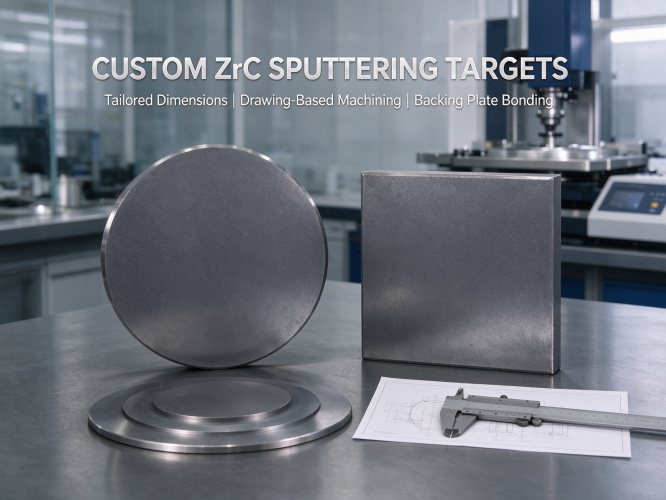
VIMATERIAL supplies zirconium carbide sputtering targets with a specified purity of 99.5% (Zr + Hf). Available configurations include round and square targets, with custom dimensions and machining according to customer drawings. Backing plate bonding services are also available to accommodate different deposition system requirements.
1. What Is a Zirconium Carbide Sputtering Target?
A zirconium carbide sputtering target is a solid source material used in physical vapour deposition processes to deposit zirconium carbide-containing thin films onto substrates.
Zirconium carbide has a face-centred cubic (FCC) crystal structure, in which carbon atoms occupy interstitial positions within the zirconium lattice. Its strong atomic bonding contributes to its high melting point, hardness and characteristic electrical conductivity.
During sputtering, energetic ions bombard the target surface, causing atoms and other species to be ejected from the material. These particles travel through the vacuum chamber and deposit onto a substrate, gradually forming a thin film.
ZrC sputtering targets are relevant to the development of functional coatings where hardness, thermal stability, wear resistance and electrical characteristics are important.
The properties of the deposited film depend on several factors, including target composition, deposition conditions, substrate characteristics and film growth parameters.
2. Key Properties of Zirconium Carbide
The physical and chemical properties of zirconium carbide make it suitable for consideration in advanced thin-film and surface engineering applications.
2.1 High Melting Point
Zirconium carbide has a reported melting point of approximately 3,400–3,540 °C, depending on composition and reference data.
This refractory characteristic makes ZrC relevant to applications involving elevated temperatures and the development of thermally stable ceramic coatings.
Its high melting point is particularly interesting for research involving refractory materials and high-temperature surface protection.
2.2 High Hardness and Wear Resistance
ZrC is a hard ceramic material with reported microhardness values generally exceeding 25 GPa under suitable measurement conditions.
Its hardness makes it interesting for developing wear-resistant surfaces and specialised protective coatings.
ZrC-containing thin films can be investigated for tools, mechanical components and surfaces exposed to abrasive or sliding contact.
Actual coating performance depends on film composition, microstructure, thickness, adhesion and deposition conditions.
2.3 Electrical Conductivity
Unlike conventional insulating ceramics, zirconium carbide exhibits metallic electrical conductivity.
This characteristic makes it relevant to functional thin-film applications where electrical properties are part of the material design requirements.
The electrical behaviour of deposited films depends on their composition, phase structure, porosity and deposition conditions.
2.4 Chemical and Thermal Stability
Zirconium carbide offers useful thermal and chemical characteristics under suitable operating conditions.
However, it can oxidise in oxygen-containing environments at elevated temperatures. Its suitability for high-temperature coating applications should therefore be evaluated according to the operating atmosphere, temperature and exposure conditions.
3. How Does Zirconium Carbide Sputtering Work?
Sputtering is a physical vapour deposition technique widely used to produce thin films with controlled thickness and composition.
In a typical magnetron sputtering process, a vacuum chamber is evacuated before a working gas, commonly argon, is introduced.
An electrical potential generates a plasma, and positively charged ions are accelerated towards the negatively biased target.
When these ions strike the target surface, atoms and other species are released through momentum transfer. The ejected material travels towards the substrate and forms a deposited layer.
The general process involves the following stages:
- Vacuum Preparation: The deposition chamber is evacuated to establish the required process environment.
- Plasma Generation: A working gas is introduced and ionised to produce plasma.
- Target Bombardment: Energetic ions strike the ZrC target surface.
- Material Deposition: Sputtered species travel towards the substrate and accumulate on its surface.
- Thin Film Formation: Continued deposition produces a zirconium carbide-containing coating.
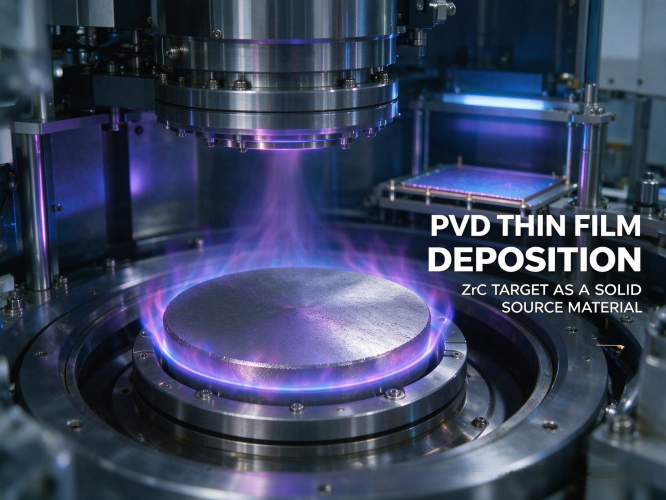
The final film composition and properties depend on the deposition system, target composition, power, working pressure, substrate temperature and other process parameters.
For compound targets such as ZrC, the target composition is an important starting point, although the deposited film composition should be verified experimentally.
4. Applications of Zirconium Carbide Sputtering Targets
Zirconium carbide sputtering targets are relevant to research and development of advanced ceramic thin films and specialised surface coatings.
4.1 Wear-Resistant Coatings
ZrC has high hardness and is therefore of interest for developing hard coatings.
ZrC-containing films can be investigated for tools, mechanical components and surfaces exposed to abrasive or sliding contact.
The effectiveness of these coatings depends on film hardness, adhesion, microstructure, thickness and deposition conditions.
4.2 High-Temperature Coatings
The high melting point of zirconium carbide makes it a candidate material for specialised coatings intended for elevated-temperature applications.
Potential research areas include refractory ceramic coatings and protective surface layers for components exposed to demanding thermal conditions.
Oxidation resistance and thermal compatibility with the substrate must be considered during material selection.
4.3 Functional Thin Films
Zirconium carbide exhibits metallic electrical characteristics and useful thermal properties.
These characteristics make ZrC-containing films relevant to research involving conductive ceramic layers and specialised functional coatings.
The resulting electrical and thermal properties depend on the deposited film’s composition, phase structure and microstructure.
4.4 Advanced Materials Research
ZrC sputtering targets are also used in academic and industrial research involving refractory carbides, ceramic coatings and thin-film material development.
Researchers can investigate the relationships between deposition parameters, film composition, crystal structure, hardness and other functional properties.
5. Important Specifications for Zirconium Carbide Sputtering Targets
Selecting a suitable zirconium carbide sputtering target requires consideration of several material and dimensional parameters.
5.1 Purity
Target purity is an important consideration because impurities can influence the composition of deposited films and the consistency of the deposition process.
VIMATERIAL offers zirconium carbide sputtering targets with a specified purity of:
99.5% (Zr + Hf)
This specification represents the combined content of zirconium and hafnium metallic elements.
It should be distinguished from the stoichiometric purity of the ZrC compound itself. Customers requiring specific elemental composition limits or additional impurity information can discuss their analytical requirements with VIMATERIAL.
5.2 Target Shape
Zirconium carbide sputtering targets can be manufactured in different geometries according to equipment requirements.
Common geometries include:
- Round Targets: Suitable for deposition systems designed for circular target configurations.
- Square Targets: Suitable for systems requiring square target geometries.
Other dimensional or geometric requirements can be evaluated according to customer specifications and technical drawings.
5.3 Target Dimensions
Target dimensions must be compatible with the deposition equipment and mounting arrangement.
Important dimensional parameters include:
- Outer diameter or length and width
- Thickness
- Overall geometry
- Mounting and interface dimensions
- Dimensional tolerances
VIMATERIAL supports customised target dimensions according to customer requirements.
5.4 Density and Microstructural Uniformity
For compound ceramic targets, density and microstructural uniformity are important considerations.
Porosity, phase distribution and compositional variations can influence target behaviour during sputtering.
The required material characteristics should be evaluated according to the deposition system and intended application.
5.5 Surface Condition and Machining Quality
Target surface condition and dimensional accuracy are relevant to installation and deposition system compatibility.
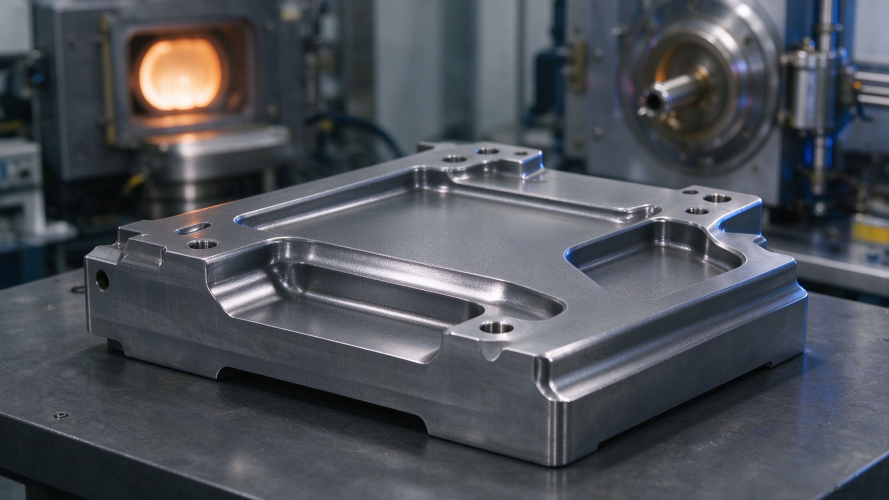
Machining requirements may include surface finishing, dimensional tolerances, mounting features and other details specified in the technical drawing.
The final requirements should be confirmed before manufacturing.
5.6 Backing Plate Bonding
For sputtering systems requiring bonded targets, the backing plate provides mechanical support and an interface for heat transfer during deposition.
VIMATERIAL provides backing plate bonding services for zirconium carbide sputtering targets according to customer requirements.
The bonding configuration should be considered together with the target geometry, backing plate material, deposition equipment and operating conditions.
Customers can discuss their preferred backing plate specifications or provide technical drawings for evaluation before manufacturing.
6. Custom Zirconium Carbide Sputtering Targets from VIMATERIAL
Different sputtering systems have different target geometries, dimensions and mounting requirements.
VIMATERIAL provides zirconium carbide sputtering targets with customised shapes and dimensions to support different equipment configurations and research applications.
6.1 Available Specifications
| Parameter | Specification |
|---|---|
| Material | Zirconium Carbide (ZrC) |
| Purity | 99.5% (Zr + Hf) |
| Target Shape | Round and Square |
| Dimensions | Customisable |
| Machining | According to Customer Drawings |
| Backing Plate Bonding | Available |
Purity represents the combined content of zirconium and hafnium metallic elements.
6.2 Round and Square Target Manufacturing
We can manufacture both round and square zirconium carbide sputtering targets.
Target geometry can be selected according to the dimensions and mounting requirements of the customer’s deposition equipment.
Whether your project requires a standard circular target or a customised square configuration, the required geometry can be discussed with our team.
6.3 Custom Dimensions and Drawing-Based Machining
VIMATERIAL supports customised dimensions and machining according to customer drawings.
Customers can provide technical drawings specifying the required geometry, dimensions, thickness, tolerances and mounting features.
Our team can review the drawings and evaluate the manufacturing requirements before confirming the proposed specification.
This service is particularly useful for research institutions, equipment manufacturers and industrial users working with specialised PVD systems.
6.4 Backing Plate Bonding Service
In addition to target manufacturing and machining, VIMATERIAL offers backing plate bonding services for zirconium carbide sputtering targets.
Bonding a sputtering target to a suitable backing plate can provide mechanical support and facilitate installation in compatible deposition systems. It also helps establish the thermal interface between the target and the backing plate.
The bonding requirements depend on the target geometry, backing plate material, bonding method and operating conditions of the sputtering equipment.
Customers can discuss their preferred bonding configuration with our team or provide technical drawings for evaluation.
Whether you require an unbonded target or a bonded assembly, VIMATERIAL can discuss a suitable configuration according to your project requirements.
6.5 What Information Should You Provide When Ordering?
To help evaluate your requirements, we recommend providing:
- Target material and required purity
- Target shape (round or square)
- Outer diameter or length and width
- Target thickness
- Dimensional tolerances
- Backing plate material and dimensions, if applicable
- Bonding requirements
- Technical drawing or reference diagram
- Required quantity
Providing these details helps establish a clear manufacturing specification and reduces the risk of dimensional incompatibility.
7. How to Select the Right Zirconium Carbide Target?
Choosing a suitable ZrC sputtering target requires more than considering material purity alone.
The target should be compatible with the deposition equipment and the intended film development process.
The following factors should be evaluated:
Purity and Composition
Confirm the required purity grade and determine whether additional elemental impurity limits are necessary.
Geometry and Dimensions
Select a target shape and size compatible with the sputtering source and mounting arrangement.
Target Thickness
Target thickness should be determined according to equipment requirements, target mounting design and operating conditions.
Mounting and Bonding Compatibility
If the system requires a backing plate or a particular bonding configuration, these requirements should be specified before manufacturing.
Deposition Requirements
The intended film composition, substrate material and deposition process should be considered when selecting the target specification.
A clear technical specification helps ensure that the supplied target meets the dimensional and material requirements of the intended application.
Frequently Asked Questions (FAQ)
1. What is a zirconium carbide sputtering target used for?
ZrC sputtering targets are used in PVD processes to deposit zirconium carbide-containing thin films. They are relevant to research and development of hard coatings, refractory ceramic films and functional surface layers.
2. Are customised dimensions available?
Yes. Target dimensions can be customised according to the requirements of the deposition equipment and customer specifications.
3. Can zirconium carbide targets be manufactured according to technical drawings?
Yes. VIMATERIAL supports drawing-based machining. Customers can provide technical drawings with dimensions, tolerances and other machining requirements for evaluation.
4. Can VIMATERIAL provide backing plate bonding?
Yes. VIMATERIAL provides backing plate bonding services for zirconium carbide sputtering targets. Bonding configurations can be discussed according to target dimensions, backing plate specifications and deposition equipment requirements.
5. What information is needed for a customised ZrC target quotation?
Please provide the required purity, target shape, dimensions, thickness, tolerances, quantity and technical drawing, if available. If bonding is required, please also specify the backing plate requirements.
6. What factors affect the performance of a ZrC sputtering target?
Target composition, density, microstructural uniformity and surface condition can influence target behaviour. Deposition conditions and equipment configuration also affect the resulting thin-film properties.
7. Can ZrC sputtering targets be used for magnetron sputtering?
ZrC targets can be used in suitable PVD sputtering systems, including magnetron sputtering configurations. Compatibility should be confirmed according to the equipment design and target specifications.
Conclusion
Zirconium carbide sputtering targets are important source materials for the development of refractory carbide thin films and specialised ceramic coatings.
Their high hardness, high melting point and electrical conductivity make them relevant to research and industrial applications involving advanced surface engineering.
Selecting an appropriate target requires consideration of purity, geometry, dimensions, microstructural characteristics, mounting requirements and compatibility with the deposition system.
VIMATERIAL supplies zirconium carbide sputtering targets with a specified purity of 99.5% (Zr + Hf), available in round and square configurations. Custom dimensions, machining according to customer drawings and backing plate bonding services are also available.
Whether you require a standard target geometry or a customised bonded assembly, VIMATERIAL can work with your technical specifications to evaluate a suitable material solution.
References
- [1] Ul-Hamid, A. (2020). The effect of deposition conditions on the properties of Zr-carbide, Zr-nitride and Zr-carbonitride coatings – a review. Materials Advances, 1, 988–1011.
- [2] Ul-Hamid, A. (2020). Microstructure, properties and applications of Zr-carbide, Zr-nitride and Zr-carbonitride coatings: a review. Materials Advances, 1, 1012–1037.
- [3] Meng, Q. N., Wen, M., Mao, F., Nedfors, N., Jansson, U., & Zheng, W. T. (2013). Deposition and characterization of reactive magnetron sputtered zirconium carbide films. Surface and Coatings Technology, 232, 876–883.
- [4] Kumar, S. S., Sharma, A., Rao, G. M., & Suwas, S. (2017). Investigations on the effect of substrate temperature on the properties of reactively sputtered zirconium carbide thin films. Journal of Alloys and Compounds, 695, 1020–1028.
Further Reading
- Zirconium Carbide (ZrC): Properties, Synthesis and Applications
- Zirconium Carbide Synthesis and Sintering Methods
- ZrC vs HfC vs TaC: Properties, Differences and Applications
- Hafnium Diboride vs Zirconium Diboride: Properties and High-Temperature Applications
- Ultra-High Temperature Ceramics (UHTCs): Materials for Extreme High-Temperature Applications
Looking for Custom Zirconium Carbide Sputtering Targets?
VIMATERIAL supplies zirconium carbide sputtering targets with a specified purity of 99.5% (Zr + Hf).
Our manufacturing and customisation capabilities include:
- Round and square target geometries
- Customisable dimensions
- Machining according to customer drawings
- Backing plate bonding services
Whether you require a standard configuration, a customised geometry or a bonded target assembly, our team is ready to discuss your technical requirements.
Send us your technical drawing or contact VIMATERIAL to request a quotation.