


Selecting zirconia powder for advanced ceramic manufacturing involves more than choosing a nominal purity or particle size. Powder characteristics influence dispersion, forming, sintering behaviour, microstructure and the consistency of the finished ceramic component.
The appropriate grade depends on the manufacturing route and the required properties of the final product. Structural ceramics, wear-resistant components, dental ceramics and functional ceramic systems may require different combinations of particle-size distribution, stabilizer content, chemical purity and powder morphology.
This guide explains the main factors to evaluate when selecting zirconia powder for ceramic processing, with a focus on practical specification review and material qualification.
How to Select Zirconia Powder for Advanced Ceramics?
Before comparing powder specifications, define the requirements of the finished component and the process used to manufacture it.
Different applications place different demands on zirconia powder. For example, a component requiring high mechanical reliability may need a different material formulation from a ceramic part designed primarily for optical properties or ionic conductivity.
Important questions include:
- What mechanical, thermal, electrical or optical properties must the finished component achieve?
- Which forming method will be used, such as uniaxial pressing, cold isostatic pressing, injection moulding or tape casting?
- What sintering or densification process is available?
- Is the component sensitive to porosity, dimensional variation or surface defects?
- Which chemical impurities or secondary phases must be controlled?
- Does the process require a particular stabilizer content or crystal-phase composition?
These requirements establish the basis for comparing zirconia powder grades. A powder should be evaluated according to its suitability for the complete manufacturing process, rather than on one specification alone.
Evaluate Particle Size and Particle-Size Distribution
Particle size is one of the most important parameters in zirconia powder selection. It can affect powder dispersion, packing, surface area and sintering behaviour.
However, a smaller nominal particle size does not automatically guarantee a better ceramic product. Very fine powders may be more difficult to disperse and can exhibit stronger agglomeration, while coarser particles may require different processing conditions to achieve the desired microstructure.
D10, D50 and D90
The particle-size distribution provides more information than a single average or median value.
- D10: The diameter below which 10% of the measured particle volume falls.
- D50: The median particle diameter, below which 50% of the measured particle volume falls.
- D90: The diameter below which 90% of the measured particle volume falls.
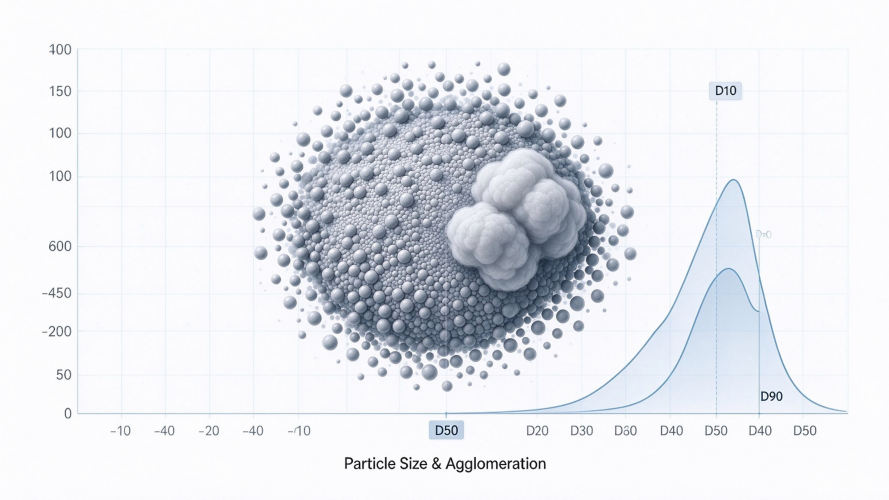
For laser diffraction measurements reported on a volume basis, these parameters help describe the finer, median and coarser portions of the distribution.
When comparing zirconia powders, consider all three values where available. Two powders with a similar D50 may have different D90 values, indicating different coarse-particle populations or distribution widths.
A broad distribution is not necessarily unsuitable, but its effect on packing, forming and the final microstructure should be assessed against the requirements of the process.
Why Agglomeration Matters?
Agglomeration is another important consideration. Fine primary particles can form larger clusters during synthesis, drying, storage or powder handling.
If agglomerates are not adequately dispersed during processing, they may create local variations in packing density. These variations can contribute to uneven shrinkage or defects during densification.
When evaluating zirconia powder, distinguish between primary particle size and the particle-size distribution measured under specified dispersion conditions. Ask whether the reported values are based on dry or wet dispersion and whether the measurement procedure is suitable for the powder being assessed.
Consider Specific Surface Area and Sintering Behaviour
Specific surface area provides additional information about a powder beyond its particle-size distribution.
For many fine ceramic powders, a higher specific surface area can be associated with increased surface energy and greater sintering activity. However, the actual densification response depends on other factors, including particle morphology, agglomeration, chemical composition, forming conditions and the sintering schedule.
A powder with a high specific surface area may require careful control of dispersion and processing conditions. Differences in surface area can also be relevant when comparing grades that have similar reported D50 values.
What Should Be Checked?
When sintering performance is important, consider the following parameters together:
- Particle-size distribution, including D10, D50 and D90 where available.
- Specific surface area, typically measured using an appropriate gas-adsorption method.
- Powder morphology and the presence of agglomerates.
- Chemical purity and relevant impurity limits.
- Green-body density and uniformity after forming.
- Sintering temperature, holding time and atmosphere.
- Final density, porosity, shrinkage and microstructure.
Powder specifications alone cannot guarantee a particular sintered density or shrinkage rate. These results depend on the complete processing route and should be verified through trials under representative manufacturing conditions.
Match Powder Characteristics to the Forming Method
The forming process determines how the powder must behave before sintering. A grade suitable for one manufacturing route may not perform equally well in another.
Uniaxial and Isostatic Pressing
For pressing processes, powder packing, flowability, agglomeration and the use of granulated feedstock can influence the uniformity of the green body.
Where granulated powder is used, granule size, strength and breakdown behaviour may be as important as the characteristics of the primary particles.
Ceramic Injection Moulding
Injection moulding typically requires a powder feedstock with controlled particle characteristics and compatibility with the binder system. Powder loading, dispersion and feedstock rheology should be assessed together.
The most appropriate zirconia powder is therefore not determined by particle size alone. Its interaction with the selected binder and processing conditions must also be considered.
Tape Casting and Other Shaping Processes
Tape casting and related shaping methods can place particular demands on dispersion, slurry stability and uniformity. Particle-size distribution, surface characteristics and formulation compatibility may affect processing behaviour and the quality of the formed layer.
For any forming method, qualification should reflect the actual equipment, formulation and processing parameters used in production.
Check Purity and Trace Impurities
Chemical purity is an important consideration for advanced zirconia ceramics, but the total purity value does not always provide enough information for demanding applications.
Different impurities may affect phase stability, grain growth, sintering behaviour or functional performance. Their significance depends on the zirconia formulation and the intended application.
When reviewing a technical data sheet or certificate of analysis, consider:
- Nominal zirconia content and the basis used to report purity.
- Stabilizer content, such as yttria, where applicable.
- Relevant metallic impurities.
- Silicon, aluminium, iron or other specified elements where they are important to the process.
- Moisture content or loss on ignition, if relevant.
- The analytical method and reporting limits.
Not every application requires the same impurity limits. Define acceptance criteria according to the performance requirements of the finished component instead of assuming that the highest nominal purity is always the best choice.
For repeat manufacturing, also establish how the supplier reports and controls relevant impurities between batches.
Confirm Stabilizer Content and Crystal-Phase Requirements
Zirconia may be supplied in different formulations depending on the stabilizer used and the intended application. Yttria-stabilized zirconia is a widely used example, with different yttria contents associated with different phase compositions and material characteristics.
The appropriate stabilizer content depends on the intended function. For example, some structural ceramic applications prioritize mechanical performance, while certain functional ceramic systems require suitable oxygen-ion conductivity at their operating temperatures.
Nominal stabilizer content is an important starting point, but it does not fully define the phase composition or final properties. Processing history, composition and microstructure can also influence the material.
Where phase composition is critical, review relevant X-ray diffraction (XRD) data or other suitable characterization results. Confirm whether the stated stabilizer content is expressed in mol%, wt% or another basis, and avoid comparing values reported on different bases without conversion.
For a detailed comparison of common yttria-stabilized zirconia grades, see 3Y-TZP vs 5Y-YSZ vs 8Y-YSZ: How to Choose the Right Zirconia Grade.
Compare the Specifications That Matter to Your Process
The following table summarizes the main powder parameters to review when qualifying zirconia for advanced ceramic manufacturing.
| Parameter | Why It Matters | What to Confirm |
|---|---|---|
| Chemical purity | Impurities may affect processing and final performance. | Nominal purity, reporting basis and relevant impurity limits. |
| Stabilizer content | Influences phase stabilization and material characteristics. | Stabilizer type, concentration and measurement basis. |
| D10, D50 and D90 | Describe the particle-size distribution. | Values, measurement method and dispersion conditions. |
| Specific surface area | Provides supplementary information about powder surface characteristics. | Reported value and measurement method. |
| Morphology | Can affect packing, dispersion and handling. | Particle shape, surface features and agglomeration. |
| Moisture and loss on ignition | May be relevant to storage and processing consistency. | Test method and acceptable limits. |
| Phase composition | Helps establish suitability for the intended application. | XRD or other relevant phase-analysis data. |
| Batch consistency | Supports repeatable manufacturing. | Agreed acceptance limits and batch documentation. |
The importance of each parameter depends on the application. For example, a process sensitive to coarse particles may place particular emphasis on D90, while a process that depends on densification behaviour may require closer evaluation of specific surface area and forming conditions.
For definitions of powder specifications and further guidance on interpreting technical data, see Zirconia Powder Specifications: Purity, Particle Size and Crystal Phase.
Process for Qualifying Zirconia Powder for Advanced Ceramics
A structured qualification process helps manufacturers avoid selecting a grade based on incomplete or incomparable data.
Step 1: Define the Application Requirements
Document the intended component, forming method, densification process and required final properties. Identify any critical quality characteristics, such as porosity, dimensional tolerance, mechanical performance or ionic conductivity.
Step 2: Establish the Required Powder Specifications
Define the relevant purity, stabilizer content, particle-size distribution and other parameters. Set acceptance limits based on process requirements rather than choosing arbitrary specifications.
Step 3: Review the Technical Data
Compare technical data sheets using consistent units, definitions and measurement methods. If a parameter is not reported, ask whether it can be measured or supplied for the proposed grade.
Step 4: Evaluate Representative Samples
Where feasible, test the candidate powder under conditions representative of the intended process. Evaluate dispersion, forming behaviour, green-body uniformity and sintering response.
Step 5: Verify the Finished Ceramic
Assess the final component against the agreed acceptance criteria. Depending on the application, this may include density, porosity, shrinkage, microstructure and functional testing.
Step 6: Confirm Batch Consistency
For production use, agree on the specifications and documentation required for subsequent batches. Establish which parameters are critical and how deviations will be evaluated.
This approach links powder selection to measurable manufacturing outcomes and provides a clearer basis for supplier comparison.
Questions to Ask a Zirconia Powder Supplier
Before selecting a grade, it is useful to clarify both the powder specification and the supporting quality documentation.
Consider asking:
- What zirconia formulation and stabilizer content are available?
- How are purity and impurity levels measured and reported?
- Are D10, D50 and D90 available, and what measurement method is used?
- Is specific surface area measured and reported?
- Is information on particle morphology or agglomeration available?
- Can a batch-specific certificate of analysis be provided?
- Are the powder characteristics controlled between batches?
- Can the grade be evaluated against the intended forming and sintering process?
- Are customized purity, particle-size or packaging requirements possible?
The answers help establish whether a grade is technically suitable and whether its specification can be maintained for repeat orders.
Frequently Asked Questions
1. What is the most important specification when choosing zirconia powder?
There is no single specification that determines suitability for every application. Purity, stabilizer content, particle-size distribution, specific surface area and morphology should be assessed according to the forming method and final component requirements.
2. Is a smaller D50 always better for zirconia powder?
No. A smaller D50 may be beneficial for some processing routes, but very fine powders can also be more difficult to disperse and may exhibit greater agglomeration. The appropriate particle size depends on the complete manufacturing process.
3. Why should D90 be checked in addition to D50?
D50 describes the median particle diameter but does not show the coarse end of the distribution. D90 provides additional information about larger particles or agglomerates that may be relevant to packing, forming and defect control.
4. Does higher purity always produce better zirconia ceramics?
Not necessarily. The required purity and individual impurity limits depend on the intended application. A suitable grade should meet the relevant chemical and process requirements, with performance verified through appropriate testing.
5. Can powder specifications predict final sintered density?
They can help assess potential processing suitability, but they cannot guarantee a specific final density. Forming conditions, green-body uniformity, sintering parameters, composition and microstructure also affect densification.
6. What documents should be requested when qualifying zirconia powder?
A technical data sheet can provide the nominal specification, while a batch-specific certificate of analysis can document measured results for the supplied lot. Depending on the application, particle-size data, impurity analysis or phase-characterization results may also be useful.
Conclusion
Choosing zirconia powder for advanced ceramic manufacturing requires a process-oriented assessment of the material. Particle-size distribution, agglomeration, specific surface area, chemical purity, stabilizer content and phase composition all contribute to the evaluation, but their relative importance depends on the intended application.
A reliable selection process begins with the final component requirements, establishes appropriate powder acceptance criteria, compares data using consistent measurement methods and verifies performance through representative processing trials.
By evaluating powder characteristics together with forming and sintering conditions, manufacturers can make more informed material decisions and establish clearer quality requirements for repeat production.
References
- [1] ISO 13320:2020. Particle size analysis — Laser diffraction methods.
- [2] ISO 9276-2:2014. Representation of results of particle size analysis — Part 2: Calculation of average particle sizes/diameters and moments from particle size distributions.
- [3] Cheong, A. C. H., & Sivanesan, S. (2023). Perspective Chapter: The Application of Yttria-Stabilized Zirconia (YSZ). IntechOpen.
- [4] Kelly, J. R., & Denry, I. (2008). Stabilized zirconia as a structural ceramic: An overview. Dental Materials, 24(3), 289–298.
Further Reading
- Zirconia Powder Specifications: Purity, Particle Size and Crystal Phase
- Everything You Need to Know About Zirconium Powder: Uses, Risks, and Strength vs Titanium
- Hafnium Oxide (HfO₂): A High-Performance High-k Material for Advanced Electronics and Beyond
- High-Purity Yttrium Oxide: A Rare Earth Gem from Advanced Technology to Wide-Ranging Applications
- Hafnium Diboride Powder: Purity, Particle Size, Properties and Quality Control
Need a Custom Material Solution?
VIMATERIAL supplies advanced ceramic and inorganic material powders for research and industrial applications. If you are evaluating zirconia powder for a specific manufacturing process, contact our team to discuss your required purity, stabilizer content, particle-size distribution, documentation and packaging requirements.
Material selection should be based on your process conditions and technical specifications. Customized requirements can be reviewed according to the intended application.