


Zirconia is used in structural ceramics, thermal and electrical applications, and advanced functional materials. However, not all zirconia powders have the same properties. The yttria (Y₂O₃) content influences phase composition and can affect mechanical performance, optical properties and oxygen-ion conductivity.
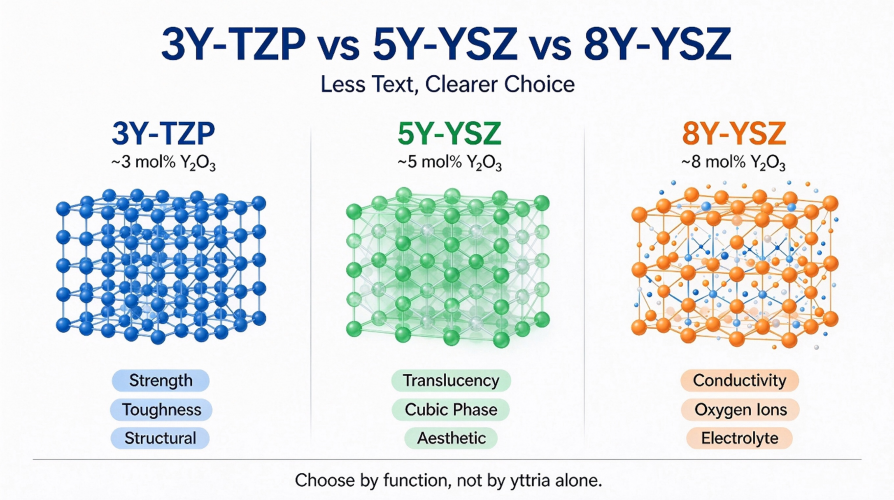
Three commonly discussed grades are 3Y-TZP, 5Y-YSZ and 8Y-YSZ. Although their names indicate nominal yttria contents of approximately 3, 5 and 8 mol%, respectively, these grades are not interchangeable. Their suitability depends on the intended application, powder characteristics and subsequent processing conditions. Understanding the differences among these grades can help in selecting the right option for your needs, particularly when considering 3Y-TZP vs 5Y-YSZ vs 8Y-YSZ.
What Do 3Y, 5Y and 8Y Mean?
The number in a zirconia grade designation generally refers to the nominal molar percentage of yttria added to zirconia.
Yttria acts as a stabilizer. It changes the phase stability of zirconia and introduces oxygen vacancies into the crystal structure. Depending on composition and processing, this can influence transformation behaviour, mechanical properties and ionic conductivity.
| Grade | Nominal Yttria Content | General Material Description |
|---|---|---|
| 3Y-TZP | Approximately 3 mol% Y₂O₃ | Commonly associated with tetragonal zirconia polycrystals and transformation-related toughening. |
| 5Y-YSZ / 5Y-PSZ | Approximately 5 mol% Y₂O₃ | Often associated with a higher cubic-phase fraction and increased translucency in relevant ceramic grades. |
| 8Y-YSZ | Approximately 8 mol% Y₂O₃ | Commonly used as an oxygen-ion-conducting electrolyte material, particularly in high-temperature electrochemical systems. |
Note: These descriptions are general guidelines, not guaranteed specifications for every commercial powder. Phase composition and properties depend on the complete formulation, manufacturing route and heat treatment.
It is also important to distinguish mol% from wt%. They describe different ways of expressing composition and should not be compared as though they were equivalent.
3Y-TZP: When Mechanical Performance Is the Priority
3Y-TZP stands for 3 mol% yttria-stabilized tetragonal zirconia polycrystal. It is widely known for its combination of strength and fracture toughness.
In suitable microstructures, metastable tetragonal zirconia can transform to the monoclinic phase near a propagating crack. The associated volume expansion can help resist crack propagation. This mechanism is known as transformation toughening.
Typical characteristics
- High mechanical strength and fracture toughness in appropriately processed materials.
- Transformation-related toughening when the phase composition and microstructure are suitable.
- Generally lower translucency than higher-yttria zirconia grades developed for aesthetic ceramic applications.
- Properties that depend strongly on grain size, stabilizer distribution, density and sintering conditions.
Where is 3Y-TZP used?
3Y-TZP is commonly used in structural and wear-resistant ceramic components. It is also widely used in dental ceramics where mechanical performance is important.
For engineering applications, the exact grade should be assessed against the component’s operating loads, environment, geometry and required reliability. The designation alone does not establish a guaranteed strength or fracture-toughness value.
5Y-YSZ: When Higher Translucency Is Required
Zirconia containing approximately 5 mol% yttria is often used in partially stabilized zirconia grades developed for improved optical properties, especially in dental ceramics.
Increasing yttria content generally promotes a greater cubic-phase fraction under suitable conditions. The cubic phase is optically isotropic, which can reduce light scattering associated with crystallographic anisotropy. This can improve translucency.
However, higher translucency is not automatically accompanied by better mechanical performance.
Typical characteristics
- Higher translucency in many relevant commercial ceramic formulations.
- A different phase balance from conventional 3Y-TZP.
- Often lower transformation-related toughening and fracture toughness than comparable 3Y-TZP materials.
- Optical and mechanical properties that vary with alumina content, grain size, density, sintering conditions and final microstructure.
Where is 5Y zirconia used?
5Y zirconia is particularly relevant to dental ceramics where translucency and appearance are important selection criteria.
For general industrial zirconia powders, the designation 5Y does not by itself establish that the material is more suitable than 3Y for a particular application. The required phase composition and performance data should be specified for the intended process.
8Y-YSZ: When Oxygen-Ion Conductivity Is Required
8Y-YSZ usually refers to zirconia stabilized with approximately 8 mol% yttria. It is an established electrolyte material for high-temperature electrochemical applications.
Yttria stabilization introduces oxygen vacancies into the zirconia structure. At elevated temperatures, these vacancies support oxygen-ion transport, which makes YSZ useful as a solid electrolyte.
Typical characteristics
- Commonly used in high-temperature oxygen-ion-conducting applications.
- A cubic fluorite-type structure is characteristic of conventional 8YSZ electrolyte materials.
- Ionic conductivity depends on temperature, composition, impurities, microstructure and processing.
- Mechanical and thermal properties must still meet the requirements of the complete component.
Where is 8Y-YSZ used?
Common applications include:
- Solid oxide fuel cells (SOFCs).
- Solid oxide electrolysis cells (SOECs).
- Oxygen sensors and related electrochemical components.
- Other high-temperature systems requiring oxygen-ion-conducting ceramic electrolytes.
8YSZ is not automatically the best choice for every application involving zirconia. Its suitability depends on the required electrical behaviour, operating temperature, component design and compatibility with adjacent materials.
3Y-TZP vs 5Y-YSZ vs 8Y-YSZ: Key Differences
The following table provides a practical first comparison. It should be used as a screening guide rather than as a substitute for product-specific technical data.
| Selection Factor | 3Y-TZP | 5Y-YSZ / 5Y-PSZ | 8Y-YSZ |
|---|---|---|---|
| Nominal yttria content | 3 mol% | 5 mol% | 8 mol% |
| Typical material focus | Structural performance | Higher translucency in relevant ceramic grades | Oxygen-ion conductivity |
| Phase-related consideration | Tetragonal phase and transformation toughening | Increased cubic-phase fraction in many relevant formulations | Stabilized cubic structure in conventional electrolyte grades |
| Mechanical performance | Often prioritised | May be lower than comparable 3Y materials | Must be assessed for the intended component |
| Optical properties | Generally less translucent than relevant 5Y grades | Often selected for improved translucency | Not usually selected primarily for translucency |
| Typical application examples | Structural ceramics, wear-resistant parts, dental ceramics | Translucent dental ceramics | SOFC/SOEC electrolytes, oxygen sensors |
| Main selection question | Is the strength and toughness suitable? | Is the optical performance sufficient without compromising required mechanical performance? | Is the ionic conductivity adequate at the operating temperature? |
Important: Mechanical strength, fracture toughness, translucency and ionic conductivity are not determined by yttria content alone. Published values should only be compared when the test methods, specimen preparation, density, grain structure and measurement conditions are sufficiently comparable.
Before selecting a grade, define the function the zirconia must perform in the finished component.
Step 1: Identify the primary requirement
Start with the most important performance target:
- Structural performance: evaluate strength, fracture toughness, hardness, wear behaviour and phase stability.
- Optical performance: evaluate translucency, colour requirements, phase composition and the final component’s thickness.
- Ionic conductivity: evaluate conductivity at the actual operating temperature, electrolyte density, impurity levels and compatibility with other cell materials.
- General ceramic processing: evaluate sintering behaviour, shrinkage, particle-size distribution, agglomeration and the required final microstructure.
Step 2: Confirm the composition
Ask whether the product is pure zirconia or yttria-stabilized zirconia. Confirm the yttria concentration and its reporting basis.
Do not assume that a grade labelled 3Y, 5Y or 8Y will have identical composition across all suppliers.
Step 3: Review powder characteristics
The powder specifications can influence forming, sintering and final component performance.
| Parameter | Why It Matters |
|---|---|
| Purity and impurity profile | Impurities can affect phase stability, sintering and functional performance. |
| Yttria content | Influences stabilization and phase composition. |
| D10, D50 and D90 | Describe the particle-size distribution and help assess processing suitability. |
| Specific surface area | Can help evaluate powder reactivity and sintering behaviour. |
| Morphology and agglomeration | Influence dispersion, packing and forming. |
| Moisture and loss on ignition | May affect handling and processing. |
| Phase composition | Helps establish whether the material is suitable for the intended function. |
For a detailed explanation of these parameters, see VIMATERIAL’s article on Zirconia Powder Specifications: Purity, Particle Size and Crystal Phase.
Step 4: Consider the manufacturing process
The required grade also depends on how the material will be processed. Powder preparation, forming method, sintering temperature, holding time and cooling conditions can all influence the final microstructure.
A powder that is suitable for one manufacturing route may not deliver the same results under another. Confirm the recommended processing conditions and evaluate the properties of the final ceramic where necessary.
Step 5: Request application-relevant test data
For a purchasing decision, request a technical data sheet (TDS) and, where required, a batch-specific certificate of analysis (COA).
For structural ceramics, prioritise the mechanical properties and phase stability relevant to the application. For electrochemical systems, request conductivity data with the corresponding test temperature and measurement conditions. For optical ceramics, ensure that translucency results are measured under comparable conditions.
Common Mistakes When Comparing Zirconia Grades
Mistake 1: Assuming more yttria always means better performance.
Increasing yttria can improve certain properties while reducing others. A higher yttria content should not be treated as a universal performance upgrade.
Mistake 2: Treating mol% and wt% as interchangeable.
These units express composition differently. Confirm the reporting basis before comparing material specifications.
Mistake 3: Comparing powders by grade name alone.
Two powders with the same nominal yttria content may differ in purity, particle-size distribution, surface area, phase composition and sintering behaviour.
Mistake 4: Using dental-grade comparisons for every industrial application.
The 3Y-versus-5Y translucency and strength comparison is especially familiar in dental ceramics. Industrial applications may have different performance priorities and should be evaluated using application-specific data.
Mistake 5: Ignoring operating conditions.
For high-temperature electrochemical applications, ionic conductivity must be assessed at the relevant temperature. For structural components, mechanical performance should be considered alongside thermal, chemical and environmental conditions.
Frequently Asked Questions
1. Is 3Y-TZP stronger than 5Y zirconia?
3Y-TZP commonly offers higher fracture toughness and mechanical strength than comparable high-translucency 5Y dental zirconia grades. However, the actual values depend on the formulation, microstructure, processing conditions and test method.
2. Is 8Y-YSZ always cubic?
Conventional 8YSZ electrolyte materials are commonly associated with a stabilized cubic fluorite structure. The actual phase composition should nevertheless be confirmed for the specific material and processing conditions.
3. What is the main difference between 3Y and 8Y zirconia?
The nominal yttria content differs, and this influences phase stability and properties. 3Y-TZP is widely associated with transformation-toughened structural ceramics, whereas 8Y-YSZ is widely used as an oxygen-ion-conducting electrolyte in high-temperature electrochemical systems.
4. Can 5Y zirconia be used for structural ceramics?
Potentially, depending on the application and the grade’s verified mechanical properties. The required strength, fracture toughness, reliability and operating conditions should be checked before selection.
5. Is yttria content enough to specify a zirconia powder?
No. A complete specification may also need purity, particle-size distribution, specific surface area, phase composition, moisture, impurity limits and application-specific performance data.
6. How should I compare zirconia powder suppliers?
Compare composition, test methods, particle-size data, phase information, impurity limits and batch documentation. Confirm that the supplied grade meets the actual processing and performance requirements of your application.
Conclusion
3Y-TZP, 5Y-YSZ and 8Y-YSZ serve different material-selection needs. 3Y-TZP is commonly associated with mechanical strength and transformation-related toughening; 5Y zirconia is often selected for higher translucency in relevant ceramic applications; and 8Y-YSZ is widely used where high-temperature oxygen-ion conductivity is required.
The most suitable grade is the one that meets the functional requirements of the finished component and can be supported by appropriate technical data. Yttria content is an important starting point, but it should always be considered together with phase composition, powder characteristics and processing conditions.
References
- [1] Cheong, A. C. H., & Sivanesan, S. (2023). Perspective Chapter: The Application of Yttria-Stabilized Zirconia (YSZ). IntechOpen.
- [2] Zakaria, Z., Abu Hassan, S. H., Shaari, N., Yahaya, A. Z., & Boon Kar, Y. (2020). A review on recent status and challenges of yttria stabilized zirconia modification to lowering the temperature of solid oxide fuel cells operation. International Journal of Energy Research, 44, 631–650.
- [3] Jerman, E., Lümkemann, N., Eichberger, M., Zoller, C., Nothelfer, S., Kienle, A., & Stawarczyk, B. (2021). Evaluation of translucency, Marten’s hardness, biaxial flexural strength and fracture toughness of 3Y-TZP, 4Y-TZP and 5Y-TZP materials. Dental Materials, 37(2), 212–222.
- [4] Translucency of recent zirconia materials and material-related variables affecting their translucency: a systematic review and meta-analysis. BMC Oral Health (2024).
- [5] Royal Society of Chemistry. Highly conductive and stable electrolytes for solid oxide electrolysis and fuel cells: fabrication, characterisation, recent progress and challenges. Materials Advances (2024).
Further Reading
- Zirconia Powder Specifications: Purity, Particle Size and Crystal Phase
- Everything You Need to Know About Zirconium Powder: Uses, Risks, and Strength vs Titanium
- Hafnium Oxide (HfO₂): A High-Performance High-k Material for Advanced Electronics and Beyond
- High-Purity Yttrium Oxide: A Rare Earth Gem from Advanced Technology to Wide-Ranging Applications
- Hafnium Diboride Powder: Purity, Particle Size, Properties and Quality Control
Need a Zirconia Powder for Your Application?
VIMATERIAL supplies advanced ceramic materials for industrial and research applications. Contact our team with your required composition, purity, particle-size range, application and documentation requirements to discuss a suitable material specification.