


I. What Materials Are Used in Sodium-Ion Batteries?
Sodium-ion batteries (SIBs) are emerging as a promising alternative to lithium-ion batteries, particularly for large-scale energy storage and cost-sensitive applications. Their basic structure is similar to that of lithium-ion batteries, consisting of a cathode, anode, electrolyte, separator, and current collectors. However, sodium-ion batteries use more abundant and lower-cost materials, making them an attractive solution for future energy systems. This article explores the key materials used in sodium-ion batteries, referred to as Sodium-Ion Battery Materials, their functions, advantages, and future development trends.
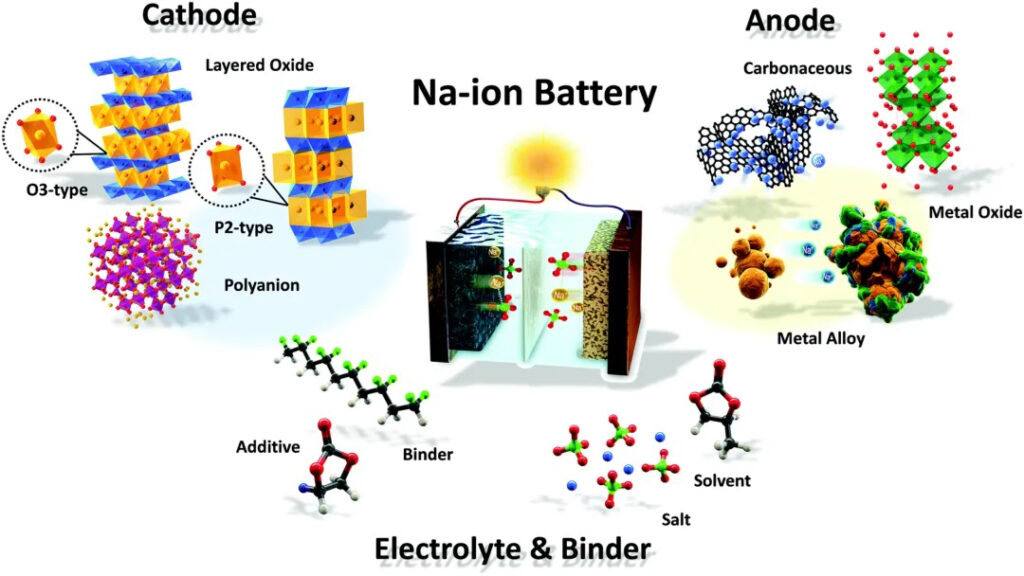
1. Cathode Materials
The cathode is one of the most important components of a sodium-ion battery because it determines energy density, voltage, and cycle life.
Layered Oxides
Layered oxide materials such as NaNiO₂ and NaCoO₂ offer relatively high energy density and fast sodium-ion transport. These materials can deliver good electrochemical performance but may experience structural changes and transition metal dissolution during repeated charge and discharge cycles.
Polyanionic Compounds
Materials such as NaFePO₄ and Na₃V₂(PO₄)₃ are known for their excellent structural stability and long cycle life. They are particularly attractive for stationary energy storage applications where durability is more important than maximum energy density.
Prussian Blue Analogues
Prussian Blue materials, including Na₂Fe[Fe(CN)₆], have attracted significant attention because of their low cost, simple synthesis process, and abundant raw materials. These cathodes are considered one of the most commercially promising options for sodium-ion batteries.
Future Development
Researchers are improving cathode performance through elemental doping, surface coatings, and advanced material engineering. New high-entropy oxide materials are also being explored to increase energy density and improve long-term stability.
2. Anode Materials
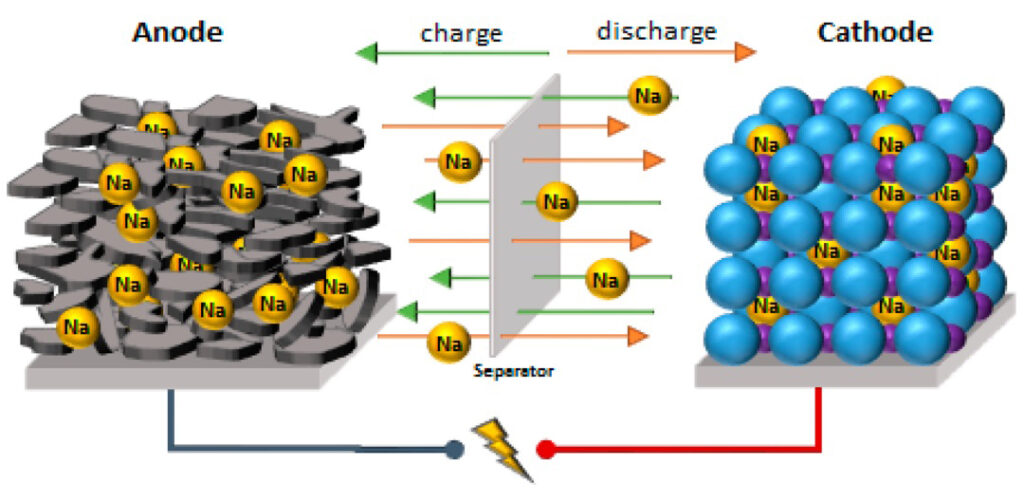
The anode stores sodium ions during charging and releases them during discharge.
Hard Carbon
Hard carbon is currently the most widely used anode material for sodium-ion batteries. Its disordered carbon structure provides sufficient space for sodium-ion storage, making it suitable for commercial applications.
Advantages include:
- Good cycle stability
- Relatively high capacity
- Mature manufacturing processes
One challenge is its lower first-cycle efficiency, which can be improved through pre-sodiation technologies.
Soft Carbon and Graphite
Soft carbon and modified graphite materials are also being investigated. Although traditional graphite performs well in lithium-ion batteries, sodium ions are larger and more difficult to intercalate into standard graphite structures.
Alloy-Based Anodes
Materials such as tin (Sn), antimony (Sb), and phosphorus (P) offer significantly higher theoretical capacities. However, they undergo substantial volume expansion during cycling, which can affect battery lifespan. Researchers are developing carbon-composite and nanostructured designs to address this issue.
3. Electrolytes
The electrolyte serves as the medium through which sodium ions move between the cathode and anode.
Liquid Electrolytes
Most commercial sodium-ion batteries currently use liquid electrolytes based on sodium salts such as:
- NaPF₆
- NaClO₄
These salts are dissolved in organic solvents including:
- Ethylene Carbonate (EC)
- Dimethyl Carbonate (DMC)
- Propylene Carbonate (PC)
Electrolyte additives such as Fluoroethylene Carbonate (FEC) are often used to improve the stability of the solid electrolyte interphase (SEI) and enhance battery performance.
Solid-State and Polymer Electrolytes
Solid-state sodium-ion batteries are attracting growing interest due to their improved safety. Common polymer matrices include PEO and PVDF-HFP combined with sodium salts such as NaFSI and NaTFSI.
Although solid-state electrolytes can reduce the risk of thermal runaway and suppress dendrite growth, improving ionic conductivity at room temperature remains a key research challenge.
4. Separators
The separator is a porous membrane positioned between the cathode and anode. Its primary function is to prevent short circuits while allowing sodium ions to pass through.
Common separator materials include:
- Polyethylene (PE)
- Polypropylene (PP)
- Ceramic-coated composite membranes
High-quality separators must provide:
- High porosity
- Excellent thermal stability
- Good electrolyte wettability
- Strong mechanical strength
These properties contribute to battery safety, performance, and lifespan.
5. Current Collectors
Current collectors transfer electrons between the electrodes and the external circuit.
Cathode Current Collector
Aluminum foil is commonly used because sodium-ion battery cathodes exhibit excellent compatibility with aluminum and experience minimal corrosion.
Anode Current Collector
Copper foil remains the most widely used anode current collector, although modified aluminum solutions are also being explored to reduce costs.
II. Advantages of Sodium-Ion Battery Materials
Abundant Raw Materials
Unlike lithium, sodium is widely available around the world and accounts for approximately 2.8% of the Earth’s crust. This abundance helps reduce supply chain risks and material costs.
Lower Cost
Many sodium-ion battery cathodes can utilize inexpensive elements such as iron and manganese instead of nickel and cobalt. This significantly lowers production costs.
Improved Safety
Sodium-ion batteries generally exhibit excellent thermal stability. Future solid-state designs could further improve safety and reduce fire risks.
Sustainable Development
The use of abundant materials and simpler recycling processes makes sodium-ion technology an environmentally friendly energy storage solution.
III. Current Challenges
Despite their advantages, sodium-ion batteries still face several limitations.
Lower Energy Density
Because sodium ions are larger than lithium ions, sodium-ion batteries typically achieve energy densities of around 100–160 Wh/kg, which is lower than many lithium-ion battery systems.
Cycle Life Optimization
Some cathode and anode materials undergo volume expansion during cycling, leading to capacity degradation over time.
Interface Stability
In solid-state battery systems, reducing interfacial resistance between electrodes and electrolytes remains a major technical challenge.
IV. Applications of Sodium-Ion Battery Materials
As manufacturing costs continue to decline, sodium-ion batteries are becoming increasingly attractive for:
- Grid-scale energy storage systems
- Renewable energy integration
- Solar and wind energy storage
- Backup power systems
- Electric bicycles and scooters
- Low-speed commercial vehicles
These applications prioritize safety, affordability, and long cycle life over maximum energy density.
V. Conclusion
Sodium-ion batteries are rapidly emerging as a competitive energy storage technology. Their key materials—including cathodes, anodes, electrolytes, separators, and current collectors—play a crucial role in determining battery performance, cost, and safety.
With ongoing advances in material science, solid-state electrolyte development, and large-scale manufacturing, sodium-ion batteries are expected to play an increasingly important role in renewable energy storage and next-generation battery markets. Their combination of low cost, abundant resources, and improved sustainability makes them a promising alternative to conventional lithium-ion technology.