


Germanium (Ge) is a rare and strategically important material that plays a vital role in modern technologies. Although it is not widely known outside specialized industries, germanium material is essential for applications such as fiber optic communications, infrared optics, semiconductor devices, aerospace technologies, and high-efficiency solar cells.
Due to its limited availability, concentrated supply chain, and difficulty of substitution, germanium has been classified as a Critical Raw Material (CRM) by the European Union and other major economies. Understanding why germanium is considered critical helps explain its growing importance in advanced manufacturing and high-tech industries.
What Is Germanium Materials?
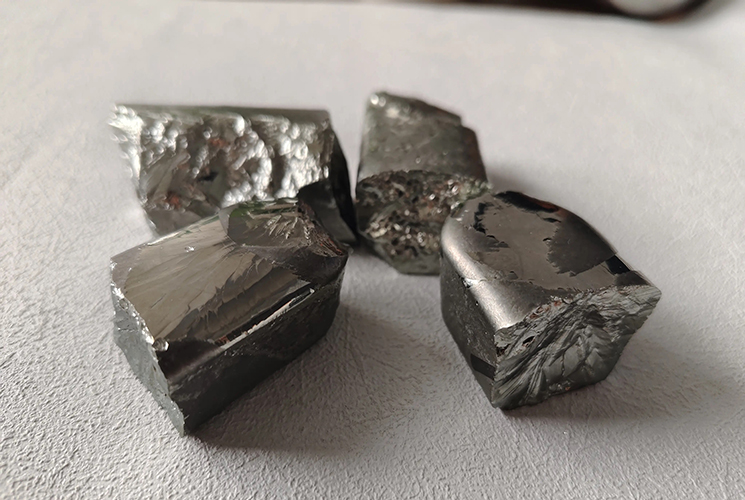
Germanium is a grayish-white metalloid with the chemical symbol Ge and atomic number 32. It belongs to Group 14 of the periodic table and has unique semiconductor and optical properties.
Unlike common metals, germanium is not found in large independent mineral deposits. It is widely distributed in the Earth’s crust at very low concentrations and is usually recovered as a by-product of zinc refining, coal processing, and recycling of germanium-containing materials. This makes germanium a typical rare dispersed element.
Germanium material was discovered in 1886 by German chemist Clemens Winkler and was named after Germania, the Latin name for Germany.
The most valuable properties of germanium include:
- Excellent semiconductor performance
- High electron mobility
- Outstanding infrared transparency
- High resistance to radiation
- Compatibility with advanced optical and electronic devices
These properties make germanium material an important material in semiconductor manufacturing, optical communications, infrared imaging, aerospace, and renewable energy applications.
Physical Properties of Germanium Materials
| Property | Value |
|---|---|
| Symbol | Ge |
| Atomic Number | 32 |
| Density | 5.32 g/cm³ |
| Melting Point | 938.3°C |
| Crystal Structure | Diamond Cubic |
What Does "Critical Raw Material" Mean?
A Critical Raw Material (CRM) is a material that has high economic importance but faces significant supply risks.
Governments and international organizations generally evaluate criticality based on two main factors:
Economic Importance
The material is essential for key industries such as:
- Semiconductors
- Renewable energy
- Telecommunications
- Aerospace
- Defense
- Advanced manufacturing
Supply Risk
Supply risks may result from:
- Limited natural resources
- Geographic concentration of production
- Difficult extraction processes
- Dependence on by-product recovery
- Geopolitical or trade disruptions
Germanium material meets both criteria. It is required for many advanced technologies, while global production remains limited and concentrated. In addition, most germanium is not directly mined but recovered during the processing of other materials, making supply expansion challenging.
For these reasons, germanium is included in critical raw material lists by the European Union, the United States, Japan, and other economies seeking to secure reliable access to strategic materials.
Why Is Germanium Considered Critical?
1. Limited Availability
Germanium material is a rare dispersed element with an average concentration of only around 1.5 ppm in the Earth’s crust. Although it exists in many geological materials, including zinc ores, coal deposits, and sulfide minerals, it rarely forms economically viable standalone deposits.
More than 99% of germanium is found as a trace element associated with other resources, especially zinc ores and coal. This limited natural availability makes germanium difficult to obtain compared with common industrial metals.
2. Mainly Produced as a By-product
Unlike metals such as copper or aluminum, germanium is rarely extracted from dedicated mines. Most germanium material production comes from:
- Zinc smelting residues
- Coal combustion by-products
- Recycled germanium-containing materials
Because germanium production depends on the output of other industries, supply cannot quickly increase when demand rises. This dependence on by-product recovery is one of the main reasons why germanium is considered a critical material.
3. Concentrated Supply Chain
The global germanium materials supply chain is highly concentrated. A limited number of countries dominate germanium mining, refining, and processing capacity.
This concentration creates supply risks because changes in production policies, trade conditions, or industrial activities in major producing regions can affect global availability.
For high-tech industries that rely on stable material supplies, maintaining a diversified and reliable germanium supply chain has become increasingly important.
4. Difficult to Substitute
Germanium’s importance comes from its unique combination of electrical and optical properties.
As a semiconductor material, germanium has higher electron mobility than silicon, making it valuable for high-speed and high-frequency electronic applications. In infrared optics, high-purity germanium provides excellent infrared transmission while blocking visible light, making it ideal for thermal imaging systems and infrared lenses.
Germanium dioxide (GeO₂) is also widely used in optical fibers to increase the refractive index and improve signal transmission performance.
Although alternative materials exist for some applications, few can fully match germanium’s performance in advanced optical and electronic technologies.
5. Growing Demand from High-Tech Industries
Demand for germanium material continues to increase due to the expansion of advanced technologies, including:
- Artificial intelligence and data centers
- Fiber optic communication networks
- Satellite systems
- Infrared sensing technologies
- High-performance electronics
The growing need for faster communication, advanced imaging, and space-based technologies is expected to maintain strong demand for germanium in the coming years.
Major Applications of Germanium Materials
Germanium is used in several high-value industries where performance and reliability are critical.
| Industry | Applications |
|---|---|
| Semiconductors | SiGe devices, high-frequency electronics, semiconductor substrates |
| Fiber Optics | Optical fibers, GeO₂ dopants, optical amplifiers |
| Infrared Optics | Thermal imaging cameras, IR lenses, night vision systems |
| Aerospace | Satellite solar cells and space technologies |
| Radiation Detection | High-purity germanium (HPGe) detectors |
| Chemical Industry | PET production catalysts |
| Biomedical | Specialized materials and research applications |
How Is Germanium Produced?
Germanium is mainly recovered from zinc refining residues, coal processing materials, and recycled germanium-containing waste.
The production process involves several purification steps:
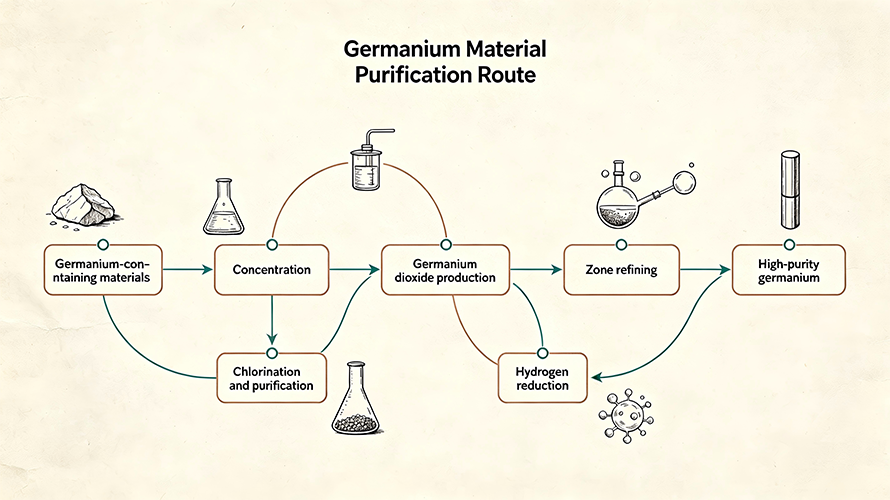
The final zone refining process removes remaining impurities and can produce germanium with purity levels exceeding 99.9999% (6N). High-purity germanium is required for semiconductor devices, infrared optical components, and aerospace applications.
Recycling and Secondary Resources
Recycling plays an increasingly important role in germanium supply.
Significant amounts of germanium can be recovered from:
- Semiconductor manufacturing waste
- Optical fiber production waste
- Solar cell materials
- Industrial processing residues
Because germanium material is valuable and difficult to replace, recycling helps reduce dependence on primary resources, improve supply security, and lower environmental impact.
Future Outlook
The strategic importance of germanium material is expected to continue growing as demand increases for advanced electronics, optical communication, satellite technologies, and infrared systems.
Although recycling, improved extraction technologies, and supply diversification can help reduce supply risks, germanium will likely remain a critical material due to its unique properties and limited availability.
As industries continue to move toward higher-performance technologies, high-purity germanium will remain an essential material for future innovation.
Conclusion
Germanium material is considered a critical raw material because it combines three important characteristics: high technological importance, limited supply, and difficult substitution.
From semiconductor devices and fiber optic networks to infrared imaging and aerospace systems, germanium supports many technologies that are essential to modern society.
With growing demand for advanced technologies, ensuring a stable supply of high-quality germanium will remain a key challenge for global industries.
Frequently Asked Questions (FAQ)
1. Why is germanium considered a critical raw material?
Germanium is considered critical because it is essential for advanced technologies while having limited availability, a concentrated supply chain, and few suitable substitutes.
2. Is germanium a rare earth element?
No. Germanium is not a rare earth element. It is classified as a rare dispersed element or critical mineral due to its limited occurrence and strategic importance.
3. What are the main applications of germanium?
The main applications include semiconductor devices, fiber optic communications, infrared optics, satellite solar cells, radiation detectors, and chemical catalysts.
4. Can germanium be replaced by other materials?
Some applications can use alternative materials, but germanium remains difficult to replace in areas requiring high infrared transparency, high electron mobility, and excellent optical performance.
5. How is high-purity germanium produced?
High-purity germanium is produced through multiple refining steps, including concentration, purification, reduction, and zone refining, which can achieve purity levels above 99.9999%.