


Cathode materials are the key electrode materials used in lithium-ion and sodium-ion batteries. They reversibly host and release lithium or sodium ions during charge and discharge cycles, directly influencing a battery’s energy density, safety, cycle life, and overall cost.
What Are Cathode Materials?
Cathode materials, also known as cathode active materials, are the primary components of the positive electrode in rechargeable batteries. They store and release electrical energy through the reversible insertion and extraction of lithium or sodium ions. The selection of cathode materials plays a critical role in determining overall battery performance, including:
- Energy Density: The amount of energy stored per unit mass or volume.
- Cycle Life: The number of charge-discharge cycles the battery can undergo while maintaining acceptable performance.
- Safety: The thermal and chemical stability of the battery during operation.
- Cost: The price of raw materials and manufacturing processes.
Characteristics of an Ideal Cathode Material
An ideal cathode material should possess the following characteristics:
- High Operating Voltage: A large Gibbs free energy change during discharge results in a high open-circuit voltage and improved energy output.
- High Theoretical Capacity: The material should be able to reversibly accommodate a large number of lithium or sodium ions per unit mass.
- Long Cycle Life: The crystal structure should remain stable during repeated ion insertion and extraction processes.
- Excellent Rate Capability: High ionic diffusivity enables fast charge and discharge performance.
- Good Chemical Stability: The material should exhibit minimal side reactions with the electrolyte during storage and operation.
- Simple and Environmentally Friendly Manufacturing: Production processes should be cost-effective and sustainable.
- High Electronic and Ionic Conductivity: Efficient electron and ion transport is essential for high electrochemical performance.
Major Types of Cathode Materials
At present, commercial lithium-ion battery cathode materials can be broadly classified into the following categories.
1. Layered Structure Materials
Typical materials: LiMO₂ (M = Co, Ni, Mn) and ternary cathode materials.
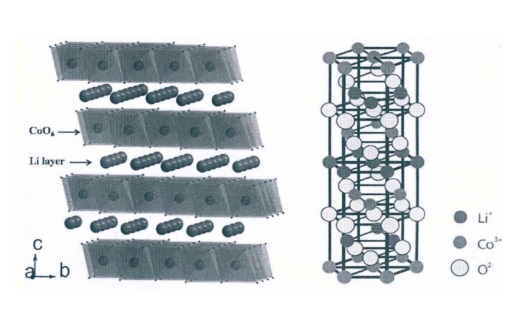
Structural Characteristics: Layered cathode materials consist of stacked atomic layers, allowing lithium ions to migrate between adjacent layers.
Representative Materials:
Lithium Cobalt Oxide (LiCoO₂, LCO): LCO was the first commercially successful lithium-ion battery cathode material and remains widely used in consumer electronics. However, its reliance on expensive cobalt and relatively poor thermal stability have limited its use in large-scale battery applications.
Ternary Materials (LiNixCoyMn1-x-yO₂, NCM): NCM materials partially replace cobalt with nickel and manganese. A typical example is NCM811, which contains 80% nickel, 10% cobalt, and 10% manganese.
Advantages
- High energy density
- High operating voltage
- Suitable for long-range applications
Disadvantages
- Relatively high cost
- Lower thermal stability at elevated temperatures
- More demanding battery management requirements
Typical Applications
- Smartphones and tablets
- Laptops and other consumer electronics
- Long-range electric vehicles
2. Spinel Structure Materials
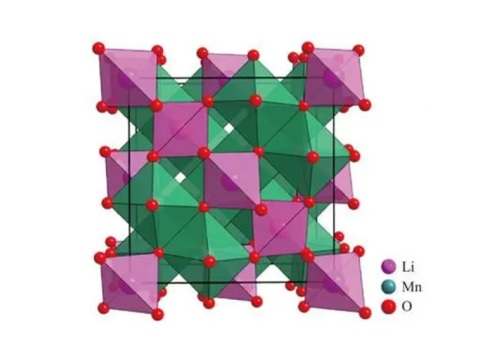
Structural Characteristics: Spinel materials possess a three-dimensional crystal framework with interconnected channels that enable rapid lithium-ion transport.
Representative Material: Lithium Manganese Oxide (LiMn₂O₄, LMO)
Advantages
- Low cost
- Fast charging capability
- Environmentally friendly composition
- Good safety characteristics
Disadvantages
- Relatively low energy density
- Capacity fading at elevated temperatures
- Manganese dissolution during cycling, which gradually degrades battery performance
Typical Applications
- Electric power tools
- Low-cost energy storage systems
- Hybrid electric vehicles
3. Olivine Structure Materials
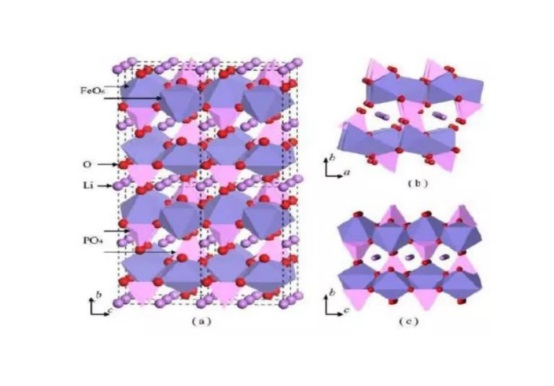
Structural Characteristics: Olivine cathodes have a highly stable framework in which phosphate (PO₄) groups act as rigid structural units, significantly enhancing thermal and structural stability.
Representative Material: Lithium Iron Phosphate (LiFePO₄, LFP)
The strong P–O covalent bonds provide exceptional structural integrity, allowing lithium ions to be repeatedly inserted and extracted without causing significant lattice degradation.
Advantages
- Low cost
- Long cycle life
- Excellent thermal stability
- High safety
- Free of expensive and toxic metals
Disadvantages
- Lower energy density than ternary cathodes
- Low electronic conductivity
- Relatively low tap density
Typical Applications
- Electric vehicles
- Energy storage systems
- Industrial power systems
4. Polyanion Cathode Materials
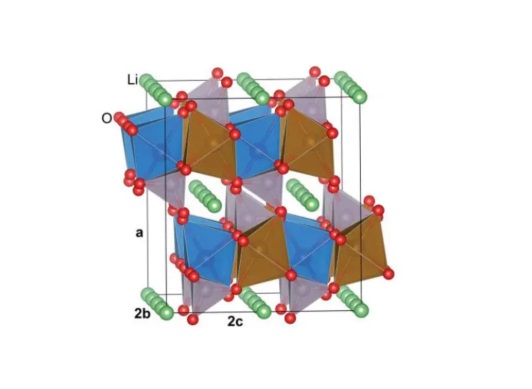
Structural Characteristics: Polyanion materials are built from stable frameworks consisting of phosphate tetrahedra combined with lithium and transition metal ions. Lithium ions migrate through specific diffusion channels within the crystal structure.
Representative Material: Lithium Manganese Phosphate (LiMnPO₄, LMP)
Advantages
- High operating voltage of approximately 4.1 V
- Relatively high theoretical capacity of approximately 171 mAh/g
- Excellent thermal stability and safety
- Abundant raw material resources
- Environmentally friendly chemistry
- High energy density potential
Disadvantages
- Low intrinsic electronic conductivity
- Relatively slow lithium-ion diffusion kinetics
- Limited rate capability and low-temperature performance
To overcome these limitations, strategies such as nanostructuring, carbon coating, and ion doping are commonly employed.
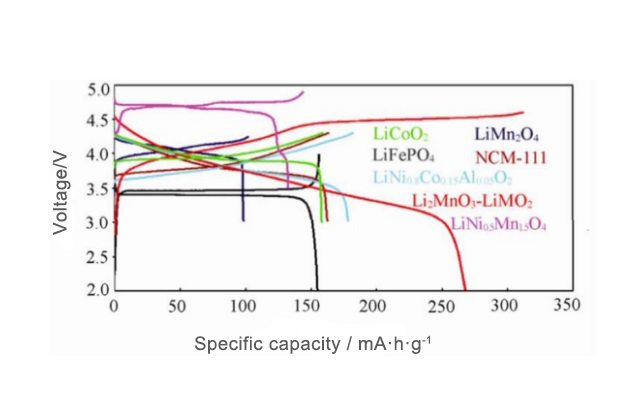
Typical Applications
- Next-generation electric vehicle batteries
- High-safety energy storage systems
- High-voltage lithium-ion batteries
Other Typical Polyanion Cathodes
Besides LiMnPO₄, important polyanion cathode materials include:
Lithium Cobalt Phosphate (LiCoPO₄, LCP): High operating voltage of approximately 4.8 V.
Lithium Vanadium Phosphate (Li₃V₂(PO₄)₃, LVP): Excellent rate capability and cycle stability.
Comparison of Major Lithium-Ion Battery Cathode Materials
| Property | LCO | LMO | LFP | LMP | NCM | NCA |
|---|---|---|---|---|---|---|
| Full Name | Lithium Cobalt Oxide | Lithium Manganese Oxide | Lithium Iron Phosphate | Lithium Manganese Phosphate | Lithium Nickel Cobalt Manganese Oxide | Lithium Nickel Cobalt Aluminum Oxide |
| Chemical Formula | LiCoO₂ | LiMn₂O₄ | LiFePO₄ | LiMnPO₄ | LiNixCoyMn1-x-yO₂ | LiNixCoyAl1-x-yO₂ |
| Specific Capacity (mAh/g) | 140–150 | 100–120 | 130–170 | 120–170 | 150–220 | 180–230 |
| Operating Voltage (V vs. Li/Li⁺) | ~3.7 | ~4.0 | ~3.4 | ~4.1 | 3.6–3.8 | 3.6–3.8 |
| Gravimetric Energy Density (Wh/kg) | 180–240 | 130–180 | 130–180 | 150–220 | 180–300 | 200–320 |
| Cycle Life (cycles) | 500–2,000 | 500–1,000 | >2,000 | >1,500 | 1,000–2,000 | 500–1,000 |
| Tap Density (g/cm³) | 4.0–4.2 | 3.1–3.3 | 2.0–2.4 | 2.3–2.6 | 3.6–3.8 | 3.6–3.8 |
| Safety | Moderate | Good | Excellent | Excellent | Good | Moderate |
| Cost | High | Low | Low | Low-Medium | Medium | Medium-High |
| Raw Material Availability | Limited cobalt resources | Abundant manganese resources | Abundant iron and phosphorus resources | Abundant manganese and phosphorus resources | Limited nickel and cobalt resources | Limited nickel and cobalt resources |
| Major Advantages | High volumetric energy density and mature technology | Low cost and good rate capability | Excellent safety, long cycle life, and low cost | High voltage platform, excellent safety, and low raw material cost | High energy density and balanced performance | Very high energy density and excellent low-temperature performance |
| Major Disadvantages | High cost and relatively poor thermal stability | Lower energy density and voltage fading | Lower energy density and poor low-temperature performance | Relatively low electronic conductivity and limited commercialization | Higher cost and thermal management requirements | Higher cost and lower thermal stability |
| Typical Applications | Smartphones, laptops, cameras | Power tools, e-bikes, hybrid vehicles | Electric vehicles, energy storage systems, power tools | Next-generation EVs, energy storage systems, power tools | Electric vehicles and high-energy battery systems | Long-range electric vehicles and premium EV applications |
Development Trends of Cathode Materials
Driven by the rapid growth of electric vehicles and portable electronics, battery technologies increasingly require higher energy density, longer cycle life, and enhanced safety. Consequently, cathode materials are evolving toward high-nickel, high-voltage, and lithium-rich systems.
1. High-Nickel Ternary Materials
Increasing nickel content while reducing cobalt usage has become a major development direction.
Advantages
- Higher energy density, potentially exceeding 300 Wh/kg
- Lower dependence on costly cobalt
- Improved driving range for electric vehicles
Challenges
- Reduced thermal stability
- More demanding manufacturing processes
- Higher requirements for material and cell engineering
2. High-Voltage Cathode Materials
High-voltage cathodes increase battery energy density by raising the operating potential.
A representative example is manganese-modified phosphate cathodes, where the operating voltage increases from approximately 3.4 V to around 4.1 V.
Advantages
- Approximately 15% higher energy density
- Safety and cost levels comparable to LFP
- Compatibility with existing production infrastructure
Challenges
- Manganese dissolution and electrolyte side reactions
- Additional material modifications are required to improve stability
3. Lithium-Rich Manganese-Based Cathodes
Lithium-rich manganese-based cathodes exhibit exceptionally high theoretical capacities exceeding 350 mAh/g, with the potential to achieve energy densities above 500 Wh/kg.
Their high capacity arises from both transition metal redox reactions and oxygen redox activity.
Challenges
- Irreversible capacity loss during the initial cycle
- Voltage fading during long-term cycling
- Complex structural degradation mechanisms
4. Advanced Structural Engineering
Novel material designs, including nanostructured and porous architectures, are being developed to improve electrochemical performance, ionic transport, and structural stability.
Emerging Cathode Materials for Next-Generation Batteries
Sodium-Ion Battery Cathodes
Layered Oxides
Examples such as NaNiO₂ offer energy densities of approximately 120–150 Wh/kg and lower material costs than lithium-ion batteries, although further improvements in cycle life are still required.
Prussian Blue Analogues
These materials exhibit theoretical capacities above 170 mAh/g but face challenges associated with structural water and long-term stability.
Polyanion Compounds (NASICON Materials)
Materials such as NaTi₂(PO₄)₃ (NTP) possess excellent structural stability and long cycle life. However, their intrinsic conductivity is relatively low and often requires carbon coating or nanostructuring.
Solid-State Battery Cathodes
Sulfide-Based Materials
Materials such as Li₂S-P₂S₅ exhibit exceptionally high ionic conductivities in the range of 10⁻³–10⁻² S/cm. However, they may react with other cell components and require careful interface engineering.
Oxide-Based Materials
Oxide systems such as LLZO provide excellent chemical stability but remain challenging to process and manufacture at large scale.
Future Outlook
Next-generation battery technologies are being developed to achieve lower cost, higher safety, and greater energy density.
Sodium-ion batteries are becoming an important technology for large-scale energy storage because of the abundance of sodium resources, cost advantages, and rapidly growing demand for stationary energy storage systems. Meanwhile, solid-state batteries are expected to deliver substantially higher energy density and improved safety through the use of solid electrolytes, making them a promising solution for premium electric vehicles and other high-performance applications.
Together, these emerging technologies are driving cathode materials toward higher performance, improved sustainability, and more cost-effective energy storage solutions.
Frequently Asked Questions
Q1: What is a cathode material in a battery?
A cathode material is the active material in the positive electrode of a rechargeable battery. It stores and releases lithium or sodium ions during charging and discharging, determining the battery’s energy density, safety, cycle life, and operating voltage.
Q2: Is LFP better than NCM?
It depends on the application. LFP offers better safety, longer cycle life, and lower cost, while NCM provides higher energy density and is better suited for long-range electric vehicles.
Q3: What are sodium-ion battery cathode materials?
Common sodium-ion battery cathodes include layered oxides, Prussian blue analogues (PBAs), and NASICON-type polyanion materials. They are widely studied for low-cost, safe, and large-scale energy storage applications.
Q4: Will LMFP replace LFP?
LMFP is expected to complement rather than replace LFP. It offers higher energy density while maintaining good safety, making it a promising cathode material for next-generation lithium-ion batteries.
Q5: What is the safest cathode material for lithium-ion batteries?
LFP (Lithium Iron Phosphate) is widely considered the safest commercial cathode material. Its stable olivine structure provides excellent thermal stability, long cycle life, and a low risk of thermal runaway.
Q6: Which cathode material has the highest energy density?
Among commercial cathode materials, NCA and high-nickel NCM offer the highest energy density. They are widely used in long-range electric vehicles where maximizing driving range is a priority.