


ITO (Indium Tin Oxide) sputtering targets are widely used to produce transparent conductive films for displays, photovoltaics, and other advanced electronic applications. One of the most common challenges encountered during magnetron sputtering is target nodule formation (also known as target nodules or surface protrusions). This phenomenon can significantly reduce film uniformity, shorten target lifetime, and lower production efficiency.
This article explains the mechanisms behind ITO target nodule formation, its impact on sputtering performance and film quality, and practical strategies to minimize or prevent it.
What Is Nodule Formation on an ITO Sputtering Target?
Why ITO Targets Matter?
ITO combines excellent optical transparency (typically over 90%) with low electrical resistivity (approximately 10⁻⁴–10⁻³ Ω·cm), making it the industry standard for transparent conductive coatings. Typical applications include:
- LCD and OLED displays
- Touch panels
- Thin-film solar cells
- Flexible electronics
- Smart windows
- Optical coatings
Among various deposition methods, magnetron sputtering remains the preferred industrial process because it offers excellent film uniformity, high deposition rates, and good process stability. The quality of the deposited film depends heavily on both the target quality and the stability of the sputtering process.
What Is "Nodule Formation"?
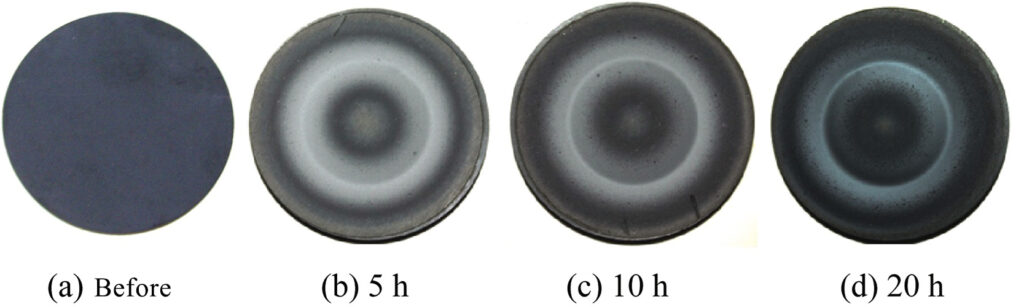
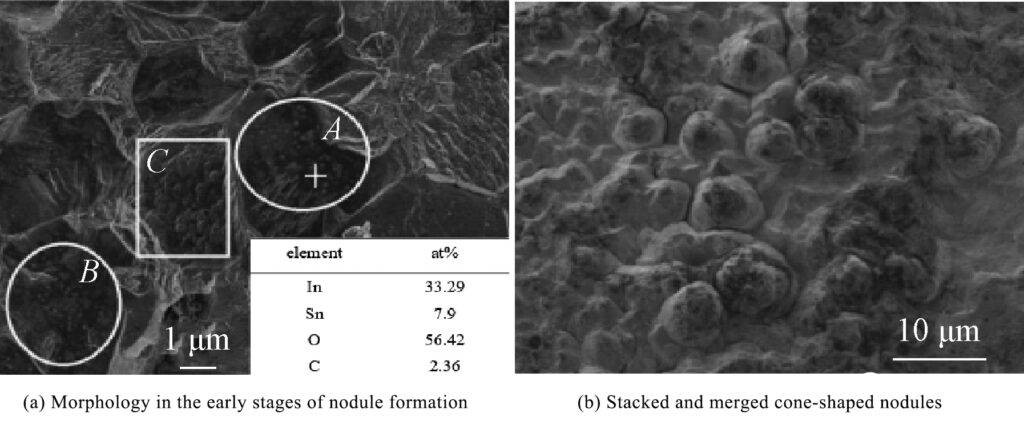
Nodule formation refers to the appearance of localized protrusions or particle-like deposits on the target surface during sputtering.
Macroscopic Characteristics
The nodules may range from several micrometers to several millimeters in diameter and are often accompanied by visible discoloration, such as dark or whitish spots.
Microscopic Mechanism
At the microscopic level, nodules typically develop as a result of localized arcing, excessive heat accumulation, or microstructural inhomogeneity. These conditions can promote abnormal grain growth or the segregation of secondary phases, such as SnO₂, eventually producing raised surface features.
What Causes ITO Target Nodule Formation?
1. Improper Sputtering Parameters
Unstable Plasma Discharge
When the working pressure is too low (below approximately 0.3 Pa) or the target current density is excessively high (above about 5 mA/cm²), the plasma becomes locally concentrated. This increases the likelihood of micro-arcing, which damages the target surface and initiates nodule growth.
Inadequate Thermal Management
Insufficient cooling allows localized temperatures to exceed the thermal stability limit of ITO (typically around 150–200°C). Elevated temperatures accelerate grain boundary migration and tin segregation, increasing the probability of nodule formation.
2. Microstructural Defects in the ITO Target
Low Density and High Porosity
Incomplete sintering—caused by insufficient holding time or non-uniform temperature distribution—may leave the target with a porosity greater than 3%.
During sputtering, pores distort the local electric field and become preferential sites for ion bombardment. Surface erosion around these regions promotes material accumulation, eventually forming nodules.
Composition Inhomogeneity
Poor powder mixing or inadequate diffusion during sintering can produce local deviations from the standard 90:10 In₂O₃/SnO₂ composition. These regions exhibit higher electrical resistance and are more susceptible to abnormal discharge.
3. Contamination and Impurities
Improper Oxygen Partial Pressure
The oxygen partial pressure inside the sputtering chamber is typically maintained between 10⁻² and 10⁻³ Pa. Poor oxygen control may lead to the oxidation of metallic indium or tin, creating insulating oxide regions that promote unstable discharge.
Surface Contamination
Residual polishing compounds, organic contaminants, or dust particles on the target surface may carbonize during sputtering. These conductive particles can act as arc initiation sites and accelerate nodule formation.
How Does Nodule Formation Affect Sputtering Performance?
Reduced Process Stability
Fluctuating Deposition Rate
The increased electrical resistance around nodules changes the local plasma impedance. The power supply continuously adjusts its output to compensate, resulting in deposition rate fluctuations that may reach 20%.
Shorter Target Lifetime
Nodules interfere with the uniform development of the erosion track, reducing target utilization by approximately 30–50% and significantly increasing production costs.
Degraded Thin Film Quality
Poor Film Uniformity
Surface nodules disturb plasma distribution, causing noticeable thickness variations. Film thickness uniformity may deteriorate from approximately ±3% to ±10%, which can negatively affect display brightness consistency and optical performance.
Electrical and Optical Defects
As nodules grow, they may eventually break apart, ejecting particles that become embedded in the deposited film. These particles can create pinholes, protrusions, or other defects, increasing film resistivity (up to around 10⁻² Ω·cm) while locally reducing optical transmittance below 80%.
How Can Nodule Formation Be Prevented?
1. Optimize Sputtering Parameters
Improve Plasma Stability
Using pulsed DC sputtering (typically 50–100 kHz with a duty cycle of 60–80%) effectively suppresses arc formation.
Stable operating conditions generally include:
- Working pressure: 0.4–0.6 Pa
- Target current density: 3–4 mA/cm²
These conditions reduce thermal loading while maintaining stable plasma operation.
Enhance Cooling Efficiency
Efficient heat removal is essential. A dual-loop water cooling system with a flow rate above 10 L/min and a temperature difference below 2°C can effectively minimize localized overheating.
Applying a high-thermal-conductivity backing layer, such as aluminum nitride (AlN), also helps distribute heat more uniformly across the target.
2. Improve Target Manufacturing
Increase Target Density
Hot Isostatic Pressing (HIP) at approximately 1400°C and 150 MPa can increase target density to 99.5% or higher, while reducing porosity below 0.5%.
Higher-density targets exhibit fewer electrical defects and improved sputtering stability.
Improve Composition Uniformity
Mechanical alloying with extended ball milling (typically over 24 hours), followed by multi-stage calcination and controlled sintering, promotes uniform distribution of indium and tin throughout the target.
Maintaining the In/Sn composition deviation below 0.5% significantly reduces localized electrical variations.
3. Implement Process Monitoring
Real-Time Arc Detection
Modern sputtering systems increasingly integrate Optical Emission Spectroscopy (OES) with voltage-current waveform monitoring. These systems can detect abnormal discharge in real time and automatically trigger arc suppression or power protection.
Target Surface Preparation
Proper target cleaning before installation is equally important.
Recommended preparation methods include:
- Argon ion beam cleaning (approximately 500 eV)
- Ultrasonic cleaning using ethanol/acetone mixtures
These procedures remove residual contaminants that could initiate arcing during sputtering.
Future Developments
Several emerging technologies are expected to further reduce nodule formation in next-generation ITO sputtering processes.
Gradient Target Structures
Functionally graded targets with an indium-rich surface layer and a tin-rich base layer may help balance sputtering rate, electrical conductivity, and compositional stability.
Intelligent Process Control
Machine learning algorithms are increasingly being developed to predict arc events and nodule formation by continuously analyzing process data, allowing real-time adjustment of sputtering parameters.
Sustainable Manufacturing
With indium considered a strategic and relatively scarce metal, recyclable ITO targets and closed-loop material recovery technologies are becoming increasingly important for reducing resource consumption and manufacturing costs.
Conclusion
Nodule formation on ITO sputtering targets is primarily the result of an imbalance between plasma behavior, thermal management, and target microstructure. Poor process parameters, insufficient target density, compositional inhomogeneity, and surface contamination all contribute to its development.
By optimizing sputtering conditions, manufacturing high-density and compositionally uniform sputtering targets, improving cooling efficiency, and implementing real-time process monitoring, manufacturers can effectively suppress nodule formation, extend target service life, improve film quality, and achieve higher production efficiency.
As sputtering technology continues to advance through intelligent process control and improved target engineering, the occurrence of nodule formation is expected to decline further, enabling more reliable and cost-effective production of high-performance transparent conductive films.
FAQs About ITO Target Nodule Formation
What causes nodule formation on an ITO sputtering target?
Nodule formation is mainly caused by unstable plasma discharge, localized overheating, target porosity, compositional inhomogeneity, and surface contamination. These factors can trigger micro-arcing and material accumulation on the target surface.
How does nodule formation affect sputtering performance?
Nodules disrupt plasma stability, causing fluctuations in the deposition rate, reduced target utilization, increased arcing, and a shorter target service life. They can also lower production efficiency and increase maintenance costs.
Can nodule formation reduce thin film quality?
Yes. Nodule formation may produce particles that become embedded in the deposited film, resulting in pinholes, surface defects, reduced optical transmittance, and higher electrical resistivity.
How can nodule formation be prevented?
The risk can be significantly reduced by optimizing sputtering parameters, improving target density and composition uniformity, enhancing cooling efficiency, maintaining a clean sputtering chamber, and using real-time arc monitoring systems.
Can contaminated targets lead to nodule formation?
Yes. Residual polishing compounds, dust, oils, or other contaminants on the target surface can become arc initiation sites during sputtering, increasing the likelihood of nodule formation.