


Sputtering targets are essential materials in physical vapor deposition (PVD) processes and play a critical role in determining coating quality, production efficiency, and overall manufacturing costs. Among the various target designs available, planar sputtering targets and rotary sputtering targets are the most widely used. This article explores the key differences in Rotary vs Planar Sputtering Targets, helping you select the most suitable solution for your specific coating process.
Understanding the differences between these two target types is essential for selecting the most suitable solution for a specific coating process. This article compares their design characteristics, operating principles, applications, performance, and cost-effectiveness.
I. What Are Planar and Rotary Sputtering Targets?
Planar Sputtering Targets
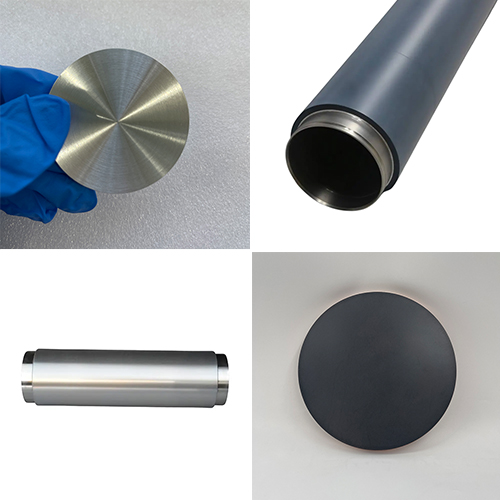
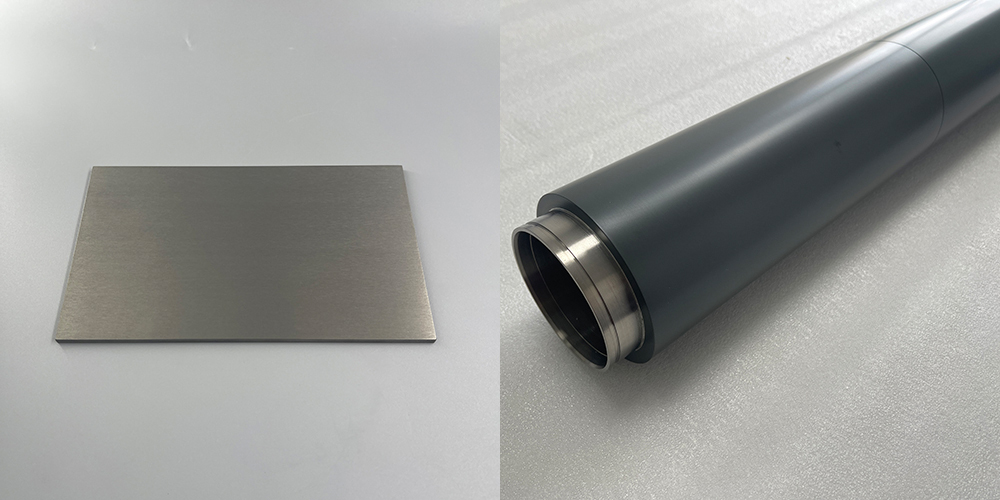
Planar sputtering targets are flat targets commonly used in magnetron sputtering systems. They are typically manufactured as circular discs or rectangular plates and are available in a wide range of materials, including pure metals, alloys, ceramics, and composite materials.
Due to their simple design and broad compatibility with sputtering equipment, planar targets remain the industry standard for many thin-film deposition applications.
Rotary Sputtering Targets
Rotary sputtering targets feature a cylindrical design and rotate continuously during the sputtering process. This rotation distributes erosion more evenly across the target surface, resulting in higher target utilization and improved process stability.
Rotary targets are particularly well suited for large-area coating applications where production efficiency, coating uniformity, and reduced material waste are critical.
II. Working Principles
How Planar Targets Work?
In a magnetron sputtering system, plasma-generated ions bombard the surface of the planar target, ejecting atoms from the target material. These atoms travel through the vacuum chamber and are deposited onto the substrate, forming a thin film.
Because erosion is concentrated within a specific racetrack region, only part of the target material is effectively consumed during operation.
How Rotary Targets Work?
Rotary targets operate on the same sputtering principle as planar targets. However, the cylindrical target continuously rotates during deposition, distributing the erosion pattern over a much larger surface area.
This results in more uniform target wear, improved thermal management, longer production runs, and significantly higher material utilization. The consistent erosion profile also helps maintain stable deposition conditions and coating quality over time.
III. Typical Applications
Applications of Planar Targets
Planar sputtering targets are widely used in:
- Semiconductor manufacturing for conductive, insulating, and barrier layers
- LCD and OLED display production
- Optical coatings
- Research and development environments
- Decorative and functional coatings
- General industrial coating applications
Applications of Rotary Targets
Rotary sputtering targets are commonly used in:
- Large-area flat panel display manufacturing
- Solar photovoltaic (PV) modules
- Architectural glass coatings
- Decorative coatings
- Wear-resistant and protective coatings
- High-volume industrial coating lines
For applications requiring exceptional coating uniformity and high throughput, rotary targets often provide significant operational advantages.
IV. Performance Comparison
Target Utilization
One of the most important differences between planar and rotary targets is material utilization.
Planar targets typically achieve utilization rates of approximately 30–50%, depending on target design, magnetron configuration, and process conditions. Since erosion is concentrated within a limited racetrack area, a considerable amount of target material remains unused at the end of its service life.
Rotary targets, by contrast, can often achieve utilization rates exceeding 70% and, in some applications, significantly higher. The rotating cylindrical geometry enables much more uniform erosion across the target surface, reducing material waste and lowering target consumption costs.
Deposition Efficiency and Film Uniformity
Planar targets perform well in many standard coating applications and are particularly suitable for smaller substrates or processes where throughput is not the primary concern.
However, as substrate size increases, maintaining uniform film thickness across the entire surface becomes more challenging.
Rotary targets are specifically designed for high-throughput, large-area coating applications. Their continuous rotation promotes stable deposition conditions, improved coating uniformity, and more consistent film properties across the substrate.
As a result, rotary targets are often preferred in industries where coating consistency directly affects product performance and yield.
Thermal Performance and Process Stability
The cylindrical geometry of rotary targets provides a larger cooling area and more effective heat dissipation compared with planar targets.
Improved thermal management helps reduce localized overheating, minimizes process fluctuations, and contributes to longer target lifetimes. This is particularly valuable in high-power sputtering applications where process stability is essential.
Cost Considerations
Planar targets generally offer lower initial costs and are easier to manufacture, install, and replace. For many standard coating processes, they represent a practical and economical solution.
Rotary targets typically require a higher initial investment in both targets and compatible cathode systems. However, their superior target utilization, reduced downtime, longer operating life, and higher deposition efficiency often result in a lower total cost of ownership (TCO) in large-scale production environments.
When evaluating long-term operating costs rather than initial purchase price alone, rotary targets can provide substantial economic benefits.
V. Rotary vs. Planar Sputtering Targets: At a Glance
| Feature | Planar Targets | Rotary Targets |
|---|---|---|
| Shape | Flat (rectangular or circular) | Cylindrical |
| Target Utilization | 30–50%* | 70%+* |
| Film Uniformity | Good | Excellent |
| Deposition Efficiency | Moderate | High |
| Initial Cost | Lower | Higher |
| Best Applications | Semiconductors, R&D, General Coatings | Large-Area Coatings, Solar Glass, Displays |
| Production Scale | Small to Medium Volume | Medium to High Volume |
VI. Conclusion
Both planar and rotary sputtering targets play important roles in modern thin-film deposition technologies. While planar targets offer simplicity, flexibility, and cost-effectiveness, rotary targets deliver significant advantages in target utilization, coating uniformity, process stability, and production efficiency.
For large-scale coating operations and applications with demanding quality requirements, rotary sputtering targets often provide the greatest long-term value. Selecting the optimal target solution ultimately requires balancing technical requirements, production goals, and overall operating costs.