


Sodium iron pyrophosphate phosphate, commonly referred to as NFPP, is a promising polyanionic cathode material for sodium-ion batteries. With the chemical formula Na₄Fe₃(PO₄)₂P₂O₇, NFPP combines an iron-based composition with a stable polyanionic framework, making it attractive for cost-sensitive and long-cycle sodium-ion battery applications.
However, the performance of NFPP depends not only on its chemical composition. Synthesis route, sodium stoichiometry, particle size, phase purity, carbon coating, and thermal treatment all have a direct influence on its electrochemical behavior.
This makes NFPP synthesis an important part of its development from laboratory-scale research toward commercial sodium-ion battery production.
What Is NFPP?
NFPP is an iron-based mixed phosphate-pyrophosphate cathode material belonging to the family of polyanionic sodium-ion battery materials. Its framework is constructed from iron-oxygen octahedra and phosphate/pyrophosphate groups, providing structural stability during repeated sodium-ion insertion and extraction.
Compared with some layered oxide cathodes, NFPP is less dependent on expensive transition metals such as nickel or cobalt. Its composition is primarily based on sodium, iron, phosphorus and oxygen, which provides significant potential for reducing raw-material costs.
NFPP also offers a relatively stable three-dimensional framework and sodium-ion transport channels. However, its intrinsic electronic conductivity is relatively low, so practical NFPP cathodes commonly require carbon coating, conductive additives, particle-size optimization, or elemental doping to improve electron transport and electrochemical kinetics.
NFPP Synthesis Methods
Several methods have been investigated for preparing NFPP, including solid-state synthesis, sol-gel synthesis and other wet-chemical approaches.
The most important difference between these methods is the balance between process simplicity, particle-size control, phase purity, energy consumption and scalability.
1. Solid-State Synthesis
Solid-state synthesis is one of the most straightforward routes for producing NFPP.
Typical raw materials can include:
- Fe₂O₃ or other iron sources
- NH₄H₂PO₄
- Na₂CO₃
- Carbon sources or conductive additives, when required
The starting materials are mixed according to the target stoichiometry and subjected to mechanical milling or other homogenization processes before thermal treatment.
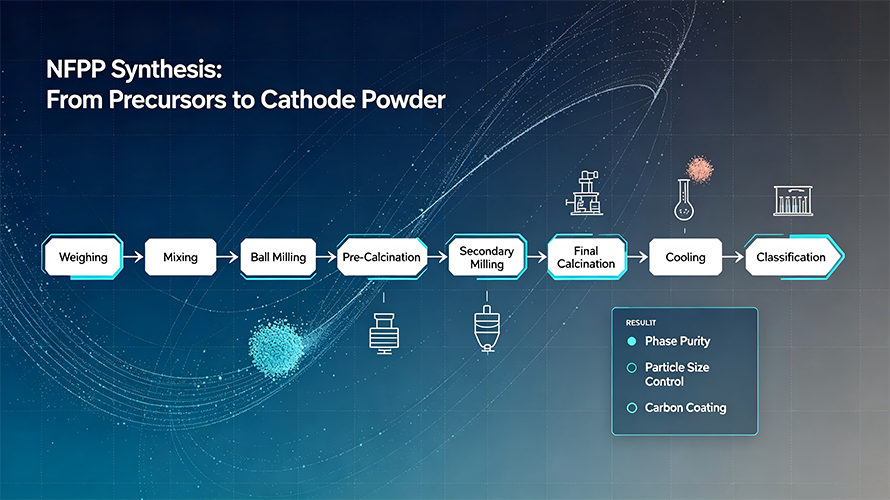
A representative process consists of:
Raw material weighing → mixing → ball milling → pre-calcination → secondary milling → final calcination → cooling → grinding/classification
A two-step thermal treatment can be used, with a lower-temperature pre-treatment followed by higher-temperature calcination to promote formation of the desired NFPP phase.
The major advantage of solid-state synthesis is its relatively simple process and suitability for scale-up. It also avoids the large quantities of organic solvents associated with some wet-chemical processes.
Its main limitation is that high-temperature solid-state reactions can produce particle agglomeration and may require careful control of temperature, mixing and sodium compensation.
2. Sol-Gel Synthesis
The sol-gel route provides better control over the distribution of precursor elements and can produce finer particles than conventional solid-state processing.
In a typical process, soluble or finely dispersed precursors are mixed with complexing agents to form a homogeneous solution or gel. After drying, the precursor is thermally treated to obtain crystalline NFPP.
The advantages include:
- More homogeneous elemental distribution
- Better control of particle morphology
- Potential for smaller particle sizes
- Improved contact between different precursor components
However, sol-gel synthesis can involve more processing steps and higher costs. Organic reagents and solvents may also introduce additional requirements for drying, solvent recovery and process control.
For laboratory research, these advantages can be significant. For large-scale manufacturing, however, process simplicity and production cost become increasingly important.
Why Is Stoichiometry Important in NFPP Synthesis?
Precise stoichiometric control is critical because NFPP is a multi-component crystalline material. Deviations in the Na/Fe/P ratio can affect phase formation and lead to secondary phases.
Sodium Compensation
Sodium-containing precursors can experience sodium loss during high-temperature processing. For this reason, a controlled excess of the sodium source may be used to compensate for volatilization.
The exact amount of excess sodium should be determined according to the specific precursor system and thermal process rather than treated as a universal value.
Insufficient sodium compensation can result in incomplete formation of the target phase, while excessive sodium may also contribute to unwanted secondary phases.
Iron Valence Control
Iron chemistry is another important consideration.
The oxidation state of iron can influence phase composition, electronic structure and electrochemical performance. Therefore, the atmosphere, precursor selection and calcination conditions need to be carefully controlled.
For industrial NFPP production, maintaining consistent iron chemistry across different batches is particularly important because small variations can translate into differences in capacity, rate performance and cycling behavior.
The Role of Calcination Temperature
Thermal treatment is one of the most important parameters in NFPP manufacturing.
The calcination process needs to achieve two objectives:
- Formation of a highly crystalline NFPP phase
- Prevention of undesirable secondary phases and excessive particle growth
If the temperature is too low, precursor reactions may remain incomplete and phase purity may be insufficient.
If the temperature is too high, several problems can occur, including particle coarsening, sodium loss and formation of secondary phases.
Therefore, NFPP synthesis should not be optimized simply by selecting the highest possible calcination temperature. Instead, temperature, holding time, atmosphere and precursor composition need to be optimized together.
Particle Size and Milling
Particle size strongly influences sodium-ion diffusion and electrode kinetics.
Smaller particles can shorten the diffusion distance for Na⁺ and increase the active surface area. This can improve rate capability, particularly when NFPP is operated at high charge and discharge rates.
However, reducing particle size indefinitely is not necessarily beneficial.
Excessively fine powders can have:
- Higher surface area
- Greater surface reactivity
- Higher moisture sensitivity
- More difficult handling
- Lower tap density
- Greater tendency toward agglomeration
For practical battery electrodes, the objective is therefore to obtain a controlled particle-size distribution, rather than simply minimizing particle size.
Ball milling is commonly used to improve precursor homogeneity and reduce particle size. Milling conditions need to be optimized together with calcination because aggressive milling followed by high-temperature treatment can still result in particle growth.
How to Improve NFPP Electronic Conductivity
One of the major challenges of NFPP is its relatively low intrinsic electronic conductivity.
This means that even when the crystal structure provides favorable sodium-ion pathways, electron transport within the electrode can limit practical electrochemical performance.
Several strategies can therefore be used during NFPP development.
Carbon Coating
Carbon coating creates a conductive layer around NFPP particles and improves electron transport between active material particles and the conductive network.
The effectiveness of carbon coating depends on:
- Carbon precursor
- Coating uniformity
- Carbon content
- Heat-treatment conditions
- Particle morphology
A uniform and sufficiently thin coating can improve conductivity without excessively reducing the active-material fraction.
Conductive Additives
Conductive carbon materials can also be incorporated into the electrode or introduced during material preparation.
A well-designed conductive network can improve electron transport throughout the electrode and reduce polarization.
Elemental Doping
Elemental doping is another strategy for modifying the electronic structure and ionic transport characteristics of NFPP.
For example, Ni doping has been investigated as a method of improving intrinsic electronic conductivity and stabilizing the crystal structure. Research on Ni-doped NFPP has reported improved sodium-ion transport kinetics and enhanced rate and cycling performance.
These approaches are not necessarily alternatives. Carbon coating, conductive additives and elemental doping can be combined to construct a more effective electronic transport network.
From Laboratory Synthesis to Industrial Manufacturing
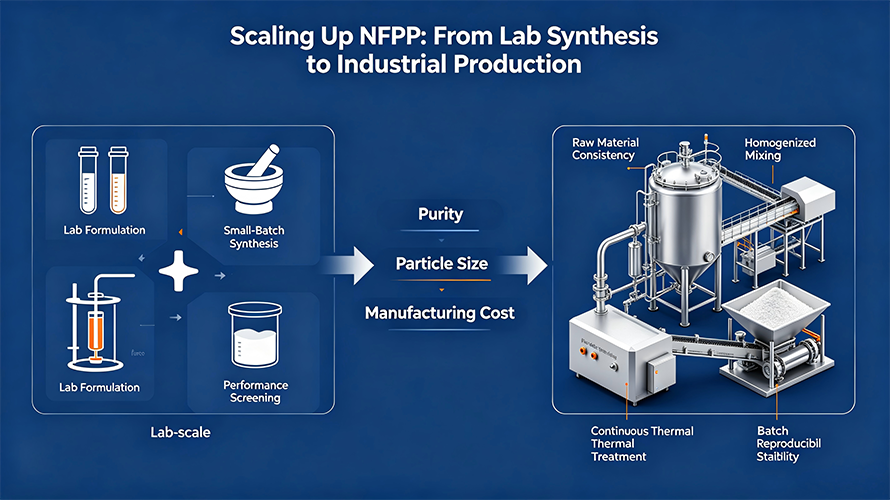
A synthesis route that performs well at gram scale does not automatically translate into an economical industrial process.
NFPP scale-up involves several additional considerations.
Raw Material Consistency
Industrial production requires stable and reproducible precursor quality.
Variations in:
- Purity
- Particle size
- Moisture
- Iron valence
- Sodium content
can influence the final NFPP phase and electrochemical performance.
Mixing and Homogeneity
At larger production volumes, achieving uniform mixing becomes more difficult.
Incomplete mixing can create local differences in Na/Fe/P composition, increasing the risk of secondary phases and batch-to-batch variation.
Therefore, industrial processes require controlled mixing, milling and material feeding systems rather than relying solely on laboratory-scale mechanical processing.
Energy Consumption
Thermal treatment is one of the major energy-consuming steps in conventional ceramic-type synthesis.
Improving furnace efficiency, reducing unnecessary holding time and optimizing the precursor reaction can help lower energy consumption.
For commercial NFPP, the best process is therefore not necessarily the one that produces the highest laboratory capacity. It should provide a balance of:
phase purity + electrochemical performance + yield + energy consumption + reproducibility + production cost.
Key Quality Parameters for NFPP Cathode Material
For battery manufacturers and material buyers, evaluating NFPP requires more than checking the nominal chemical formula.
Important quality parameters include:
| Parameter | Why It Matters |
|---|---|
| Chemical purity | Influences electrochemical stability and consistency |
| Phase purity | Reduces performance variation caused by secondary phases |
| Particle size | Affects Na+ diffusion and electrode kinetics |
| Particle morphology | Influences packing and electrode processing |
| Tap density | Affects volumetric energy density |
| Carbon content | Determines part of the electronic conductivity strategy |
| Moisture content | Important for storage and electrode processing |
| Iron composition/valence | Influences phase formation and electrochemical behavior |
| Specific capacity | Indicates practical sodium-storage capability |
| Rate performance | Determines high-power performance |
| Cycle life | Important for long-term energy-storage applications |
| Batch consistency | Critical for commercial battery production |
For B2B applications, batch-to-batch consistency can be as important as peak laboratory performance.
NFPP Synthesis: What Determines the Final Performance?
NFPP performance is the result of multiple interconnected variables rather than a single processing parameter.
A simplified relationship can be expressed as:
Precursor chemistry → phase formation → crystal structure → particle morphology → electronic/ionic transport → electrode performance
For example, poor phase purity may reduce reversible capacity, while excessive particle growth can slow sodium-ion transport. On the other hand, an overly aggressive strategy for reducing particle size may lower tap density and complicate electrode processing.
This is why NFPP optimization should be considered as a system-level materials engineering problem. Understanding the interaction between cathode, anode, electrolyte and conductive materials is essential when evaluating battery-material performance.
Frequently Asked Questions About NFPP Synthesis
1. What is the most common method for synthesizing NFPP?
Solid-state synthesis is an important route because of its relatively simple process and potential scalability. Wet-chemical methods such as sol-gel synthesis can provide better control over particle morphology and elemental distribution, but they generally involve more processing steps.
2. Why is carbon coating used in NFPP?
Carbon coating is mainly used to improve the electronic conductivity of NFPP. Because the intrinsic electronic conductivity of NFPP is relatively limited, a conductive carbon layer can facilitate electron transport and reduce electrode polarization.
3. Does smaller NFPP particle size always mean better battery performance?
No. Smaller particles can shorten Na⁺ diffusion distances, but excessively small particles may increase surface area, moisture sensitivity, agglomeration and processing difficulties. Practical NFPP should therefore use a controlled particle-size distribution suitable for the target electrode.
4. What are the most important parameters when purchasing NFPP powder?
Chemical purity, phase purity, particle-size distribution, tap density, moisture content, specific capacity, rate performance, cycle life and batch consistency are among the most important parameters. The appropriate specifications depend on the intended sodium-ion battery application.
5. Can doped NFPP be used instead of conventional NFPP?
Doped NFPP can be considered when higher electronic conductivity, improved sodium-ion diffusion or enhanced cycling performance is required. The suitability depends on the specific doping element, concentration, synthesis process and target battery design.
Conclusion
NFPP synthesis is moving beyond simple laboratory-scale preparation toward more controlled and reproducible materials engineering.
The key challenge is not merely producing Na₄Fe₃(PO₄)₂P₂O₇, but consistently producing a material with the required phase purity, particle morphology, conductivity, tap density and electrochemical performance at an economically viable production scale.
Solid-state synthesis offers a practical foundation for scale-up, while sol-gel and other advanced approaches provide additional control over morphology and composition. Carbon coating, conductive additives and elemental doping can further address the intrinsic limitations of NFPP.
For commercial sodium-ion batteries, the most valuable NFPP material will ultimately be the one that combines stable performance, reproducible quality, scalable manufacturing and competitive cost.
References
- [1] Y. Xin, H. Zhang, K. Zhao, M. M. Abdelghany, Y. Wang, Q. Wang, F. Wu, H. Gao, “Bridging fundamental mechanisms and scalable manufacturing of Na₄Fe₃(PO₄)₂P₂O₇ for large-scale sodium-ion storage,” Green Chemistry, 2026, 28, 6095–6111. DOI: 10.1039/D5GC06522D.
- [2] “Research progress on Na₄Fe₃(PO₄)₂P₂O₇: Synthesis methods, modification strategies, and future directions,” Journal of Energy Storage, 2025, 139, 118969. DOI: 10.1016/j.est.2025.118969.
- [3] “Na₄Fe₃(PO₄)₂P₂O₇ for commercial sodium-ion batteries: Properties, practicality, and prospects,” Materials Today Energy, 2026, 60, 102353. DOI: 10.1016/j.mtener.2026.102353.
- [4] T. Jin, H. Li, K. Zhu, P. Wang, P. Liu, L. Jiao, “Polyanion-type cathode materials for sodium-ion batteries,” Chemical Society Reviews, 2020, 49, 2342–2377. DOI: 10.1039/C9CS00846B.
- [5] “Fabrication of onion-like carbon frameworks and uniform carbon coating layer at Na₄Fe₃(PO₄)₂P₂O₇ for synergistically improving conductivity and structural stability,” Journal of Power Sources, 2025, 650, 237475. DOI: 10.1016/j.jpowsour.2025.237475.
Further Reading
- NFPP Sodium-Ion Battery Cathode: Properties, Advantages, Synthesis and Applications
- NFPP vs LFP vs Layered Oxide vs Prussian Blue: Which Cathode Is Better for Sodium-Ion Batteries?
- Sodium-Ion Battery Materials: Key Components, Advantages and Future Trends
- Aqueous Sodium-Ion Battery Cathode Materials: Structure, Performance, and Future Prospects
- Cathode Materials Explained: Types, Structures, Properties, Applications, and Future Trends
Explore NFPP Cathode Materials
VIMATERIAL provides advanced battery materials for research, development and industrial applications. NFPP cathode material can be supplied according to application-specific requirements such as purity, particle size and material specifications.
For technical requirements or sourcing inquiries, contact our team to discuss the appropriate NFPP material for your sodium-ion battery project.