


Sodium iron phosphate pyrophosphate (NFPP), with the chemical formula Na₄Fe₃(PO₄)₂P₂O₇, is a polyanionic cathode material developed for sodium-ion batteries. Its combination of structural stability, thermal safety, long cycle life, abundant raw materials, and balanced electrochemical performance makes NFPP an attractive option for applications where reliability and lifetime are more important than maximum energy density.
Unlike some high-capacity layered oxide cathodes, NFPP does not aim to maximize a single performance metric. Its value lies in balancing safety, durability, cost, and electrochemical performance, making it particularly relevant to stationary energy storage and other long-life applications.
1. What Is NFPP?
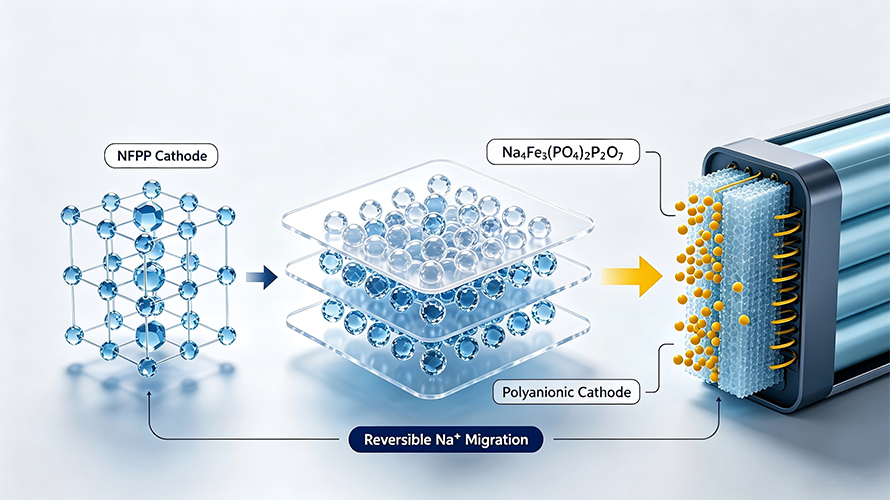
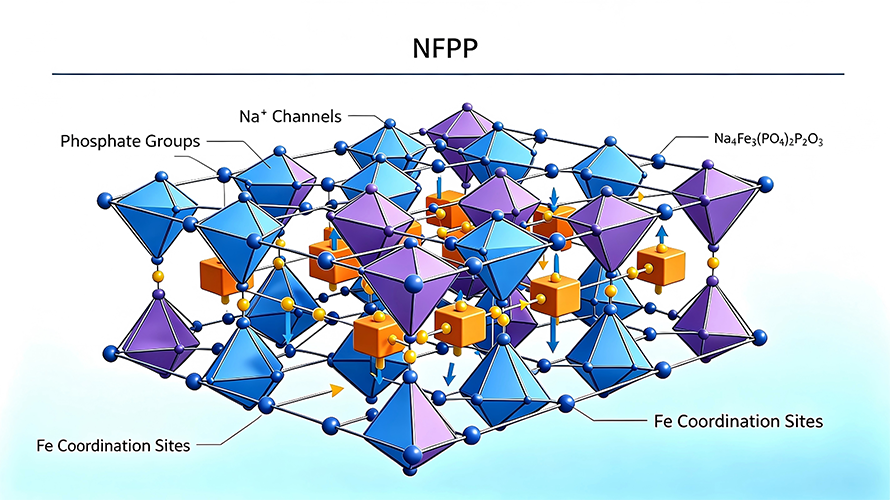
NFPP stands for sodium iron phosphate pyrophosphate, a mixed phosphate-pyrophosphate polyanionic compound with the chemical formula Na₄Fe₃(PO₄)₂P₂O₇, which is a low-cost iron-based polyanionic cathode with a stable framework and three-dimensional Na⁺ diffusion channels.
Its crystal framework contains strongly bonded phosphate and pyrophosphate groups together with iron-centered coordination units. The robust polyanionic framework helps maintain structural integrity during repeated sodium-ion insertion and extraction.
Key Properties
| Property | Typical / Representative Value |
|---|---|
| Chemical formula | Na₄Fe₃(PO₄)₂P₂O₇ |
| Material type | Polyanionic sodium-ion cathode |
| Theoretical specific capacity | ~129 mAh/g |
| Typical operating voltage | Around 3 V class vs. Na⁺/Na |
| Main structural feature | Phosphate-pyrophosphate framework |
| Key advantages | Stability, safety, cycle life, cost potential |
| Main limitation | Low intrinsic electronic conductivity |
Actual electrochemical performance depends strongly on particle size, morphology, synthesis conditions, electrode formulation, carbon coating, doping, electrolyte composition, and testing conditions.
2. How Does NFPP Work in a Sodium-Ion Battery?
NFPP operates as a sodium-ion battery cathode through a reversible “rocking-chair” mechanism. During charging, sodium ions are extracted from the NFPP cathode and migrate through the electrolyte toward the anode. During discharge, sodium ions move back toward the cathode and are reinserted into the NFPP structure.
When the battery is charged:
Na⁺ ions are extracted from the NFPP cathode → migrate through the electrolyte → and are stored in the anode.
During discharging:
Na⁺ ions leave the anode → migrate through the electrolyte → and return to the NFPP cathode.
This reversible sodium-ion movement enables the battery to store and release electrical energy.
3. Why Is NFPP Considered a Stable Sodium-Ion Cathode?
Sodium iron phosphate pyrophosphate is not necessarily the highest-capacity sodium-ion cathode. Its advantage is its overall balance of performance and reliability.
3.1 Structural and Thermal Stability
The strong P–O bonds within phosphate and pyrophosphate groups contribute to a stable polyanionic framework. Compared with some transition-metal oxide cathodes, this structure can provide better resistance to structural degradation and thermal instability.
This makes NFPP particularly attractive for applications where thermal safety and long-term reliability are important.
3.2 Long Cycle Life
The relatively stable framework limits structural changes during repeated sodium-ion insertion and extraction. With appropriate particle engineering and conductivity modification, NFPP-based cathodes have demonstrated thousands of charge-discharge cycles in reported studies.
Some modified NFPP systems have achieved cycle retention above 80% after several thousand cycles, although actual cycle life varies considerably with testing conditions.
3.3 Abundant and Cost-Competitive Raw Materials
It is based primarily on sodium, iron, and phosphorus, avoiding large quantities of expensive nickel or cobalt.
Sodium is widely available, while iron and phosphorus are also established industrial raw materials. This gives NFPP strong potential for applications where material cost and supply-chain stability are important.
3.4 Balanced Electrochemical Performance
It offers a practical compromise between capacity, voltage, stability and durability.
It may not compete directly with the highest-energy cathode chemistries when energy density is the only priority. However, its combination of long lifetime and structural stability can make the total cost of ownership attractive for stationary energy storage and other applications requiring frequent cycling.
4. NFPP vs. Layered Oxide and Prussian Blue Cathodes
Sodium-ion batteries currently use several major cathode families, including layered transition-metal oxides, Prussian blue analogues, and polyanionic compounds.
| Cathode Type | Main Strength | Main Challenge | Typical Opportunity |
|---|---|---|---|
| Layered oxides | Higher capacity and energy density | Structural and air-stability challenges | Higher-energy applications |
| Prussian blue analogues | Low cost, open framework | Defect, moisture and water control | Cost-sensitive storage |
| NFPP | Stability, safety and long cycle life | Low electronic conductivity | Long-life energy storage |
This comparison explains why NFPP is attracting industrial interest. It does not necessarily win every individual performance category. Instead, it offers a relatively balanced combination of safety, durability, cost potential and manufacturability.
For early-stage battery technologies, the most commercially useful material is not always the one with the highest laboratory performance. A material that is stable, scalable, predictable and easier to manage over its lifetime can have a significant advantage.
5. NFPP Electrochemical Performance
Theoretical capacity is an important indicator, but it does not directly represent the performance of a commercial electrode.
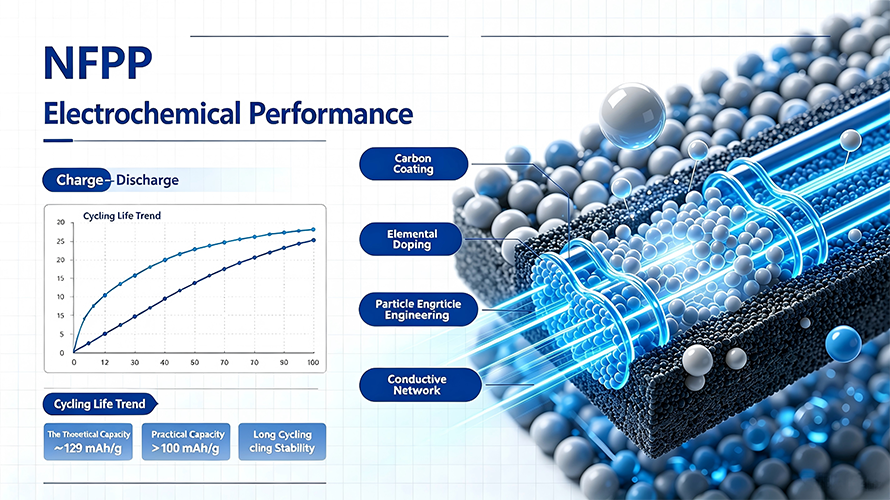
Sodium iron phosphate pyrophosphate has a theoretical specific capacity of approximately 129 mAh/g. Reported experimental values vary depending on material design and testing conditions. Modified NFPP materials can achieve practical capacities above 100 mAh/g, while improvements in carbon coating, doping and particle engineering can substantially improve rate capability and cycling stability.
Representative performance indicators include:
- Theoretical specific capacity: ~129 mAh/g
- Reported practical capacity: commonly above 100 mAh/g for optimized materials
- High-rate performance: modified NFPP can retain useful capacity at elevated C-rates
- Cycle life: optimized systems have demonstrated several thousand cycles
- Low-temperature operation: performance can be improved through particle and conductivity engineering
For example, Ni-doped and carbon-containing NFPP systems have demonstrated improved sodium-ion diffusion and electronic transport. Reported studies have shown strong cycling performance at high rates, including systems retaining substantial capacity after several thousand cycles.
These results demonstrate an important point: NFPP’s electrochemical performance is highly dependent on materials engineering rather than being determined solely by its basic chemical composition.
6. How Is NFPP Produced?
Several synthesis routes can be used to prepare NFPP. The appropriate method depends on the desired particle size, morphology, purity, production scale and performance requirements.
6.1 Solid-State Synthesis
Solid-state synthesis is one of the most straightforward routes for large-scale production. Sodium, iron and phosphate-containing precursors are mixed, mechanically milled and calcined at controlled temperatures.
Its main advantages are:
- relatively simple processing;
- readily scalable equipment;
- suitable raw materials;
- potential compatibility with industrial powder production.
However, achieving uniform precursor mixing and controlling sodium loss, phase purity and particle growth are important challenges.
6.2 Sol-Gel Synthesis
The sol-gel method provides better molecular-level precursor mixing and can produce finer particles with more controlled morphology.
It is particularly useful for research and performance optimization, but solvent use, process complexity and production cost can make large-scale implementation more challenging.
6.3 Spray Drying and Other Routes
Spray drying can improve precursor homogeneity and particle morphology while offering potential advantages for scale-up.
Other approaches, including freeze drying and hydrothermal or solution-assisted methods, can also be used to control particle structure.
For commercial production, the key objective is not simply obtaining the correct crystal phase. Manufacturers must simultaneously control purity, particle size distribution, morphology, sodium stoichiometry, carbon content, tap density and batch-to-batch consistency.
7. How Is NFPP Conductivity Improved?
The major technical limitation of NFPP is its relatively low intrinsic electronic conductivity. This can restrict charge transfer and sodium-ion kinetics, particularly at high current densities.
Several modification strategies are therefore used.
Carbon Coating
A thin conductive carbon layer can improve electron transport around NFPP particles and reduce polarization. Carbon coating can also help control particle growth during thermal treatment.
Elemental Doping
Doping NFPP with selected metal ions can modify its electronic structure, crystal chemistry and sodium-ion transport.
For example, Ni doping has been investigated as a strategy to improve intrinsic electronic conductivity and stabilize the material structure. Reported Ni-doped NFPP systems have shown improved sodium-ion diffusion kinetics and enhanced high-rate cycling performance.
Particle Engineering
Reducing particle size and optimizing morphology can shorten sodium-ion diffusion pathways and increase the effective electrode/electrolyte interface.
Conductive Network Design
Combining carbon coating with conductive additives or other structural engineering approaches can create more continuous electron-transport pathways throughout the electrode.
In practice, carbon coating, doping and particle engineering are often used together, rather than relying on a single modification strategy.
8. Sodium iron phosphate pyrophosphate Applications
The characteristics of NFPP make it particularly attractive for applications where long service life, safety and predictable cycling are important.
Potential applications include:
- Stationary energy storage
- Grid-scale energy storage
- Residential and commercial energy storage
- Backup power systems
- Industrial energy storage
- Low-speed electric vehicles
- Battery systems requiring frequent cycling
For stationary storage, energy density is important, but it is not the only consideration. Safety, cycle life, material cost and lifetime operating cost can have an equally important impact on the overall economics of the system.
This is where NFPP can offer a compelling value proposition.
9. Advantages and Limitations of NFPP
A realistic assessment should consider both its strengths and its remaining technical challenges.
| Advantages | Limitations |
|---|---|
| Strong polyanionic framework | Low intrinsic electronic conductivity |
| Good structural and thermal stability | Capacity lower than some high-energy cathodes |
| Long cycle-life potential | Conductivity modification is often required |
| Iron-, sodium- and phosphorus-based chemistry | Performance depends strongly on synthesis |
| Cost and supply-chain potential | Commercial maturity varies by application |
| Suitable for long-life storage | Energy density may not be the primary strength |
The most important limitation is conductivity. This is why modern NFPP development increasingly focuses on carbon engineering, doping, particle optimization and conductive network design.
Therefore, it should not be considered a universally superior cathode. Its strongest advantage is its balanced performance profile.
10. What Is the Future of NFPP?
The development of sodium-ion batteries is increasingly shifting from laboratory material discovery toward cost, scale-up, reliability and application-specific optimization.
In this environment, NFPP has an important advantage: it does not need to be the strongest cathode in every individual metric.
Its potential lies in the combination of:
Safety + cycle life + structural stability + abundant raw materials + cost potential.
As synthesis technology, conductivity modification and electrode engineering continue to improve, NFPP could become increasingly relevant to long-duration and high-cycle sodium-ion battery applications.
Frequently Asked Questions
1. What is NFPP?
NFPP is sodium iron phosphate pyrophosphate, with the chemical formula Na₄Fe₃(PO₄)₂P₂O₇. It is a polyanionic cathode material developed for sodium-ion batteries.
2. What is the main limitation of NFPP?
NFPP has relatively low intrinsic electronic conductivity. Carbon coating, elemental doping and conductive-network engineering are commonly used to improve its electrochemical performance.
3. What is the theoretical capacity of NFPP?
The theoretical specific capacity is approximately 129 mAh/g. Practical capacity depends on particle morphology, conductivity, electrode formulation and operating conditions.
4. What is the main advantage of NFPP?
Its primary advantage is its balanced combination of structural stability, thermal safety, cycle-life potential and cost-competitive raw materials.
5.What applications are suitable for NFPP?
NFPP is particularly promising for stationary energy storage, grid storage, backup power, industrial storage and other applications where safety and long cycle life are important.
References
- [1] Na₄Fe₃(PO₄)₂P₂O₇ Cathode for Sodium-Ion Batteries: Critical Technologies and Progress from Fundamental Advances to Industrialization Challenges. Energy Storage Materials, 2025. https://doi.org/10.1016/j.ensm.2025.104788
- [2] Research Progress on Na₄Fe₃(PO₄)₂P₂O₇: Synthesis Methods, Modification Strategies, and Future Directions. Journal of Energy Storage, 2025. https://doi.org/10.1016/j.est.2025.118969
- [3] Entropy-Driven Enhancement of the Conductivity and Phase Purity of Na₄Fe₃(PO₄)₂P₂O₇ as the Superior Cathode in Sodium-Ion Batteries. ACS Applied Materials & Interfaces, 2024, 16, 7070–7079. https://doi.org/10.1021/acsami.3c15947
- [4] Tailoring the Phase Composition of Na₄Fe₃(PO₄)₂P₂O₇ via Ni Doping toward High-Performance Cathodes for Sodium-Ion Batteries. Journal of Energy Storage, 2026. https://doi.org/10.1016/j.est.2026.123538
- [5] Synergistic Ni Doping and Carbon Coating for High-Performance Na₄Fe₃(PO₄)₂P₂O₇ Cathodes in Sodium-Ion Batteries. Applied Surface Science, 2026.
- [6] Na₄Fe₃(PO₄)₂P₂O₇ for Commercial Sodium-Ion Batteries: Properties, Practicality, and Prospects. Materials Today Energy, 2026.
Further Reading
- Sodium-Ion Battery Materials: Key Components, Advantages and Future Trends
- Aqueous Sodium-Ion Battery Cathode Materials: Structure, Performance, and Future Prospects
- Cathode Materials Explained: Types, Structures, Properties, Applications, and Future Trends
- Lithium Aluminum Titanium Phosphate (LATP): A Promising Solid-State Electrolyte for Next-Generation Batteries
- Battery Materials Explained: Types, Components and Applications (2026 Guide)
Looking for NFPP Cathode Material for Sodium-Ion Batteries?
VIMATERIAL supplies advanced battery materials for research, development and industrial applications. NFPP specifications can be tailored according to requirements such as purity, particle size, morphology and application.
Contact our technical team to discuss your NFPP material requirements, performance targets and customized specifications.