


I. What Are Aqueous Sodium-Ion Batteries?
Aqueous sodium-ion batteries are a new type of energy storage system. Compared with traditional organic lithium-ion batteries, aqueous sodium-ion batteries offer higher safety and lower cost. In addition, sodium resources are abundant and widely distributed on Earth, giving aqueous sodium-ion batteries significant advantages in terms of resource sustainability.
Cathode materials are key components of aqueous sodium-ion batteries, and their performance directly affects the energy density, power density, and cycle life of the battery. Therefore, the development of high-performance sodium-ion battery cathode materials is of great importance.
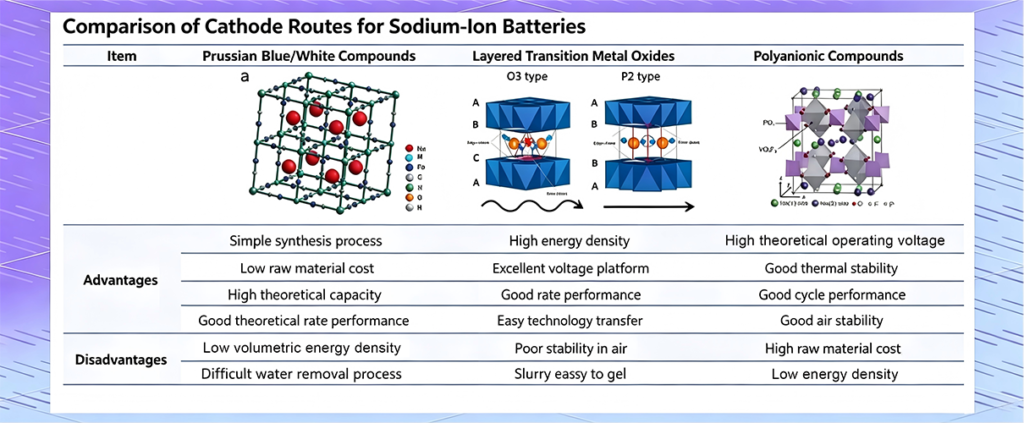
At present, the three most widely studied categories of cathode materials are layered transition metal oxides, Prussian blue analogs, and polyanionic compounds. Among them:
- Layered oxides possess high specific capacity and good rate performance, but their structural stability still needs improvement.
- Prussian blue analogs are low-cost and easy to synthesize, but are limited by side reactions caused by crystal water.
- Polyanionic compounds exhibit excellent voltage platforms and cycling stability due to strong inductive effects, though they suffer from relatively low electronic conductivity.
To address these bottlenecks, composite modification, interface engineering, and precise crystal structure design have become key strategies for improving their overall electrochemical performance. Furthermore, ongoing research into sodium-ion battery cathode materials promises to enhance the efficiency and longevity of these batteries.
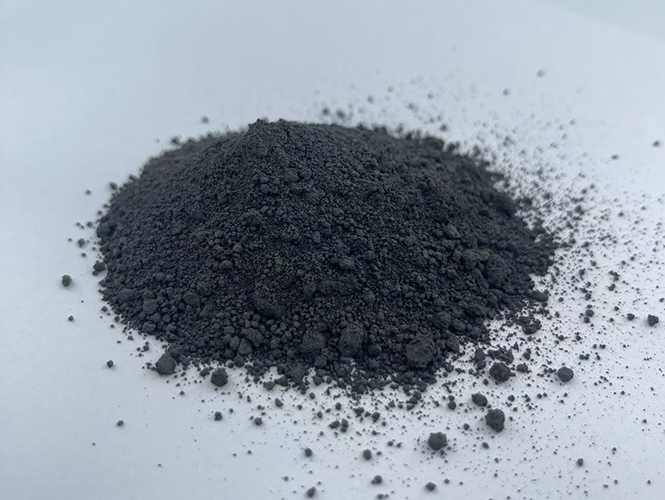
Working Principle of Aqueous Sodium-Ion Batteries
Recent advancements in the field highlight the significance of sodium-ion battery cathode materials in the broader context of energy storage technologies.
Aqueous sodium-ion batteries are secondary batteries that use water-based electrolytes. Their working principle is similar to that of lithium-ion batteries, except that sodium ions replace lithium ions as the charge carriers. Because sodium is abundant, inexpensive, and non-toxic, and aqueous electrolytes are highly safe, environmentally friendly, and easy to handle, aqueous sodium-ion batteries are considered a promising energy storage technology with broad application prospects.
II. Types of Aqueous Sodium-Ion Battery Cathode Materials
Common aqueous Sodium Ion Battery Cathode Materials include layered oxides (such as Na0.44MnO2), Prussian blue compounds (such as Na2Fe[Fe(CN)6]), and polyanionic compounds (such as Na3V2(PO4)3).
1. Layered Transition Metal Oxides
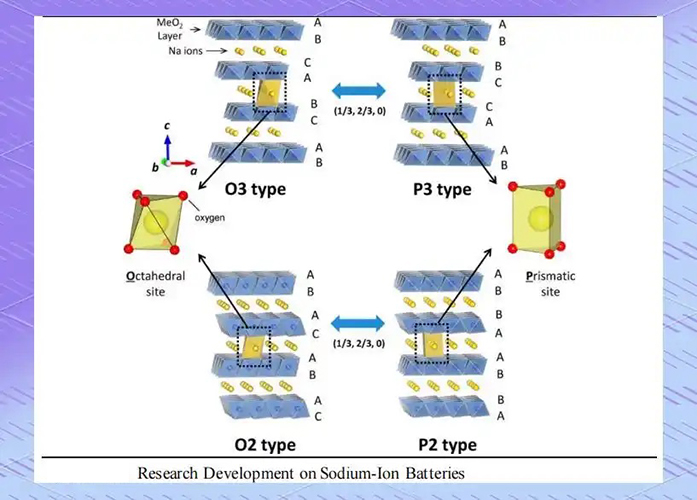
Layered transition metal oxide cathode materials for sodium-ion batteries have structures similar to ternary cathodes used in lithium-ion batteries, generally following the molecular formula NaxMO2, where M represents transition metal elements such as nickel, cobalt, iron, and manganese.
Typical materials include MnO2, NaMnO4, and Na0.44MnO2. These materials exhibit good structural tunability during sodium-ion insertion and extraction. By doping or substituting different transition metal elements, various binary, ternary, and multicomponent layered oxides can be synthesized.
Currently, O3-type and P2-type structures are the mainstream layered oxide systems. Compared with O3-type materials, P2-type materials show superior rate capability and cycling stability. Although their specific capacity is slightly lower, they still maintain capacities in the range of 100–140 mAh/g, demonstrating excellent overall electrochemical performance.
2. Prussian Blue Analog Compounds
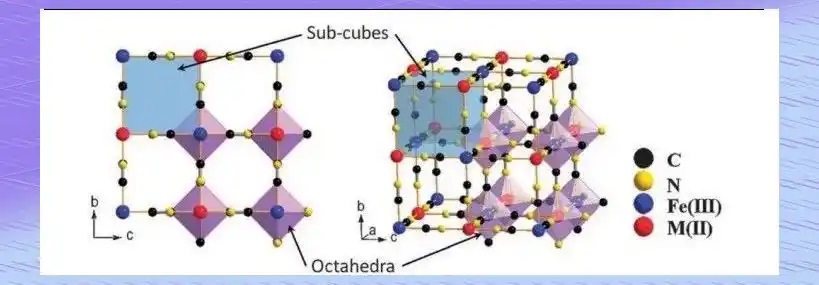
Prussian blue analogs are transition metal cyanide coordination polymers with the general formula:
AxM[Fe(CN)6]y·nH2O
where A represents alkali metal ions such as Li, Na, and K, while M represents transition metal ions such as Fe, Mn, Co, Ni, and Cu.
These materials can be synthesized easily at room temperature and possess a theoretical specific capacity of up to 170 mAh/g. Their unique three-dimensional cubic framework provides spacious transport channels for sodium ions, enabling fast charge/discharge performance.
However, Prussian blue analogs face several challenges in practical applications, including low actual capacity, limited efficiency, poor rate capability, and insufficient cycling stability. These issues mainly arise because vacancies in the Fe(CN)6 framework tend to combine with lattice water molecules, making crystal water difficult to remove.
Therefore, suppressing the formation of crystal water and improving lattice defects are critical for the industrialization of Prussian blue analog cathode materials.
3. Polyanionic Cathode Materials
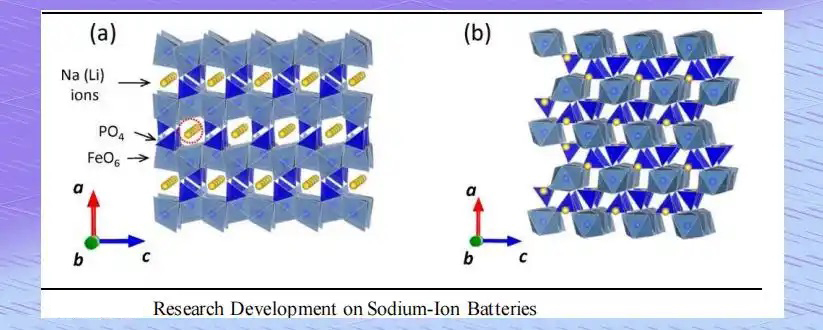
Polyanionic cathode materials possess stable crystal structures and relatively high operating voltages, making them promising candidates for aqueous sodium-ion batteries.
Common polyanionic cathode materials include phosphates, sulfates, and silicates, with the general formula:
NaxMy[(XOm)n−]z
where M represents variable-valence transition metals, mainly vanadium, but also manganese, iron, cobalt, and others.
Representative compounds include:
- Na3V2(PO4)3
- Na3V2(PO4)2F3
- NaFePO4
- Na2Fe2(SO4)3
- Na2Fe2P2O7
These materials demonstrate high energy density and excellent cycling stability in aqueous sodium-ion batteries. However, they also suffer from low electrical conductivity and poor rate performance.
To improve their electrochemical properties, researchers have adopted modification strategies such as elemental doping and carbon coating, which have achieved promising results.
III. Challenges and Prospects of Aqueous Sodium Ion Battery Cathode Materials
Although significant progress has been made in recent years, aqueous Sodium-Ion Battery Cathode Materials still face several challenges.
First, the energy density and power density of aqueous sodium-ion batteries still need improvement. Second, key performance indicators such as cycle life and rate capability require further enhancement. In addition, production cost and environmental friendliness are also important considerations.
To address these challenges, future research directions may include:
- Developing novel high-performance cathode materials to improve energy density and power density.
- Enhancing cycle life and rate capability through material design and modification strategies.
- Exploring low-cost and environmentally friendly manufacturing processes to reduce production costs.
- Strengthening fundamental research on reaction mechanisms and degradation mechanisms to provide theoretical guidance for practical applications.
IV. Conclusion
Cathode materials are core components of aqueous sodium-ion batteries, and their performance directly determines the overall battery performance.
In recent years, significant progress has been achieved in layered transition metal oxides, Prussian blue analogs, and polyanionic cathode materials. However, challenges such as low energy density, limited cycle life, and high production cost still remain.
Future research should focus on developing novel high-performance cathode materials, improving the properties of existing materials, and exploring low-cost and environmentally friendly production processes in order to accelerate the commercial application of aqueous sodium-ion batteries.
Frequently Asked Questions (FAQs)
What is the cathode material in a sodium-ion battery?
The cathode material in a sodium-ion battery is the positive electrode responsible for storing and releasing sodium ions during charge and discharge cycles. Common cathode materials include layered transition metal oxides, Prussian blue analogs, and polyanionic compounds such as phosphates. These materials directly influence the battery’s energy density, cycle life, safety, and rate performance.
What materials go into a sodium-ion battery?
A sodium-ion battery typically consists of four main components: a cathode, an anode, an electrolyte, and a separator. Cathodes are commonly made from layered oxides or Prussian blue materials, while hard carbon is widely used as the anode. The electrolyte can be aqueous or organic and contains sodium salts that enable ion transport.
What is the best anode material for a sodium-ion battery?
Hard carbon is considered one of the best anode materials for sodium-ion batteries because it offers good capacity, low cost, and long cycle life. It can efficiently store larger sodium ions compared to graphite.
What are the raw materials for sodium-ion battery?
The raw materials used in sodium-ion batteries mainly include sodium salts, transition metals, carbon materials, electrolytes, and separator materials. Common elements include sodium, iron, manganese, nickel, vanadium, phosphorus, and carbon. Compared with lithium-ion batteries, sodium-ion batteries rely on more abundant and lower-cost resources, making them attractive for large-scale energy storage applications.