


Sodium iron pyrophosphate phosphate (NFPP) is a polyanionic cathode material for sodium-ion batteries that combines structural stability, safety, rate capability and long cycle life. However, the performance of NFPP cannot be represented by a single capacity value.
Its electrochemical behavior depends on several factors, including material composition, particle size, electronic conductivity, carbon modification, electrode formulation, electrolyte, temperature and testing conditions.
For this reason, NFPP performance is better evaluated across several parameters: theoretical specific capacity, operating voltage, practical discharge capacity, rate capability, cycle life and temperature performance.
NFPP Theoretical Specific Capacity
The theoretical specific capacity of NFPP is approximately 129 mAh/g.
This value represents the maximum charge storage capacity calculated from the electrochemically active redox reactions in the material. It should not be interpreted as the capacity that every NFPP electrode will deliver in practical battery testing.
Actual capacity depends on factors such as:
- the degree of sodium extraction and insertion;
- particle size and morphology;
- phase purity;
- electronic conductivity;
- sodium-ion diffusion;
- carbon coating or conductive additives;
- electrode loading and formulation;
- current density and test conditions.
Therefore, the theoretical capacity of approximately 129 mAh/g provides a useful reference point, while practical discharge capacity is more relevant when evaluating an NFPP material for battery development.
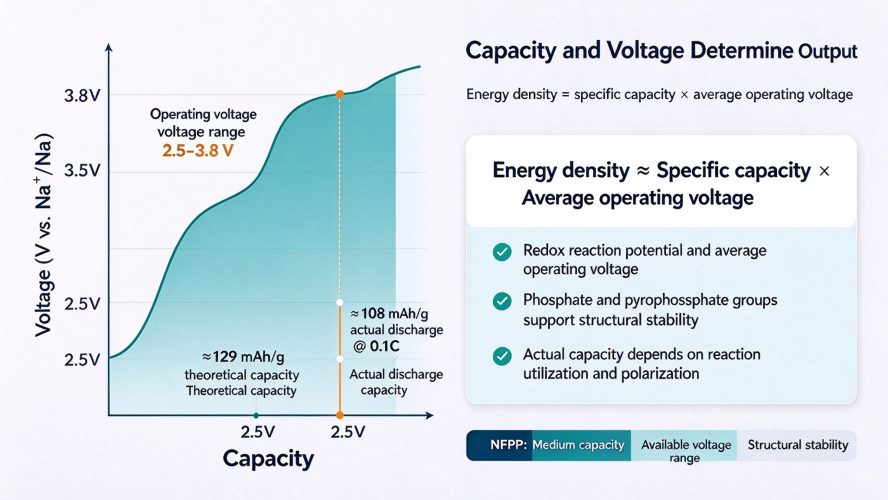
NFPP Operating Voltage
NFPP operates within a sodium-ion battery cathode voltage range commonly around 2.5–3.8 V vs. Na⁺/Na, depending on material composition and testing conditions.
The voltage profile is closely related to the redox activity of iron within the polyanionic framework. The phosphate and pyrophosphate groups also contribute to the structural stability of the cathode during sodium-ion extraction and insertion.
Operating voltage is important because the energy delivered by a battery depends on both capacity and average voltage.
In simplified terms:
Energy density ≈ specific capacity × average operating voltage
NFPP does not necessarily provide the highest voltage or capacity among sodium-ion cathode families. Its strength is the combination of moderate capacity, a useful voltage range and strong structural stability.
Practical Discharge Capacity
Practical discharge capacity varies between NFPP materials because synthesis conditions, particle characteristics, conductive modification and electrode design can all affect electrochemical utilization.
Under a 0.1C discharge rate, NFPP can deliver approximately 108 mAh/g under suitable electrode and testing conditions. This corresponds to a substantial fraction of the theoretical capacity of 129 mAh/g.
With conductive modification, practical utilization can be further improved, with NFPP materials capable of delivering more than 110 mAh/g at 0.1C.
These values should always be considered together with the corresponding electrode formulation, voltage window, temperature, active-material loading and test conditions.
For material selection, it is therefore important to evaluate the complete test conditions rather than compare capacity numbers alone.
NFPP Rate Capability
Rate capability describes how effectively an electrode maintains its capacity when the charging or discharging current increases.
NFPP has a relatively stable polyanionic framework, but its intrinsic electronic conductivity is limited. At high current densities, poor electronic transport and sodium-ion diffusion can therefore restrict the utilization of active material.
A typical NFPP performance profile can include:
| Current Rate | Specific Discharge Capacity |
|---|---|
| 0.1C | Approximately 108 mAh/g |
| 10C | More than 70 mAh/g |
With additional material modification, NFPP can maintain useful capacity at even higher rates. For example, Ni-doped NFPP/C can deliver approximately 47.7 mAh/g at 20C.
Rate performance is particularly sensitive to particle size, carbon distribution, conductive-network design and sodium-ion diffusion kinetics. Consequently, a high-rate NFPP material normally requires optimization beyond simply producing a phase-pure powder.
NFPP Cycle Life
Long cycle life is one of the most important reasons NFPP is considered for sodium-ion battery applications.
The strong P–O bonds in the polyanionic framework help maintain structural integrity during repeated sodium-ion insertion and extraction. This can reduce structural degradation compared with less stable cathode structures under certain operating conditions.
With appropriate material and electrode optimization, NFPP can maintain stable electrochemical performance over thousands of cycles.
For example:
- 85.60% capacity retention after 4,500 cycles at 10C
- More than 80% capacity retention after 6,000 cycles for conductive-agent-doped NFPP
- 77.43% capacity retention after 2,000 cycles at 5C for Ni-doped NFPP/C
- Stable cycling performance can also be maintained over 5,000 cycles at 10C with suitable material modification
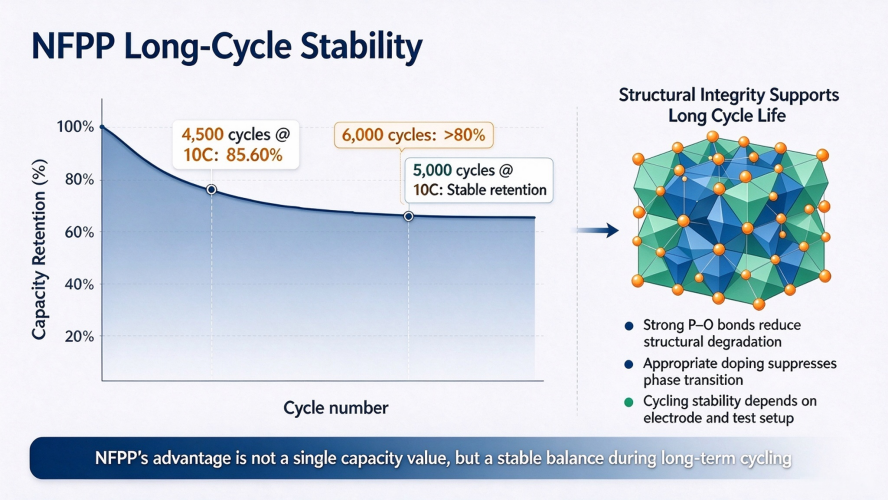
These values demonstrate the potential of NFPP for applications where long service life and stable cycling are important.
Cycle life is not a fixed property determined only by the NFPP chemical formula. It depends strongly on material modification, electrode design, current rate, voltage window and other testing parameters.
NFPP High-Temperature Performance
Temperature has a direct influence on sodium-ion transport and electrochemical reaction kinetics.
At elevated temperatures, ion transport can become faster and electrode polarization can decrease. This can improve the practical utilization of an NFPP cathode, although excessive temperature can introduce other degradation mechanisms at the cell level.
Ni-doped NFPP/C can deliver approximately 93.6 mAh/g at 1C and 60°C, demonstrating useful high-temperature electrochemical performance.
This type of performance is particularly relevant for applications where the battery may experience elevated operating temperatures.
However, cathode performance at high temperature should not be interpreted as the complete thermal performance of a battery. Cell safety also depends on the electrolyte, separator, anode, current collectors, cell design and thermal-management system.
NFPP Low-Temperature Performance
Low-temperature operation is generally more challenging for sodium-ion batteries because ion transport and electrochemical reaction kinetics become slower.
NFPP-based materials can nevertheless retain useful capacity under sub-zero conditions when their composition and electrode structure are properly optimized.
Ni-doped NFPP/C can deliver approximately 86.5 mAh/g at 0.1C and −10°C. Under a subsequent 1C cycling condition, capacity retention can reach 86.8% after 200 cycles.
These performance characteristics indicate that modified NFPP can maintain meaningful electrochemical activity at low temperatures.
For commercial applications, however, low-temperature performance should be evaluated at the full-cell level rather than based solely on half-cell cathode data.
NFPP in Full Cells
Half-cell performance provides useful information about cathode behavior, but commercial battery development ultimately depends on full-cell performance.
NFPP can be used in sodium-ion full cells with hard carbon anodes. A full cell using Ni-doped NFPP as the cathode can maintain approximately 96.9% capacity after 100 cycles at 1C.
Full-cell evaluation is important because it incorporates interactions between the cathode, anode, electrolyte and electrode formulation.
It also reveals performance characteristics that cannot be fully predicted from cathode half-cell testing, including:
- energy efficiency;
- voltage behavior;
- electrode balancing;
- sodium inventory;
- impedance growth;
- practical energy density;
- cycle stability under realistic cell conditions.
For B2B material evaluation, full-cell validation is therefore an important step after initial cathode screening.
What Determines NFPP Performance?
NFPP performance is determined by more than its chemical formula. Several material and cell-level parameters can significantly influence the final electrochemical results.
Composition and Phase Purity
The chemical composition and phase purity determine the available electrochemical active sites and structural stability. Unwanted secondary phases can reduce capacity and increase polarization.
Particle Size and Morphology
Smaller particles can shorten sodium-ion diffusion distances and increase the active surface area. However, excessively small particles can also increase surface reactions and processing complexity.
Particle size therefore needs to be optimized rather than simply minimized.
Carbon Coating
Carbon coating improves electronic transport around NFPP particles and can reduce charge-transfer resistance. It is particularly useful because the intrinsic electronic conductivity of NFPP is relatively limited.
However, carbon coating mainly addresses surface and interparticle electron transport. It does not necessarily eliminate limitations associated with bulk electronic conductivity.
Elemental Doping
Elemental doping can modify the electronic structure and crystal environment of NFPP.
For example, Ni doping can be used to improve electronic conductivity, stabilize the structure and accelerate sodium-ion transport. Proper doping can therefore improve electrochemical kinetics compared with unmodified NFPP.
Conductive Network Design
The electrode-level conductive network determines how efficiently electrons can move between active particles and the current collector.
A well-designed network can complement carbon coating and doping by improving electron transport throughout the electrode rather than only around individual NFPP particles.
Electrode Formulation and Test Conditions
The final electrochemical performance also depends on active-material loading, conductive-agent content, binder, electrode density, electrolyte, voltage window, current rate and temperature.
Consequently, two NFPP powders with similar chemical composition can produce noticeably different battery performance when tested under different electrode and cell conditions.
These factors are strongly influenced by synthesis conditions, particularly particle size, morphology, phase purity and carbon modification. For more information, see NFPP synthesis and carbon coating methods.
What Performance Can NFPP Realistically Deliver?
NFPP should not be evaluated simply by asking which material has the highest capacity.
Its practical value comes from the balance between capacity, voltage, rate capability, safety and cycle life.
Under moderate-rate conditions, optimized NFPP materials can achieve approximately 100–110+ mAh/g, while modified compositions can retain useful capacity at high current rates and maintain capacity over thousands of cycles.
At the same time, performance should always be reported together with the relevant testing conditions. A capacity value measured at 0.1C cannot be directly compared with a value measured at 10C, and half-cell results should not be treated as equivalent to full-cell performance.
For B2B material selection, the more useful question is therefore:
Can the NFPP material deliver the required capacity and rate capability while maintaining the required cycle life under the target operating conditions?
This requires evaluating not only chemical composition and purity, but also particle size, morphology, carbon modification, conductive-network design and electrode compatibility.
For applications prioritizing long service life, structural stability, safety and balanced electrochemical performance, NFPP remains a strong candidate among sodium-ion battery cathode materials.
Frequently Asked Questions
1. What is the theoretical specific capacity of NFPP?
The theoretical specific capacity of Na₄Fe₃(PO₄)₂P₂O₇ (NFPP) is approximately 129 mAh/g. Practical capacity is usually lower and depends on phase purity, particle size, conductivity, electrode formulation and testing conditions.
2. What practical discharge capacity can NFPP achieve?
NFPP can deliver around 100–110+ mAh/g under suitable conditions, while optimized or modified NFPP materials can achieve higher values. Capacity should always be compared together with the current rate, voltage window, temperature and electrode configuration.
3. What is the operating voltage of NFPP?
NFPP generally operates around 2.5–3.8 V vs. Na⁺/Na, although the actual voltage range depends on composition and testing conditions. Its average working potential is commonly around 3.0 V vs. Na⁺/Na.
4. How does carbon coating improve NFPP performance?
Carbon coating improves electronic transport between NFPP particles and helps reduce polarization. It is especially useful for addressing the relatively low intrinsic electronic conductivity of NFPP, although carbon coating alone does not remove all limitations associated with sodium-ion diffusion.
5. How does doping affect NFPP electrochemical performance?
Elemental doping can modify the crystal structure, electronic conductivity and sodium-ion transport kinetics. For example, recent work shows that Zr doping combined with Fe-defect engineering and carbon coating can significantly improve high-rate performance and cycling stability. ACS Publications
6. Does NFPP perform well at low temperatures?
NFPP can retain useful electrochemical activity at sub-zero temperatures when its composition and electrode structure are properly optimized. However, low-temperature performance depends strongly on the complete electrode and electrolyte system, so half-cell data should not be directly treated as full-cell performance.
7. What factors have the greatest influence on NFPP performance?
The most important factors include phase purity, chemical composition, particle size, morphology, carbon modification, elemental doping, conductive-network design, electrode loading, electrolyte, voltage window, temperature and current rate.
8. Is NFPP suitable for commercial sodium-ion batteries?
NFPP has strong potential for applications requiring a balance of cost, safety, cycle life and rate capability. However, commercial suitability depends on reproducible material synthesis, electrode processing, full-cell performance, energy density and long-term stability under application-specific conditions.
Conclusion
NFPP offers a balanced electrochemical profile rather than relying on a single standout parameter. Its theoretical specific capacity is approximately 129 mAh/g, while practical capacities can exceed 100 mAh/g under suitable conditions.
More importantly, optimized NFPP materials can combine useful rate capability with long cycle life. Capacity retention over several thousand cycles, together with useful performance at elevated and sub-zero temperatures, makes NFPP suitable for sodium-ion battery systems where durability and operating stability are important.
For commercial development, however, the performance of NFPP should always be evaluated under clearly defined test conditions. Material composition, particle size, carbon coating, doping, conductive-network design and electrode formulation can all influence the final result.
This makes NFPP less about achieving one record-breaking number and more about achieving a reproducible balance of capacity, power capability, durability and safety for the intended sodium-ion battery application.
References
- [1] Pu, X., Wang, H., Yuan, T., Cao, S., Liu, S., Xu, L., Yang, H., Ai, X., Chen, Z., & Cao, Y. Na₄Fe₃(PO₄)₂P₂O₇/C nanospheres as low-cost, high-performance cathode material for sodium-ion batteries. Energy Storage Materials, 2019, 22, 330–336. DOI: 10.1016/j.ensm.2019.02.017.
- [2] Wang, Y., Deng, F., Ouyang, S., Jiang, C., & Li, H. Current progress of Na₄Fe₃(PO₄)₂(P₂O₇): Key issues, modifications, and perspectives. Journal of Energy Chemistry, 2025, 111, 914–934. DOI: 10.1016/j.jechem.2025.08.027.
- [3] Na₄Fe₃(PO₄)₂P₂O₇ cathode for sodium-ion batteries: Critical technologies and progress from fundamental advances to industrialization challenges. Energy Storage Materials, 2026, 84, 104788. DOI: 10.1016/j.ensm.2025.104788.
- [4] Na₄Fe₃(PO₄)₂(P₂O₇) cathodes for sodium-ion batteries: Modification strategies and practical prospects. eScience Energy, 2026, 100125. DOI: 10.1016/j.esen.2026.100125.
- [5] Wang, B., Lu, M., Yang, C., et al. Structure Engineering of Na₄Fe₃(PO₄)₂P₂O₇ via W-Doping Enhanced Cycling Stability and Rate Performance for Sodium-Ion Batteries. Industrial & Engineering Chemistry Research, 2026, 65(1), 466–475. DOI: 10.1021/acs.iecr.5c03835.
Further Reading
- NFPP Sodium-Ion Battery Cathode: Properties, Advantages, Synthesis and Applications
- NFPP Synthesis and Manufacturing: From Laboratory Preparation to Industrial-Scale Production
- NFPP vs LFP vs Layered Oxide vs Prussian Blue: Which Cathode Is Better for Sodium-Ion Batteries?
- NFPP Modification Strategies: Carbon Coating, Elemental Doping and Conductive Network Design
- Aqueous Sodium-Ion Battery Cathode Materials: Structure, Performance, and Future Prospects
Need NFPP Material for Your Battery Development?
VIMATERIAL supplies battery-grade inorganic materials and can support customized requirements for purity, particle size, morphology and packaging. For NFPP or other sodium-ion battery cathode materials, contact our technical team to discuss your target specifications, evaluation requirements and application.