


Lithium Manganese Iron Phosphate (LMFP) is an olivine-type phosphate cathode material with the general chemical formula LiMnₓFe₁₋ₓPO₄. By adjusting the relative proportions of manganese (Mn) and iron (Fe), manufacturers and researchers can modify its electrochemical properties, including operating voltage, specific capacity, energy density and cycling stability. Understanding how the Mn/Fe ratio affect LMFP is crucial for optimizing performance.
The Mn/Fe ratio is one of the most important compositional parameters in LMFP development. Increasing manganese content generally raises the operating voltage by introducing a greater contribution from the Mn²⁺/Mn³⁺ redox reaction. However, higher manganese content can also increase challenges related to electronic conductivity, lithium-ion transport and structural stability.
Therefore, selecting an appropriate Mn/Fe ratio requires balancing energy density and electrochemical stability rather than maximising manganese content alone.
This article examines how manganese-to-iron composition affects LMFP cathode performance and why composition optimisation is essential for developing high-performance lithium-ion battery materials.
1. Understanding the Mn/Fe Ratio in LMFP
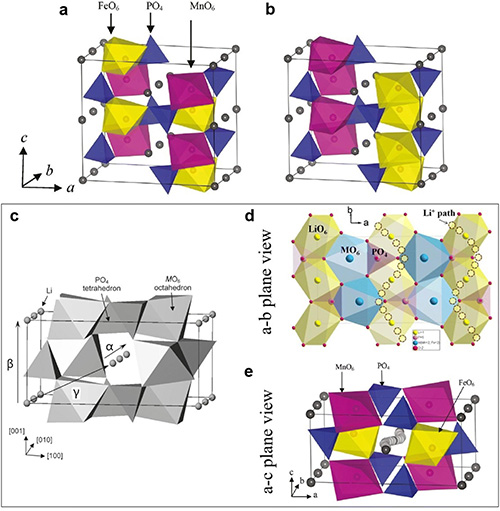
The general chemical formula of LMFP is:
LiMnₓFe₁₋ₓPO₄ (0 ≤ x ≤ 1)
In this formula:
- x: Represents the manganese fraction in the transition-metal sublattice.
- 1 − x: Represents the iron fraction.
- Mn/Fe ratio: Describes the relative proportion of manganese and iron.
For example, an LMFP composition with x = 0.5 contains equal molar proportions of manganese and iron.
The Mn/Fe ratio can be expressed as follows:
Mn/Fe Ratio = x / (1 − x)
Different compositions produce different electrochemical characteristics.
- Higher manganese content generally increases the contribution of the higher-voltage manganese redox reaction.
- Higher iron content increases the relative contribution of the iron redox reaction.
- Intermediate compositions combine the electrochemical characteristics of both transition metals.
Because manganese and iron occupy corresponding transition-metal sites in the olivine structure, their distribution and compositional uniformity are also important for achieving consistent material performance.
2. How Mn/Fe Ratio Affects the Operating Voltage
One of the main reasons for incorporating manganese into LFP-based cathode materials is to increase the operating voltage.
This improvement originates from the different redox potentials of iron and manganese.
2.1 Iron and Manganese Redox Reactions
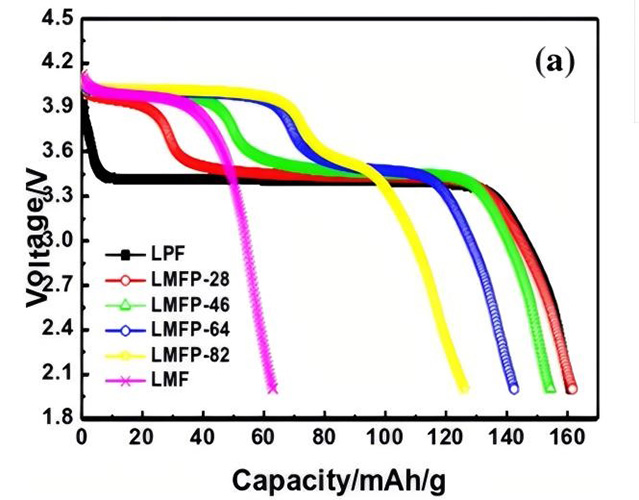
In LFP, the Fe²⁺/Fe³⁺ redox reaction produces a relatively stable voltage plateau at approximately 3.4 V versus Li/Li⁺.
In LMFP, manganese introduces an additional Mn²⁺/Mn³⁺ redox reaction, typically associated with a higher voltage plateau around 4.1 V versus Li/Li⁺.
As a result, LMFP can exhibit two distinct voltage regions corresponding to iron and manganese electrochemical activity.
2.2 Effect of Increasing Manganese Content
As the manganese fraction increases, the contribution of the higher-voltage manganese redox reaction generally becomes more significant.
This can increase the average discharge voltage of the material.
However, the relationship between manganese content and voltage is influenced by phase composition, reaction kinetics and electrochemical testing conditions.
A higher manganese fraction does not automatically guarantee better overall battery performance.
The actual voltage profile also depends on electrode formulation, particle characteristics and the charge-discharge conditions.
3. Effect of Mn/Fe Ratio on Specific Capacity and Energy Density
The Mn/Fe ratio affects both specific capacity and energy density, although these two properties do not necessarily change in the same direction.
3.1 Specific Capacity
The theoretical specific capacity of LMFP is approximately 170 mAh/g, based on one-electron redox activity per formula unit.
However, the practical specific capacity depends on how much of the active material participates in electrochemical reactions.
Manganese content can influence the utilisation of active material through changes in electronic conductivity, lithium-ion diffusion and reaction kinetics.
When manganese content becomes too high, slower reaction kinetics and manganese-related structural changes may limit the achievable discharge capacity under certain conditions.
Therefore, the practical capacity depends on both material composition and the effectiveness of material modification.
3.2 Energy Density
Energy density is determined by the product of specific capacity and average operating voltage.
The relationship can be expressed as:
Specific Energy (Wh/kg) = Specific Capacity (Ah/kg) × Average Voltage (V)
Increasing manganese content can improve the average operating voltage, potentially increasing energy density.
However, if the increase in manganese content causes a significant reduction in practical specific capacity, the energy-density benefit may become smaller.
The relationship between manganese content and energy density is therefore not necessarily linear.
An appropriate Mn/Fe ratio should provide a favourable balance between higher operating voltage and sufficient specific capacity.
4. Effect of Mn/Fe Ratio on Cycling Stability
Cycling stability is another important factor affected by manganese content.
Although manganese contributes to a higher operating voltage, excessive manganese can increase the challenges associated with structural degradation during repeated charge and discharge.
4.1 Jahn-Teller Distortion
During electrochemical cycling, Mn³⁺ ions can undergo Jahn-Teller distortion.
This phenomenon results from the electronic configuration of Mn³⁺ and causes distortion of the surrounding metal-oxygen coordination environment.
Repeated structural changes during charging and discharging may contribute to:
- Local lattice deformation.
- Increased structural strain.
- Particle cracking under demanding conditions.
- Reduced structural stability during long-term cycling.
A higher manganese fraction can increase the significance of manganese-related structural challenges, although the actual effect depends on the material structure and modification strategy.
4.2 Manganese Dissolution
Manganese dissolution is another concern in LMFP cathode materials.
Under certain electrochemical and temperature conditions, manganese species can dissolve from the cathode surface into the electrolyte.
Dissolved manganese may migrate toward the negative electrode, contributing to interfacial degradation and loss of active lithium.
This process can negatively affect capacity retention and long-term battery performance.
Controlling manganese distribution, adjusting composition and applying suitable surface modification techniques are important approaches for improving cycling stability.
5. Effect of Mn/Fe Ratio on Electronic Conductivity and Rate Capability
Manganese and iron also influence the electronic and ionic transport characteristics of LMFP.
The olivine structure has relatively restricted lithium-ion transport pathways, while the electronic conductivity of LMFP is generally low.
Increasing manganese content can make these transport limitations more challenging, depending on the composition and material structure.
Poor electronic conductivity and limited lithium-ion diffusion can result in:
- Increased electrode polarisation.
- Lower active material utilisation at high rates.
- Reduced discharge capacity under demanding current conditions.
- Greater sensitivity to low-temperature operation.
These effects explain why manganese content must be considered together with particle size, carbon coating and conductive network design.
Appropriate material modification can help compensate for transport limitations and improve the electrochemical performance of different LMFP compositions.
6. Relationship Between Mn/Fe Ratio and LMFP Performance
The following table summarises the general relationships between manganese content and important LMFP performance parameters.
| Performance Parameter | Effect of Increasing Mn Content | Main Consideration |
|---|---|---|
| Operating Voltage | Generally increases | Greater contribution from Mn²⁺/Mn³⁺ redox activity |
| Specific Capacity | May decrease under certain conditions | Reaction kinetics and active material utilisation |
| Energy Density | Can initially improve, but is composition-dependent | Balance between average voltage and practical capacity |
| Cycling Stability | May become more challenging | Jahn-Teller distortion and manganese dissolution |
| Electronic Conductivity | Can become more difficult to maintain | Requires suitable conductive modification |
| Lithium-Ion Transport | May become more challenging | Particle size and structural optimisation |
| Structural Stability | Requires greater attention at higher Mn content | Composition control and surface engineering |
These trends describe general compositional effects. Actual results depend on synthesis conditions, material structure and electrochemical testing parameters.
Optimising the Mn/Fe ratio involves balancing energy density, capacity retention and material stability.
There is no universally optimal composition for every LMFP application.
Several factors should be considered when selecting a suitable manganese fraction.
7.1 Balance Operating Voltage and Specific Capacity
Increasing manganese content can raise the average operating voltage, but the resulting material must retain sufficient practical discharge capacity.
Composition screening should therefore evaluate both voltage characteristics and specific capacity rather than relying on voltage improvement alone.
7.2 Consider Cycling Stability
A composition with a higher initial energy output may not provide the best long-term performance if manganese-related degradation becomes significant.
Cycling tests under controlled conditions are necessary to evaluate capacity retention and structural stability.
7.3 Improve Material Conductivity
Carbon coating, conductive additives and particle-size optimisation can help improve electronic transport and lithium-ion diffusion.
These modification strategies may allow different Mn/Fe compositions to achieve more balanced electrochemical performance.
7.4 Ensure Uniform Elemental Distribution
The uniformity of manganese and iron distribution is important for producing consistent LMFP materials.
Local manganese-rich regions may exhibit different electrochemical behaviour from the surrounding material, potentially contributing to uneven degradation.
Therefore, precursor mixing, synthesis conditions and elemental distribution should be carefully controlled.
8. Conclusion
The Mn/Fe ratio is a key factor governing the electrochemical properties of LMFP cathode materials.
Increasing manganese content generally raises the operating voltage and can improve energy density. However, excessive manganese may introduce additional challenges related to specific capacity, electronic conductivity, lithium-ion transport and cycling stability.
The best composition depends on the intended performance requirements and the effectiveness of material modification and synthesis processes.
By balancing manganese and iron content with appropriate particle engineering, carbon coating and structural optimisation, LMFP materials can be developed with more suitable combinations of energy density, rate capability and cycling stability.
Understanding the relationship between Mn/Fe composition and electrochemical behaviour is therefore essential for the development and evaluation of advanced LMFP cathode materials.
Frequently Asked Questions (FAQ)
1. What is the Mn/Fe ratio in LMFP?
The Mn/Fe ratio describes the relative molar proportions of manganese and iron in LiMnₓFe₁₋ₓPO₄. It is determined by the value of x in the chemical formula.
2. How does manganese content affect LMFP voltage?
Increasing manganese content generally increases the contribution of the higher-voltage Mn²⁺/Mn³⁺ redox reaction, which can raise the average operating voltage.
3. Does higher manganese content always improve LMFP energy density?
No. Higher manganese content can increase average voltage, but it may also affect practical specific capacity and reaction kinetics. Energy density depends on the balance between capacity and average voltage.
4. How does the Mn/Fe ratio affect LMFP cycling stability?
Higher manganese content can increase the challenges associated with Jahn-Teller distortion and manganese dissolution, potentially affecting structural stability and capacity retention.
5. What is the role of iron in LMFP?
Iron contributes to the lower-voltage Fe²⁺/Fe³⁺ redox reaction and forms part of the olivine phosphate structure. Adjusting iron content helps balance the electrochemical properties of LMFP.
6. Is there an ideal Mn/Fe ratio for LMFP?
There is no universally optimal Mn/Fe ratio. The appropriate composition depends on the desired operating voltage, specific capacity, cycling stability, synthesis conditions and intended battery application.
References
- [1] Liu, H., Deng, X., Wang, S., Zhang, B., & Li, Y. (2025). Optimization of Fe/Mn Content Ratio of LiMn₁₋ₓFeₓPO₄ Cathodes by Experiment and Calculation. Langmuir, 41(24), 15450–15460.
- [2] Yao, M., Wang, Y.-T., Chen, J.-A., Dong, H., Li, M., Zhang, X., Wang, C., Huang, G., & Xu, S. (2024). Mn-Rich Induced Alteration on Band Gap and Cycling Stability Properties of LiMnₓFe₁₋ₓPO₄ Cathode Materials. ACS Applied Materials & Interfaces, 16(48), 66077–66088.
- [3] Huang, W., Hu, J., Yang, L., Zhao, W., Wang, Z., Wang, H., Guo, Z., Li, Y., Liu, J., Yang, K., & Pan, F. (2019). Revealing the Degradation Mechanism of LiMnₓFe₁₋ₓPO₄ by the Single-Particle Electrochemistry Method. ACS Applied Materials & Interfaces, 11(1), 957–962.
- [4] Ricci, B., Mocanu, F.-C., Chatzogiannakis, D., Fuentes, V., Black, A. P., Cluzeau, B., Tessier, C., Bernard, P., Islam, M. S., & Palacín, M. R. (2026). Investigating the Asymmetric Electrochemical, Structural and Electronic Properties of Mn-Rich Li(Mn,Fe)PO₄ Electrode Materials. Journal of Materials Chemistry A, 14, 12351–12361.
Further Reading
- LMFP vs LFP: What’s the Difference and Why LMFP Is Gaining Momentum
- LMFP vs NCM Cathode Materials: Key Differences for Next-Generation Lithium-Ion Batteries
- LMFP Cathode Material: Crystal Structure, Composition and Electrochemical Properties
- LMFP Synthesis Methods: Solid-State and Liquid-Phase Processes
- Sodium-Ion Battery Materials: Key Components, Advantages and Future Trends
Looking for High-Purity Materials for Battery Research?
The performance of advanced cathode materials depends on precise chemical composition, raw material purity and consistent material quality.
VIMATERIAL supplies a wide range of high-purity inorganic materials for battery research, material development and industrial applications.
Whether you are evaluating new cathode compositions or sourcing materials for research and production, our team can help discuss your technical requirements and customised supply needs.
Contact VIMATERIAL to discuss your material requirements.