| Product ID | Formula | Purity | Dimension | Quantity | Price in € | Inquiry |
|---|---|---|---|---|---|---|
| 032526150800PD001 | LiMn0.2Fe0.8PO4 | 99% | D50=0.3-0.7 μm | 100g | POR | Inquire |
| 032526150800PD002 | LiMn0.6Fe0.4PO4 | 99% | D50=1.2-1.6 μm | 100g | POR | Inquire |
| 032526150800PD003 | LiMn0.7Fe0.3PO4 | 99% | D50=1.2-1.6 μm | 100g | POR | Inquire |
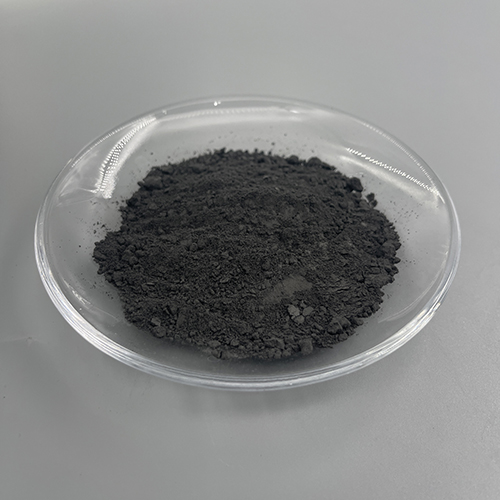
Lithium manganese iron phosphate powder is an advanced phosphate-based cathode material for lithium-ion batteries. Commonly represented by the general formula LiFe₁₋ₓMnₓPO₄, LMFP combines the structural stability and safety characteristics of lithium iron phosphate (LFP) with the higher operating voltage potential of lithium manganese phosphate (LMP).
By adjusting the manganese-to-iron ratio, particle size, morphology, and carbon-coating structure, LMFP can be engineered to achieve a balance of energy density, thermal stability, cycle life, and cost efficiency. It is being increasingly investigated for next-generation lithium-ion batteries used in electric vehicles, energy storage systems, power tools, and other high-performance applications.
| Property | Description |
| Material | Lithium Manganese Iron Phosphate |
| Abbreviation | LMFP |
| General Formula | LiMnₓFe₁₋ₓPO₄ |
| Appearance | Gray powder |
| Crystal Structure | Olivine-type phosphate structure |
| Water Solubility | Generally insoluble or very slightly soluble in water |
| Thermal Stability | High thermal and structural stability |
| Typical Application | Lithium-ion battery cathode material |
| Item | Standard | |||
| LiMn0.2Fe0.8PO4 | LiMn0.6Fe0.4PO4 | LiMn0.7Fe0.3PO4 | ||
| Element Content | Li (wt%) | 4.3±0.2 | 4.4±0.3 | 4.4±0.3 |
| Fe (wt%) | 27.6±1.5 | 14.3±1.0 | 7.1±1.0 | |
| Mn (wt%) | 6.9±0.4 | 21.0±1.0 | 28.0±1.0 | |
| P (wt%) | 19.3±0.5 | 19.6±1.0 | 19.6±1.0 | |
| C (wt%) | 1.5±0.2 | 2.5±0.5 | 2.5±0.5 | |
| Size (Primary Particle) | D10 (μm) | 0.1~0.3 | 0.5~0.8 | 0.5~0.8 |
| D50 (μm) | 0.3~0.7 | 1.2~1.6 | 1.2~1.6 | |
| D90 (μm) | 6~7 | <5 | <7 | |
| D97 (μm) | 13~14 | <9 | <9 | |
| PH | 8.0~9.0 | 7.0~8.0 | 8.0~9.0 | |
| Moisture Content (ppm) | ≤1000 | ≤800 | ≤800 | |
| Initial Discharge Capacity (2.5-4.5V VS Li) |
0.1C (mAh/g) | ≥155 | – | ≥155 |
| 0.2C (mAh/g) | ≥150 | ≥155 | ≥150 | |
| C-Rate | 0.3C (mAh/g) | ≥150 | – | – |
| 0.5C (mAh/g) | ≥110 | ≥145 | ≥145 | |
LMFP offers an attractive balance between energy density and safety.
Compared with LiFePO₄, LMFP generally provides a higher average operating voltage, while maintaining the fundamental advantages of phosphate-based cathode materials. Depending on composition, morphology, carbon coating, particle size, and electrode formulation, LMFP can deliver a practical specific capacity typically in the range of approximately 120–160 mAh/g.
Its electrochemical performance is strongly influenced by manganese content and material engineering. In particular, the relatively low intrinsic electronic and lithium-ion conductivity of LMFP makes particle-size control, carbon coating, and conductive-network design important factors in achieving high-rate performance.
| Property | LMFP | LFP |
| Main Composition | LiMnₓFe₁₋ₓPO₄ | LiFePO₄ |
| Average Voltage | Higher | Lower |
| Potential Energy Density | Higher | Moderate |
| Thermal Stability | Excellent | Excellent |
| Safety | Excellent | Excellent |
| Cycle Life | High, composition-dependent | Excellent |
| Raw Material Cost | Competitive | Competitive |
| Electronic Conductivity | Relatively low; conductive modification often required | Relatively low; conductive modification often required |
| Typical Applications | EVs, ESS, power batteries | EVs, ESS, power tools |
VIMATERIAL supplies LMFP powder for battery material research, cathode development, and industrial applications. Material characteristics can be tailored according to application requirements, including:
Custom specifications may be available according to your battery chemistry, electrode formulation, and processing requirements.
Handled in a dry, clean, and well-ventilated environment. Keep the material tightly sealed and protected from moisture, contamination, and excessive heat. For long-term storage, use moisture-resistant packaging and avoid unnecessary exposure to ambient humidity.
When handling fine powders, appropriate personal protective equipment and dust-control procedures should be followed in accordance with the applicable SDS and workplace safety requirements.
Q1. What is LMFP powder?
LMFP powder is a lithium-ion battery cathode material based on lithium manganese iron phosphate, generally represented by LiMnₓFe₁₋ₓPO₄. It combines the safety and structural stability of LFP with the higher voltage potential associated with manganese substitution.
Q2. What is the difference between LMFP and LFP?
The primary difference is the partial substitution of iron with manganese. LMFP generally provides a higher operating voltage and potentially higher energy density than LFP while retaining many of LFP’s safety and thermal-stability advantages.
Q3. Is LMFP suitable for electric vehicle batteries?
Yes. LMFP is being actively investigated for EV applications because it can provide a useful balance of energy density, safety, cycle life, and material cost.
Q4. Does LMFP require carbon coating?
LMFP has relatively low intrinsic electronic conductivity. Carbon coating and/or other conductive modifications are therefore commonly used to improve electronic conductivity and rate performance.
Q5. Can LMFP powder be customized?
Yes. Depending on the application, parameters such as Mn/Fe ratio, particle size, morphology, carbon coating, surface area, and packaging can be discussed according to specific technical requirements.
VI HALBLEITERMATERIAL GmbH (VIMATERIAL) employs a stringent quality assurance system to ensure the reliability of our product quality. Strict quality control is implemented throughout the entire production chain, and for defective products, we strictly enforce the principle of rework and redo. Each batch is released only after passing detailed specification tests.
Every batch of our materials is independently tested, and, if necessary, we send samples to certified companies for testing. We provide these documents and analysis certificates with the shipment to certify that our products meet the required standards.
Contact our team of experts today and let us help you with your business!