


Lithium Manganese Iron Phosphate (LMFP) is a promising olivine-type cathode material for lithium-ion batteries. Its higher operating voltage compared with lithium iron phosphate (LFP) provides an opportunity to improve energy density while retaining the structural stability associated with phosphate-based materials.
However, LMFP has several material-related limitations, including low intrinsic electronic conductivity, restricted lithium-ion diffusion and challenges associated with manganese dissolution and structural degradation during cycling.
These limitations can affect rate capability, low-temperature performance and long-term cycling stability.
To address these challenges, various LMFP modification strategies have been investigated. Common approaches include carbon coating, nanostructuring, elemental doping and core-shell structural engineering. These techniques aim to improve electron and lithium-ion transport, stabilise the crystal structure and enhance the overall electrochemical performance of LMFP cathode materials.
1. Why Does LMFP Require Material Modification?
Although LMFP offers a higher operating voltage than LFP, its electrochemical performance is influenced by several intrinsic material characteristics.
The olivine crystal structure provides relatively restricted lithium-ion transport pathways. In addition, the electronic conductivity of LMFP is relatively low, which can increase electrode polarisation and limit the utilisation of active material during high-rate operation.
Manganese also introduces additional challenges. During electrochemical cycling, Mn³⁺ can undergo Jahn-Teller distortion, potentially causing local lattice deformation. Manganese dissolution under demanding operating conditions can further contribute to capacity degradation and reduced cycling stability.
The main objectives of LMFP modification are therefore to:
- Improve electronic conductivity and establish effective conductive networks.
- Shorten lithium-ion diffusion pathways.
- Reduce manganese dissolution and improve structural stability.
- Improve rate capability and cycling performance.
- Maintain suitable particle characteristics for electrode processing.
Different modification techniques address different aspects of these challenges. In many cases, combining multiple approaches can provide better overall performance than relying on a single modification method.
2. Carbon Coating: Improving Electronic Conductivity
Carbon coating is one of the commonly investigated modification strategies for LMFP cathode materials.
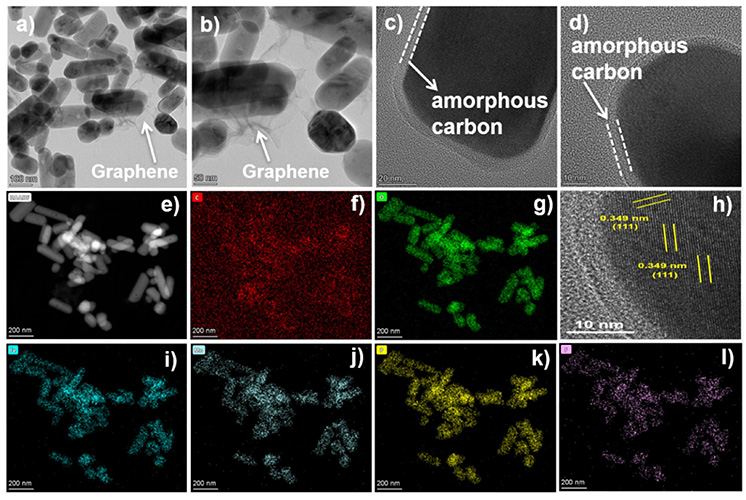
The process involves forming a conductive carbon layer around or on the surface of LMFP particles. This layer helps establish electronic connections between active material particles and improves charge transport within the electrode.
2.1 How Carbon Coating Works?
Carbon coating can improve LMFP performance through several mechanisms:
Formation of Conductive Networks
A suitable carbon layer provides additional pathways for electron transport between particles, helping compensate for the low intrinsic electronic conductivity of LMFP.
Control of Particle Growth
Carbon coating can restrict excessive crystal particle growth during thermal processing, helping control particle size and morphology.
Protection of Particle Surfaces
A suitable coating can reduce direct contact between active material surfaces and the electrolyte. It may also help limit surface degradation associated with electrolyte decomposition products.
Improved Electrochemical Reaction Kinetics
By improving electronic connectivity, carbon coating can reduce polarisation and support better utilisation of active material during charge and discharge.
2.2 Why Carbon Content Matters
The amount of carbon used during modification is an important processing parameter.
Insufficient carbon may result in incomplete surface coverage and an inadequate conductive network.
Excessive carbon, however, can cause particle agglomeration, increase inactive material content and reduce the proportion of electrochemically active material in the electrode.
Therefore, carbon content and coating uniformity need to be carefully optimised.
The objective is to achieve effective particle coverage and electronic conductivity without compromising active material loading or lithium-ion transport.
3. Nanostructuring: Improving Lithium-Ion Diffusion
Nanostructuring is another important strategy for improving the electrochemical performance of LMFP.
Reducing particle dimensions can shorten the distance lithium ions need to travel during insertion and extraction, helping improve reaction kinetics.
3.1 Reducing Particle Size
The lithium-ion diffusion distance is closely related to particle dimensions.
Smaller primary particles can provide shorter diffusion pathways, which may improve charge and discharge performance, particularly under higher-rate conditions.
Nanostructuring can also improve the accessibility of active material during electrochemical reactions.
3.2 Primary and Secondary Particle Design
LMFP powder can contain primary particles assembled into larger secondary particles.
Controlling the relationship between primary and secondary particle structures is important for balancing electrochemical performance and powder processing characteristics.
- Primary particle size: Influences lithium-ion diffusion distance and reaction kinetics.
- Secondary particle structure: Influences powder flowability, packing behaviour and electrode processing.
- Particle distribution: Affects the consistency of the powder and the resulting electrode structure.
A suitable particle design should balance short diffusion pathways with good powder handling and electrode fabrication properties.
3.3 Limitations of Nanostructuring
Although smaller particles can improve reaction kinetics, excessive particle-size reduction may introduce other challenges.
Smaller particles generally have a higher specific surface area, increasing the potential for interfacial reactions with the electrolyte.
They may also show stronger agglomeration tendencies and lower tap density, which can affect electrode processing and volumetric energy density.
Therefore, nanostructuring should be combined with appropriate surface modification and particle morphology control.
4. Elemental Doping: Modifying the Crystal Structure
Elemental doping involves introducing selected metal ions or other elements into the LMFP material during synthesis.
The purpose is to modify the local crystal environment and influence properties such as structural stability, electronic conductivity and lithium-ion transport.
4.1 Mechanism of Elemental Doping
Depending on the dopant type, concentration and substitution site, doping may influence:
- Local crystal structure and lattice parameters.
- Defect concentration and charge compensation.
- Electronic transport properties.
- Lithium-ion diffusion behaviour.
- Structural stability during repeated cycling.
Doping strategies are generally designed to improve the electrochemical properties of LMFP without significantly disrupting its olivine framework.
4.2 Metal-Ion Doping
Selected metal ions have been investigated for modifying LMFP cathode materials.
For example, magnesium (Mg), aluminium (Al) and niobium (Nb) have been explored in phosphate-based cathode material research.
Their effects depend on the specific composition and synthesis conditions.
Potential objectives include improving structural stability, modifying defect chemistry and reducing performance degradation during cycling.
However, excessive dopant concentrations or unsuitable substitution mechanisms may introduce secondary phases or interfere with lithium-ion transport.
Therefore, dopant selection and concentration require systematic evaluation.
5. Core-Shell Structure and Concentration-Gradient Design
Surface engineering is another approach used to address manganese-related degradation in LMFP.
The basic concept is to modify the composition or structure of the particle surface while maintaining a suitable active material composition in the particle interior.
Two important approaches are core-shell structures and concentration-gradient designs.
5.1 Core-Shell Structure
A core-shell design consists of an inner LMFP particle surrounded by a modified outer layer.
Depending on the material system, the shell may contain carbon, metal phosphates or other suitable protective components.
This structure can provide several benefits:
- Reduce direct contact between manganese-rich regions and the electrolyte.
- Help limit manganese dissolution.
- Improve surface stability during electrochemical cycling.
- Provide additional protection against surface degradation.
The effectiveness of a core-shell structure depends on shell composition, thickness, uniformity and interfacial compatibility.
5.2 Concentration-Gradient Design
Concentration-gradient engineering involves controlling the distribution of manganese and iron across the particle.
For example, the manganese concentration can be designed to be lower near the particle surface while maintaining a different composition in the interior.
This approach aims to reduce manganese-related surface degradation while retaining the higher-voltage contribution of manganese within the active material.
Compared with a conventional uniform composition, a concentration-gradient structure provides an additional way to manage the relationship between energy output and structural stability.
However, producing a consistent gradient requires precise control of precursor composition and synthesis conditions.
6. Conductive Additives: Carbon Nanotubes and Conductive Carbon
In addition to modifying individual LMFP particles, conductive additives can improve the electrical connectivity of the cathode electrode.
Common conductive additives include carbon black, conductive carbon fibres and carbon nanotubes (CNTs).
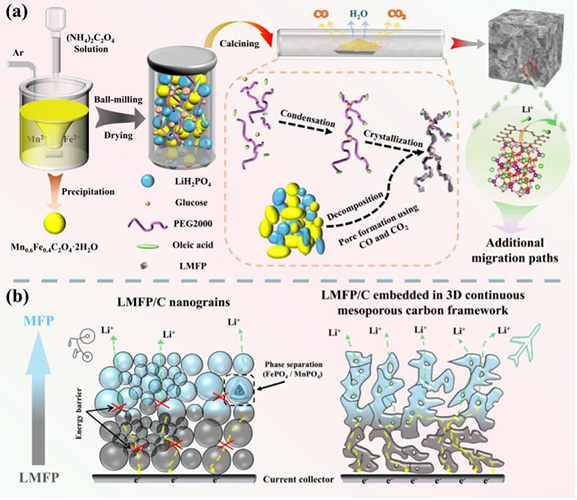
Carbon nanotubes have a high aspect ratio and can form interconnected conductive networks throughout the electrode.
6.1 How CNTs Improve LMFP Performance?
When properly dispersed, CNTs can connect active material particles and improve electron transport across the electrode.
Potential benefits include:
- Improved electronic conductivity.
- Reduced interparticle resistance.
- Better charge and discharge rate performance.
- Improved low-temperature discharge behaviour.
- Potential improvement in cycling stability.
However, CNTs need to be uniformly dispersed in the electrode slurry to achieve these benefits.
Poor dispersion can result in agglomeration and an uneven conductive network.
It is also important to distinguish conductive additives from particle-level modification: CNTs mainly improve the conductive network within the electrode, while carbon coating directly modifies the surface of active material particles.
7. Lithium Compensation: Addressing Initial Capacity Loss
Lithium compensation is another strategy investigated for improving the initial electrochemical performance of lithium-ion batteries.
During the first charge-discharge cycle, irreversible lithium consumption can occur due to interfacial reactions and other side reactions.
This reduces the amount of lithium available for subsequent reversible cycling.
Lithium compensation involves introducing additional lithium sources to offset part of this initial lithium loss.
Depending on the material system, lithium compensation may involve lithium-rich compounds or other lithium-containing additives.
Its effectiveness depends on the selected additive, dosage, reaction behaviour and compatibility with the electrode system.
Lithium compensation can help improve initial discharge capacity, although its benefits under high-rate conditions and long-term cycling require separate evaluation.
8. Comparison of LMFP Modification Strategies
Different modification techniques target different limitations of LMFP. Their selection depends on the desired material properties and the intended battery application.
| Modification Strategy | Main Objective | Potential Benefits | Key Considerations |
|---|---|---|---|
| Carbon Coating | Improve particle-level electronic conductivity | Better conductive connectivity and surface protection | Carbon content and coating uniformity |
| Nanostructuring | Shorten lithium-ion diffusion pathways | Improved reaction kinetics and rate capability | Specific surface area and particle agglomeration |
| Elemental Doping | Modify crystal structure and defect chemistry | Potential improvement in structural stability and transport properties | Dopant type, concentration and secondary phases |
| Core-Shell Structure | Modify and protect particle surfaces | Reduced manganese exposure and improved surface stability | Shell composition, thickness and uniformity |
| Concentration-Gradient Design | Control manganese distribution within particles | Potential reduction in manganese-related surface degradation | Precise composition and process control |
| Conductive Additives | Improve electrode-level electron transport | Better conductive networks and rate performance | Dispersion and electrode formulation |
| Lithium Compensation | Offset initial irreversible lithium loss | Potential improvement in initial discharge capacity | Additive compatibility and dosage |
No single modification strategy can address every limitation of LMFP. The best approach depends on the target composition, synthesis route, particle design and electrochemical requirements.
9. Conclusion
LMFP modification is essential for improving the electrochemical performance and practical applicability of phosphate-based cathode materials.
Carbon coating and conductive additives help address electronic conductivity limitations, while nanostructuring can shorten lithium-ion diffusion pathways.
Elemental doping provides opportunities to modify crystal structure and defect chemistry. Core-shell and concentration-gradient designs focus on improving surface stability and controlling manganese-related degradation.
Lithium compensation offers another approach to reducing initial irreversible capacity loss.
Combining suitable modification strategies with controlled synthesis and particle engineering can help improve LMFP conductivity, rate capability and cycling stability.
As research into LMFP cathode materials continues, the optimisation of composition, surface structure and particle characteristics will remain important for developing materials with more consistent electrochemical performance.
Frequently Asked Questions (FAQ)
1. Why does LMFP need modification?
LMFP has relatively low intrinsic electronic conductivity and limited lithium-ion diffusion. Manganese-related structural changes and dissolution can also affect cycling stability. Modification techniques help address these limitations.
2. How does carbon coating improve LMFP performance?
Carbon coating creates conductive pathways around active material particles, improving electronic transport. It can also help control particle growth and reduce direct contact between particle surfaces and the electrolyte.
3. Does reducing LMFP particle size improve performance?
Reducing particle size can shorten lithium-ion diffusion pathways and improve reaction kinetics. However, excessively small particles may increase specific surface area, agglomeration and processing difficulties.
4. What is the purpose of elemental doping in LMFP?
Elemental doping is used to modify the local crystal structure and defect chemistry, potentially improving structural stability and electronic or ionic transport properties.
5. What is the difference between carbon coating and conductive additives?
Carbon coating modifies the surface of individual active material particles, while conductive additives such as carbon black and CNTs establish conductive networks throughout the electrode.
6. How can core-shell structures improve LMFP stability?
A suitable outer shell can reduce direct exposure of manganese-containing regions to the electrolyte, helping limit surface degradation and manganese dissolution.
7. Can different LMFP modification techniques be combined?
Yes. Carbon coating, particle-size control, elemental doping and structural engineering can be combined. Their compatibility and overall effectiveness need to be evaluated through material characterisation and electrochemical testing.
References
- [1] Chi, Z. X., Zhang, W., Wang, X. S., Cheng, F. Q., Chen, J. T., Cao, A. M., & Wan, L. J. (2014). Accurate Surface Control of Core-Shell Structured LiMn₀.₅Fe₀.₅PO₄@C for Improved Battery Performance. Journal of Materials Chemistry A, 2, 17359–17365.
- [2] Ruan, T., Wang, B., Wang, F., Song, R., Jin, F., Zhou, Y., Wang, D., & Dou, S. (2019). Stabilizing the Structure of LiMn₀.₅Fe₀.₅PO₄ via the Formation of Concentration-Gradient Hollow Spheres with Fe-Rich Surfaces. Nanoscale, 11, 3933–3944.
- [3] Hu, H., Li, H., Lei, Y., Liu, J., Liu, X., Wang, R., Peng, J., & Wang, X. (2023). Mg-Doped LiMn₀.₈Fe₀.₂PO₄/C Nano-Plate as a High-Performance Cathode Material for Lithium-Ion Batteries. Journal of Energy Storage, 73, 109006.
- [4] Pan, D., et al. (2024). Modification of LiMn₀.₆Fe₀.₄PO₄ Lithium-Ion Battery Cathode Materials with a Fluorine-Doped Carbon Coating. Particuology, 92, 278–287.
- [5] Niu, S., et al. (2025). Synergistic Surface Coating and Doping Modification Strategy for High Rate and Stable LiFe₀.₄Mn₀.₆PO₄ Cathode Materials. Acta Materialia, 293, 121117.
Further Reading
- LMFP vs LFP: What’s the Difference and Why LMFP Is Gaining Momentum
- LMFP vs NCM Cathode Materials: Key Differences for Next-Generation Lithium-Ion Batteries
- LMFP Cathode Material: Crystal Structure, Composition and Electrochemical Properties
- LMFP Synthesis Methods: Solid-State and Liquid-Phase Processes
- Sodium-Ion Battery Materials: Key Components, Advantages and Future Trends
Looking for Advanced Materials for Battery Research?
Developing high-performance cathode materials requires careful selection of raw materials, controlled compositions and consistent material quality.
VIMATERIAL supplies a wide range of high-purity inorganic materials for battery research, advanced ceramics and other industrial applications.
Whether you are working on material development, laboratory research or customised material requirements, our team is available to discuss your needs.
Contact VIMATERIAL for discuss your material requirements and technical specifications.