


Yttria-stabilized zirconia (YSZ) powder is used as a ceramic supporting material in high-temperature and high-pressure (HPHT) diamond synthesis. Under demanding HPHT conditions, the consistency of supporting components can be affected by the Y₂O₃ content, chemical purity, particle size, powder density, and crystal phase of the YSZ powder. The selection of the right grade of Yttria-Stabilized Zirconia Powder for HPHT diamond production requires more than simply choosing a high-purity zirconia material. Y₂O₃ content, impurity levels, powder characteristics, and XRD phase composition should be evaluated together according to the specific process and diamond quality requirements.
This article focuses on the key factors to consider when selecting YSZ powder for HPHT diamond synthesis, with particular attention to 5Y and 8Y YSZ, chemical purity, particle size, bulk density, and crystal phase.
Why YSZ Powder Is Used in HPHT Diamond Synthesis
HPHT diamond synthesis requires supporting materials that can maintain suitable thermal and mechanical performance under high-temperature and high-pressure conditions.
YSZ is a stabilized zirconia material whose properties can be adjusted through the addition of yttrium oxide (Y₂O₃). Different Y₂O₃ levels result in different stabilized zirconia characteristics and phase compositions.
For HPHT applications, the main factors to consider include:
- Thermal stability for high-temperature processing
- Mechanical stability under high-pressure conditions
- Controlled chemical composition to minimize unwanted impurities
- Consistent crystal phase for stable material performance
- Uniform powder properties for reliable forming and sintering
Therefore, YSZ powder should be selected based on its complete material profile rather than a single specification.
For a general introduction to YSZ composition, properties, and applications, see What Is YSZ Material?
5Y vs 8Y YSZ Powder: Which Grade Is More Suitable?
The Y₂O₃ content is one of the most important parameters when selecting stabilized zirconia.
Two grades that may be considered for HPHT applications are 5Y YSZ and 8Y YSZ.
| Parameter | 5Y YSZ | 8Y YSZ |
|---|---|---|
| Y₂O₃ level | Approximately 5 mol% | Approximately 8 mol% |
| Approx. Y₂O₃ by weight | Around 5.2 wt% | Around 8.8 wt% |
| Phase characteristics | Commonly associated with tetragonal zirconia | Higher yttria stabilization and cubic-phase characteristics |
| Main consideration | Mechanical stability and phase control | Specific phase and process requirements |
5Y YSZ
5Y YSZ contains approximately 5 mol% Y₂O₃, corresponding to around 5.2 wt% Y₂O₃.
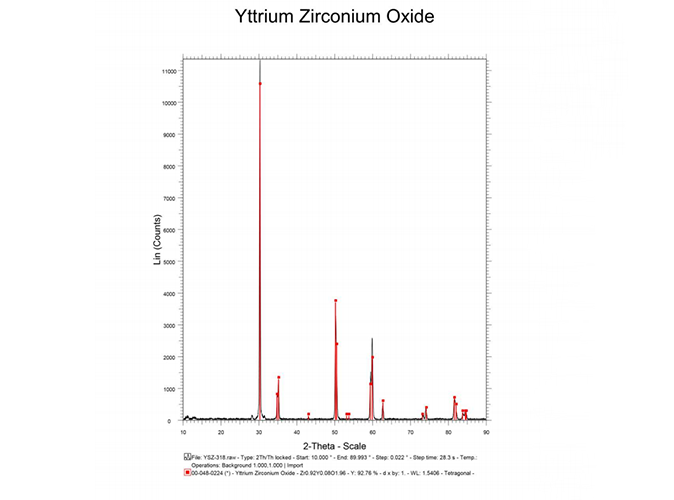
Based on the supplied XRD characterization, the 5Y material is associated with a tetragonal zirconia phase. For applications where mechanical stability, thermal-shock resistance, and controlled phase composition are important, 5Y YSZ can be considered as a suitable grade.
For high-quality HPHT diamond production, a 5Y grade with controlled impurities and consistent powder properties may be preferred when these characteristics are key process requirements.
8Y YSZ
8Y YSZ contains approximately 8 mol% Y₂O₃, corresponding to around 8.8 wt% Y₂O₃.
In the supplied batch report, the measured Y₂O₃ content was 8.85%, within the stated specification of 8.8 ± 0.3%. Zr(Hf)O₂ was measured at 90.7%, compared with a specification of ≥90.5%.
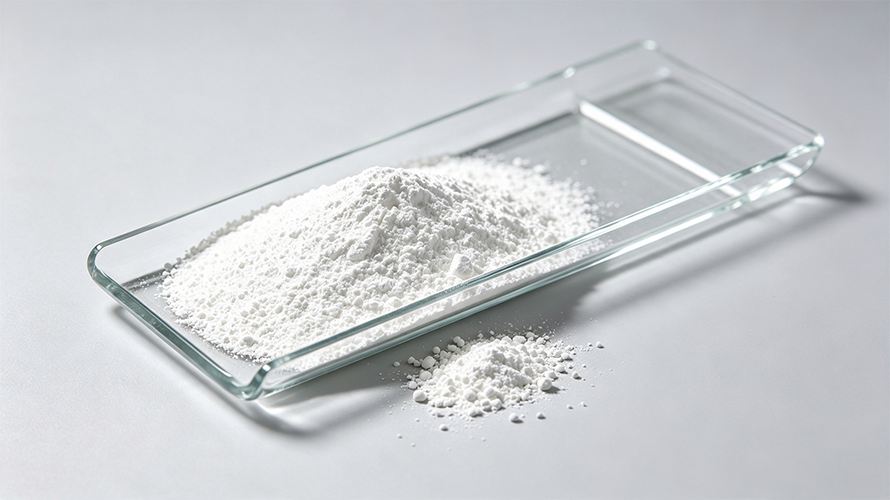
8Y YSZ should not simply be considered a higher- or lower-quality version of 5Y YSZ. Its suitability should be evaluated according to the required phase characteristics, mechanical properties, HPHT process conditions, and final product requirements.
Understanding mol% and wt%
When comparing YSZ specifications, it is important to distinguish between mol% and wt%.
As commonly used grades:
- 5 mol% YSZ ≈ 5.2 wt% Y₂O₃
- 8 mol% YSZ ≈ 8.8 wt% Y₂O₃
When purchasing YSZ powder, buyers should therefore check both the nominal grade and the actual measured Y₂O₃ content.
Purity and Impurity Control for HPHT Diamond Applications
Chemical purity is another important consideration when selecting yttria stabilized zirconia powder for HPHT diamond production.
Trace impurities such as Al, Fe, Ti, and Si should be controlled according to the requirements of the application. For high-purity processes, batch-specific chemical analysis can provide useful information for incoming quality control.
Example YSZ Powder COA Data
The following data are from a supplied 8Y YSZ batch test report:
| Parameter | Specification | Tested Value |
|---|---|---|
| Y₂O₃ | 8.8 ± 0.3% | 8.85% |
| Zr(Hf)O₂ | ≥90.5% | 90.7% |
| Al₂O₃ | <0.01% | 0.002% |
| Fe₂O₃ | <0.01% | 0.0007% |
| TiO₂ | <0.01% | 0.0005% |
| SiO₂ | <0.01% | 0.003% |
| Loss on Ignition (LOI) | <0.6% | 0.22% |
| Moisture | <0.5% | 0.31% |
The report shows that the measured Al₂O₃, FeO₃, TiO₂, and SiO₂ levels were within the stated specifications. The measured LOI and moisture values were also within their specified limits.
Why Are Trace Impurities Important?
For high-purity HPHT applications, impurity control helps minimize unwanted material input from the ceramic supporting material.
In particular, Al₂O₃, Fe₂O₃, TiO₂, and SiO₂ should be included in the chemical specification when they are relevant to the production process.
The supplied batch, for example, contained 0.002% Al₂O₃, 0.0007% FeO₃, 0.0005% TiO₂, and 0.003% SiO₂.
Moisture and Loss on Ignition
Moisture and loss on ignition are also useful parameters for YSZ powder used in high-temperature processing.
Excess moisture or volatile components may contribute to gas release during heating. Controlling these values can therefore help improve process consistency.
The supplied batch showed a 0.22% LOI and 0.31% moisture, compared with limits of <0.6% and <0.5%, respectively.
Particle Size, Surface Area and Bulk Density
Chemical composition alone does not fully describe the performance of a ceramic powder.
For YSZ powder, D50, specific surface area (SSA), and bulk density can affect powder handling, packing, forming, and sintering behavior.
D50 Particle Size
D50 represents the median particle size of the powder.
The supplied material information gives a D50 of approximately 0.22 μm.
Particle size can influence:
- Powder packing
- Forming behavior
- Sintering activity
- Density uniformity
- Agglomeration
A smaller particle size is not necessarily better. Excessively fine powders may have stronger agglomeration tendencies, while overly coarse powders may result in less uniform packing.
Therefore, D50 should be evaluated together with the other powder characteristics.
Specific Surface Area
Specific surface area provides additional information about powder activity and surface characteristics.
It can help assess:
- Sintering behavior
- Powder activity
- Agglomeration tendency
- Batch consistency
For fine YSZ powder, D50 and SSA should be considered together rather than treated as independent specifications.
Bulk Density
Bulk density affects powder filling and packing behavior during processing.
A suitable and consistent bulk density can contribute to more uniform powder filling and forming. For HPHT applications, it is therefore useful to evaluate D50, SSA, and bulk density as a combined powder-property profile.
Why XRD Phase Analysis Matters for YSZ Powder
X-ray diffraction (XRD) is an important method for verifying the crystal phase of YSZ powder.
The phase composition of stabilized zirconia is related to Y₂O₃ content and material processing. Therefore, chemical analysis alone does not provide a complete description of the material.
XRD can be used to evaluate the presence and relative characteristics of:
- Tetragonal zirconia
- Cubic zirconia
- Monoclinic zirconia
The supplied XRD characterization identifies the tested material as tetragonal yttrium zirconium oxide, providing an example of why phase analysis is useful when evaluating YSZ powder.
Why Monitor the Monoclinic Phase?
The transformation between tetragonal and monoclinic zirconia is associated with a volume change. A high level of unwanted monoclinic phase may therefore affect the mechanical stability of zirconia-based ceramic components.
For this reason, XRD testing can be used as an additional quality-control method to verify phase composition and monitor batch-to-batch consistency.
YSZ Powder Selection Checklist for HPHT Diamond Production
When purchasing YSZ powder for HPHT diamond synthesis, the following parameters should be reviewed together:
| Parameter | What to Check | Why It Matters |
|---|---|---|
| Y₂O₃ content | Nominal grade and actual value | Defines the stabilized zirconia grade |
| Zr(Hf)O₂ | Purity level | Confirms the main material composition |
| Al₂O₃ | Trace impurity level | Controls aluminum-related impurities |
| Fe₂O₃ | Trace impurity level | Controls iron-related impurities |
| TiO₂ | Trace impurity level | Controls titanium-related impurities |
| SiO₂ | Trace impurity level | Controls silicon-related impurities |
| Moisture | Actual value | Helps evaluate high-temperature processing behavior |
| LOI | Actual value | Indicates weight loss during heating |
| D50 | Particle size | Influences packing and forming |
| SSA | Specific surface area | Helps evaluate powder activity and agglomeration |
| Bulk density | Measured value | Helps assess filling and packing consistency |
| XRD | Crystal phase | Verifies phase composition |
For demanding applications, a supplier should ideally be able to provide batch-specific COA data together with relevant powder-property and XRD information.
How to Choose the Right YSZ Powder
A practical yttria stabilized zirconia powder powder selection process can be simplified into five steps:
1. Define the Y₂O₃ grade
Determine whether 5Y, 8Y, or another stabilized zirconia grade is appropriate for the specific HPHT process.
2. Set impurity requirements
Define acceptable levels for Al, Fe, Ti, Si, and other relevant impurities according to the required material purity.
3. Specify powder properties
Evaluate D50, SSA, bulk density, and other relevant physical characteristics.
4. Verify crystal phase
Use XRD to confirm the required phase composition and monitor consistency between batches.
5. Check batch consistency
Compare actual COA and test data across batches instead of relying only on nominal product specifications.
The key principle is simple: select YSZ powder based on the complete material profile, not on Y₂O₃ content or purity alone.
Frequently Asked Questions
1. What is 5Y YSZ powder?
Lorem ipsum dolor sit amet, consectetur adipiscing elit. Ut elit tellus, luctus nec ullamcorper mattis, pulvinar dapibus leo.
2. What is the difference between 5Y and 8Y YSZ?
The main difference is the Y₂O₃ stabilization level. 5Y YSZ contains approximately 5 mol% Y₂O₃, while 8Y YSZ contains approximately 8 mol%. The difference in yttria content results in different phase characteristics and material properties.
3. Why is Y₂O₃ content important in YSZ powder?
Y₂O₃ content influences the stabilized zirconia structure and phase characteristics. The actual Y₂O₃ content should therefore be controlled within an appropriate specification range for consistent material performance.
4. What should be checked when purchasing YSZ powder for HPHT applications?
Important parameters include Y₂O₃ content, Zr(Hf)O₂ purity, Al/Fe/Ti/Si impurities, D50, SSA, bulk density, moisture, LOI, and XRD phase composition.
5. Why is XRD important for YSZ powder?
XRD helps verify the crystal phase composition of YSZ powder and provides an additional method for monitoring material consistency between batches.
References
- [1] Vasanthavel, S., Kannan, S. “Structural investigations on the tetragonal to cubic phase transformations in zirconia induced by progressive yttrium additions.” Journal of Physics and Chemistry of Solids, 112, 100–105, 2018.
- [2] Nakamura, K., et al. “Critical evaluations on the crystallographic properties of translucent dental zirconia ceramics stabilized with 3–6 mol% yttria.” Dental Materials, 40(9), 1425–1451, 2024.
- [3] Rhodes, W. H. “Agglomerate and Particle Size Effects on Sintering Yttria-Stabilized Zirconia.” Journal of the American Ceramic Society, 64(1), 19–22, 1981.
- [4] “The Effect of Yttria Content on Microstructure, Strength, and Fracture Behavior of Yttria-Stabilized Zirconia.” Materials, 15(15), 5212, 2022.
- [5] “Effect of boron oxide on the cubic-to-monoclinic phase transition in yttria-stabilized zirconia.” Journal of the European Ceramic Society, 2004.
If you’re interested in aluminum oxynitride and other advanced ceramic materials, you may also find these articles helpful:
- What is YSZ material?
- High-Purity Yttrium Oxide: A Rare Earth Gem from Advanced Technology to Wide-Ranging Applications
- Everything You Need to Know About Yttrium Oxide Granulated Powder
- Yttrium Oxide: The Rare Earth Material Quietly Supporting Modern Industry
- Stabilized Zirconia: “Stability Is the Key to Longevity”
Need YSZ Powder for HPHT Diamond Synthesis?
VIMATERIAL supplies yttria-stabilized zirconia powder with controlled composition and purity for demanding high-temperature applications.
Depending on your requirements, parameters including Y₂O₃ content, impurity levels, particle size, specific surface area, bulk density, moisture, LOI, and crystal phase can be considered when selecting the appropriate YSZ grade.
Contact VIMATERIAL to discuss YSZ powder specifications for your HPHT diamond synthesis process.