
Sodium Manganese Iron Phosphate (NMFP), with the chemical formula NaMnₓFe₁₋ₓPO₄ (0 < x < 1), is a manganese-iron phosphate material developed for sodium-ion battery cathodes. By combining manganese (Mn) and iron (Fe) within a phosphate-based framework, NMFP provides a compositionally tunable material system for investigating and balancing operating voltage, electrochemical capacity and structural stability.
As a member of the polyanionic phosphate cathode family, NMFP benefits from the strong P–O covalent bonds within its phosphate framework. The incorporation of manganese introduces additional redox activity and provides opportunities to adjust the electrochemical properties through changes in the Mn/Fe ratio.
NMFP is attracting research interest as a potential cathode material for sodium-ion batteries, particularly in applications where material cost, resource availability and electrochemical performance need to be considered together.
VIMATERIAL supplies Sodium Manganese Iron Phosphate (NMFP) powder with customizable Mn/Fe ratios, particle sizes and carbon coating options to meet different research and material development requirements.
1. What Is Sodium Manganese Iron Phosphate (NMFP)?
Sodium Manganese Iron Phosphate is a mixed-transition-metal phosphate compound in which manganese and iron occupy transition-metal sites within the phosphate structure.
Its general chemical formula is:
NaMnₓFe₁₋ₓPO₄ (0 < x < 1)
In this formula:
- Na represents sodium.
- Mn represents manganese.
- Fe represents iron.
- PO₄ represents the phosphate group.
- x represents the manganese fraction.
- 1−x represents the iron fraction.
The manganese and iron contents can be adjusted by changing the value of x, allowing different compositions to be investigated for specific electrochemical requirements.
For example:
| Chemical Formula | Mn Fraction (x) | Fe Fraction (1−x) |
|---|---|---|
| NaMn₀.₂Fe₀.₈PO₄ | 0.2 | 0.8 |
| NaMn₀.₄Fe₀.₆PO₄ | 0.4 | 0.6 |
| NaMn₀.₅Fe₀.₅PO₄ | 0.5 | 0.5 |
| NaMn₀.₆₆Fe₀.₃₄PO₄ | 0.66 | 0.34 |
| NaMn₀.₈Fe₀.₂PO₄ | 0.8 | 0.2 |
These compositions illustrate how the Mn/Fe ratio can be varied within the NMFP material system.
The choice of composition influences the relative contributions of manganese and iron redox reactions, which can affect operating voltage, capacity and electrochemical behaviour.
2. Crystal Structure of NMFP
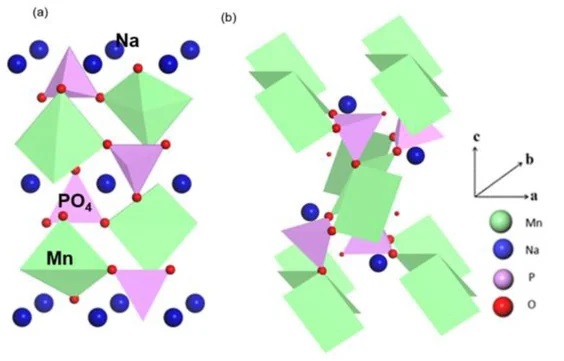
NMFP belongs to the polyanionic phosphate material family. Olivine-type structures have been investigated for sodium manganese iron phosphate compositions, including NaMn₀.₆₆Fe₀.₃₄PO₄.
In an olivine-type phosphate framework, transition-metal ions occupy metal sites within a structure formed by interconnected phosphate tetrahedra.
Several structural features are important:
Phosphate Framework
PO₄ tetrahedra form a strong covalent framework that contributes to the structural stability of the material during electrochemical reactions.
Transition-Metal Sites
Manganese and iron occupy transition-metal positions. Their relative concentrations influence the electronic structure and redox behaviour of the material.
Sodium-Ion Transport
Sodium ions move through crystallographic pathways during charging and discharging. The accessibility and mobility of these pathways influence the rate capability and electrochemical performance.
Structural Stability
The phosphate framework helps maintain structural integrity during sodium-ion insertion and extraction. However, phase stability and structural changes depend on composition, synthesis conditions and electrochemical operating conditions.
The actual crystal phase of NMFP should be confirmed through structural characterization, particularly X-ray diffraction (XRD).
3. Electrochemical Properties of NMFP
The electrochemical properties of NMFP are closely related to its manganese and iron composition, crystal structure and particle characteristics.
3.1 Operating Voltage
The operating voltage of NMFP is influenced by the redox reactions of manganese and iron.
Iron-based redox reactions generally contribute at lower potentials, while manganese-related redox reactions can contribute at higher potentials.
By adjusting the Mn/Fe ratio, researchers can investigate different voltage profiles and electrochemical responses.
A 2024 study of olivine NaMn₀.₆₆Fe₀.₃₄PO₄ reported an equilibrium potential of approximately 3.2 V versus Na/Na⁺ under the investigated conditions.
3.2 Specific Capacity
Specific capacity describes the amount of electrical charge that a cathode material can store per unit mass.
The theoretical capacity depends on the number of reversibly transferred electrons per formula unit and the molar mass of the compound.
In practice, the achievable capacity is influenced by:
- The Mn/Fe composition.
- The extent of reversible sodium-ion extraction and insertion.
- Electronic conductivity.
- Sodium-ion diffusion kinetics.
- Particle size and morphology.
- Electrode preparation and testing conditions.
Published experimental results should always be evaluated alongside their testing conditions, including current rate, voltage window and electrode configuration.
3.3 Electronic Conductivity
Phosphate cathode materials generally have relatively low intrinsic electronic conductivity.
This can limit electron transport within the electrode, particularly at higher charging and discharging rates.
Carbon coating, conductive additives and particle-size optimization are commonly investigated to improve electronic transport and electrode performance.
3.4 Cycling Stability
Cycling stability refers to the ability of a cathode material to retain its electrochemical capacity over repeated charge-discharge cycles.
The phosphate framework provides a structural basis for reversible sodium-ion reactions. Nevertheless, long-term performance depends on phase stability, transition-metal behaviour, particle morphology and electrode-electrolyte interactions.
4. Role of Manganese and Iron in NMFP
The combination of manganese and iron is a key feature of NMFP.
Both elements contribute to the electrochemical behaviour of the cathode through their respective redox couples.
4.1 Contribution of Manganese
Manganese introduces additional redox activity at relatively high potentials.
Its incorporation can help increase the operating voltage of phosphate-based cathode compositions compared with corresponding iron-rich materials.
However, manganese-related Jahn–Teller distortion, particularly when Mn³⁺ is involved, can affect local structural stability and electrochemical reversibility.
Therefore, manganese content needs to be optimized according to the desired balance between voltage and cycling performance.
4.2 Contribution of Iron
Iron provides an important redox contribution through the Fe²⁺/Fe³⁺ couple.
Iron-based phosphate materials are of interest because iron is relatively abundant and offers a practical cost profile for battery material development.
The incorporation of iron can also influence the overall redox response and structural characteristics of mixed manganese-iron phosphate materials.
4.3 Why Combine Manganese and Iron?
Combining manganese and iron provides an opportunity to adjust the electrochemical characteristics of the cathode through composition control.
The main considerations include:
- Operating voltage and voltage profile.
- Reversible specific capacity.
- Structural stability.
- Sodium-ion diffusion.
- Electronic transport.
- Long-term cycling behaviour.
The optimum Mn/Fe ratio depends on the intended battery design and should be established through experimental evaluation.
5. Synthesis Methods of NMFP
The synthesis process has a significant influence on the phase composition, crystallinity, particle morphology and electrochemical properties of NMFP.
Several preparation approaches can be considered.
5.1 Solid-State Synthesis
Solid-state synthesis is a widely investigated route for phosphate cathode materials.
The general process involves mixing appropriate sodium, manganese, iron and phosphate precursors, followed by thermal treatment under controlled conditions.
Typical processing stages include:
- Raw material selection and stoichiometric calculation.
- Mixing and homogenization of precursor materials.
- Grinding or milling to improve precursor contact.
- Thermal treatment under a controlled atmosphere.
- Cooling and subsequent powder processing.
- Phase and composition characterization.
Temperature, atmosphere, precursor chemistry and reaction time all influence the final product.
5.2 Sol-Gel Synthesis
The sol-gel method provides a route for achieving more homogeneous mixing of metal components at the precursor stage.
Metal salts are dissolved and mixed with suitable complexing agents to form a homogeneous precursor solution or gel.
After drying and thermal treatment, the precursor is converted into the desired phosphate material.
This approach can help control elemental distribution and particle morphology.
5.3 Hydrothermal Synthesis
Hydrothermal synthesis uses aqueous solutions under controlled temperature and pressure conditions.
It can provide opportunities to regulate particle morphology, crystallinity and precursor formation.
However, the suitability of this method depends on the target NMFP composition and the required phase characteristics.
5.4 Importance of Synthesis Control
Regardless of the selected method, several parameters require careful control:
| Parameter | Influence on Material |
|---|---|
| Mn/Fe Ratio | Determines transition-metal composition |
| Sodium Content | Influences phase formation and stoichiometry |
| Reaction Temperature | Affects crystallinity and phase purity |
| Atmosphere | Influences oxidation states and reaction chemistry |
| Particle Size | Affects electrode processing and reaction kinetics |
| Carbon Content | Influences electronic conductivity |
XRD, SEM, ICP and particle-size analysis can be used to evaluate different aspects of the resulting material.
6. Technical Challenges and Modification Strategies
Although NMFP offers opportunities for composition-controlled cathode development, several technical challenges remain.
| Technical Challenge | Potential Improvement Strategy |
|---|---|
| Low Electronic Conductivity | Carbon coating and conductive additives |
| Limited Sodium-Ion Diffusion Kinetics | Particle-size and morphology optimization |
| Manganese-Related Structural Distortion | Mn/Fe ratio optimization and structural modification |
| Elemental Inhomogeneity | Improved precursor mixing and synthesis control |
| Unwanted Secondary Phases | Optimized stoichiometry and thermal processing |
| Capacity Degradation During Cycling | Composition optimization and surface modification |
6.1 Carbon Coating
Carbon coating is an important modification approach for phosphate cathode materials.
A conductive carbon layer can improve electron transport between particles and help establish conductive pathways throughout the electrode.
The effectiveness of carbon coating depends on carbon content, coating uniformity, particle morphology and processing conditions.
6.2 Composition Optimization
Adjusting the Mn/Fe ratio provides a direct approach to modifying the electrochemical characteristics of NMFP.
Different compositions can be evaluated to investigate the relationship between transition-metal content, operating voltage, capacity and structural stability.
6.3 Particle-Size Optimization
Particle size influences the distance that sodium ions and electrons must travel during electrochemical reactions.
Appropriate particle-size control can improve reaction kinetics and electrode processing, although excessively small particles may increase surface-related side reactions.
7. Applications of NMFP in Sodium-Ion Batteries
NMFP is primarily investigated as a cathode material for sodium-ion batteries.
Its potential applications are associated with the development of sodium-based energy storage systems.
7.1 Stationary Energy Storage
Stationary energy storage is an important target market for sodium-ion battery technology.
Potential applications include:
- Grid-scale energy storage.
- Renewable energy integration.
- Commercial and industrial energy storage.
- Backup power systems.
The resource availability of sodium and the potential for cost-effective battery manufacturing make sodium-ion systems attractive for these applications.
7.2 Renewable Energy Storage
Solar and wind power generation require energy storage systems to manage fluctuations in electricity production.
Sodium-ion batteries are being investigated for stationary storage applications, where cost, safety, service life and operating performance are important considerations.
NMFP may contribute to the development of alternative cathode compositions for these systems.
7.3 Electric Mobility
Sodium-ion batteries are also being explored for selected electric mobility applications, including electric two-wheelers and low-speed vehicles.
The suitability of NMFP-based batteries depends on the achievable energy density, power capability, cycling performance and overall battery cost.
7.4 Battery Research and Development
NMFP is also relevant to laboratory research and cathode material development.
Its adjustable Mn/Fe composition provides an opportunity to investigate relationships between chemical composition, crystal structure and electrochemical behaviour.
8. NMFP vs. LMFP: Key Differences
Sodium Manganese Iron Phosphate (NMFP) and Lithium Manganese Iron Phosphate (LMFP) are two mixed-transition-metal phosphate cathode materials developed for sodium-ion and lithium-ion batteries, respectively.
Both materials combine manganese and iron within a phosphate-based framework. However, they differ in their alkali-metal composition, ion storage mechanisms and electrochemical characteristics.
| Comparison | NMFP | LMFP |
|---|---|---|
| Full Name | Sodium Manganese Iron Phosphate | Lithium Manganese Iron Phosphate |
| Chemical Formula | NaMnₓFe₁₋ₓPO₄ | LiMnₓFe₁₋ₓPO₄ |
| Battery Type | Sodium-Ion Battery | Lithium-Ion Battery |
| Charge Carrier | Na⁺ | Li⁺ |
| Main Transition Metals | Mn and Fe | Mn and Fe |
| Material Family | Polyanionic Phosphate | Polyanionic Phosphate |
| Main Research Focus | Mn/Fe Ratio and Sodium Storage Performance | Mn/Fe Ratio and Lithium Storage Performance |
Key Differences Between NMFP and LMFP
1. Sodium-Ion vs. Lithium-Ion Storage
The primary difference lies in the charge-carrying ions. NMFP stores and releases sodium ions, whereas LMFP operates through lithium-ion insertion and extraction.
The different ionic sizes and transport characteristics influence the structural and electrochemical behaviour of the two materials.
2. Resource Availability
Sodium is more abundant and widely distributed than lithium, making sodium-based battery technologies attractive for applications where raw material availability and cost are important considerations.
3. Electrochemical Characteristics
Both materials utilize manganese and iron redox reactions. However, their operating voltages, specific capacities and cycling behaviour depend on their respective chemical compositions, crystal structures and testing conditions.
4. Application Scenarios
LMFP is being developed for lithium-ion battery applications, including electric vehicles and energy storage systems. NMFP is being investigated for sodium-ion batteries, particularly stationary energy storage and other emerging applications.
The choice between NMFP and LMFP depends on battery chemistry, performance requirements, material availability and application-specific considerations.
For a more detailed comparison of their crystal structures, electrochemical properties and application potential, see our article: NMFP vs LMFP: Comparing Sodium and Lithium Manganese Iron Phosphate Cathode Materials.
9. NMFP Powder Specifications and Customization
The chemical composition and particle characteristics of NMFP can be adjusted to meet different research and development requirements.
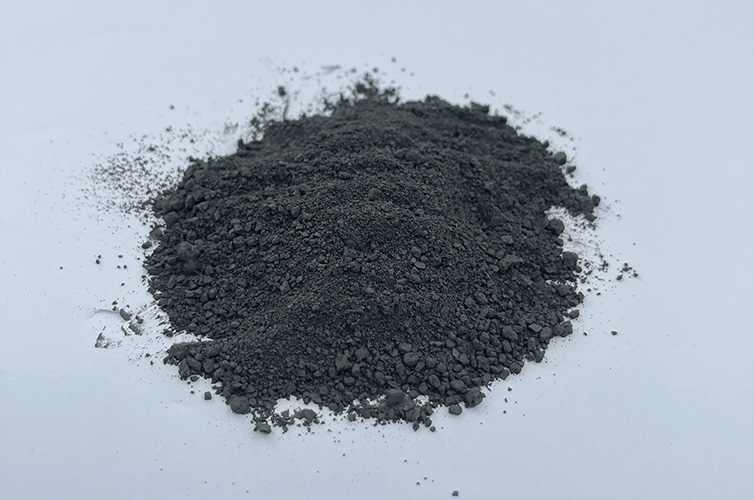
VIMATERIAL supplies Sodium Manganese Iron Phosphate (NMFP) powder for sodium-ion battery material development.
Available Specifications
| Property | Specification |
|---|---|
| Chemical Name | Sodium Manganese Iron Phosphate |
| Chemical Formula | NaMnₓFe₁₋ₓPO₄ |
| Mn/Fe Ratio | Customizable, 0 < x < 1 |
| Purity | 99% |
| Form | Powder |
| Particle Size | D50 < 10 μm |
| Carbon Coating | Available Upon Request |
Customization Options
VIMATERIAL can provide customized NMFP powder according to specific material requirements, including:
- Mn/Fe Composition: Adjustable manganese and iron proportions.
- Particle Size: Customized particle-size distribution.
- Carbon Coating: Carbon-coated NMFP powder options.
- Additional Specifications: Other material parameters can be discussed according to application requirements.
Customized compositions allow researchers and battery developers to evaluate different material formulations without being restricted to a single fixed Mn/Fe ratio.
For detailed specifications, availability and customization requirements, contact the VIMATERIAL team.
10. Frequently Asked Questions (FAQ)
1. What is NMFP?
NMFP stands for Sodium Manganese Iron Phosphate, a mixed-transition-metal phosphate material with the general chemical formula NaMnₓFe₁₋ₓPO₄. It is investigated as a cathode material for sodium-ion batteries.
2. What does x represent in the NMFP chemical formula?
In NaMnₓFe₁₋ₓPO₄, x represents the manganese fraction, while 1−x represents the iron fraction. The value of x can be adjusted between 0 and 1 to obtain different Mn/Fe compositions.
3. How does the Mn/Fe ratio affect NMFP performance?
The Mn/Fe ratio influences the contributions of manganese and iron redox reactions, which can affect operating voltage, capacity and structural stability. The optimal composition depends on the intended electrochemical requirements.
4. What is the crystal structure of NMFP?
Olivine-type structures have been reported for sodium manganese iron phosphate compositions. The actual crystal phase depends on the specific composition and synthesis conditions.
5. Why is carbon coating used for NMFP?
Carbon coating is used to improve electronic conductivity by creating conductive pathways around or between active material particles.
6. What are the main applications of NMFP powder?
NMFP powder is primarily investigated for sodium-ion battery cathodes, including stationary energy storage, renewable energy storage and selected electric mobility applications.
7. Can the Mn/Fe ratio of NMFP powder be customized?
Yes. VIMATERIAL provides customizable Mn/Fe compositions within the NaMnₓFe₁₋ₓPO₄ material system, with 0 < x < 1.
8. Does VIMATERIAL provide carbon-coated NMFP powder?
Yes. Carbon-coated NMFP powder is available upon request. Specific carbon coating requirements can be discussed according to the intended application.
Conclusion
Sodium Manganese Iron Phosphate (NMFP) is a promising phosphate-based cathode material for sodium-ion battery research and development.
Its combination of manganese and iron provides opportunities to adjust electrochemical properties through composition control. The Mn/Fe ratio, crystal structure, particle characteristics and surface modification all play important roles in determining material performance.
Further development of synthesis methods, conductivity enhancement and composition optimization will be important for improving its practical electrochemical performance.
VIMATERIAL supplies NMFP powder with customizable Mn/Fe ratios, particle sizes and carbon coating options, supporting the material development requirements of battery manufacturers, research laboratories and advanced energy storage projects.
References
- [1] Ouaneche, T., Stievano, L., Monconduit, L., Guéry, C., Sougrati, M. T., & Recham, N. (2024). Olivine NaMn₀.₆₆Fe₀.₃₄PO₄ as a Cathode Material for Advanced Sodium Ion Batteries. Batteries & Supercaps, 7(10), e202400214.
- [2] Minnetti, L., Sbrascini, L., Staffolani, A., Marangon, V., Nobili, F., & Hassoun, J. (2024). Unravelling the Ion Transport and the Interphase Properties of a Mixed Olivine Cathode for Na-Ion Battery. Journal of Energy Chemistry, 96, 300–317.
- [3] Jin, T., Li, H., Zhu, K., Wang, P.-F., Liu, P., & Jiao, L. (2020). Polyanion-Type Cathode Materials for Sodium-Ion Batteries. Chemical Society Reviews, 49, 2342–2377.
- [4] Yuan, Y., Wei, Q., Yang, S., Zhang, X., Jia, M., Yuan, J., & Yan, X. (2022). Towards High-Performance Phosphate-Based Polyanion-Type Materials for Sodium-Ion Batteries. Energy Storage Materials.
Further Reading
- LMFP Cathode Material: Crystal Structure, Composition and Electrochemical Properties
- LATP Powder: Particle Size, Purity, Ionic Conductivity and How to Choose the Right Grade
- LMFP vs NCM Cathode Materials: Key Differences for Next-Generation Lithium-Ion Batteries
- NFPP Sodium-Ion Battery Cathode: Properties, Advantages, Synthesis and Applications
- Sodium-Ion Battery Materials: Key Components, Advantages and Future Trends
Looking for Customized NMFP Powder?
VIMATERIAL supplies Sodium Manganese Iron Phosphate (NMFP) powder for sodium-ion battery research and development.
We offer flexible customization options to meet different material requirements:
- Adjustable Mn/Fe Ratio: Customized compositions with 0 < x < 1.
- Particle Size: Tailored particle-size specifications.
- Carbon Coating: Available upon request.
Whether you are developing new sodium-ion battery cathodes or evaluating different manganese-iron compositions, our team can support your material requirements.
Contact VIMATERIAL for technical details, specifications and a quotation.