


LATP powder (Li₁.₃Al₀.₃Ti₁.₇(PO₄)₃) is a NASICON-type oxide solid electrolyte widely studied for solid-state lithium batteries and other electrochemical applications. While ionic conductivity and crystal structure are important, the practical performance of LATP powder also depends strongly on particle size, phase purity, moisture content, and processing characteristics.
For battery researchers and manufacturers, selecting the right LATP powder grade is therefore not simply a matter of choosing the highest purity. Particle size and powder characteristics must be matched to the intended application.
1. What Is LATP Powder?
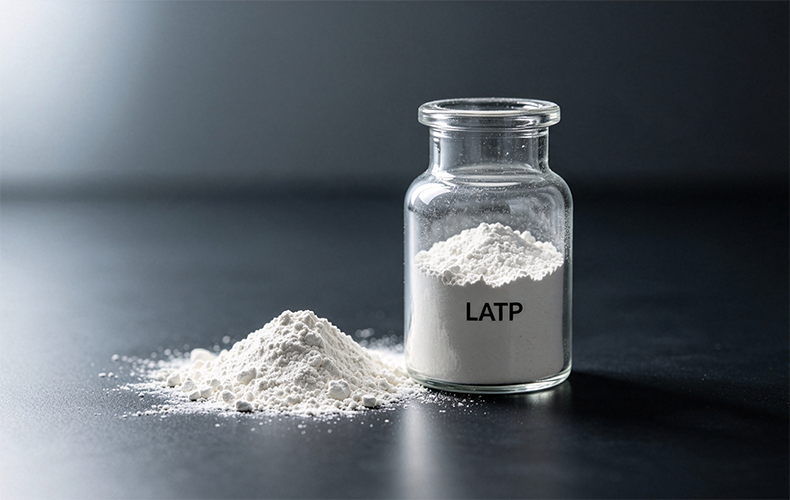
Lithium aluminum titanium phosphate (LATP), with the chemical formula Li₁.₃Al₀.₃Ti₁.₇(PO₄)₃, is a NASICON-type oxide solid electrolyte with a three-dimensional lithium-ion transport framework.
Its open crystal structure provides interconnected pathways for lithium-ion migration, while the phosphate-based framework contributes to structural and thermal stability. LATP is mainly investigated for solid-state electrolytes, composite electrolytes, electrode coatings, and separator coatings.
Compared with sulfide solid electrolytes, oxide-based LATP offers advantages in handling and environmental stability, making it attractive for processes where strict moisture- and oxygen-free conditions are difficult to maintain.
2. Why Does LATP Particle Size Matter?
Particle size is one of the most important parameters when selecting LATP powder.
Reducing particle size can increase specific surface area and shorten diffusion distances, which can be beneficial for thin electrolyte layers and surface coating applications. However, excessively fine powders may also increase moisture sensitivity, agglomeration, and slurry-processing challenges.
Larger particles generally offer lower specific surface area and easier powder handling, but may require optimization when thin layers or highly uniform coatings are needed.
Therefore, there is no single “best” LATP particle size for every application.
The appropriate grade should be selected according to:
- electrolyte layer thickness
- coating requirements
- slurry solid loading
- particle dispersion
- moisture sensitivity
- sintering behavior
- target battery operating conditions
3. LATP Powder Particle Size Options
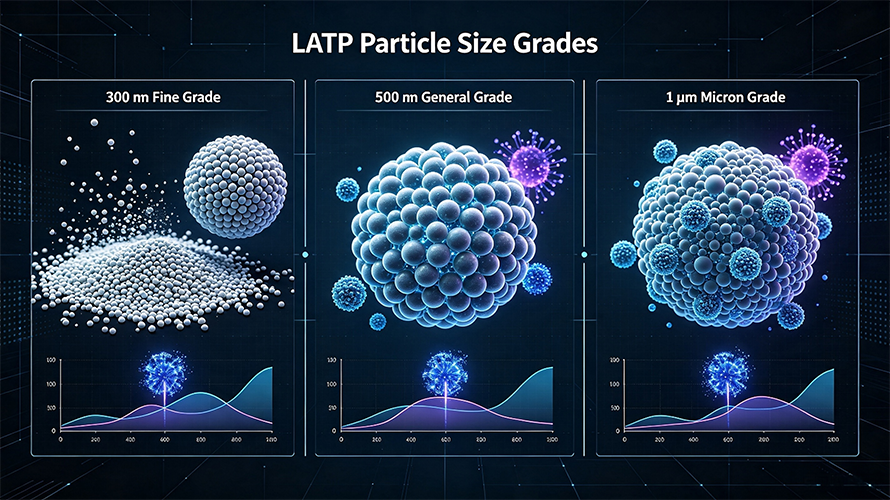
VIMATERIAL provides three particle-size grades designed for different processing and application requirements.
| LATP Grade | Typical D50 | Main Characteristics | Recommended Applications |
|---|---|---|---|
| Fine LATP | 300 nm | High specific surface area and large interface contact area | Thin electrolyte films, precision electrode coatings |
| General-purpose LATP | 500 nm | Balanced particle size, dispersion, surface area and processing performance | Solid-state batteries, low-temperature energy storage, general coating applications |
| Micron LATP | 1 μm | Lower specific surface area, easier handling and good storage stability | Thick ceramic electrolyte layers, composite separators, high-solid-loading slurries |
D50 = 300 nm LATP Powder
The 300 nm grade provides a relatively high specific surface area and large contact area between LATP particles and other functional materials.
It is particularly suitable for:
- thin solid-state electrolyte layers
- high-precision electrode coatings
- fine composite electrolyte structures
- applications requiring intimate particle-to-particle contact
The main consideration is that finer powders may require more careful control of slurry formulation and dispersion conditions.
D50 = 500 nm LATP Powder
The 500 nm grade is a balanced option between fine-particle surface area and processing stability.
It provides a practical balance among:
- particle surface area
- powder dispersion
- moisture sensitivity
- grain-boundary effects
- slurry processability
For applications requiring a combination of electrochemical performance and manufacturing compatibility, 500 nm LATP powder can be considered a versatile grade.
D50 = 1 μm LATP Powder
The 1 μm grade has a lower specific surface area and is generally easier to handle and process in high-solid-loading systems.
It is suitable for:
- thicker ceramic electrolyte layers
- composite separator coatings
- high-solid-loading slurry systems
- applications where powder handling and storage stability are important
4. Key LATP Powder Specifications
In addition to particle size, several parameters should be evaluated when selecting LATP powder.
| Parameter | Typical Product Specification |
|---|---|
| Material | Lithium Aluminum Titanium Phosphate |
| Chemical Formula | Li₁.₃Al₀.₃Ti₁.₇(PO₄)₃ |
| Crystal Structure | NASICON-type, R-3c |
| Phase Purity | Pure LATP phase by XRD |
| Ionic Conductivity | ≥0.45 mS/cm at room temperature |
| Electronic Conductivity | < 1 × 10⁻⁸ S/cm |
| Purity | ≥99.5% |
| Magnetic Impurities | <500 ppb |
| Moisture Content | ≤1000 ppm |
| Particle Size | D50 300 nm / 500 nm / 1 μm |
| Particle Size Control | Customizable, D50 ±50 nm |
These specifications are particularly relevant when LATP is used in solid-state battery development, where small differences in composition, phase purity, particle morphology, and moisture content can influence electrochemical and processing performance.
5. Why Is XRD Phase Purity Important for LATP?
A high-purity LATP powder should exhibit the characteristic diffraction pattern of the target NASICON phase.
Unwanted secondary phases can influence ionic transport and introduce additional interfaces or resistive regions within the electrolyte.
For this reason, X-ray diffraction (XRD) is an important quality-control method for LATP powder.
VIMATERIAL’s LATP powder is evaluated by XRD to verify phase composition and identify potential secondary phases such as TiO₂ and other unwanted crystalline phases.
A well-defined LATP phase provides a reliable structural basis for subsequent electrolyte processing and electrochemical evaluation.
6. Why Are Moisture and Impurities Important?
For solid-state electrolyte powders, moisture and trace impurities should not be overlooked.
Moisture Content
Water adsorption can affect powder surface chemistry, dispersion behavior, and subsequent processing.
This becomes increasingly important for fine LATP powders because their larger specific surface area can make surface moisture control more challenging.
VIMATERIAL provides LATP powder with a moisture specification of ≤1000 ppm, with packaging and handling designed to help maintain material quality during storage and transportation.
Metallic and Magnetic Impurities
Trace metallic impurities can be particularly undesirable in battery materials because they may affect electrochemical behavior or introduce unwanted contamination.
For this reason, VIMATERIAL controls magnetic impurities to <500 ppb according to the stated product specification.
7. LATP Powder Applications
Solid-State Electrolytes
LATP powder can be processed into ceramic electrolyte layers or dense solid electrolyte components.
Its NASICON-type structure and lithium-ion transport pathways make it suitable for research and development of oxide-based solid-state batteries.
Electrode Coatings
Fine LATP powder can be used as a functional coating material on electrode particles.
A LATP coating can provide an ion-conducting interface and may help improve contact between the electrode and solid electrolyte.
The 300 nm and 500 nm grades are particularly relevant when a fine and uniform coating is required.
Separator Coatings
LATP can also be incorporated into functional separator coatings.
Unlike conventional electrically insulating ceramic fillers, LATP provides lithium-ion transport pathways, making it interesting for advanced battery separator designs.
Composite Polymer Electrolytes
LATP powder can be combined with polymer electrolytes to form composite solid electrolytes.
The inorganic LATP phase can contribute ionic transport, mechanical reinforcement, and thermal stability, while the polymer phase can improve flexibility and processability.
8. How to Choose the Right LATP Powder Grade?
The appropriate particle size depends primarily on the processing method and final battery structure.
Choose 300 nm LATP when:
- a thin electrolyte layer is required
- a high surface area is beneficial
- fine electrode coating is required
- intimate particle contact is important
Choose 500 nm LATP when:
- a balanced powder grade is needed
- dispersion and processing are important
- the material is being developed for solid-state battery applications
- both electrochemical performance and processability need to be considered
Choose 1 μm LATP when:
- thicker ceramic layers are required
- high-solid-loading slurry is used
- easy powder processing is important
- lower specific surface area is preferred
9. How Is LATP Powder Produced?
LATP powder can be prepared through several synthesis routes, including solid-state reaction, co-precipitation, sol-gel processing, and hydrothermal or solvothermal methods.
For scalable production, process control is particularly important for obtaining consistent phase composition and particle-size distribution.
A typical controlled production route includes:
High-purity raw material preparation → Wet ball milling and mixing → Controlled calcination → Air classification → Particle-size separation → XRD and physical-property testing
Key quality-control parameters include:
- XRD phase composition
- particle-size distribution
- ionic conductivity
- elemental impurities
- moisture content
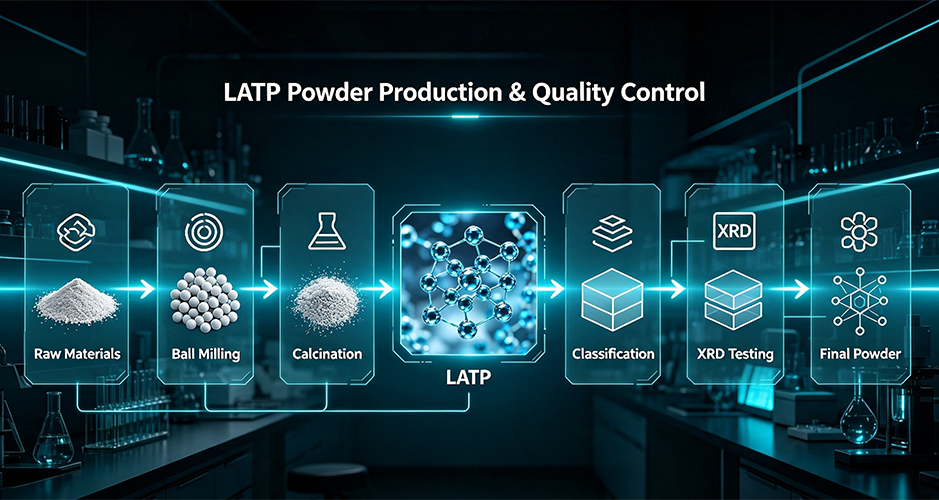
Each parameter contributes to the consistency of LATP powder from batch to batch.
10. LATP Powder for Research and Industrial Development
Different solid-state battery designs require different powder characteristics.
A research project developing a thin electrolyte film may prioritize fine particle size and surface contact, while a high-solid-loading coating process may favor larger particles with easier processing characteristics.
For this reason, LATP powder should be selected according to the complete processing route rather than a single specification.
VIMATERIAL offers 300 nm, 500 nm, and 1 μm LATP powder grades, with customizable particle-size requirements for different research and manufacturing applications.
Small quantities can be supplied for laboratory evaluation, while larger quantities are available for scale-up and production development.
Frequently Asked Questions
1. What particle sizes of LATP powder are available?
LATP powder is available in 300 nm, 500 nm, and 1 μm particle sizes. Custom size are also available.
2. How do I choose the right LATP powder particle size?
The choice depends on the application and processing requirements:
- 300 nm: Suitable for thin electrolyte films and fine coatings.
- 500 nm: A balanced option for general-purpose applications.
- 1 μm: Suitable for thicker ceramic layers and high-solid-content slurries.
3. What is the ionic conductivity of LATP powder?
Our LATP powder has an ionic conductivity of ≥0.45 mS/cm at room temperature.
4. What purity and moisture specifications are available for LATP powder?
Our LATP powder offers purity ≥99.5%, magnetic impurities <500 ppb, and moisture ≤1000 ppm.
5. Can LATP powder be customized for specific applications?
Yes. LATP powder can be supplied according to specific requirements, with a focus on particle size and purity. We support both R&D-scale and bulk supply for different application needs.
Conclusion
LATP powder is more than simply a high-ionic-conductivity solid electrolyte material. Particle size, phase purity, moisture content, impurity levels, dispersion, and processing behavior all contribute to its suitability for a specific battery application.
For thin electrolyte films and fine coatings, 300 nm LATP provides a high-surface-area option. For applications requiring a balance between performance and processability, 500 nm LATP is a versatile choice. For thicker ceramic layers and high-solid-loading systems, 1 μm LATP offers easier processing and handling.
By matching LATP powder characteristics with the intended application, battery researchers and manufacturers can better optimize electrolyte processing, electrode interfaces, and overall cell design.
References
- [1] Tian, B., et al. “Optimizing Li₁.₃Al₀.₃Ti₁.₇(PO₄)₃ Particle Sizes toward High Ionic Conductivity.” ACS Applied Materials & Interfaces, 2023, 15, 36289–36300.
- [2] Kozawa, T., et al. “Combined wet milling and heat treatment in water vapor for producing amorphous to crystalline ultrafine Li₁.₃Al₀.₃Ti₁.₇(PO₄)₃ solid electrolyte particles.” RSC Advances, 2021, 11, 14796–14804.
- [3] Zhang, H., et al. “The influence of phosphorous source on the properties of NASICON lithium-ion conductor Li₁.₃Al₀.₃Ti₁.₇(PO₄)₃.” Solid State Ionics, 2020.
- [4] Zhu, Y., et al. “Preparation and evaluation of high lithium ion conductivity Li₁.₃Al₀.₃Ti₁.₇(PO₄)₃ solid electrolyte obtained using a new solution method.” Solid State Ionics, 2016, 295, 7–12.
- [5] Mertens, A., et al. “Superionic bulk conductivity in Li₁.₃Al₀.₃Ti₁.₇(PO₄)₃ solid electrolyte.” Solid State Ionics, 2017.
Further Reading
- LATP Solid Electrolyte: Structure, Ionic Conductivity, and Future Prospects
- Lithium Aluminum Titanium Phosphate (LATP): A Promising Solid-State Electrolyte for Next-Generation Batteries
- Sodium-Ion Battery Materials: Key Components, Advantages and Future Trends
- Aqueous Sodium-Ion Battery Cathode Materials: Structure, Performance, and Future Prospects
- LMFP vs LFP: What’s the Difference and Why LMFP Is Gaining Momentum
Need a Custom LATP Powder?
VIMATERIAL supplies LATP powder in 300 nm, 500 nm, and 1 μm particle-size grades, with customizable specifications for particle size, purity, and application requirements.
Contact us to discuss your LATP powder requirements, including research quantities, customized particle sizes, and larger-scale supply.