


NFPP, with the chemical formula Na₄Fe₃(PO₄)₂P₂O₇, is a promising iron-based polyanionic cathode material for sodium-ion batteries. Its stable phosphate-pyrophosphate framework provides good structural stability, thermal safety and long-cycle potential. However, NFPP has a key limitation: relatively low intrinsic electronic conductivity, which can restrict charge-transfer kinetics and rate performance.
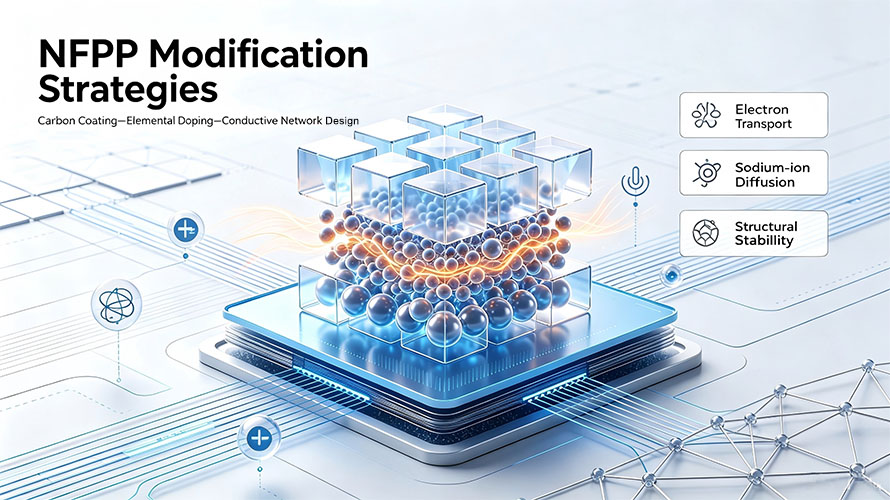
As a result, NFPP development increasingly focuses on carbon coating, elemental doping, conductive-network design and particle engineering. These approaches target different limitations. Carbon coating mainly improves electron transport around active particles, doping can modify the intrinsic electronic structure and crystal chemistry, while particle engineering helps shorten sodium-ion diffusion pathways.
The goal is not simply to maximize conductivity or capacity, but to achieve a balanced combination of electronic transport, sodium-ion diffusion, structural stability, particle morphology and electrode processability.
1. Why Does NFPP Need Modification?
During battery operation, sodium ions move through the NFPP crystal structure while electrons travel through the active material and conductive network.
A simplified process can be described as:
Na⁺ transport + electron transport → charge transfer → reversible sodium storage
If either transport process is insufficient, polarization increases and the practical capacity and rate capability decrease.
The main challenges addressed by NFPP modification include:
- Low intrinsic electronic conductivity
- Limited charge-transfer kinetics
- Restricted ion transport at high rates
- Particle agglomeration
- Excessive sodium-ion diffusion distance
- Performance degradation under demanding temperature or rate conditions
Therefore, NFPP modification should be considered a materials-engineering strategy, rather than simply the addition of a conductive component.
2. Carbon Coating: Improving Particle-Level Conductivity
Carbon coating is one of the most widely investigated approaches for improving NFPP electrochemical performance.
The basic concept is to form a conductive carbon layer around NFPP particles. Because carbon has much higher electronic conductivity than the NFPP active phase, a suitable coating can create additional electron-transport pathways and reduce resistance at the particle interface.
How Does Carbon Coating Improve NFPP?
An optimized carbon layer can:
- Improve electron transport around active particles
- Reduce interparticle resistance
- Lower electrode polarization
- Improve charge-transfer kinetics
- Enhance high-rate performance
- Help maintain particle integrity during processing
The coating must, however, be carefully controlled. A layer that is too thin may provide insufficient conductivity, while excessive carbon can reduce active-material loading and negatively affect volumetric performance.
Therefore, carbon content, coating thickness, uniformity and precursor selection all need to be optimized.
In-Situ Carbon Coating
In-situ carbon coating introduces a carbon precursor during NFPP synthesis. During heat treatment, the precursor decomposes and forms a carbon layer around the NFPP particles.
Compared with simply mixing NFPP with conductive carbon after synthesis, an effective in-situ coating can provide closer contact between the conductive phase and active material.
This approach is particularly attractive when combined with other modification strategies.
3. Conductive Network Design
Carbon coating primarily improves electron transport around individual particles, but a practical electrode also needs continuous electrical connections between particles and the current collector.
This is the role of conductive additives and conductive-network design.
Common carbon-based conductive components include conductive carbon, carbon black, graphitic carbon and carbon nanotubes. Their purpose is not simply to increase total carbon content, but to establish an efficient conductive network throughout the electrode.
A poorly distributed conductive additive may leave some NFPP particles electrically isolated. A well-designed network, in contrast, can improve particle-to-particle connectivity and reduce electrode-level resistance.
Therefore:
Carbon coating → particle/interface-level electron transport
Conductive additives → electrode-level electron transport
Combining these approaches can provide complementary benefits.
4. Elemental Doping: Modifying NFPP from the Inside
Carbon coating mainly improves external electron transport. It does not fundamentally change the electronic structure of the NFPP crystal.
This has driven interest in elemental doping, in which selected elements are introduced into the NFPP structure during synthesis.
Depending on the dopant and concentration, doping can influence:
- Electronic structure
- Local crystal chemistry
- Phase stability
- Defect chemistry
- Sodium-ion diffusion
- Electronic conductivity
- Structural stability during cycling
NFPP modification strategies: The key advantage is that doping can address limitations inside the active material, rather than only improving its surface conductivity.
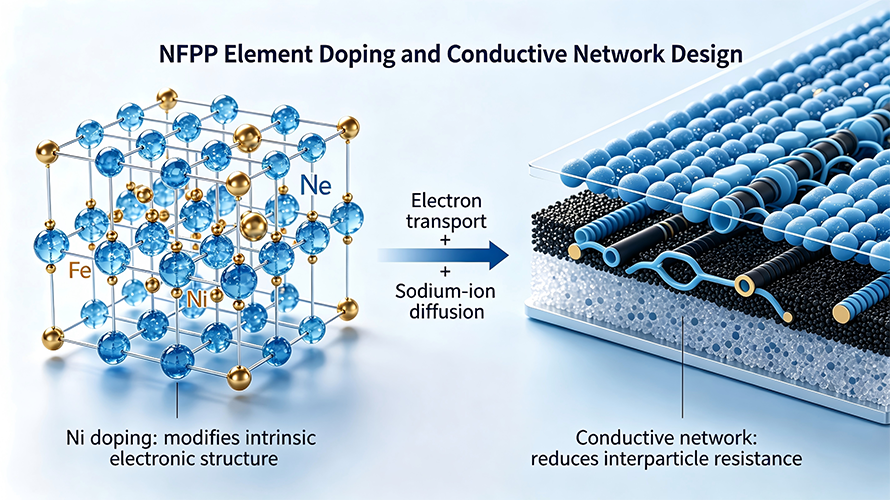
5. Ni-Doped NFPP: An Example of Intrinsic Conductivity Engineering
Nickel doping provides an example of this approach. Research has investigated compositions such as Na₃Fe₁.₉Ni₀.₁(PO₄)P₂O₇/C, where part of the Fe sites is substituted by Ni.
The objective is to improve intrinsic electronic conductivity while maintaining the structural advantages of the NFPP framework.
A reported Ni-doped NFPP/C material demonstrated:
- 77.43% capacity retention after 2,000 cycles at 5C
- Stable cycling performance after 5,000 cycles at 10C
- 47.7 mAh g⁻¹ discharge capacity at 20C
These results demonstrate the potential of combining elemental doping with carbon engineering.
Importantly, such values represent specific reported materials under specific test conditions, rather than universal specifications for all Ni-doped NFPP.
Electronic-Structure Mechanism
Electronic-structure calculations have indicated that suitable Ni incorporation can introduce electronic states around the Fermi level and reduce the effective energy gap.
In one reported study, the calculated energy gap decreased from approximately 0.93 eV for NFPP to 0.42 eV for the Ni-doped system.
This change can facilitate electron transport and contribute to improved electronic conductivity.
At the same time, reported GITT measurements showed sodium-ion diffusion coefficients in the approximate range of 10⁻¹¹–10⁻⁹ cm² s⁻¹, depending on the state of charge.
The significance is that modification can potentially improve both sides of the transport problem:
electron transport + Na⁺ diffusion → improved electrochemical kinetics
6. Particle Engineering: Controlling Sodium-Ion Diffusion
Electronic conductivity is only one part of NFPP performance. Sodium ions must also diffuse through the active material during charge and discharge.
Reducing particle size can shorten the diffusion distance:
Smaller particle → shorter Na⁺ diffusion pathway → faster ion transport
It can also increase the effective electrode/electrolyte contact area.
However, smaller particles are not automatically better for commercial materials. Excessive particle refinement may result in:
- Increased surface area
- Higher surface reactivity
- Greater moisture sensitivity
- Particle agglomeration
- More difficult powder handling
- Lower tap density
The practical objective is therefore to achieve a controlled particle-size distribution and suitable morphology, rather than simply minimizing particle size.
This is especially important for B2B battery-material development, where powder properties must remain compatible with electrode manufacturing.
7. Combining Carbon Coating, Doping and Particle Engineering
No single modification strategy can eliminate every limitation of NFPP.
The practical significance of these modifications becomes clearer when NFPP is compared with other sodium-ion cathode chemistries such as LFP and layered oxide materials.
Carbon coating improves particle-level electronic transport. Conductive additives improve connectivity across the electrode. Elemental doping can modify intrinsic electronic and ionic transport, while particle engineering reduces diffusion distances and influences packing behavior.
A representative integrated strategy can therefore be expressed as:
Precursor design → controlled synthesis → elemental doping → particle engineering → in-situ carbon coating → conductive-network construction → electrode optimization
The challenge is maintaining the right balance.
For example, excessive carbon may improve conductivity but reduce active-material loading. Excessive particle refinement may improve ion kinetics but reduce tap density. Excessive doping may alter the desired phase or introduce secondary phases.
For this reason, the best NFPP material is not necessarily the one with the highest conductivity or smallest particle size, but the one that provides the best overall balance of electrochemical and manufacturing properties.
8. Carbon-Coated NFPP vs. Doped NFPP
| Modification Strategy | Main Target | Primary Effect | Key Consideration |
|---|---|---|---|
| Carbon coating | Particle/interface | Improves external electron transport | Carbon content and coating uniformity |
| Conductive additives | Electrode network | Improves particle-to-particle connectivity | Dispersion and network efficiency |
| Elemental doping | Crystal structure | Modifies intrinsic electronic/ionic transport | Dopant type, concentration and site |
| Particle engineering | Ion transport | Shortens Na⁺ diffusion distance | Particle size, morphology and tap density |
| Combined modification | Multiple limitations | Provides synergistic improvement | Process compatibility and cost |
9. Key NFPP Quality Parameters for Battery Applications
Modified NFPP should not be evaluated based on specific capacity alone. For practical battery-material development, several parameters need to be considered together.
| Parameter | Why It Matters |
|---|---|
| Phase purity | Influences electrochemical consistency and batch stability |
| Chemical purity | Affects electrochemical stability and reproducibility |
| Particle size distribution | Influences Na⁺ diffusion and electrode processing |
| Morphology | Affects packing, surface area and electrode behavior |
| Carbon content | Determines the effectiveness of electronic conduction |
| Dopant concentration | Influences structural and electronic properties |
| Tap density | Affects volumetric energy density |
| Moisture content | Important for powder storage and electrode processing |
| Cycle performance | Indicates long-term structural and electrochemical stability |
For B2B customers, batch-to-batch consistency is also critical. A material that delivers excellent performance in one laboratory experiment but shows significant variation between batches is difficult to scale into commercial battery production.
10. How Should Modified NFPP Be Evaluated for Commercialization?
For laboratory research, high specific capacity or excellent high-rate performance can be useful indicators. For commercial development, however, the evaluation criteria are broader.
A practical NFPP material should ideally combine:
High phase purity + controlled particle size + stable conductivity + suitable tap density + long cycle life + reproducible synthesis + competitive cost
The modification strategy should also be:
- Scalable
- Reproducible
- Compatible with industrial synthesis
- Economically reasonable
- Stable during storage
- Compatible with electrode manufacturing
This distinction is important because the modification that produces the best laboratory result may not necessarily be the most suitable for large-scale battery production.
11. Future Development of NFPP Modification
NFPP modification is moving from single-parameter optimization toward integrated materials engineering.
Future development is likely to focus on the relationship between:
Crystal structure → electronic structure → particle morphology → Na⁺ transport → electron transport → electrode architecture
Carbon coating will remain an important route for improving electronic conductivity, while elemental doping provides a way to modify intrinsic electronic and structural properties.
Particle engineering and conductive-network design can then help translate these improvements into better electrode-level performance.
The key question is therefore not simply “Which NFPP modification is best?”, but:
“Which combination of modifications provides the required electrochemical performance at an acceptable manufacturing cost?”
For sodium-ion batteries targeting long cycle life, cost efficiency and demanding operating conditions, this integrated approach is likely to be increasingly important.
Frequently Asked Questions
1. Why does NFPP need carbon coating?
NFPP has relatively low intrinsic electronic conductivity. Carbon coating provides additional conductive pathways around NFPP particles, helping improve electron transport, reduce polarization and enhance rate performance.
2. What is the difference between carbon-coated NFPP and Ni-doped NFPP?
Carbon coating primarily improves electron transport around the NFPP particles, while Ni doping can modify the intrinsic electronic structure and crystal chemistry. The two approaches can also be combined.
3. Does Ni doping improve sodium-ion diffusion in NFPP?
Reported studies indicate that Ni doping can improve sodium-ion transport kinetics in NFPP. The actual effect depends on dopant concentration, synthesis conditions and the resulting crystal structure.
4. Is smaller NFPP particle size always better?
No. Smaller particles can shorten Na⁺ diffusion distances, but excessively fine particles may increase surface reactivity, agglomeration, moisture sensitivity and processing difficulties. An optimized particle-size distribution is generally more practical.
5. Can carbon coating and elemental doping be used together?
Yes. Carbon coating and elemental doping address different aspects of NFPP performance. A combined strategy can use doping to modify intrinsic properties while carbon engineering improves electron transport at the particle and electrode levels.
6. What NFPP specifications are important for battery-material buyers?
Important specifications can include chemical purity, phase purity, particle-size distribution, morphology, tap density, moisture content, carbon content, specific capacity, rate performance and cycle-life data. The appropriate specification depends on the target cell chemistry and application.
Conclusion
NFPP offers an attractive combination of iron-based chemistry, structural stability and long-cycle potential for sodium-ion batteries, but its relatively low intrinsic electronic conductivity makes materials modification an important part of performance optimization.
Carbon coating improves electron transport around active particles, conductive additives establish electrode-level conductive pathways, and elemental doping such as Ni doping can modify intrinsic electronic and ionic transport. Particle engineering complements these approaches by controlling diffusion distance, morphology and powder-processing characteristics.
The most promising NFPP systems are therefore likely to come from integrated modification strategies, rather than from optimizing a single parameter.
For battery-material development, the ultimate objective is a balanced NFPP material that provides the required capacity and rate performance while maintaining long cycle life, structural stability, reproducibility and scalable manufacturing.
References
- [1] “Na₄Fe₃(PO₄)₂P₂O₇ Cathode for Sodium-Ion Batteries: Critical Technologies and Progress from Fundamental Advances to Industrialization Challenges.” Energy Storage Materials, 2025. DOI: 10.1016/j.ensm.2025.104788.
- [2] “Research Progress on Na₄Fe₃(PO₄)₂P₂O₇: Synthesis Methods, Modification Strategies, and Future Directions.” Journal of Energy Storage, 2025, 139, 118969. DOI: 10.1016/j.est.2025.118969.
- [3] “Entropy-Driven Enhancement of the Conductivity and Phase Purity of Na₄Fe₃(PO₄)₂P₂O₇ as the Superior Cathode in Sodium-Ion Batteries.” ACS Applied Materials & Interfaces, 2024, 16, 7070–7079. DOI: 10.1021/acsami.3c15947.
- [4] T. Jin, H. Li, K. Zhu, P. Wang, P. Liu, L. Jiao, “Polyanion-type cathode materials for sodium-ion batteries.” Chemical Society Reviews, 2020, 49, 2342–2377. DOI: 10.1039/C9CS00846B.
- [5] “Fabrication of onion-like carbon frameworks and uniform carbon coating layer at Na₄Fe₃(PO₄)₂P₂O₇ for synergistically improving conductivity and structural stability.” Journal of Power Sources, 2025, 650, 237475. DOI: 10.1016/j.jpowsour.2025.237475.
Further Reading
- NFPP Sodium-Ion Battery Cathode: Properties, Advantages, Synthesis and Applications
- NFPP Synthesis and Manufacturing: From Laboratory Preparation to Industrial-Scale Production
- NFPP vs LFP vs Layered Oxide vs Prussian Blue: Which Cathode Is Better for Sodium-Ion Batteries?
- Sodium-Ion Battery Materials: Key Components, Advantages and Future Trends
- Aqueous Sodium-Ion Battery Cathode Materials: Structure, Performance, and Future Prospects
Explore NFPP Cathode Materials
VIMATERIAL supplies Sodium Iron Pyrophosphate Phosphate (NFPP), Na₄Fe₃(PO₄)₂P₂O₇, for research, development and advanced sodium-ion battery applications. Specifications can be customized according to application requirements, including particle size, morphology and other material parameters.
For technical requirements, sample requests or customized NFPP material solutions, contact our technical team.
Need a Custom Material Solution? Contact VIMATERIAL for NFPP powder specifications and technical support.