


Sodium-ion batteries are attracting increasing attention for applications where cost, safety, resource availability and long service life are more important than achieving the highest possible energy density.
Among the available cathode materials, layered oxides, Prussian blue analogues (PBAs), and polyanionic materials such as Na₄Fe₃(PO₄)₂P₂O₇ (NFPP) represent three important sodium-ion battery routes. Lithium iron phosphate (LFP), although used in lithium-ion batteries rather than sodium-ion batteries, is also an important benchmark because of its combination of safety, cycle life and relatively low material cost.
NFPP is particularly interesting because it sits between several competing priorities. It does not necessarily deliver the highest specific capacity, but its iron-based chemistry, robust polyanionic framework, stable operating voltage and long-cycle potential make it attractive for applications where reliability and lifetime matter more than maximum energy density. Recent reviews continue to identify NFPP as a promising candidate for large-scale energy storage while highlighting conductivity, impurity control and energy density as key challenges for commercialization.
So, which cathode is actually better?
The answer depends on the application.
NFPP vs LFP vs Layered Oxide vs Prussian Blue: What Are the Main Differences?
The four materials belong to different battery chemistry systems and should therefore not be compared on capacity alone.
| Cathode | Battery System | Main Strengths | Main Limitations | Typical Positioning |
|---|---|---|---|---|
| NFPP | Sodium-ion | Safety, structural stability, long cycle life, low-cost elements | Moderate capacity, low intrinsic electronic conductivity | Stationary storage, long-life applications |
| LFP | Lithium-ion | Safety, mature manufacturing, long cycle life | Lithium dependence, higher resource cost than sodium | EVs, ESS, industrial batteries |
| Layered Oxide | Sodium-ion | Higher capacity, relatively high energy-density potential | Structural changes, air/moisture sensitivity and safety challenges for some compositions | Higher-energy SIB applications |
| Prussian Blue Analogue | Sodium-ion | Low-cost elements, open framework, good Na+ kinetics | Defects, vacancies, crystal water and material consistency | Energy storage, high-power applications |
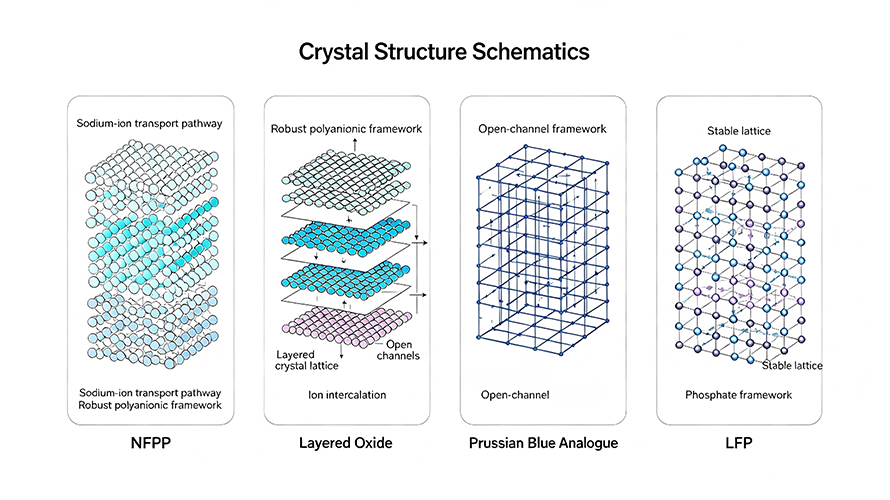
The comparison is therefore not simply:
Which material has the highest capacity?
A more useful question for battery developers is:
Which cathode provides the best balance between energy density, safety, lifetime, cost and manufacturing requirements for a specific application?
This is where NFPP becomes particularly interesting.
NFPP vs LFP
LFP is one of the most important benchmarks for NFPP because both materials are iron-based polyanionic cathodes with strong structural stability and good safety characteristics.
However, they belong to different battery systems.
LFP uses lithium ions, while NFPP uses sodium ions.
Similarities
Both materials benefit from strong phosphate-based frameworks.
The P–O bonds in phosphate groups contribute to structural and thermal stability, helping suppress oxygen release and structural degradation compared with some less stable oxide cathodes.
Both are also based primarily on relatively abundant elements, particularly iron and phosphorus.
This gives them an important advantage for applications where raw material availability and cost stability matter.
Key differences
The biggest difference is the mobile ion.
LFP operates in lithium-ion batteries, whereas NFPP is designed for sodium-ion batteries.
Sodium is considerably more abundant and geographically widespread than lithium, which is one of the fundamental reasons sodium-ion technology is being investigated for cost-sensitive applications.
However, sodium ions are larger than lithium ions. This affects ion transport, electrode chemistry and ultimately the achievable energy density.
NFPP therefore should not be positioned simply as a “better LFP.”
A more accurate description is:
NFPP aims to provide an LFP-like combination of safety and durability within a sodium-ion battery platform.
This distinction is important for B2B material selection.
If maximum energy density is the primary requirement, LFP remains a strong benchmark.
If resource availability, cost structure, safety and long service life are more important, NFPP becomes increasingly attractive.
NFPP vs Layered Oxide Cathodes
Layered transition-metal oxides are another major sodium-ion cathode family.
Their biggest advantage is higher potential for energy density.
Depending on composition, layered oxides can provide relatively high specific capacity and operating voltage, making them attractive for applications where reducing battery weight or volume is important.
However, layered structures can undergo structural changes during sodium extraction and insertion.
These phase transitions can influence:
- cycle stability
- voltage hysteresis
- air stability
- thermal stability
- capacity retention
The exact behaviour depends strongly on composition and synthesis.
This creates an important trade-off.
Layered oxide
Strength:
Higher capacity and energy-density potential.
Challenge:
More complex structural and chemical behaviour during cycling.
NFPP
Strength:
Rigid polyanionic framework and strong structural stability.
Challenge:
Lower theoretical capacity and relatively low intrinsic electronic conductivity.
Recent NFPP reviews identify structural robustness and cycling stability as major advantages, while also pointing to moderate voltage and limited conductivity as areas requiring further engineering.
Therefore:
Layered oxides are attractive when energy density is the priority; NFPP is attractive when stability and lifetime are given greater weight.
NFPP vs Prussian Blue Analogues
Prussian blue analogues are another important sodium-ion cathode family.
Their open framework provides relatively large channels for sodium-ion transport, which can support good rate capability.
They can also be manufactured from relatively inexpensive elements, making them attractive from a cost perspective.
However, PBAs have their own material-control challenges.
Crystal water
Water molecules can exist within the open framework and influence electrochemical behaviour.
Vacancies and defects
The concentration and distribution of vacancies can strongly affect capacity and cycling behaviour.
Composition control
The final properties depend heavily on transition-metal composition, crystal defects and synthesis conditions.
This makes material consistency particularly important when moving from laboratory synthesis to commercial production.
NFPP has a different challenge.
Its rigid polyanionic framework provides strong structural stability, but its intrinsic electronic conductivity is relatively low. Current research therefore focuses heavily on carbon coating, doping, defect engineering, morphology control and conductive-network design.
In simplified terms:
Prussian blue offers an open structure with favourable ion transport, while NFPP offers a highly robust polyanionic framework.
Neither chemistry is universally superior.
Capacity vs Safety vs Cycle Life: Which Matters Most?
This is where cathode selection becomes more complicated.
A cathode with a higher specific capacity does not automatically produce a better battery.
The final cell depends on:
- cathode capacity
- average voltage
- electrode loading
- tap density
- compaction density
- first-cycle efficiency
- electrolyte compatibility
- negative-electrode capacity
- cycle life
- operating temperature
- safety requirements
For example, NFPP has a theoretical specific capacity of approximately 129 mAh/g and an average operating voltage around 3.2 V vs. Na⁺/Na. These values are moderate rather than exceptional.
Its competitive advantage comes from the combination of these electrochemical properties with structural stability, long-cycle potential and iron-based chemistry.
This leads to an important B2B principle:
The best cathode is not necessarily the cathode with the highest laboratory capacity. It is the cathode that delivers the required performance at acceptable lifetime and cost.
Why NFPP Is Attractive for Long-Life Applications
NFPP’s main value proposition is its balance.
Its polyanionic framework can maintain strong structural integrity during repeated sodium-ion insertion and extraction.
This contributes to low structural strain and good cycling stability.
At the same time, NFPP is based primarily on sodium, iron and phosphorus rather than expensive nickel or cobalt.
That combination makes it particularly relevant to applications where the battery is expected to operate for many years.
Recent studies and reviews continue to investigate NFPP specifically for large-scale energy storage, where long lifetime, safety and cost are often more important than achieving the highest gravimetric energy density.
Which Cathode Is Better for Stationary Energy Storage?
For stationary energy storage, the selection criteria are different from those of passenger EVs.
Battery weight is often less important.
Instead, developers may place greater emphasis on:
- Safety
- Cycle life
- Cost per kWh
- Calendar life
- Temperature stability
- Raw material availability
- Manufacturing consistency
This changes the competitive landscape.
NFPP
Well suited to applications where long lifetime and structural stability are priorities.
Layered oxide
Potentially advantageous when higher energy density is required, but material-specific stability and degradation behaviour need careful evaluation.
Prussian blue
Attractive for cost-sensitive sodium-ion systems and applications requiring good sodium-ion transport, provided crystal water, defects and composition are well controlled.
LFP
A mature benchmark for safe, long-life lithium-ion storage, but it remains part of a lithium-based supply chain.
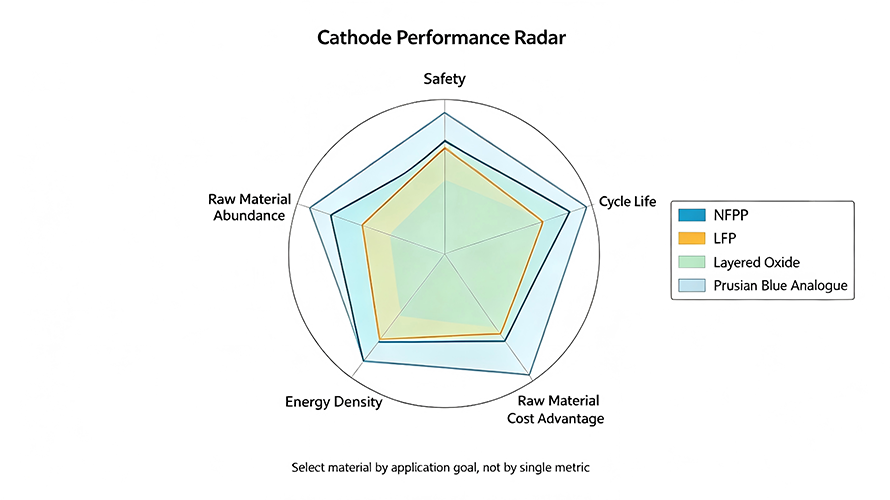
Therefore, for a stationary storage developer evaluating sodium-ion technology, NFPP deserves consideration not because it dominates every individual metric, but because it provides a balanced performance profile.
Which Chemistry Is Better for High-Power Applications?
High-power applications place greater emphasis on rapid ion and electron transport.
NFPP’s intrinsic electronic conductivity is one of its major technical limitations.
This is why current research focuses on:
- carbon coating
- conductive additives
- elemental doping
- particle-size optimisation
- morphology engineering
- heterostructure design
For example, Ni doping has been investigated as a way of modifying the electronic structure and improving sodium-ion transport kinetics. Recent research has also explored defect engineering and conductive networks to overcome NFPP’s intrinsic transport limitations.
This means that commercial NFPP should not be evaluated only by chemical composition.
Material engineering is equally important.
Two NFPP powders with the same nominal chemical formula can show substantially different electrochemical behaviour depending on:
- phase purity
- particle-size distribution
- carbon content
- morphology
- tap density
- surface characteristics
- electronic conductivity
For material buyers, this distinction is critical.
How Should Battery Developers Choose a Cathode Material?
A practical selection process should begin with the application rather than the material name.
Choose NFPP when:
- long cycle life is important
- safety is a major requirement
- cost-sensitive sodium-ion chemistry is preferred
- stationary storage is the target
- iron-based chemistry is desirable
- moderate energy density is acceptable
- structural stability is prioritised
Consider layered oxide when:
- higher energy density is a major target
- higher specific capacity is required
- the battery design can accommodate more complex structural behaviour
- the specific layered-oxide composition has demonstrated sufficient stability
Consider Prussian blue analogues when:
- fast sodium-ion transport is important
- cost is highly sensitive
- open-framework chemistry is preferred
- crystal water and defect concentrations can be tightly controlled
Consider LFP when:
- a mature lithium-ion supply chain is preferred
- established manufacturing infrastructure is important
- high safety and long cycle life are required
- lithium-based chemistry is acceptable
A Practical Comparison for B2B Material Selection
For material procurement, a simple chemistry comparison is not enough.
A battery developer evaluating NFPP should request technical data covering at least:
| Parameter | Why It Matters |
|---|---|
| Chemical Composition | Confirms material composition and batch consistency. |
| Phase Purity | Impurity phases can affect electrochemical performance and cycle stability. |
| Particle Size / PSD | Influences sodium-ion kinetics, electrode processing and material uniformity. |
| Specific Surface Area | Affects reaction kinetics and electrode formulation. |
| Tap Density | Important for electrode packing and volumetric energy density. |
| Carbon Content | Important for conductive NFPP grades and electronic transport. |
| Specific Capacity | Indicates the electrochemical capacity of the material. |
| First-Cycle Efficiency | Important for full-cell balancing and practical energy efficiency. |
| Rate Capability | Indicates performance under higher charge and discharge rates. |
| Cycle Retention | Helps evaluate long-term battery lifetime. |
| Moisture Content | Important for material storage, handling and cell manufacturing. |
| Batch Consistency | Critical for process development, scale-up and reproducible cell performance. |
This is particularly important because recent NFPP research continues to identify impurity phases, conductivity, moisture sensitivity, energy density and scale-up consistency as practical challenges rather than purely academic issues.
For a B2B purchaser, therefore, the question should not simply be:
“Is this NFPP?”
It should be:
“What grade of NFPP is it, how consistent is it, and what performance can it deliver under my electrode and cell conditions?”
So, Which Cathode Is Better?
There is no single winner across all applications.
Layered oxides have an advantage when higher energy density is the priority.
Prussian blue analogues offer attractive open-framework structures and good sodium-ion transport, but require careful control of defects and crystal water.
LFP remains a strong benchmark for safe and durable lithium-ion batteries with mature industrial manufacturing.
NFPP occupies a different but increasingly important position.
Its combination of:
- iron-based composition
- low-cost raw materials
- strong polyanionic framework
- stable operating voltage
- good structural reversibility
- long-cycle potential
- safety
- sodium-ion compatibility
makes it particularly attractive for long-life, cost-sensitive sodium-ion applications, especially stationary energy storage.
The trade-off is equally important: NFPP still needs improvement in electronic conductivity, energy density, phase purity and manufacturing consistency before its full commercial potential can be realised. Current research is therefore moving beyond simply demonstrating NFPP’s feasibility toward controlling its structure, transport properties, particle engineering and scalable manufacturing.
Conclusion
The future of sodium-ion batteries is unlikely to depend on one cathode chemistry winning every performance category.
Instead, different materials will occupy different application niches.
For applications demanding maximum energy density, layered oxides may remain attractive.
For applications prioritising open-framework ion transport and cost, Prussian blue analogues have strong potential.
For mature lithium-ion systems requiring safety and long cycle life, LFP remains an important benchmark.
For sodium-ion systems where cost, safety, structural stability and long service life are central requirements, NFPP offers one of the most balanced material platforms available today.
That is ultimately NFPP’s strongest competitive advantage:
It does not have to be the best at everything. It needs to be good enough where it matters most—and reliable enough to keep working for a long time.
FAQs
1. Is NFPP better than LFP for sodium-ion batteries?
NFPP is generally more suitable for sodium-ion batteries because it is specifically designed for Na⁺ storage, while LFP is a lithium-ion battery cathode material. NFPP offers good structural stability, safety, cycle life, and cost advantages, making it particularly attractive for stationary energy storage and other applications where long service life and material cost are important.
2. How does NFPP compare with layered oxide cathodes?
Layered oxide cathodes generally offer higher specific capacity and energy density, but NFPP provides better structural and thermal stability and can offer longer cycle life. The choice depends on the application: layered oxides are attractive when energy density is the priority, while NFPP is better suited to applications that prioritise safety, durability, and cost.
3. Is NFPP better than Prussian Blue for sodium-ion batteries?
NFPP and Prussian Blue cathodes have different strengths. Prussian Blue materials can offer good rate performance and relatively low-cost raw materials, while NFPP provides a more structurally stable phosphate-based framework and strong long-cycle performance. NFPP can therefore be a strong choice for applications where durability and thermal stability are key requirements.
4. Which sodium-ion cathode material is best for stationary energy storage?
There is no single cathode material that is best for every application. NFPP is particularly promising for stationary energy storage because of its combination of low-cost elements, structural stability, safety, and long cycle life. Layered oxides may be preferred where higher energy density is required, while Prussian Blue materials can be considered where fast charging and power performance are more important.
5. What should buyers consider when selecting an NFPP cathode material?
Beyond nominal capacity, buyers should evaluate specific capacity, tap density, particle size, electronic conductivity, cycle life, rate performance, moisture sensitivity, purity, and batch-to-batch consistency. For commercial battery development, the material’s carbon-coating or conductive-additive strategy, processing compatibility, and full-cell performance are also important considerations.
References
- [1] Hwang, J.-Y., Myung, S.-T., Sun, Y.-K. Sodium-ion batteries: present and future. Chemical Society Reviews, 2017, 46, 3529–3614. DOI: 10.1039/C6CS00776G.
- [2] Na₄Fe₃(PO₄)₂P₂O₇ cathode for sodium-ion batteries: Critical technologies and progress from fundamental advances to industrialization challenges. Energy Storage Materials, 2025, 104788. DOI: 10.1016/j.ensm.2025.104788.
- [3] Yang, L., Yin, X., Wang, J., et al. Substitution and electrochemistry in layered oxide cathode materials for sodium-ion batteries. Nature Reviews Chemistry, 2026, 10, 196–211.
- [4] Liu, Q., Hu, Z., Chen, M., et al. The Cathode Choice for Commercialization of Sodium-Ion Batteries: Layered Transition Metal Oxides versus Prussian Blue Analogs. Advanced Functional Materials, 2020, 30, 1909530. DOI: 10.1002/adfm.201909530.
- [5] Yabuuchi, N., Kubota, K., Dahbi, M., Komaba, S. Research Development on Sodium-Ion Batteries. Chemical Reviews, 2014, 114, 11636–11682. DOI: 10.1021/cr500192f.
Further Reading
- Sodium-Ion Battery Materials: Key Components, Advantages and Future Trends
- Aqueous Sodium-Ion Battery Cathode Materials: Structure, Performance, and Future Prospects
- Cathode Materials Explained: Types, Structures, Properties, Applications, and Future Trends
- NFPP Sodium-Ion Battery Cathode: Properties, Advantages, Synthesis and Applications
- Battery Materials Explained: Types, Components and Applications (2026 Guide)
Need NFPP for Your Sodium-Ion Battery Development?
VIMATERIAL supplies NFPP (Na₄Fe₃(PO₄)₂P₂O₇) cathode material for research, development and battery-material evaluation. Material specifications can be tailored to your requirements, including purity, particle size, morphology and conductive modification.
Contact VIMATERIAL to discuss your NFPP material requirements, technical specifications and application needs.