


ITO (Indium Tin Oxide) sputtering targets are widely used to produce transparent conductive films for displays, touch panels, photovoltaic devices, and other optoelectronic applications. During magnetron sputtering, however, ITO targets may develop cracks, chipping, abnormal arcing, or even sudden fracture, commonly referred to as ITO target cracking or “target explosion”. The phenomenon of ITO Sputtering Targets Crack is complex and multifaceted.
This failure is rarely caused by a single factor. It is usually related to the combined effects of sintered density, pore distribution, grain structure, residual stress, internal defects, target bonding, cooling conditions, and sputtering power.
Understanding these relationships is essential for producing ITO targets that can withstand high-power sputtering and provide stable film deposition.
1. What Causes ITO Target Explosion?
During magnetron sputtering, energetic ions continuously bombard the ITO target surface. The bombardment generates both thermal and mechanical loading.
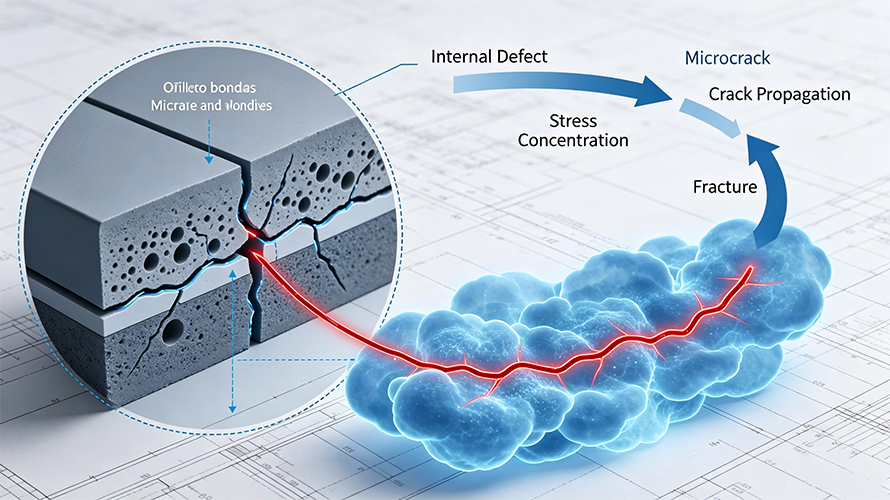
If the target contains internal defects or residual stress, these loads can concentrate around weak regions and initiate microscopic cracks. Once a crack forms, repeated thermal cycling and ion bombardment can drive its propagation.
A simplified failure mechanism is:
Internal defect → stress concentration → microcrack initiation → crack propagation → target fracture
In severe cases, cracking may occur together with abnormal discharge or arcing. Target fragments can then contaminate the sputtering chamber or substrate, causing process interruption and reduced production yield.
Therefore, ITO target explosion should be understood as a materials-structure and process-coupling problem, rather than simply a mechanical failure.
Ultimately, addressing the issue of ITO Sputtering Targets Crack is vital for enhancing the reliability and performance of sputtering processes.
2. Why Sintering Structure Is Critical?
ITO targets are generally manufactured from an In₂O₃-SnO₂ ceramic system. The powder characteristics, forming process, sintering profile, and cooling process collectively determine the final microstructure.
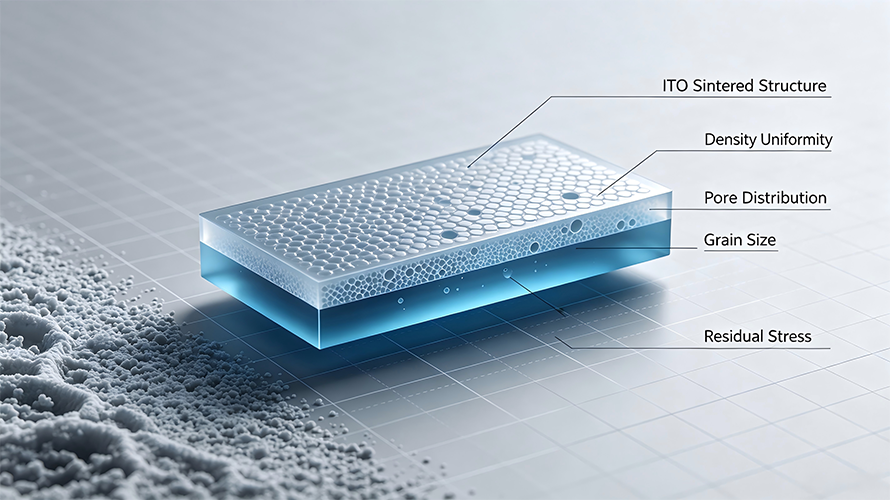
Several parameters directly influence target reliability:
- Sintered density
- Density uniformity
- Porosity and pore distribution
- Grain size and grain uniformity
- Chemical composition
- Internal defects
- Residual stress
A high average density alone does not guarantee a reliable target. A target can show a satisfactory overall density while still containing local low-density regions, pores, or weak interfaces.
These regions can become stress concentration points during sputtering.
For this reason, uniformity throughout the target is often more important than simply maximizing the average density.
3. Uneven Density and Differential Shrinkage
The problem can begin before sintering.
ITO powder must first be formed into a green body. Cold isostatic pressing (CIP) is often used because it can provide relatively uniform pressure and reduce density gradients.
However, powder filling, particle-size distribution, powder dispersion, and forming conditions can still produce differences in green density.
During sintering, regions with different initial densities may shrink at different rates.
The resulting process can be described as:
Uneven powder packing → green-density gradient → differential shrinkage → residual stress → crack initiation
This problem becomes increasingly important for large-area or thick ITO targets, where maintaining uniform density throughout the entire cross-section is more difficult.
To reduce density-related cracking, manufacturers should control:
- Powder particle-size distribution
- Powder dispersion
- Powder filling uniformity
- Forming pressure
- CIP conditions
- Green-body density distribution
- Sintering shrinkage behavior
The objective is to produce a green body with consistent initial density, allowing more uniform densification during sintering.
4. Porosity and Internal Defects
Porosity is another major factor affecting target reliability.
During sintering, pores should progressively shrink and disappear as the material densifies. If organic residues, gases, or poorly dispersed powder remain inside the green body, however, pores may become trapped or develop into closed internal defects.
These defects are particularly problematic because they act as local stress concentrators.
Internal defects can also contribute to abnormal sputtering behavior and particle generation, which is closely related to ITO target nodule formation during sputtering.
Under sputtering conditions, thermal and mechanical loading is repeatedly applied to the target. A pore or weak region can therefore become the starting point for crack propagation.
The mechanism can be summarized as:
Pore or internal defect → local stress concentration → microcrack → crack growth → target failure
This is why surface inspection alone is insufficient for evaluating a high-performance ITO target. Internal integrity must also be considered.
Appropriate inspection methods can include density measurement, microscopic or SEM analysis, ultrasonic inspection, dimensional inspection, and chemical analysis.
5. Residual Stress and Thermal Shock
One of the most important factors in target cracking is residual stress generated during heating and cooling.
During sintering, different regions of a large ceramic body may experience different temperatures. During cooling, the material contracts as its temperature decreases.
If the surface and interior cool at different rates, differential thermal contraction occurs.
This produces a temperature-gradient-driven stress:
Temperature gradient → differential thermal contraction → thermal stress → residual stress
If the accumulated stress exceeds the local fracture resistance of the ceramic, cracks can initiate or existing microcracks can become unstable.
The cooling stage is therefore just as important as the heating stage.
Important parameters include:
- Heating rate
- Cooling rate
- Holding time
- Target thickness
- Target geometry
- Furnace temperature uniformity
- Sintering atmosphere
Controlled cooling can reduce thermal gradients and minimize residual stress. Depending on the manufacturing process, a subsequent annealing treatment may also be used to relieve internal stress.
6. Grain Size and Microstructural Uniformity
Grain structure also affects the mechanical and sputtering behavior of ITO targets.
Excessive grain growth can reduce mechanical strength and change fracture behavior. At the other extreme, an excessively fine-grained structure increases grain-boundary density and may influence electrical properties and sputtering characteristics.
Therefore, the objective is not simply to obtain the smallest possible grains, but to achieve a controlled and uniform grain structure.
Grain-size distribution is particularly important. Large variations in grain size can produce local differences in mechanical strength, thermal response, and sputtering behavior.
A properly controlled microstructure should balance:
Mechanical strength + electrical properties + sputtering stability
This is especially important for targets intended for high-power or long-duration sputtering.
7. Impurities and Abnormal Discharge
High-purity raw materials are essential for ITO target manufacturing.
Impurities, foreign particles, organic residues, and other contaminants can introduce local compositional or structural abnormalities.
During magnetron sputtering, these abnormal regions may respond differently to electrical and thermal loading compared with the surrounding ITO matrix.
They can potentially become preferential locations for:
- Localized heating
- Abnormal discharge
- Arcing
- Particle generation
- Crack initiation
Therefore, quality control should cover not only the chemical purity of In₂O₃ and SnO₂ powders but also cleanliness during mixing, forming, sintering, machining, and packaging.
8. How Sputtering Conditions Trigger Target Failure
A well-manufactured target can still experience cracking if the sputtering process generates excessive thermal stress.
During magnetron sputtering, energetic ions transfer energy to the target surface. A significant portion of this energy becomes heat.
If heat removal is insufficient, the target temperature can increase locally. Existing pores, microcracks, or residual stresses can then amplify the thermal response.
A typical process is:
Ion bombardment → localized heating → thermal stress → crack propagation → arcing → target failure
Sputtering parameters that can influence this process include:
- Applied power
- Power density
- Current and voltage
- Working pressure
- Gas composition
- Sputtering duration
- Cooling-water conditions
- Thermal contact between target and backing plate
Therefore, target quality and sputtering parameters must be evaluated together.
9. Why High-Power Sputtering Increases the Risk
Higher-power sputtering is increasingly used to improve deposition rates and production efficiency. However, increasing power also increases the thermal load applied to the target.
This places greater demands on:
- Target density
- Mechanical strength
- Thermal conductivity
- Microstructural uniformity
- Thermal-shock resistance
- Cooling efficiency
- Target bonding quality
A target that performs well under conventional power conditions may show abnormal arcing or cracking when power density is significantly increased.
This is why high-power sputtering requires not only a high-density ITO target, but also uniform structure and effective thermal management.
10. Target Bonding and Cooling
The ceramic target itself is not the only component involved in thermal management.
In a typical sputtering assembly, heat must travel from the ITO target through the bonding layer and backing plate to the cooling system.
Poor thermal contact can create localized temperature differences and increase thermal stress.
Potential problems include:
- Uneven bonding-layer thickness
- Voids in the bonding layer
- Poor thermal contact
- Insufficient cooling
- Local overheating
- Excessive thermal cycling
Therefore, target reliability should be evaluated as a complete assembly:
ITO target → bonding layer → backing plate → cooling system
Good thermal contact helps maintain a more uniform target temperature and reduces the probability of thermally induced cracking.
11. How to Prevent ITO Target Explosion
Preventing target failure requires coordinated control from powder preparation through sputtering.
11.1 Control Powder Quality
Use high-purity In₂O₃ and SnO₂ powders with controlled particle-size distribution, good dispersion, and uniform Sn distribution.
Important parameters include:
- Chemical purity
- Particle-size distribution
- Specific surface area
- Powder morphology
- Composition uniformity
- Moisture and impurity levels
11.2 Improve Green-Body Density Uniformity
The forming process should minimize density gradients.
CIP can help achieve more uniform compaction, while powder filling and pressing conditions should be optimized according to target geometry.
11.3 Optimize the Sintering Profile
The sintering schedule should provide controlled binder removal, densification, grain growth, and cooling.
A typical process concept is:
Binder removal → controlled heating → densification → controlled cooling → optional annealing
The exact temperature profile should be determined according to powder characteristics, target dimensions, furnace configuration, and material composition rather than using one fixed recipe for all targets.
11.4 Control Microstructure
The finished target should have:
- High and uniform density
- Low and uniformly distributed porosity
- Controlled grain size
- Uniform composition
- Minimal internal defects
- Low residual stress
11.5 Optimize Bonding and Cooling
The bonding layer should provide reliable mechanical attachment and efficient heat transfer. Cooling conditions should also be sufficient to prevent excessive target temperature and thermal gradients.
12. How to Evaluate ITO Target Quality?
A reliable quality-control system should combine several inspection methods.
| Quality Parameter | Evaluation Method |
|---|---|
| Sintered Density | Density measurement |
| Grain Structure | SEM / Microscopic analysis |
| Internal Defects | Ultrasonic inspection |
| Surface Condition | Visual inspection |
| Chemical Purity | Chemical analysis |
| Dimensions | Dimensional inspection |
| Residual Stress | Process and stress evaluation |
The most effective approach is to establish a correlation between manufacturing parameters and inspection results.
For example, recurring internal defects can be traced back to powder dispersion, forming density, or sintering conditions. Abnormal grain growth can be correlated with sintering temperature and holding time.
This creates a closed-loop process:
Powder properties → Forming density → Sintering → Microstructure → Inspection → Process optimization
Such a system helps manufacturers move from simply detecting defective targets toward predicting and preventing potential failures.
13. ITO Target Explosion as a Coupled Materials Problem
ITO target cracking should not be attributed to a single parameter such as density or sputtering power.
The complete failure chain can be represented as:
Powder quality
↓
Green-body density uniformity
↓
Sintering and cooling
↓
Density + porosity + grain structure
↓
Residual stress and internal defects
↓
Machining and bonding
↓
Thermal load during sputtering
↓
Arcing / crack propagation
↓
Target failure
This explains why simply increasing the average density of an ITO target does not necessarily eliminate cracking.
A reliable target requires a combination of high density, structural uniformity, controlled porosity, appropriate grain size, low residual stress, high purity, and effective thermal management.
Conclusion
ITO target explosion is a complex failure phenomenon involving sintering structure, density uniformity, porosity, grain size, residual stress, internal defects, bonding conditions, cooling, and sputtering parameters.
Among these factors, sintering quality is particularly important because it determines the target’s initial mechanical and thermal stability.
A high-performance ITO target should therefore achieve not only high density, but also uniform density, controlled pore distribution, homogeneous grain structure, low residual stress, high purity, and minimal internal defects.
As sputtering processes move toward larger target sizes and higher power densities, precise control of these parameters becomes increasingly important.
Ultimately, the key to preventing ITO target cracking is not a single process adjustment, but a complete manufacturing and sputtering control system that connects powder preparation, forming, sintering, cooling, machining, bonding, inspection, and process optimization.
Frequently Asked Questions
Why do ITO sputtering targets crack during sputtering?
ITO sputtering targets can crack because of a combination of uneven density, internal pores, residual stress, thermal gradients, microstructural defects, poor bonding, and excessive thermal loading during sputtering. Existing microcracks or weak regions can expand under repeated ion bombardment and thermal cycling.
What is the main cause of ITO target explosion?
There is usually no single cause. Uneven sintered density, internal defects, residual thermal stress, and insufficient heat dissipation are major contributors. High sputtering power or power density can further increase thermal stress and trigger crack propagation or abnormal arcing.
Can rapid cooling cause ITO target cracking?
Yes. Rapid or uneven cooling can generate temperature gradients between different regions of the ITO target. Because ceramic materials undergo thermal contraction during cooling, these gradients can produce residual stress and increase the risk of microcrack formation or crack propagation.
How can I prevent ITO target explosion during sputtering?
ITO target failure can be reduced by controlling powder quality, green-body density, sintering and cooling conditions, grain structure, internal defects, target bonding, and cooling efficiency. During sputtering, appropriate power density, thermal management, and process stability are also important.
Does higher ITO target density always mean better sputtering performance?
Not necessarily. High density is important, but target quality also depends on density uniformity, pore distribution, grain size, residual stress, chemical purity, and internal integrity. A highly dense target with significant internal stress or structural non-uniformity can still experience cracking or abnormal discharge.
References
- [1] Medvedovski, E., et al. (2008). Advanced indium-tin oxide ceramics for sputtering targets. Ceramics International, 34(5), 1173–1182.
- [2] Comparing Microstructures of ITO Sputtering Targets Prepared by Tin Doped Indium Oxide Powders and In₂O₃-SnO₂ Mixed Powders. (2015). Rare Metal Materials and Engineering, 44(12), 2937–2942.
- [3] Omata, T., Kita, M., Okada, H., Otsuka-Yao-Matsuo, S., Ono, N., & Ikawa, H. (2006). Characterization of indium–tin oxide sputtering targets showing various densities of nodule formation. Thin Solid Films, 503(1–2), 22–28.
- [4] Effect of tin oxide dispersion on nodule formation in ITO sputtering. (2002). Vacuum, 66(3–4), 221–226.
- [5] Indium–tin-oxide coatings for applications in photovoltaics and displays deposited using rotary ceramic targets: Recent insights regarding process stability and doping level. (2013). Thin Solid Films, 532, 94–97.
Further Reading
- Indium Tin Oxide Targets (ITO) – Overview of ITO target composition, properties, preparation, and applications.
- ITO Target Nodule Formation During Sputtering – Mechanisms and prevention of nodule formation during sputtering.
- ITO Sputtering Target Problems and Solutions – Common ITO target problems and practical solutions.
Need High Quality ITO Sputtering Targers?
If you are looking for high-quality ITO sputtering targets for display, photovoltaic, touch-panel, or other transparent conductive film applications, contact us for available purity levels, target dimensions, bonding options, and customized solutions.