


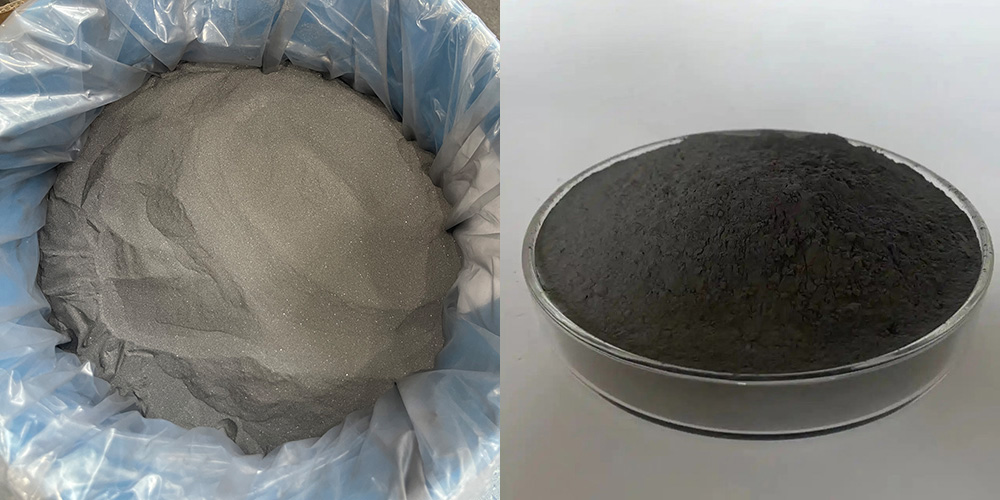
Titanium carbide (TiC) and tungsten carbide (WC) are hard, refractory materials used in wear-resistant components, cutting tools, powder metallurgy and advanced material systems. Both offer high hardness and good thermal stability, but they serve different roles in many industrial applications.
The main difference between titanium carbide and tungsten carbide is their combination of density, mechanical properties and role in the final material. TiC is a lower-density carbide commonly used in ceramic composites and selected cemented carbide formulations, while WC is the primary hard phase in many conventional cemented carbide grades.
Understanding these differences helps engineers select the right carbide for a specific application, whether the material is used as a powder, a ceramic phase or part of a finished hardmetal component.
Titanium Carbide vs Tungsten Carbide: Key Differences
| Property | Titanium Carbide (TiC) | Tungsten Carbide (WC) |
|---|---|---|
| Chemical formula | TiC | WC |
| Material type | Refractory carbide ceramic | Refractory carbide |
| Crystal structure | Cubic, rock-salt type | Hexagonal |
| Typical density | Approximately 4.93–4.94 g/cm³ | Approximately 15.7 g/cm³ |
| Hardness | Very high; depends on composition and test method | Very high; depends on composition and test method |
| Relative weight | Lower density | Much higher density |
| Role in cemented carbides | Additional carbide phase in selected grades | Primary hard phase in many conventional grades |
| Typical applications | Ceramic composites, wear-resistant materials and selected hardmetals | Cutting tools, mining tools, dies and wear-resistant components |
These values describe the carbide materials themselves, not every commercial powder or finished component. Actual performance depends on composition, microstructure, processing and test conditions. The density of WC is approximately three times that of TiC, making density one of the clearest differences between the two materials.
Crystal Structure and Material Properties
TiC and WC have different crystal structures, which influence their bonding, mechanical behaviour and response to processing.
Titanium carbide has a cubic rock-salt-type structure. It is valued for its high hardness, refractory characteristics and use in ceramic and composite systems.
Tungsten carbide has a hexagonal crystal structure under ordinary conditions. Its combination of hardness and wear resistance makes it particularly important in cemented carbide manufacturing.
Neither crystal structure alone determines the performance of a finished component. Grain size, porosity, binder composition and manufacturing conditions can substantially change the properties of the final material.
Hardness and Wear Resistance
Both TiC and WC are used where resistance to abrasion and mechanical wear is important. However, hardness should not be treated as the only criterion when comparing them.
TiC offers very high hardness and is suitable for wear-resistant ceramics, composite materials and selected hardmetal formulations. Its performance depends on the quality of the carbide phase and how it is incorporated into the final structure.
WC is widely used in cemented carbide cutting tools and industrial wear components. When combined with a metallic binder, typically cobalt or another suitable binder, WC forms a hardmetal with a carefully balanced combination of hardness and fracture resistance.
For practical material selection, the following factors matter alongside hardness:
- Carbide grain size and distribution
- Binder type and content
- Porosity and microstructural uniformity
- Abrasive or adhesive wear conditions
- Contact pressure and operating temperature
- Workpiece material and machining conditions
A material with higher measured hardness does not automatically deliver longer service life. The correct choice depends on the dominant wear mechanism and the mechanical demands of the application.
Density: Why TiC Is Much Lighter Than WC
Density is a significant distinction between titanium carbide and tungsten carbide.
TiC has a typical density of approximately 4.93–4.94 g/cm³, whereas WC has a typical density of approximately 15.7 g/cm³. The difference comes primarily from the much higher atomic mass of tungsten compared with titanium.
For applications where component weight is important, TiC can offer an advantage. It is also useful when a material designer wants to introduce a hard carbide phase without the same density contribution associated with WC.
However, lower density does not automatically mean better performance. In cutting tools, dies and other heavily loaded components, wear resistance, fracture toughness, thermal behaviour and the properties of the complete material system may be more important than weight alone.
High-Temperature Performance
Both titanium carbide and tungsten carbide are refractory materials used in demanding thermal environments.
TiC has a reported melting point around 3,100°C and is used in high-temperature ceramic and composite applications. Its hardness and refractory nature make it suitable for material systems where thermal stability is an important design consideration.
WC is also used in demanding thermal and mechanical environments, particularly in cemented carbide tools and wear-resistant components.
For either material, high-temperature suitability depends on more than melting point. Oxidation resistance, thermal expansion, thermal conductivity, binder stability and the surrounding atmosphere must also be considered.
A carbide intended for use in air at elevated temperature may require a different assessment from one operating in a vacuum, an inert atmosphere or a protected composite structure.
TiC and WC in Cemented Carbides
One of the most important distinctions between TiC and WC is their role in cemented carbide formulations.
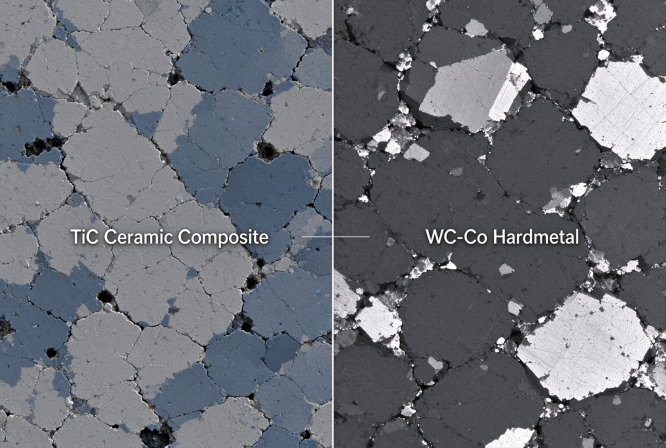
WC is the principal hard phase in many conventional cemented carbides, particularly WC-Co grades. A metallic binder holds the carbide grains together and helps provide the balance between hardness and toughness required for industrial tooling.
TiC is used as an additional carbide phase in selected systems, including WC-TiC-Co formulations. Depending on the composition and manufacturing route, it can influence the hardness, wear behaviour and high-temperature performance of the material. For a closer look at its role in these formulations, see our guide to “titanium carbide in cemented carbides“.
This means that TiC and WC are not generally interchangeable on a one-to-one basis. Replacing one with the other changes the material system, and the resulting component may exhibit different wear behaviour, fracture resistance and thermal performance.
For cutting tools and other hardmetal applications, the appropriate formulation should be selected according to the workpiece material, operating conditions, required service life and manufacturing process.
Typical Applications of Titanium Carbide
Titanium carbide is used in several material systems where high hardness, refractory characteristics and a relatively low density are beneficial.
Common application areas include:
- Cemented carbides: An additional carbide phase in selected hardmetal formulations.
- Wear-resistant materials: Components and material systems designed to resist abrasion.
- Ceramic composites: Hard phases incorporated into engineered ceramic structures.
- Powder metallurgy: A carbide feedstock for manufacturing specialised components.
- Surface engineering: Selected coatings and protective material systems.
- High-temperature materials: Components and composites designed for demanding thermal environments.
The suitability of TiC depends on the required properties of the finished material and the processing route used to produce it.
Typical Applications of Tungsten Carbide
Tungsten carbide is extensively used in cemented carbide products because of its established processing technologies and combination of hardness and wear resistance.
Typical applications include:
- Cutting tools and machining inserts
- Mining and drilling tools
- Wear-resistant industrial components
- Dies, punches and moulding tools
- Hardfacing and protective wear systems
- Precision tooling for demanding mechanical applications
In these applications, WC is commonly combined with a metallic binder to achieve the required balance of hardness, toughness and durability. Different WC grain sizes and binder contents are used to meet different service requirements.
How to Choose Between TiC and WC?
The most effective way to select a carbide is to begin with the intended application and manufacturing process.
| Selection requirement | What to consider |
|---|---|
| Lower material density | Consider TiC where reduced density is beneficial to the material design. |
| Conventional cemented carbide tooling | Evaluate WC-based grades and their established processing routes. |
| High hardness and wear resistance | Compare the complete material system, including grain size, binder and operating conditions. |
| High-temperature operation | Assess oxidation behaviour, thermal properties and binder stability, not only melting point. |
| High fracture resistance | Evaluate the balance between hardness, toughness, microstructure and component geometry. |
| Powder-based manufacturing | Match powder purity, particle size, morphology and composition to the intended process. |
| Custom ceramic or composite formulation | Consider whether TiC, WC or a combination of carbide phases best meets the target properties. |
For applications requiring conventional WC-based hardmetal performance, WC will often remain the starting point. TiC is worth considering when the formulation calls for a different carbide phase, lower density or specific ceramic and composite characteristics.
Titanium Carbide Powder vs Tungsten Carbide Powder
When selecting TiC powder or WC powder, the powder specification is just as important as the intrinsic properties of the carbide.
For TiC powder, relevant factors include purity, particle-size distribution, carbon-to-titanium ratio, oxygen content and other impurities. These characteristics can affect sintering behaviour, phase composition and the microstructure of the finished product. When specifying a grade for a particular process, understanding “TiC powder size and purity requirements” helps narrow down the appropriate material specification.
For WC powder, grain size, purity, carbon content, oxygen level and morphology are important considerations. These parameters influence grain growth, densification and the properties of the resulting cemented carbide.
The appropriate specification depends on the manufacturing route and final application. Powder intended for a ceramic composite may require different characteristics from powder intended for a cemented carbide cutting tool.
Before selecting a grade, define the required particle size, chemical composition, impurity limits and processing conditions. These details provide a more useful basis for comparison than a general designation such as “high-purity carbide powder.”
Conclusion
Titanium carbide and tungsten carbide both offer high hardness and wear resistance, but their different densities and roles in engineered materials make them suitable for different applications.
TiC is a lower-density refractory carbide used in ceramic composites, wear-resistant materials and selected cemented carbide formulations. WC is the principal hard phase in many established cemented carbide systems used for cutting tools and industrial wear components.
Neither material is universally better. The right choice depends on the required balance of hardness, wear resistance, fracture toughness, density, thermal performance and process compatibility.
For powder-based manufacturing, evaluating purity, particle size, composition and morphology is essential to achieving the intended material properties.
Frequently Asked Questions
1. Is titanium carbide harder than tungsten carbide?
Both are exceptionally hard carbide materials. A reliable comparison requires hardness measurements taken using comparable methods and material conditions. For finished cemented carbides, grain size and binder content also influence hardness.
2. Is TiC lighter than WC?
Yes. TiC has a typical density of approximately 4.93–4.94 g/cm³, compared with approximately 15.7 g/cm³ for WC.
3. Can titanium carbide replace tungsten carbide in cutting tools?
Not necessarily. TiC and WC play different roles in many hardmetal formulations. Any substitution requires evaluation of the complete composition, microstructure, machining conditions and required tool performance.
4. Why is TiC added to WC-based cemented carbides?
TiC can modify the properties and behaviour of selected WC-based formulations. The effect depends on the formulation, processing conditions and intended application.
5. Can TiC and WC be used together?
Yes. Both are used in selected cemented carbide formulations, including WC-TiC-based systems. Their proportions and processing conditions must be designed for the required properties.
6. What should I check when purchasing TiC or WC powder?
Check chemical purity, particle-size distribution, composition, impurity limits and morphology. The specification should match the intended process, such as sintering, powder metallurgy or ceramic composite production.
References
- [1] National Institute of Standards and Technology (NIST). NIST Chemistry WebBook: Titanium Carbide (TiC).
- [2] National Institute of Standards and Technology (NIST). Structural Ceramics Database: Tungsten Carbide (WC).
- [3] ASM International. Properties and Selection of Cemented Carbides. ASM Handbook, Volume 7: Powder Metallurgy, 2015, pp. 705–710.
- [4] ASM International. Cemented Carbides and Cermets. Metals Handbook Desk Edition, 2nd Edition, 1998, pp. 634–638.
- [5] International Organization for Standardization (ISO). ISO 4499-3:2016 — Hardmetals: Metallographic Determination of Microstructure, Part 3.
Further Reading
- High Purity Titanium Carbide: The “Ultra-Hard Pioneer” Powering Advanced Technologies
- How to make titanium carbide?- 8 Major Synthesis Routes for Titanium Carbide (TiC)
- Ti3AlC2 MAX Phase: Structure, Properties and Applications
- Titanium Carbide in Cemented Carbides: Role and Applications
- Titanium Carbide TiC Powder: Particle Size, Purity and Selection
Need a Custom Titanium Carbide or Tungsten Carbide Solution?
Choosing between titanium carbide (TiC) and tungsten carbide (WC) depends on your application, processing method and required material properties. VIMATERIAL supplies high-purity titanium carbide powder with customizable specifications to meet different material and manufacturing requirements.
Contact our team to discuss your required purity, particle size and application-specific specifications.
Looking for the right TiC grade for your project? Contact VIMATERIAL for a tailored material solution.