


Ti3AlC2 is one of the most widely studied members of the MAX phase family. This titanium aluminum carbide combines several properties normally associated with metals and ceramics, including electrical conductivity, thermal conductivity, high-temperature stability, damage tolerance and machinability.
Because of its unique layered structure, Ti3AlC2 is used both as a functional ceramic material and as an important precursor for MXene research.
The Ti3AlC2 Max Phase is notable for its versatility in various applications, including energy storage and structural materials.
What Is Ti3AlC2?
Ti3AlC2 is a ternary layered carbide composed of titanium, aluminum and carbon.
Its general MAX phase formula can be written as:
Mₙ₊₁AXₙ
For Ti₃AlC₂:
- M = Ti
- A = Al
- X = C
- n = 2
Therefore, Ti3AlC2 belongs to the 312 MAX phase family.
Other well-known MAX phase materials include Ti₂AlC and Ti₃SiC₂, which exhibit different compositions and property profiles.
The material normally exhibits a hexagonal layered crystal structure. The Ti-C structural units are separated by aluminum-containing layers, producing a characteristic layered architecture.
Crystal Structure of Ti3AlC2
The layered structure is central to the properties of Ti₃AlC₂.
Strong bonding within the Ti-C layers provides structural stability and contributes to mechanical strength and high-temperature performance.
The relatively weaker bonding associated with the Al layers allows some degree of layer sliding and damage accommodation.
This combination helps explain why Ti₃AlC₂ can show:
- Ceramic-like thermal stability
- Metal-like electrical conductivity
- Good thermal conductivity
- Thermal shock resistance
- Damage tolerance
- Relatively good machinability
The material therefore occupies an unusual position between conventional ceramics and metals.
Key Properties of Ti3AlC2 Max Phase
Electrical Conductivity
Unlike many conventional structural ceramics, Ti₃AlC₂ exhibits relatively high electrical conductivity.
This property makes it attractive for conductive ceramic components, electrodes and other applications where both electrical and thermal performance are required.
Thermal Conductivity
Ti₃AlC₂ can transfer heat more effectively than many conventional insulating ceramics.
Combined with its thermal shock resistance, this makes the material interesting for thermal management and high-temperature applications.
Thermal Stability
The layered structure allows Ti₃AlC₂ to retain its structural integrity under demanding thermal conditions, particularly in controlled atmospheres.
Its thermal performance makes it suitable for research involving high-temperature structural materials and protective coatings.
Damage Tolerance
The layered architecture can facilitate crack deflection and energy dissipation.
Instead of behaving like a completely brittle ceramic, Ti₃AlC₂ can accommodate mechanical damage through mechanisms associated with its layered structure.
Chemical Resistance
Ti₃AlC₂ shows good resistance to many chemical environments, although the aluminum-containing layers can be selectively attacked under sufficiently aggressive chemical conditions.
Therefore, chemical compatibility should always be evaluated for the specific application.
Ti₃AlC₂ and High-Temperature Oxidation
An important feature of Ti-Al-C MAX phases is their behavior during oxidation.
Aluminum can diffuse toward the surface and form an aluminum oxide layer during oxidation. This oxide layer can act as a protective barrier against further oxidation.
The same mechanism has been associated with self-healing behavior in Ti-Al-C MAX phase materials.
When surface cracks or scratches form under suitable high-temperature conditions, oxidation products can partially fill the damaged region.
This characteristic makes Ti₃AlC₂ interesting for high-temperature protective materials.
Ti₃AlC₂ as an MXene Precursor
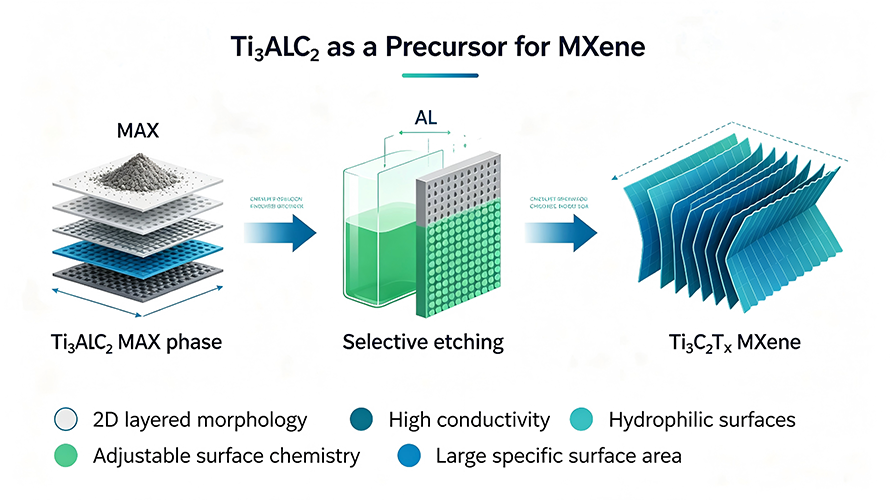
One of the most important research applications of Ti₃AlC₂ is its role as a precursor for MXene.
The aluminum layers can be selectively removed from Ti3AlC2 through appropriate etching processes. The resulting titanium carbide-based material can then be further delaminated into two-dimensional Ti₃C₂Tₓ MXene.
This process is one of the reasons Ti₃AlC₂ has become particularly important in advanced materials research.
The resulting MXene materials can exhibit:
- Two-dimensional layered morphology
- High electrical conductivity
- Hydrophilic surfaces
- Adjustable surface chemistry
- Large specific surface area
- Abundant surface reaction sites
These properties have stimulated research into batteries, supercapacitors, sensors, electromagnetic interference shielding and catalysis.
Applications of Ti3AlC2 MAX Phase
High-Temperature Structural Materials
It can be investigated for high-temperature structural components where thermal stability, conductivity and damage tolerance are required.
Protective Coatings
Its combination of high-temperature performance and chemical resistance makes Ti₃AlC₂ interesting as a coating material or coating precursor.
Conductive Ceramics
Ti₃AlC₂ can provide electrical conductivity while retaining ceramic-like thermal and mechanical properties.
This makes it attractive for electrodes, heating elements and other conductive ceramic systems.
Self-Lubricating and Wear-Resistant Materials
The layered structure can contribute to low-friction and damage-tolerant behavior, making Ti₃AlC₂ relevant to tribological material research.
Energy Storage and Electrochemistry
Ti₃AlC₂ itself and its MXene derivatives are widely studied in electrochemical systems.
The MAX phase provides a convenient precursor platform for preparing Ti₃C₂Tₓ and related two-dimensional materials.
Ti₃AlC₂ Powder for Research
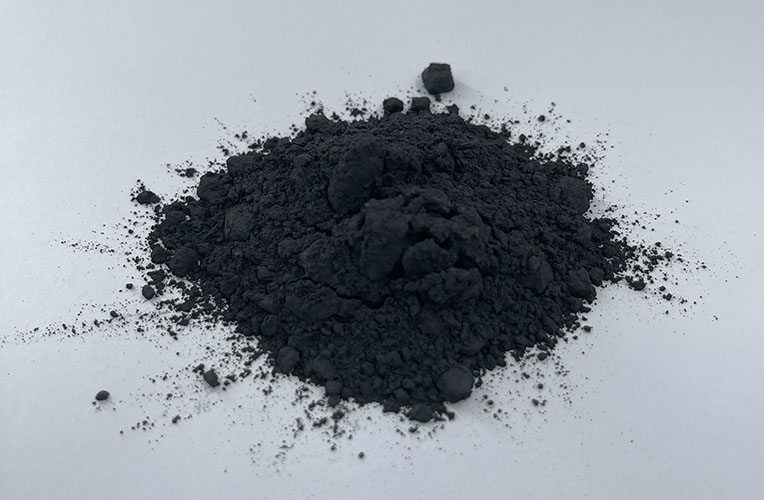
Ti₃AlC₂ is commonly supplied as a black powder with particle sizes selected according to the intended application.
Particle size can influence:
- Powder mixing
- Reaction kinetics
- Etching behavior
- Dispersion
- Sintering
- Composite processing
For research involving MXene preparation, precursor purity and particle-size distribution are particularly important because they can influence the consistency of the etching and delamination processes.
Storage and Handling
Ti₃AlC₂ powder should generally be stored in a dry, sealed and light-protected environment.
For long-term storage, protection from moisture and unnecessary exposure to air is recommended.
When handling fine powders, appropriate laboratory precautions should be used to minimize dust exposure.
Conclusion
Ti₃AlC₂ is an important 312 MAX phase material that combines metallic and ceramic characteristics through its unique layered structure.
Its electrical conductivity, thermal performance, damage tolerance, chemical resistance and machinability make it attractive for high-temperature structural materials, conductive ceramics, protective coatings and tribological systems.
At the same time, its ability to serve as a precursor for Ti₃C₂Tₓ MXene gives Ti₃AlC₂ a particularly important role in modern research on two-dimensional materials and electrochemical technologies.
Frequently Asked Questions
1. What is Ti₃AlC₂?
Ti₃AlC₂ is a 312 MAX phase material composed of titanium, aluminum and carbon. It combines metallic properties such as electrical conductivity with ceramic properties such as high-temperature stability and damage tolerance.
2. What does Ti₃AlC₂ mean in the MAX phase formula?
Ti₃AlC₂ follows the general MAX phase formula Mₙ₊₁AXₙ, where Ti is the M element, Al is the A element, C is the X element, and n = 2. Therefore, Ti₃AlC₂ is classified as a 312 MAX phase.
3. Is Ti₃AlC₂ a ceramic or a metal?
Ti₃AlC₂ is generally classified as a MAX phase ceramic rather than a conventional metal. However, its layered crystal structure gives it several metal-like characteristics, including electrical and thermal conductivity.
4. Is Ti₃AlC₂ an MXene?
No. Ti₃AlC₂ is a MAX phase precursor rather than an MXene. Selective removal of the Al layers from Ti₃AlC₂ can produce Ti₃C₂Tₓ MXene under appropriate etching conditions.
5. What are the main applications of Ti₃AlC₂?
Ti₃AlC₂ is studied for high-temperature structural materials, conductive ceramics, protective coatings, tribological systems, and as a precursor for MXene and electrochemical materials research.
6. What particle size of Ti₃AlC₂ powder should I choose?
The appropriate particle size depends on the intended application. Particle size can affect powder dispersion, reaction kinetics, etching behavior, sintering and composite processing, so the specification should be selected according to the experimental process.
7. What should I consider when purchasing Ti₃AlC₂ powder?
Important factors include chemical purity, particle-size distribution, phase composition, impurity levels, packaging and consistency between batches. For MXene research, precursor quality and particle-size characteristics are particularly important.
References
- [1] Barsoum, M. W. “The MN+1AXN phases: A new class of solids; thermodynamically stable nanolaminates.” Progress in Solid State Chemistry, 2000, 28(1–4), 201–281.
- [2] Naguib, M., et al. “Two-Dimensional Nanocrystals Produced by Exfoliation of Ti₃AlC₂.” Advanced Materials, 2011, 23(37), 4248–4253.
- [3] Naguib, M., et al. “Two-Dimensional Transition Metal Carbides.” ACS Nano, 2012, 6(2), 1322–1331.
- [4] Barsoum, M. W., & Radovic, M. “Elastic and mechanical properties of the MAX phases.” Annual Review of Materials Research, 2011, 41, 195–227.
- [5] Eklund, P., Beckers, M., Jansson, U., Högberg, H., & Hultman, L. “The Mn+1AXn phases: Materials science and thin-film processing.” Thin Solid Films, 2010, 518(8), 1851–1878.
Further Reading
- Ti3AlC2/MXene – The rising star in research
- What Are MAX Phase Ceramics? A Guide to Ti₃AlC₂, Ti₂AlC and Ti₃SiC₂
- High Purity Titanium Carbide: The “Ultra-Hard Pioneer” Powering Advanced Technologies
- Barium Carbonate: Properties, Production Process and Applications
- Aluminum Nitride (AlN) — The “Heat-Dissipating, Electrically Insulating All-Rounder” of the Electronics Industry
Need Ti₃AlC₂ Materials?
Looking for Ti₃AlC₂ MAX phase powder for MXene research or advanced materials development? VIMATERIAL can provide customized purity, particle size and packaging to match your experimental requirements.
Tell us what you need.