


Titanium carbide (TiC) is a hard refractory ceramic widely used in cemented carbides, wear-resistant materials, ceramic composites, abrasives and other high-temperature applications. In powder form, its performance is strongly influenced by purity, particle size, particle-size distribution, morphology and the requirements of the final application.
For this reason, selecting titanium carbide powder is not simply a matter of choosing the highest available purity. The appropriate grade depends on how the powder will be processed and what properties are required from the final material.
The unique properties of TiC Powder make it suitable for demanding applications where durability and performance are critical.
What Is Titanium Carbide Powder?
Titanium carbide powder is a fine particulate form of TiC, a titanium-carbon ceramic compound with a cubic rock-salt-type crystal structure. This TiC Powder is known for its high hardness, high-temperature stability, wear resistance and electrical conductivity. Titanium carbide has a typical density of approximately 4.93–4.94 g/cm³, a hardness of around 28–29 GPa, and a melting point of approximately 3100°C. The exact properties of a commercial powder can vary with composition, stoichiometry, particle characteristics and processing history.
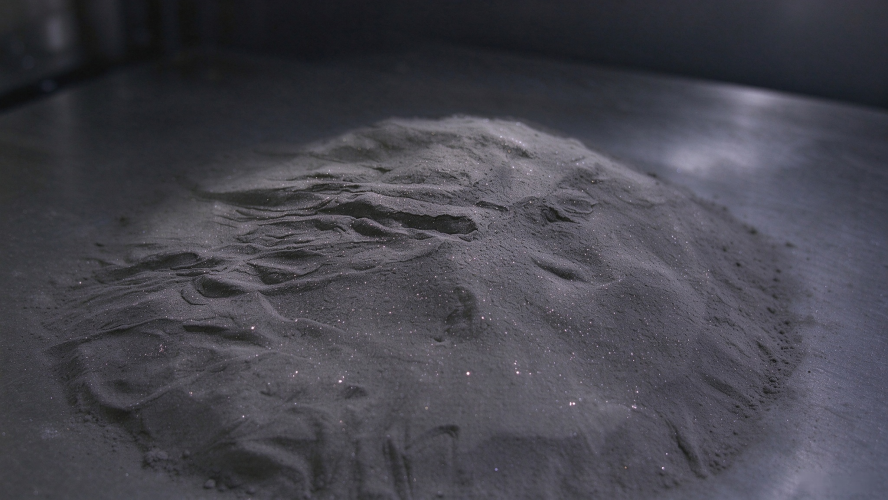
Typical TiC Powder is black to grey-black in appearance.
Key Specifications of TiC Powder
The most important specifications to evaluate are not limited to chemical purity. Particle size and powder characteristics can be equally important.
| Property | Typical information |
|---|---|
| Chemical formula | TiC |
| CAS No. | 12070-08-5 |
| Molecular weight | 59.878 g/mol |
| Crystal structure | Cubic, rock-salt type |
| Density | Approximately 4.93–4.94 g/cm³ |
| Hardness | Approximately 28–29 GPa |
| Melting point | Approximately 3100°C |
| Appearance | Black to grey-black powder |
Why Particle Size Matters?
Particle size affects powder handling, packing, mixing, sintering and the microstructure of the final product.
Fine TiC powder provides a larger specific surface area and can be useful when rapid reaction, fine microstructure or improved sintering behaviour is required. Larger particles may be preferable when powder flow, handling or a particular composite structure is more important.
Particle size should therefore be selected according to the processing route rather than treated as an independent specification.
For example:
- Nano-scale TiC can be considered when a very fine microstructure and high surface activity are required.
- Submicron or fine micron TiC can be useful for ceramic and powder-metallurgy processing.
- Micron-sized TiC is commonly considered for cemented carbide and wear-resistant material formulations.
- Spherical or classified powder can be useful where particle morphology and flow behaviour are important.
Nano Titanium Carbide Powder
Nano TiC generally refers to titanium carbide powder with particle dimensions in the nanometre range.
The smaller particle size provides a high specific surface area and can increase surface activity. This makes nano TiC attractive for research and advanced ceramic or composite formulations where fine microstructural control is important.
However, smaller particles can also increase agglomeration and handling challenges. A nano-sized powder is therefore not automatically the best choice for every application.
When selecting nano TiC, consider:
- primary particle size;
- agglomerated particle size;
- particle-size distribution;
- surface condition;
- purity;
- oxygen and other impurity levels;
- dispersion requirements.
Micron Titanium Carbide Powder
Micron-sized TiC powders are widely considered for conventional powder processing, cemented carbide, wear-resistant materials and ceramic composites.
Compared with nano powders, micron powders are generally easier to handle and may provide better powder-flow characteristics depending on morphology and particle-size distribution.
For industrial applications, the target particle size should be selected according to the final processing method and desired microstructure.
Purity and Impurity Control
Chemical purity is an important consideration when TiC is used in high-performance materials.
A higher-purity powder can be appropriate when unwanted elements may affect sintering, electrical properties, phase composition or the performance of the final component.
However, purity should always be considered together with:
- particle size;
- carbon-to-titanium ratio;
- oxygen content;
- metallic impurities;
- moisture;
- particle morphology.
For some applications, controlling a specific impurity can be more meaningful than simply comparing the headline purity percentage.
How to Choose the Right TiC Powder?
A practical selection process starts with the final application.
| Application requirement | Important powder considerations |
|---|---|
| Cemented carbide | Purity, particle size, carbon balance and compatibility with the carbide formulation |
| Ceramic composites | Particle size, distribution, purity and sintering behaviour |
| Wear-resistant materials | Hardness, particle size, morphology and dispersion |
| Research and advanced materials | Fine particle size, purity and reproducible powder characteristics |
| Powder metallurgy | Particle size distribution, flow, packing and chemical composition |
The most useful powder specification is therefore the one that matches the complete processing route.
Titanium Carbide Powder Particle Sizes
VIMATERIAL can provide TiC powder in different particle-size ranges for research and industrial applications.
Available particle-size options include nano-scale grades such as 20 nm, 40 nm, 80 nm, 100 nm and 500 nm, as well as micron-scale ranges such as 1–2 μm and 4–5 μm. Spherical TiC powder can also be supplied in ranges including 0–15 μm, 15–53 μm and 45–105 μm.
The actual particle-size requirement should be confirmed according to the intended application and processing method.
How Is TiC Powder Produced?
Industrial titanium carbide is commonly produced through high-temperature carbothermal processing of titanium-containing raw materials with a carbon source.
The reaction conditions influence the resulting composition, particle characteristics and phase purity. For more information about TiC production routes, see:
How to Make Titanium Carbide (TiC)?
TiC Powder for Cemented Carbides
TiC is particularly important in cemented carbide systems containing tungsten carbide and metallic binders.
In WC-TiC-Co materials, TiC can contribute to hardness, wear resistance, crater-wear resistance and high-temperature performance. Its effect depends on the overall composition, grain structure and sintering conditions rather than TiC content alone.
For a more detailed discussion, see:
Titanium Carbide in Cemented Carbides: Role and Applications
FAQs
1. What is titanium carbide powder used for?
TiC powder is used in cemented carbides, wear-resistant materials, ceramic composites, abrasives, powder metallurgy and other high-temperature material systems.
2. What particle size should I choose for TiC powder?
The appropriate particle size depends on the application and processing method. Fine powders are generally considered when fine microstructures or high surface activity are required, while micron-sized powders may be more practical for conventional powder processing.
3. Is nano TiC always better than micron TiC?
No. Nano TiC offers a high specific surface area but can also be more difficult to disperse and handle. The correct particle size depends on the final application.
4. What purity of TiC powder is available?
VIMATERIAL currently provides TiC powder at 99% purity, with particle size and other specifications available according to application requirements. Our TiC Powder is essential for various industrial applications.
5. Can TiC powder particle size be customized?
Yes. Particle-size requirements can be discussed according to the intended processing method and application.
References
- [1] NIST Structural Ceramics Database — Titanium Carbide Basic physical and mechanical properties of titanium carbide, including density, hardness and melting point.
- [2] NIST Chemistry WebBook — Titanium Carbide Chemical and thermochemical reference data for TiC, including molecular weight and CAS information.
- [3] ScienceDirect — Carbothermal Reduction Technical background on carbothermal production routes for titanium carbide powders.
- [4] Ceramics International — WC–TiC–Co Ultrafine Cemented Carbide Research on the role of TiC in cemented carbide systems, including hardness, wear behaviour and grain-size effects.
Further Reading
- High Purity Titanium Carbide: The “Ultra-Hard Pioneer” Powering Advanced Technologies
- How to make titanium carbide?- 8 Major Synthesis Routes for Titanium Carbide (TiC)
- Ti3AlC2 MAX Phase: Structure, Properties and Applications
- Si3N4 vs SiC: A quick guide of these two ceramic materials.
- Hexagonal Boron Nitride (h-BN): A Versatile High-Performance Material Across Multiple Industries
Need a Specific TiC Powder Grade?
For TiC powder, particle size and purity can be specified according to the intended application. Custom particle-size requirements and other powder specifications can be discussed based on the processing route and material requirements.
Need a Custom Material Solution? Contact VIMATERIAL for TiC powder specifications, particle sizes and packaging options.