


Titanium carbide (TiC) is an important hard-phase component in selected cemented carbide systems. Although tungsten carbide (WC) remains the primary hard phase in many conventional cemented carbides, TiC can be introduced to modify hardness, wear behaviour, high-temperature performance and the overall microstructure of the material.
The role of TiC should therefore be understood as part of a complete carbide-binder system rather than as a standalone additive.
What Is Cemented Carbide?
Cemented carbide is a composite material consisting primarily of hard carbide phases combined with a metallic binder.
A conventional cemented carbide may contain:
- tungsten carbide (WC) as the principal hard phase;
- TiC and other carbides as additional hard phases;
- cobalt (Co) as a common binder;
- nickel or other metallic binders in selected formulations.
The final performance depends on the composition, carbide grain size, binder content, carbon balance and manufacturing process.
What Does Titanium Carbide in Cemented Carbide?
TiC can contribute several functions in cemented carbide formulations.
| Role of TiC | Material effect |
|---|---|
| Hard-phase addition | Contributes to hardness and wear resistance |
| High-temperature performance | Helps maintain hardness and performance at elevated temperatures |
| Crater-wear resistance | Can improve resistance to crater wear in cutting applications |
| Friction behaviour | Can influence friction between the cutting tool and workpiece |
| Microstructural modification | Influences carbide-phase distribution and composite microstructure |
The actual effect depends on TiC content, WC grain size, binder composition, carbon balance and sintering conditions.
TiC in WC-TiC-Co Cemented Carbides
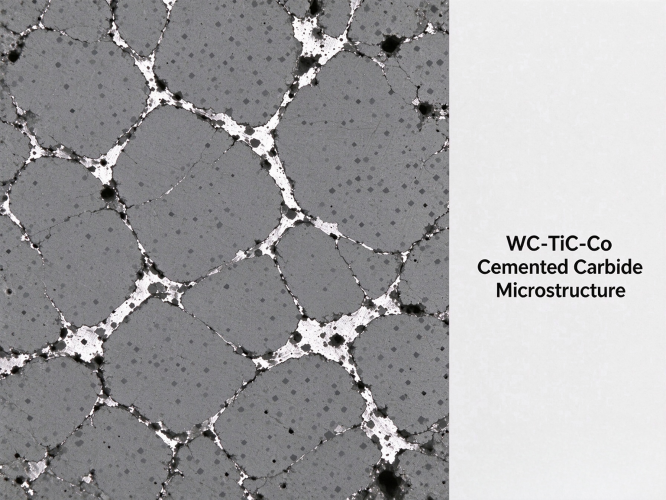
One important system is based on WC-TiC-Co.
WC provides the main hard phase, while TiC modifies the carbide phase and can contribute to high-temperature hardness and wear resistance.
The balance between WC, TiC and Co is important. Increasing one component does not automatically improve every property because cemented carbide performance involves trade-offs among hardness, wear resistance, toughness, thermal behaviour and manufacturability.
For this reason, TiC should be selected according to the complete formulation rather than simply specified at the highest possible concentration.
TiC and Red Hardness
Cutting tools can experience substantial temperature increases during machining.
Under these conditions, the ability of a carbide material to retain hardness at elevated temperature becomes important.
TiC is used in selected cemented carbide formulations partly because of its high-temperature stability and hardness. This can help maintain cutting performance under demanding thermal conditions.
However, the high-temperature performance of a cemented carbide cannot be attributed to TiC alone. Binder content, carbide grain size, phase composition and processing conditions also influence the final behaviour.
TiC and Wear Resistance
Wear resistance is another important reason for using TiC in carbide materials.
The high hardness of TiC can contribute to resistance against abrasive and adhesive wear mechanisms. In cutting applications, TiC-containing carbide systems can also be designed to improve resistance to crater wear.
The result depends strongly on the workpiece material, cutting conditions, tool geometry and complete carbide composition.
TiC and Grain Structure
The microstructure of cemented carbide is critical to its performance.
Important parameters include:
- carbide grain size;
- carbide-phase distribution;
- binder distribution;
- porosity;
- TiC content;
- carbon balance;
- sintering conditions.
TiC therefore needs to be considered together with the rest of the microstructure.
A powder with an appropriate particle size and composition can help provide better control over the final carbide structure.
Why Carbon Balance Matters
Carbon control is particularly important in cemented carbide production.
An excessive carbon level can result in free graphite, while insufficient carbon can promote the formation of undesirable eta phases.
Therefore, TiC addition should not be evaluated independently from the total carbon balance of the formulation.
For quality control, carbon analysis may be combined with techniques such as XRF, ICP-OES, high-frequency infrared carbon analysis, oxygen/nitrogen analysis, XRD and metallographic examination.
Typical Cemented Carbide Systems
Several common carbide systems can be distinguished by their main hard phases.
| System | Main composition | Typical characteristics |
|---|---|---|
| YG | WC + Co | Conventional WC-Co cemented carbide |
| YT | WC + TiC + Co | Higher hardness and high-temperature cutting performance |
| YW | WC + TiC + TaC/NbC + Co | Multi-carbide system for demanding cutting applications |
| Ultrafine carbide | Fine WC-Co + grain-growth inhibitors | Fine microstructure and high hardness |
These classifications are useful for understanding material families, but actual compositions and grades vary between standards, manufacturers and applications.
TiC for Cutting Tools
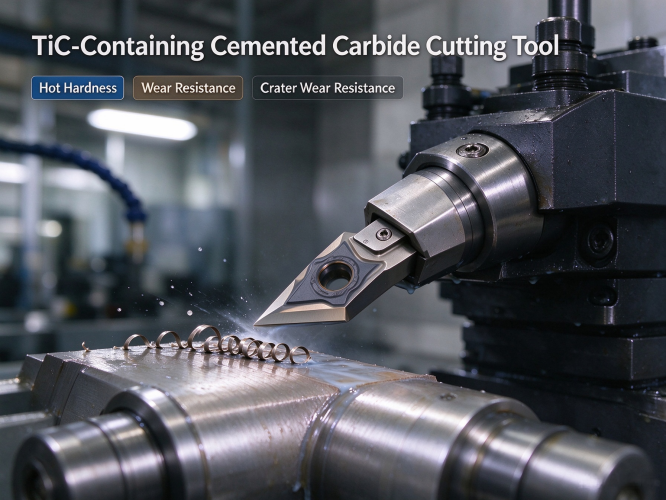
TiC-containing cemented carbides can be used in cutting-tool applications where hardness, wear resistance and high-temperature performance are important.
Potential applications include:
- turning tools;
- milling tools;
- machining inserts;
- wear components;
- dies and moulds;
- other hardmetal components.
The appropriate grade depends on the workpiece material and cutting conditions.
TiC Compared with WC in Cemented Carbide
TiC and WC play different roles in many cemented carbide formulations.
WC is the primary hard phase in a large proportion of conventional cemented carbide systems. TiC is often introduced as an additional carbide phase to modify the properties of the composite.
This distinction is important when selecting raw materials. TiC should not simply be treated as a direct replacement for WC.
For a broader material comparison, see:
Titanium Carbide vs Tungsten Carbide: Properties and Applications
Selecting TiC Powder for Cemented Carbide
When TiC powder is intended for cemented carbide production, the following characteristics should be evaluated:
| TiC Powder Parameter | Why It Matters |
|---|---|
| Chemical purity | Helps control the composition and properties of the final carbide |
| Particle size | Influences mixing, sintering and final microstructure |
| Particle-size distribution | Affects powder packing and processing behaviour |
| Carbon content | Must be controlled together with the overall carbon balance |
| Oxygen and other impurities | May affect processing and final material properties |
| Batch consistency | Supports stable processing and reproducible results |
A suitable TiC powder specification should therefore be based on the complete formulation and processing route.
Quality Control for TiC-Containing Carbides
A comprehensive quality-control programme may include:
- chemical composition analysis;
- carbon and sulfur analysis;
- oxygen and nitrogen analysis;
- XRD phase identification;
- SEM/EDS examination;
- metallographic analysis;
- hardness testing;
- density measurement.
Metallographic examination can be particularly useful for evaluating carbide grain size, binder distribution and abnormal phases.
Conclusion
TiC is an important carbide phase in selected cemented carbide systems. Its high hardness and high-temperature stability can contribute to wear resistance, crater-wear resistance and hardness retention in demanding applications.
However, TiC performance is determined by the complete material system. WC content, binder composition, carbide grain size, carbon balance and sintering conditions all need to be considered together.
For manufacturers selecting TiC powder, particle size, purity and consistency are therefore as important as the nominal chemical formula.
FAQs
1. Why is TiC added to cemented carbide?
TiC can be added to contribute hardness, wear resistance, high-temperature performance and specific microstructural characteristics.
2. Is TiC a replacement for WC?
Not generally. WC is the main hard phase in many cemented carbide systems, while TiC is commonly used as an additional carbide phase.
3. Does more TiC always mean better performance?
No. Cemented carbide properties depend on the complete composition and microstructure. Excessive changes in one component can affect toughness, sintering behaviour and other properties.
4. Why is carbon balance important?
Excess carbon can lead to free graphite, while insufficient carbon can promote eta phases. Carbon control is therefore essential for producing a suitable carbide microstructure.
5. What TiC powder properties are important for cemented carbide?
Purity, particle size, particle-size distribution, carbon balance and impurity control are among the key factors.
References
- [1] Xiong, X. et al. “Tool wear mechanism of WC–5TiC–10Co ultrafine cemented carbide during AISI 1045 carbon steel cutting process.” International Journal of Refractory Metals and Hard Materials, 2012.
- [2] Xiong, X. et al. “Tool life and wear of WC–TiC–Co ultrafine cemented carbide during dry cutting of AISI H13 steel.” Ceramics International, 2013, 39(1), 337–346.
- [3] “Wear behavior and tool life of modified WC-based cemented carbides.” Materials Characterization, 1994, 32(1), 41–49.
- [4] Zeng, K. et al. “A comprehensive review on the cutting and abrasive machining of cemented carbide materials.” Journal of Manufacturing Processes, 2023, 108, 335–358.
Further Reading
- High Purity Titanium Carbide: The “Ultra-Hard Pioneer” Powering Advanced Technologies
- How to make titanium carbide?- 8 Major Synthesis Routes for Titanium Carbide (TiC)
- Titanium Carbide TiC Powder: Particle Size, Purity and Selection
- Si3N4 vs SiC: A quick guide of these two ceramic materials.
- Hexagonal Boron Nitride (h-BN): A Versatile High-Performance Material Across Multiple Industries
Need TiC Powder for Cemented Carbide Production?
Choosing the right titanium carbide powder depends on more than chemical purity. Particle size, particle-size distribution, carbon content, impurity levels and batch consistency can all affect powder processing and the final cemented carbide microstructure.
VIMATERIAL supplies titanium carbide (TiC) powder for research, development and industrial material applications, with specifications tailored to your processing and formulation requirements.
Send us your TiC powder requirements and application details for a material specification and quotation.