


NFPP (sodium iron phosphate pyrophosphate) is a promising cathode material for stationary sodium-ion batteries, particularly where cycle life, structural stability and raw-material availability are important. Its suitability depends on validated cell performance, operating conditions, safety requirements and lifetime system cost. Compared with LFP, NFPP offers a different balance of supply-chain considerations and technical maturity, making application-specific evaluation essential.
NFPP for Stationary Energy Storage is an important topic to consider as it addresses safety, cycle life, cost, and performance in energy systems.
Stationary energy storage systems are designed around long service life, operational reliability, safety requirements and total cost of ownership. Unlike electric vehicles, where weight and driving range are major constraints, grid-scale and commercial storage systems can often accommodate lower energy density if the battery delivers dependable performance over many years.
Sodium iron phosphate pyrophosphate (NFPP) is a promising cathode material for sodium-ion batteries because it combines an iron-based composition, structural stability and the potential for long cycle life. Its suitability for stationary storage, however, depends on more than cathode chemistry. Cell design, electrode quality, operating conditions, manufacturing consistency and system-level safety all influence the final result.
For battery developers, system integrators and material purchasers, the key question is whether NFPP can meet the technical and economic requirements of a specific storage application.
1. Why Is NFPP Suitable for Stationary Energy Storage?
Stationary storage applications often prioritize predictable performance, long operating life and manageable maintenance costs over maximum energy density. These requirements align with several characteristics of NFPP-based sodium-ion batteries.
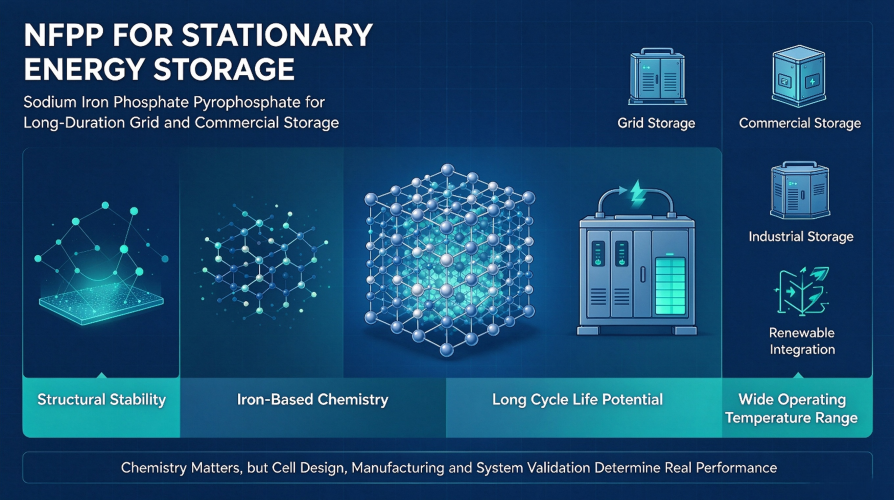
Structural stability is one of NFPP’s main advantages. Its phosphate–pyrophosphate framework supports repeated sodium-ion insertion and extraction, making it a candidate for applications involving frequent charge–discharge cycles.
Iron-based chemistry is another consideration. Iron is relatively abundant, and NFPP does not rely on nickel or cobalt as essential elements in its basic composition. This can help reduce exposure to certain raw-material supply risks, although the final cost still depends on synthesis, processing, yield and manufacturing scale.
NFPP can also be developed for applications requiring high-rate operation and a broad operating-temperature range. These characteristics may be useful in renewable energy integration, grid balancing and industrial storage, where charging and discharging requirements can vary throughout the day.
Nevertheless, NFPP is not automatically the best choice for every stationary storage project. Its energy density, cell availability, warranty terms, system integration costs and commercial maturity must be evaluated against the project’s operating profile.
Therefore, embracing NFPP for Stationary Energy Storage can lead to better investment decisions in energy technology.
2. NFPP Safety for Energy Storage
Safety is a major consideration in stationary battery installations because systems may contain large quantities of stored energy and operate close to buildings, industrial facilities or electrical infrastructure.
NFPP’s inorganic polyanionic framework and iron-based chemistry provide a useful foundation for developing stable sodium-ion cathodes. However, cathode stability alone does not establish the safety of a complete battery cell or storage system.
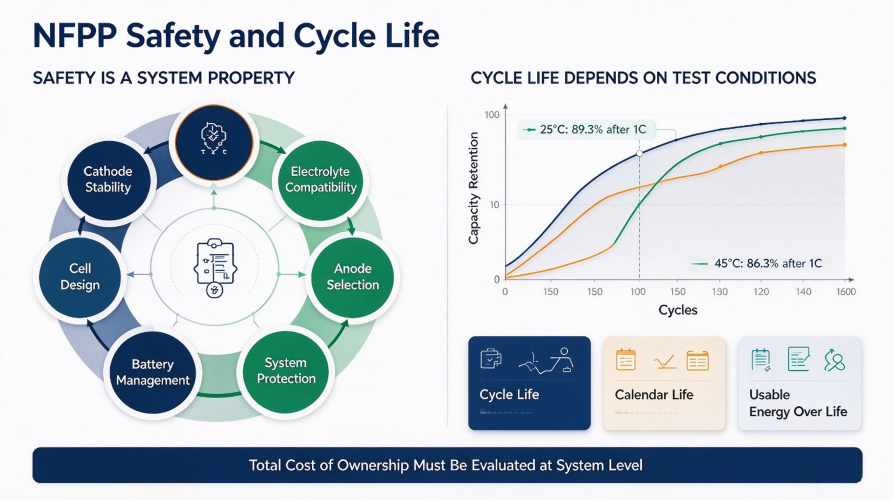
Actual safety performance depends on several interacting factors:
- Cathode stability: Material composition and structural integrity influence behavior during repeated cycling and under abnormal operating conditions.
- Electrolyte compatibility: Electrolyte composition, flammability and reactions with electrode materials affect cell-level safety.
- Anode selection: The anode and its interface with the electrolyte influence thermal and electrochemical behavior.
- Cell design: Electrode loading, separator properties, cell construction and manufacturing quality affect failure risks.
- Battery management: Voltage, current and temperature monitoring help prevent operation outside specified limits.
- System protection: Thermal management, electrical isolation, fault detection and appropriate installation design remain essential.
For developers evaluating NFPP cells, relevant evidence includes thermal stability testing, overcharge testing, short-circuit or penetration testing where applicable, and results from recognized cell- and system-level safety assessments.
NFPP can be a strong candidate where safety and durability are priorities, but procurement decisions should be based on documented performance of the actual cell and system rather than assumptions about chemistry alone.
3. NFPP Cycle Life and Lifetime Cost
Cycle life is especially important in stationary storage because a battery may charge and discharge regularly over many years. A material with a moderate initial capacity can still be attractive if it maintains usable capacity over an extended service period.
NFPP-based cathodes have demonstrated long-cycle operation in laboratory cells and larger pouch-cell formats. In a study published in the Journal of Power Sources in 2026, a 20 Ah-level pouch cell using an NFPP cathode and a hard-carbon anode operated for more than 3,500 cycles at 1C. The reported capacity retention was 89.3% at 25°C and 86.3% at 45°C under the study’s test conditions [1]. These results illustrate the potential of NFPP-based cells, but they should not be interpreted as a guaranteed service life for every commercial product.
For project evaluation, distinguish between three measures:
- Cycle life: The number of charge–discharge cycles completed before a defined end-of-life threshold is reached.
- Calendar life: How the battery degrades over time, including periods when it is not cycling.
- Usable energy over life: The energy the system can deliver under its actual operating conditions, accounting for degradation and operating limits.
Cycle-life figures are meaningful only when their test conditions are understood. Current rate, depth of discharge, temperature, voltage limits, initial capacity and the end-of-life criterion can all affect the result.
Lifetime cost should therefore be evaluated at the system level. A useful approach is to estimate the total cost of ownership over the project period, including the initial battery and installation costs, charging losses, cooling and auxiliary power, maintenance, replacement, and end-of-life costs.
A lower-priced cathode does not automatically produce a lower-cost storage system. Conversely, a battery with a higher initial cost may offer better economics if it provides more usable energy over its service life and reduces replacement requirements.
Want to learn more about the electrochemical performance of NFPP? Please refer to [NFPP Performance: Capacity, Voltage, Rate Capability and Cycle Life].
4. NFPP vs LFP for Stationary Storage
Lithium iron phosphate (LFP) is an established cathode chemistry for stationary lithium-ion batteries. NFPP belongs to the sodium-ion battery family and offers a different balance of material availability, energy density, manufacturing maturity and operating characteristics.
The comparison should focus on the requirements of the project rather than assuming one chemistry is universally superior.
| Evaluation Factor | NFPP-Based Sodium-Ion Batteries | LFP-Based Lithium-Ion Batteries |
|---|---|---|
| Charge Carrier | Sodium ions | Lithium ions |
| Key Cathode Elements | Sodium, iron, phosphate and pyrophosphate | Lithium, iron and phosphate |
| Raw-Material Considerations | Uses abundant sodium and iron; avoids dependence on lithium for the cathode | Uses iron and phosphate but requires lithium |
| Energy Density | Depends on cell design; may be lower in some commercial configurations | Established performance with a mature range of cell formats |
| Cycle Life | Strong potential, but verify the specific cell’s validated performance | Extensive commercial experience; actual life depends on cell and operating conditions |
| Safety | Promising cathode chemistry; full-cell and system validation remain essential | Established safety practices and a substantial field history; system-level safeguards remain necessary |
| Cold-Temperature Operation | Can be attractive in selected designs; charging limits must be checked | Performance can be constrained at low temperatures, especially during charging |
| Supply-Chain Maturity | Developing, with availability varying by supplier and market | Mature global manufacturing and service ecosystem |
| Project Economics | Depends on cell pricing, energy density, lifetime and system integration | Often benefits from established production scale, sourcing and project experience |
For many projects, LFP remains a strong reference option because of its established supply chain and extensive deployment experience. NFPP becomes more interesting when sodium-based chemistry, raw-material diversification, operating-temperature requirements or a particular cell’s cycle-life characteristics offer a meaningful advantage.
A fair comparison should use cells intended for similar applications and compare usable energy, power capability, warranted lifetime, efficiency, safety documentation and delivered system cost.
NFPP is not the only cathode option for sodium-ion batteries. Layered oxide materials and Prussian blue analogues are also relevant, and each chemistry involves different trade-offs.
| Cathode Type | Potential Strengths | Key Considerations for Stationary Storage |
|---|---|---|
| NFPP | Iron-based composition, structural stability and potential for long cycle life | Electronic conductivity, phase purity, electrode density and full-cell validation |
| Layered Oxides | Potential for relatively high specific capacity and energy density | Structural changes, moisture sensitivity in some compositions and composition-dependent stability |
| Prussian Blue Analogues | Open framework and potential for favorable ion transport | Water content, vacancy control, material consistency and electrode processing |
NFPP may be attractive when long-term stability and iron-based chemistry are central selection criteria. Layered oxides may be considered when energy density is a higher priority, while Prussian blue analogues can be relevant when their processing and electrochemical characteristics fit the application.
These categories are broad. Performance varies substantially with composition, synthesis route, modification strategy and cell engineering. Battery developers should compare specific commercial materials and validated cells rather than relying on chemistry labels alone.
6. Energy Density vs Lifetime Cost
Stationary storage does not always need the highest energy density. It needs a practical combination of usable energy, power output, service life, safety and total installed cost.
For a space-constrained application, energy density can directly influence equipment footprint, enclosure size and installation cost. For a grid-connected site with sufficient land, however, a lower-energy-density battery may remain competitive if it offers favorable lifetime performance or reduces other project costs.
The relevant question is not simply how much energy a kilogram of active material can store. It is how much usable energy the complete system can deliver over its lifetime, and at what cost.
Battery developers should evaluate:
- Cell-level energy density: Determines the energy stored relative to cell mass or volume.
- System-level energy density: Accounts for racks, enclosures, cooling, electrical equipment and other supporting components.
- Round-trip efficiency: Affects how much purchased or generated electricity can be recovered.
- Lifetime energy throughput: Captures cumulative energy delivered during operation.
- Degradation and replacement: Influence usable capacity and long-term expenditure.
- Installation and operating costs: Include land, infrastructure, thermal management, maintenance and auxiliary consumption.
A practical economic comparison can use the following relationship:

The calculation should use consistent assumptions for system boundaries, operating schedule, depth of discharge, efficiency, degradation and project lifetime.
For NFPP, this means evaluating the complete cell and storage solution rather than assuming that the use of abundant raw materials alone guarantees a lower cost per delivered kilowatt-hour.
7. Where Can NFPP Be Used?
NFPP-based sodium-ion batteries may be suitable for several stationary storage applications, subject to the specifications and validation of the selected cell.
Grid storage
Grid-connected systems can use batteries for renewable energy shifting, peak shaving, frequency regulation and other grid-support services. Cycle life, power capability, efficiency and system availability are important selection criteria.
Commercial storage
Commercial buildings can use storage to manage peak demand, increase on-site solar utilization and improve energy-cost control. Space requirements, operating schedules and the economics of electricity tariffs affect battery selection.
Residential storage
Residential systems typically combine batteries with rooftop solar or other distributed energy resources. Safety, compact system design, usable capacity, noise-free operation and warranty support are important considerations.
Backup power
Backup systems prioritize dependable availability and predictable performance during outages. Calendar life, standby behavior, maintenance requirements and readiness under specified temperatures should be evaluated.
Renewable energy storage
Solar and wind installations can benefit from batteries that shift energy production to periods of higher demand or lower generation. The required storage duration and cycling profile determine which battery characteristics matter most.
Industrial storage
Industrial facilities may use batteries for peak shaving, load management, backup power and integration of on-site renewable energy. Power demand, environmental conditions, installation constraints and maintenance access should guide chemistry selection.
NFPP should be considered a potential cathode option rather than a universal solution across these applications. Final suitability depends on the complete battery product and its verified operating limits.
8. What Should Battery Developers Consider When Selecting NFPP?
Material selection has a direct influence on electrode processing, cell consistency and electrochemical performance. For NFPP, the specification should cover more than nominal chemical purity.
Purity and phase composition
Chemical purity and phase purity are related but distinct. Chemical analysis identifies elemental impurities, while phase analysis helps determine whether unwanted crystalline phases are present. Both can affect active-material utilization and reproducibility.
Particle size and morphology
Particle size distribution, particle shape and agglomeration influence mixing, coating behavior, sodium-ion transport and electrode uniformity. The appropriate specification depends on the electrode process and target loading.
Tap density and electrode compaction
Tap density provides information about how powder packs under a defined procedure. It is not the same as electrode density, but it can help with powder handling and preliminary formulation decisions. Electrode compaction and porosity should be evaluated separately.
Carbon content and conductivity
NFPP’s relatively limited intrinsic electronic conductivity makes conductive modification an important consideration. Carbon content, coating uniformity and measured conductivity can influence the conductive network and electrochemical performance. Higher carbon content is not automatically better because it can reduce the proportion of electrochemically active material by mass.
Batch consistency
Consistent composition, particle size, phase purity, moisture level and other critical properties help reduce variation during electrode production. Buyers should define acceptance criteria and request appropriate batch documentation.
Customization and application compatibility
Depending on the manufacturing process, developers may need specific particle-size ranges, morphology, carbon content, powder density or packaging. The material should be evaluated using the intended electrode formulation and cell design rather than selected solely from a generic specification sheet.
9. NFPP Material Selection Checklist
Before qualifying an NFPP material for stationary energy storage, battery developers and purchasers can use the following checklist.
| Selection Item | What to Verify | Why It Matters |
|---|---|---|
| Chemical Purity | Target purity and limits for relevant impurities | Helps control contamination and electrochemical variability |
| Phase Purity | Phase composition and acceptable impurity phases | Supports reproducible electrochemical behavior |
| Particle Size | D10, D50, D90 or another agreed particle-size specification | Influences processing, transport kinetics and electrode uniformity |
| Morphology | Particle shape, agglomeration and consistency | Affects mixing, coating and packing behavior |
| Tap Density | Measured value and test method | Supports powder-handling and formulation assessment |
| Carbon Content | Total carbon content and, where relevant, coating characteristics | Influences electronic conductivity and active-material fraction |
| Conductivity | Test method and conditions | Helps evaluate electronic transport |
| Moisture | Water content and recommended storage conditions | Supports material stability and processing control |
| Batch Consistency | Batch-to-batch data and certificate of analysis | Helps maintain manufacturing reproducibility |
| Electrochemical Validation | Capacity, rate capability, cycle life and test conditions | Connects powder specifications to electrode performance |
| Packaging and Storage | Moisture protection, packaging size and handling requirements | Helps preserve material quality during transport and storage |
| Customization | Available options for particle size, morphology, composition or packaging | Aligns the material with the target production process |
For a new NFPP grade, a practical qualification process is to review the specification and certificate of analysis, evaluate a representative sample, confirm electrode-processing compatibility, and then validate performance under the intended cell conditions.
A supplier’s powder data should be considered alongside electrode-level and full-cell results. A material that performs well in one laboratory formulation may behave differently when electrode loading, conductive additives, electrolyte or cell design changes.
FAQs About NFPP for Stationary Energy Storage
1. Is NFPP suitable for stationary energy storage?
NFPP is a promising cathode material for sodium-ion batteries used in stationary energy storage. Its iron-based composition and potential for structural stability and long cycle life make it worth evaluating for grid storage, commercial energy management and renewable energy integration. Actual suitability depends on validated cell performance, safety requirements, operating conditions and lifetime cost.
2. How does NFPP compare with LFP for stationary storage?
NFPP is used in sodium-ion batteries, whereas LFP is an established cathode material for lithium-ion batteries. NFPP offers a different raw-material supply profile, while LFP benefits from mature manufacturing capacity and extensive deployment experience. A meaningful comparison should consider usable energy, cycle life, round-trip efficiency, safety validation, warranty conditions and total system cost.
3. What affects the cycle life of NFPP-based batteries?
The cycle life of an NFPP-based battery depends on cathode composition, electrode formulation, anode compatibility, electrolyte, cell design and operating conditions. Charge and discharge rates, depth of discharge, temperature and voltage limits also influence degradation. Published cycle-life results should therefore be compared only when the test conditions and end-of-life criteria are understood.
4. What specifications should buyers check when sourcing NFPP powder?
Buyers should review chemical purity, phase composition, particle-size distribution, morphology, tap density, carbon content, moisture and batch consistency. Depending on the application, conductivity data and electrochemical test results may also be required. A certificate of analysis and representative sample testing can help determine whether the material is compatible with the intended electrode process and cell design.
Conclusion
NFPP is a promising cathode material for stationary sodium-ion batteries because it combines iron-based chemistry with the potential for structural stability, long cycle life and useful high-rate performance. These characteristics make it worth evaluating for grid storage, commercial energy management, renewable energy integration and industrial applications.
Its value, however, depends on the requirements of the specific project. NFPP should be compared with LFP and other sodium-ion cathodes using verified cell performance, usable energy, safety evidence, warranty conditions and lifetime cost—not theoretical material advantages alone.
For battery developers and system integrators, the right NFPP material is one that combines suitable electrochemical performance with consistent quality, reliable processing and compatibility with the target cell design.
References
- [1] Cao, Y., Sun, P., Liu, Z., Wang, Z., Wu, J., Cheng, X., Li, G., Zhao, S., & Xia, Y. (2026). Studies on the electrochemical and safety performances of a 20 Ah-level iron-based phosphate sodium-ion pouch cell. Journal of Power Sources, 670, 239516. https://doi.org/10.1016/j.jpowsour.2026.239516
- [2] Bielewski, M., Pfrang, A., Quintero-Pulido, D., Bobba, S., Georgakaki, A., Letout, S., Kuokkanen, A., Mountraki, A., Ince, E., & Shtjefni, D. (2023). Clean Energy Technology Observatory: Battery Technology in the European Union – 2023 Status Report on Technology Development, Trends, Value Chains and Markets. Publications Office of the European Union. https://doi.org/10.2760/52259
- [3] Liu, T., Zhang, Y., Jiang, Z., Zeng, X., Ji, J., Li, Z., Gao, X., Sun, M., Lin, Z., Ling, M., Zheng, J., & Liang, C. (2019). Exploring competitive features of stationary sodium ion batteries for electrochemical energy storage. Energy & Environmental Science, 12, 1512–1533. https://doi.org/10.1039/C8EE03727B
- [4] Roca Reina, J. C., Volt, J., Carlsson, J., Ince, E., Letout, S., Mountraki, A., Eulaerts, O. D., & Grabowska, M. (2024). Clean Energy Technology Observatory: Novel Energy Storage in the European Union – 2024 Status Report on Technology Development, Trends, Value Chains and Markets. Publications Office of the European Union. https://doi.org/10.2760/6320829
- [5] Niu, Y., Zhang, Y., & Xu, M. (2019). A review on pyrophosphate framework cathode materials for sodium-ion batteries. Journal of Materials Chemistry A, 7, 15006–15025. https://doi.org/10.1039/C9TA04274A
Further Reading
- NFPP Sodium-Ion Battery Cathode: Properties, Advantages, Synthesis and Applications
- NFPP Synthesis and Manufacturing: From Laboratory Preparation to Industrial-Scale Production
- NFPP vs LFP vs Layered Oxide vs Prussian Blue: Which Cathode Is Better for Sodium-Ion Batteries?
- NFPP Modification Strategies: Carbon Coating, Elemental Doping and Conductive Network Design
- NFPP Performance: Capacity, Voltage, Rate Capability and Cycle Life
Need NFPP Material for Your Battery Development?
VIMATERIAL supplies advanced inorganic materials for battery research and development. For NFPP and other sodium-ion battery cathode materials, we can discuss material requirements such as purity, particle size, morphology and packaging to support your evaluation and development process.
Contact our technical team to discuss your target specifications, sample requirements and material qualification needs.