| Product ID | Formula | Purity | Dimension | Quantity | Price in € | Inquiry |
|---|---|---|---|---|---|---|
| 5000GN001 | Sn | 99.99% | 1 mm - 3 mm | 250g | 224.00 | Inquire |
| 5000GN002 | Sn | 99.999% | 1 mm - 3 mm | 250g | 245.00 | Inquire |
| 5000GN003 | Sn | 99.9999% | 1 mm - 6 mm | 100g | 556.00 | Inquire |
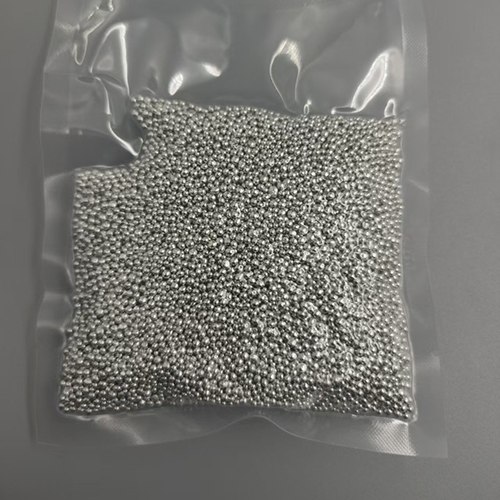
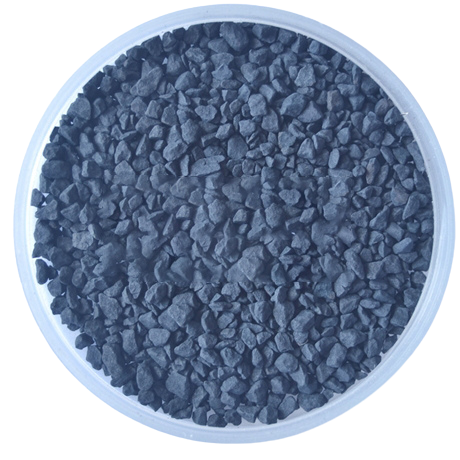
Tin granules are near-spherical metallic tin with a silvery-gray appearance. They are highly ductile, corrosion-resistant, and suitable for various industrial and process applications such as soldering, tin plating, and alloy manufacturing.
VIMATERIAL offers high-purity tin granules, customizable in various sizes to meet your needs. Contact us for more information.
Appearance: There are two kinds of isomers, β- tin (white tin) is more stable at room temperature, the appearance of silver-white bright; α- tin (grey tin) is more stable at low temperatures, the colour is grey.
Crystal structure: β-tin has a body-centred tetragonal structure; α-tin has a face-centred cubic diamond structure.
Density: White tin has a density of about 7.29 g/cm3; grey tin has a density of about 5.77 g/cm3.
Melting point: 231.93°C
Boiling point: 2260°C
Hardness: Soft texture, relatively low Mohs hardness, easy to process and mould.
Stability: stable in air, but tin powder (when finer particles) is more easily oxidised, especially in humid air. A thin film of tin oxide will form on the surface after oxidation.
Solubility: easily soluble in concentrated hydrochloric acid, aqua regia, gradually soluble in cold dilute hydrochloric acid, dilute nitric acid and hot dilute sulfuric acid; soluble in hot caustic solution or concentrated nitric acid, but it will change into insoluble metastannic acid.
Ductility: It has good ductility and can be pressed into sheets or drawn into filaments.
Electrical and Thermal Conductivity: It has a certain electrical and thermal conductivity, and can be used in electronic soldering and other fields that require electrical and thermal conductivity.
Electronics industry: Tin granules are mainly used in solder paste to connect electronic components to circuit boards. Their low melting point allows safe soldering without damaging sensitive devices, making them essential in products like phones and computers.
Metallurgy and alloys: Tin granules are used to produce alloys such as bronze and lead-free solders. These alloys improve strength, corrosion resistance, and are widely used in industrial parts, bearings, and electronic soldering materials.
Surface coating: Sn granules are used in electroplating and hot-dip coating to form protective tin layers on metals. This helps prevent rust and is commonly used in food cans and packaging materials.
Chemical industry: Tin granules can act as reducing agents and are used to produce tin-based compounds such as catalysts and gas-sensitive materials in chemical processes and laboratories.
Emerging and special uses: Tin granules are also explored in solar energy materials and used in artistic crafts, where they serve as decorative and functional metal materials.
Packaging
Tin granules are usually packed in sealed moisture-proof bags or plastic drums to prevent exposure to air and humidity. For industrial use, they may also be packed in metal containers or lined cartons with protective inner packaging to avoid contamination, oxidation, and mechanical damage during transportation.
Storage
Tin metal granules should be stored in a cool, dry, and well-ventilated environment, away from moisture, strong acids, alkalis, and oxidizing agents. Proper storage conditions help maintain their metallic purity and prevent surface oxidation or degradation over time.
Q1: What are the two types of tin?
A: Tin mainly exists in two allotropic forms: white tin (β-tin) and gray tin (α-tin). White tin is the stable form at room temperature, with a silvery metallic appearance, good ductility, and excellent conductivity, and it is the type commonly used in industry. Gray tin forms at low temperatures (below about 13.2°C), has a dull gray color, is brittle, and can crumble into powder, making it unsuitable for most practical applications.
Q2: Is tin better than aluminum?
A: Tin is not universally “better” than aluminum—they are used for different purposes. Tin has advantages in corrosion resistance, solderability, and low-temperature processing, making it important in electronics, coatings, and solder materials. Aluminum, however, is much lighter, stronger for its weight, cheaper, and more widely used in construction, transportation, and packaging. In most structural and mass applications, aluminum is preferred, while tin is chosen for specialized roles such as soldering and protective coatings.
Q3: What is tin powder used for?
A: Tin powder is widely used in electronics, metallurgy, and chemical industries. It is mainly used to produce solder paste for connecting electronic components, and is also applied in alloy manufacturing and metal coating to improve strength and corrosion resistance. In addition, it can act as a reducing agent in chemical reactions and is used in producing catalysts, sensors, and other functional materials, with some emerging applications in advanced energy and manufacturing technologies.
VI HALBLEITERMATERIAL GmbH (VIMATERIAL) employs a stringent quality assurance system to ensure the reliability of our product quality. Strict quality control is implemented throughout the entire production chain, and for defective products, we strictly enforce the principle of rework and redo. Each batch is released only after passing detailed specification tests.
Every batch of our materials is independently tested, and, if necessary, we send samples to certified companies for testing. We provide these documents and analysis certificates with the shipment to certify that our products meet the required standards.
Contact our team of experts today and let us help you with your business!