| Product ID | Formula | Purity | Dimension | Quantity | Price in € | Inquiry |
|---|---|---|---|---|---|---|
| 2800FI001 | Ni | 99.9% | Ø 100 mm x 100 mm x 0.05 mm | 1 | 138.00 | Inquire |
| 2800FI002 | Ni | 99.95% | Ø 100 mm x 100 mm x 0.05 mm | 1 | 213.00 | Inquire |
| 2800FI003 | Ni | 99.9% | Ø 100 mm x 100 mm x 0.1 mm | 1 | 92.00 | Inquire |
| 2800FI004 | Ni | 99.95% | Ø 100 mm x 100 mm x 0.1 mm | 1 | POR | Inquire |
| 2800FI005 | Ni | 99.95% | Ø 100 mm x 0.1 mm x L (Roll) | 1 | POR | Inquire |
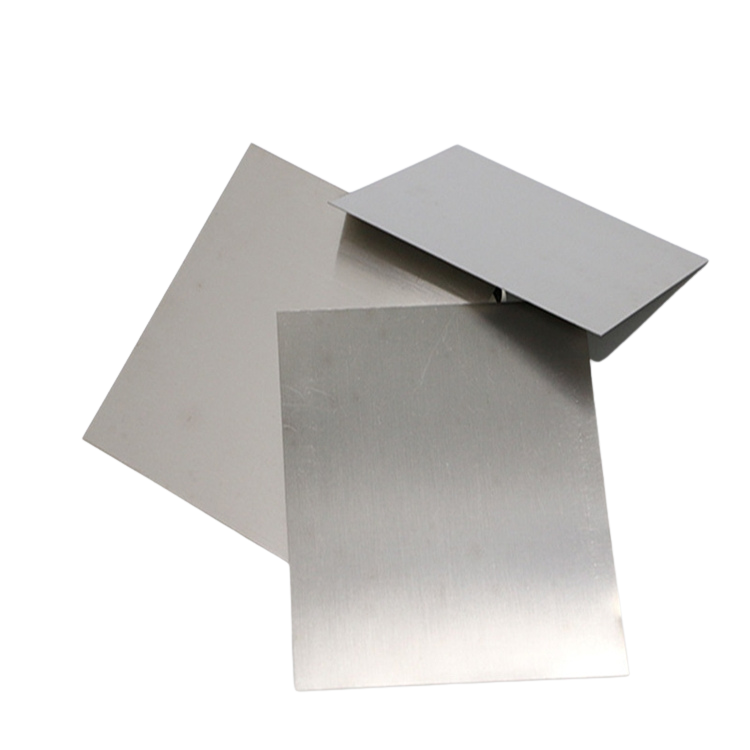
Nickel foil is a thin, flat sheet of nickel metal valued for its ductility, electrical conductivity, and corrosion resistance in suitable environments. Its formability and metallic properties make it useful in electronic components, battery-related applications, laboratory research, and specialised industrial processes.
VIMATERIAL supplies nickel foil with a focus on material purity, thickness uniformity, and surface quality. Custom thicknesses, dimensions, and other specifications can be discussed according to your application requirements. Our technical team can assist with material selection and specification matching.
For product specifications, availability, or a quotation, please contact our team.
| Property | Value |
| Chemical Symbol | Ni |
| Atomic Weight | 58.69 g/mol |
| Appearance | Silver-grey metallic solid |
| Density | Approx. 8.908 g/cm³ |
| Melting Point | Approx. 1455 °C |
| Boiling Point | Approx. 2732 °C |
| Crystal Structure | Face-Centred Cubic (FCC) |
The values above are typical reference values for nickel metal. Foil thickness, width, length, purity, and surface condition depend on the supplied specification.
VIMATERIAL offers nickel metal foil for research, prototyping, and industrial applications. Specifications can be discussed according to your technical requirements.
When requesting a quotation, please specify the required purity, thickness, width, length, quantity, and intended application.
VIMATERIAL applies quality control procedures throughout material sourcing, production, and final inspection. Inspection requirements are determined according to the agreed product specifications, with relevant quality documentation available for discussion.
For further information, visit our Quality Control page.
It is packed in protective packaging, vacuum-sealed where appropriate, and placed in cartons to help prevent contamination and surface damage during transportation.
Store nickel foil in a clean, dry, and cool environment, away from moisture, corrosive substances, and contaminants. Keep the foil sealed in its protective packaging when not in use. Handle it with clean gloves or suitable tools to minimise fingerprints, scratches, creasing, and surface contamination.
A: Nickel foil is used in selected electronic components, battery-related applications, laboratory research, and specialised industrial assemblies where a thin, conductive, and formable nickel material is required.
A: Custom thicknesses, widths, and lengths can be discussed according to manufacturing feasibility and order requirements. Please provide your target dimensions when requesting a quotation.
A: It can be used in selected battery research and manufacturing applications. Suitability as a current collector or electrode support depends on the battery chemistry, electrode design, and required electrochemical performance.
A: Nickel offers corrosion resistance in a range of environments, but it is not universally resistant to all chemicals. Material selection should consider the chemical medium, concentration, temperature, and operating conditions.
A: Store in a clean, dry environment and retain suitable protective packaging to minimise moisture exposure, contamination, oxidation, and mechanical damage.
VI HALBLEITERMATERIAL GmbH (VIMATERIAL) employs a stringent quality assurance system to ensure the reliability of our product quality. Strict quality control is implemented throughout the entire production chain, and for defective products, we strictly enforce the principle of rework and redo. Each batch is released only after passing detailed specification tests.
Every batch of our materials is independently tested, and, if necessary, we send samples to certified companies for testing. We provide these documents and analysis certificates with the shipment to certify that our products meet the required standards.
Contact our team of experts today and let us help you with your business!