


Thermal interface materials (TIMs) help transfer heat between electronic components and heat-dissipation surfaces. They are used in applications where heat must be removed efficiently while the material maintains suitable electrical, mechanical and processing properties.
Aluminum nitride (AlN) is a ceramic material that can serve as a thermally conductive, electrically insulating filler in polymer-based TIMs. Depending on the formulation, AlN powder can be incorporated into thermal gels, greases, gap-filling pads, encapsulants and other polymer composites. The use of Aluminum Nitride Fillers can significantly enhance the thermal performance of these materials.
This article explains how to evaluate AlN fillers for TIM applications and which powder specifications deserve attention during material selection.
Why Is Aluminum Nitride Used in TIMs?
A TIM is placed between a heat-generating component and a heat sink or another heat-dissipation surface. Its purpose is to reduce the thermal resistance caused by microscopic gaps, surface irregularities and imperfect contact between the two surfaces.
Many polymer materials are electrically insulating but have relatively low thermal conductivity. Adding a thermally conductive ceramic filler can improve heat transfer without introducing the electrical conductivity associated with metallic fillers.
Aluminum nitride offers several useful characteristics for this purpose:
- Thermal conductivity: AlN is a thermally conductive ceramic and can help establish heat-transfer paths through a polymer matrix.
- Electrical insulation: AlN can support applications that require heat dissipation without an electrically conductive filler.
- Thermal expansion characteristics: Its coefficient of thermal expansion is relatively close to that of silicon compared with many other materials, which can be relevant in electronic packaging.
- Formulation flexibility: AlN powders are available in different particle sizes and morphologies for different processing requirements.
These properties make AlN a candidate for electronic thermal management, including power electronics, semiconductor packaging, LED assemblies and other applications where heat transfer and electrical insulation are both important.
The performance of the finished TIM still depends on the complete formulation, including the polymer matrix, other fillers, interfaces and manufacturing process.
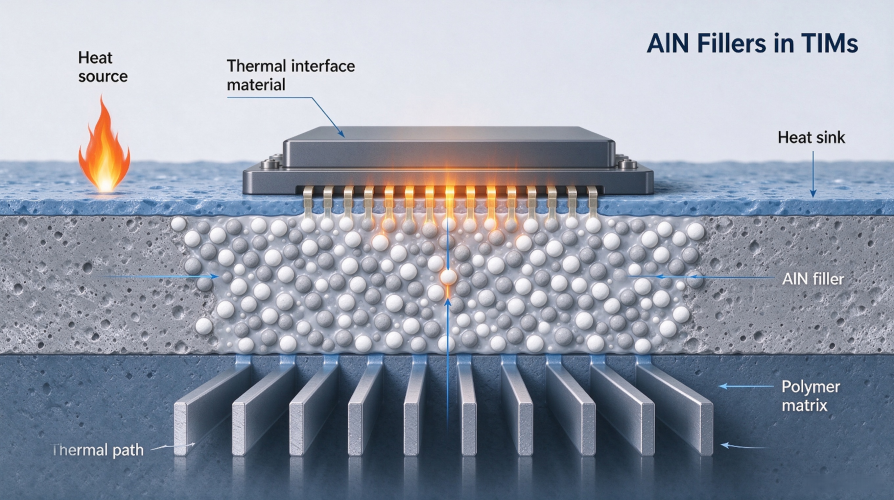
How Does AlN Filler Improve Thermal Conductivity?
Heat transfer through a filled polymer depends on the properties of the filler and the way its particles are arranged within the matrix.
When AlN particles are dispersed in a polymer, heat can pass through the ceramic particles and across the interfaces between neighbouring particles. As the filler network becomes more effective, heat can travel through the composite more readily.
Three factors are particularly important.
Filler content
Increasing the AlN content can help form more continuous thermal conduction paths. However, a higher loading also changes the compound’s viscosity, flow behaviour, flexibility and processability.
The optimum filler content is therefore not necessarily the highest possible content. It is the loading that delivers the required thermal performance while remaining compatible with mixing, dispensing, coating, moulding or compression processes.
Particle-size distribution
A mixture of larger and smaller particles can sometimes pack more efficiently than a single-size powder. Smaller particles may occupy spaces between larger particles, helping to improve particle contact and the continuity of heat-transfer paths.
The result depends on the particle-size ratio, distribution, surface condition and matrix formulation. A mixed-size system should be evaluated experimentally rather than assumed to be better in every application.
Filler–matrix interfaces
The interface between an AlN particle and the surrounding polymer can contribute to thermal resistance. Poor wetting, voids, agglomeration or weak compatibility may interrupt heat-transfer paths.
Surface treatment can help improve moisture resistance, dispersion or compatibility with a particular polymer system. Its suitability depends on the treatment chemistry and the intended formulation.
Why Consider Spherical Aluminum Nitride Powder?
Particle morphology affects how a powder flows, packs and disperses during processing. Compared with angular or irregular particles, spherical AlN particles can offer advantages in formulations where flowability and high filler loading are important.
Improved flow and handling
Spherical particles generally experience less mechanical interlocking than angular particles of comparable size. This can improve powder flow and may make the mixing and handling of highly filled compounds easier.
Packing density and filler loading
A suitable spherical particle-size distribution can support efficient packing. When combined with an appropriate blend of particle sizes, this may help reduce unfilled spaces in the composite.
Better packing does not automatically guarantee higher thermal conductivity. Particle contact, interface resistance, void content and matrix behaviour also matter.
Rheology and processability
The shape of the filler influences friction and movement between particles. Spherical particles may help control viscosity and improve flow in some formulations, allowing manufacturers to investigate higher filler loading without making the compound too difficult to process.
The actual effect depends on particle size, surface treatment, resin chemistry and the complete filler system.
Electrical insulation
AlN is a ceramic filler that can support thermally conductive, electrically insulating composite formulations. Electrical performance must nevertheless be verified on the finished TIM, especially where dielectric strength and insulation reliability are critical.
For a closer look at spherical AlN powder morphology, flowability, packing behaviour and representative particle-size options, see our guide to “spherical aluminum nitride powder properties, particle sizes and applications”.
Which AlN Particle Size Is Suitable for TIMs?
Particle size influences packing, dispersion, viscosity, surface area and the formation of thermal conduction paths. The best size depends on the intended TIM type and its processing requirements.
| Filler Category | Potential Use | Main Selection Considerations |
|---|---|---|
| Fine AlN Powder | Fine coatings, thin layers and formulations requiring smaller particles | Dispersion, surface area, agglomeration and viscosity |
| Medium-Size Spherical AlN | Thermal gels, greases and gap-filling compounds | Flow behaviour, packing and compatibility with the matrix |
| Coarse Spherical AlN | Highly filled compounds and thicker thermal management materials | Packing density, settling, surface finish and minimum layer thickness |
| Blended Particle Sizes | Formulations designed to improve packing and particle contact | Size ratio, distribution, viscosity and void formation |
These categories are practical selection guides, not universal particle-size standards. Actual requirements should be defined by the target formulation and manufacturing process.
For example, very fine powder can provide a large particle surface area, but it may also increase viscosity and the tendency to agglomerate. Coarser powder may support packing and flow in some systems, but particles that are too large can be unsuitable for thin bond lines or fine surface features.
D50 and particle-size distribution
D50 is the particle diameter below which 50% of the measured particle population falls under the specified measurement basis. It is commonly used to describe a powder’s median particle size.
D50 alone does not describe the complete distribution. D90, for example, indicates the diameter below which 90% of the measured population falls. It can help identify the coarser part of a powder distribution.
When selecting AlN for TIMs, consider:
- D50 and D90 rather than D50 alone.
- The width of the particle-size distribution.
- Whether agglomerates are present.
- Compatibility with the intended bond-line thickness.
- The effect of the powder on viscosity and dispensing behaviour.
The particle-size measurement method should also be consistent when comparing suppliers or batches.
When comparing AlN powder grades, it is also important to consider purity, particle-size distribution, morphology and batch quality. Our guide to “aluminum nitride powder purity, particle size and quality control” explains these specification factors in more detail.
Surface Treatment and Moisture Resistance
Surface condition is an important consideration when AlN powder is used in polymer-based materials.
AlN can be sensitive to moisture, and exposure conditions may affect its surface chemistry and storage stability. Moisture control and suitable packaging are therefore relevant to maintaining consistent powder quality.
Surface treatment may be used to improve water resistance, dispersion or compatibility with a specific polymer matrix. Silane-based treatments, for example, are used in some ceramic-filler systems to modify the interaction between the filler surface and the surrounding matrix.
A treated powder should not automatically be assumed to be compatible with every resin. The treatment needs to match the chemistry of the intended formulation.
Before selecting treated or untreated AlN, confirm:
- Whether the powder is surface-treated.
- The treatment type, where disclosure is available.
- Compatibility with the target resin or polymer.
- Moisture-control and storage requirements.
- Whether the treatment affects viscosity, curing or other formulation properties.
Selecting AlN Fillers for Different TIM Applications
Different TIM products have different processing conditions and performance priorities. A powder that works well in one formulation may not be suitable for another.
Thermal gels and greases
Gels and greases need to flow or spread sufficiently to fill surface irregularities and establish contact between the heat source and heat sink.
For these applications, evaluate particle-size distribution, spherical morphology, dispersion, filler loading and the viscosity of the finished compound. The formulation must remain workable during mixing and application.
Thermal pads and gap fillers
Pads and gap-filling materials are often designed to accommodate component-height differences and surface irregularities. Their performance depends on thermal conductivity, compressibility, hardness, mechanical integrity and the ability to maintain contact under operating conditions.
Spherical AlN can be considered where packing and high filler loading are important. Particle size must also suit the required thickness and surface characteristics of the finished product.
Electronic encapsulation
Encapsulants protect electronic components while helping dissipate heat. In these systems, filler selection must balance thermal performance with flow into the intended spaces, curing behaviour, adhesion and electrical insulation.
The compatibility of the AlN surface with the encapsulant chemistry is particularly important for achieving consistent processing and reliable interfaces.
High-performance polymer composites
AlN can also be used in thermally conductive polymer composites beyond conventional TIMs. The formulation may require a specific balance of thermal conductivity, mechanical properties, dielectric behaviour and manufacturing requirements.
In such applications, filler morphology and the combination of different particle sizes should be evaluated alongside the polymer matrix and processing method.
Representative Spherical AlN Powder Specifications
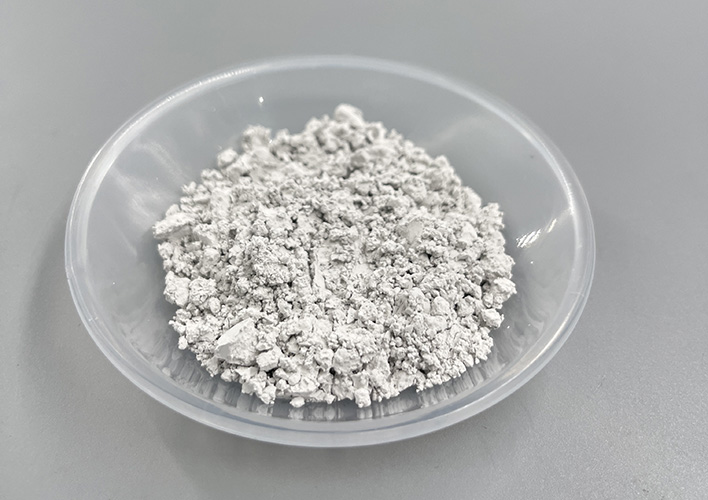
The appropriate powder specification depends on the target application. The following examples reflect spherical AlN grades listed in the supplied VIMATERIAL material information. They are representative specification options, not universal industry grades or a guarantee of current stock availability.
| Material | Purity | Representative D50 |
|---|---|---|
| Spherical AlN Powder | 99% | 30–40 μm |
| Spherical AlN Powder | 99% | 45–55 μm |
| Spherical AlN Powder | 99% | 70–80 μm |
| Spherical AlN Powder | 99% | 90–105 μm |
Other particle-size ranges may be considered according to the required formulation and supply specification.
For TIM development, purity and D50 should not be the only acceptance criteria. It is also useful to confirm the particle-size distribution, morphology, surface-treatment status, moisture-control requirements and batch documentation.
How to Evaluate AlN Filler Performance?
The powder specification is only one part of the selection process. A practical evaluation should connect powder characteristics with the performance of the finished compound.
| Evaluation Item | What to Check |
|---|---|
| Thermal Conductivity | Measure the finished TIM using a suitable method and test configuration. |
| Electrical Insulation | Verify dielectric strength or other relevant electrical requirements. |
| Viscosity and Flow | Check mixing, dispensing, coating or compression behaviour. |
| Filler Loading | Determine the maximum practical loading that meets processing requirements. |
| Dispersion | Inspect agglomeration and the uniformity of filler distribution. |
| Mechanical Properties | Evaluate hardness, flexibility, compressibility or adhesion as relevant. |
| Moisture Resistance | Confirm powder storage stability and finished-material performance under the intended conditions. |
| Batch Consistency | Compare particle size, purity and other agreed parameters between batches. |
Thermal conductivity values reported for a finished gel or pad should not be treated as the intrinsic thermal conductivity of the AlN powder. Results depend on the filler fraction, polymer matrix, particle contacts, interfaces, voids and measurement method.
Likewise, a high filler loading does not necessarily produce the best overall product. The formulation must meet its thermal target while retaining the required processability and mechanical behaviour.
What Should Buyers Specify When Sourcing AlN Fillers?
When requesting an AlN filler for TIM development or production, provide enough information to connect the powder specification with the intended process.
A useful enquiry includes:
- Application: Thermal gel, grease, pad, encapsulant or another polymer composite.
- Purity requirement: The target purity and any specific impurity limits.
- Particle size: Required D50, D90 or particle-size range.
- Morphology: Spherical, irregular or a combination of particle types.
- Surface condition: Whether untreated or surface-treated powder is required.
- Processing method: Mixing, dispensing, coating, compression or moulding.
- Performance targets: Thermal conductivity, electrical insulation, viscosity, hardness or other relevant criteria.
- Quantity and documentation: Sample quantity, production quantity and required quality documents.
Where the final formulation is still under development, it can be useful to compare a small number of powder grades rather than selecting a single specification based on particle size alone.
Frequently Asked Questions
1. Is aluminum nitride a good filler for thermal interface materials?
AlN is a candidate for TIMs that require both thermal conduction and electrical insulation. Its suitability depends on the complete formulation and whether the finished material meets the required thermal, electrical and processing targets.
2. Why use spherical AlN instead of irregular AlN powder?
Spherical AlN can offer improved flow and packing behaviour in suitable formulations. It may also help control viscosity at high filler loading. The benefits depend on particle-size distribution, surface condition and the polymer matrix.
3. Does a higher AlN filler loading always improve thermal conductivity?
No. Increasing filler loading can improve thermal conduction paths, but it can also increase viscosity and make processing more difficult. Voids, poor dispersion and interface resistance may limit the improvement.
4. Is a larger D50 always better for TIMs?
No. Coarser particles may support packing in some formulations, while finer particles may be needed for thin layers or detailed features. D50 should be evaluated together with D90, morphology, bond-line thickness and processing requirements.
5. Does surface-treated AlN work with every polymer?
No. Surface treatment should be selected according to the polymer chemistry and intended process. Compatibility should be confirmed through formulation testing.
6. Can AlN powder specifications guarantee the thermal conductivity of a finished TIM?
No. Powder specifications help guide material selection, but the thermal conductivity of the finished TIM also depends on filler loading, matrix properties, dispersion, particle contacts, void content and the measurement method.
Conclusion
Aluminum nitride fillers can help manufacturers develop thermal interface materials that combine heat transfer with electrical insulation. Spherical AlN is worth evaluating when flowability, packing and high filler loading are important, but its advantages depend on the particle-size distribution, surface condition and compatibility with the polymer matrix.
The most suitable powder is not necessarily the finest, coarsest or highest-purity option. It is the grade that meets the target performance while remaining compatible with the intended formulation and manufacturing process.
References
- [1] Ohashi, M. (2005). “Spherical Aluminum Nitride Fillers for Heat-Conducting Plastic Packages.” Journal of the American Ceramic Society.
- [2] Wang, Q., Chen, K., & Cao, W. (2018). “Carbothermal Synthesis of Spherical AlN Fillers.” IntechOpen.
- [3] Mumtaz, N., Li, Y., Artiaga, R., Farooq, Z., Mumtaz, A., Guo, Q., & Nisa, F. (2024). “Fillers and Methods to Improve the Effective (Out-Plane) Thermal Conductivity of Polymeric Thermal Interface Materials – A Review.” Heliyon, 10(3), e25381.
- [4] “Thermally Conducting Aluminum Nitride Polymer-Matrix Composites.” Composites Science and Technology.
- [5] Deshmukh, G. S. (2026). “Recent Advances in Creating 3D-Interconnected Networks within Thermally Conductive Aluminum Nitride Polymer Composites: A Review.” Current Materials Science, 19(2).
Further Reading
- Aluminum Nitride (AlN) — The “Heat-Dissipating, Electrically Insulating All-Rounder” of the Electronics Industry
- How to Make Aluminium Nitride Powder?
- Aluminum Nitride Powder: Purity, Particle Size and Quality Control
- Spherical Aluminum Nitride Powder: Properties, Particle Sizes and Applications
- AlON Powder: Properties, Synthesis Methods and Applications
Need an AlN Powder Specification for Your Application?
VIMATERIAL supplies aluminum nitride powder in different purity levels and particle-size ranges, including spherical grades. Contact our team to discuss your required particle size, morphology, surface condition, quantity and documentation needs.