
The manganese-to-iron (Mn/Fe) ratio is an important compositional parameter in Sodium Manganese Iron Phosphate (NMFP) cathode materials. With the general chemical formula NaMnₓFe₁₋ₓPO₄, NMFP allows the relative manganese and iron contents to be adjusted to investigate different electrochemical characteristics.
Both manganese and iron contribute to the redox reactions of phosphate-based cathode materials. However, their electrochemical activities occur at different potentials, meaning that changes in their relative concentrations can influence the operating voltage profile, reversible capacity and structural behaviour.
Understanding the relationship between the NMFP Mn/Fe ratio and electrochemical performance is important for researchers and battery developers seeking to optimize cathode compositions for specific sodium-ion battery applications.
VIMATERIAL supplies Sodium Manganese Iron Phosphate (NMFP) powder with customizable Mn/Fe compositions, supporting research and development requirements for different cathode formulations.
The Mn/Fe Ratio Affects NMFP performance significantly, making it a critical factor in the design of sodium-ion batteries.
1. Why Is the Mn/Fe Ratio Important in NMFP?
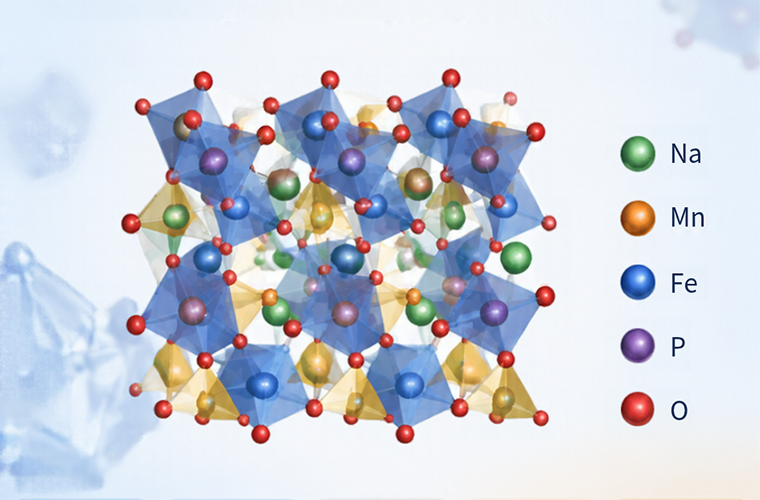
NMFP combines manganese (Mn) and iron (Fe) within a phosphate-based structure. The relative amounts of these transition metals influence the electrochemical reactions that occur during sodium-ion insertion and extraction.
Its general chemical formula is:
NaMnₓFe₁₋ₓPO₄ (0 < x < 1)
In this formula:
- Na represents sodium.
- Mn represents manganese.
- Fe represents iron.
- PO₄ represents the phosphate group.
- x represents the manganese fraction.
- 1−x represents the iron fraction.
The Mn/Fe ratio can be expressed as:
Mn/Fe Ratio = x / (1 − x)
For example, when x = 0.4, the composition is NaMn₀.₄Fe₀.₆PO₄, corresponding to a Mn/Fe ratio of 40:60.
Changing the Mn/Fe ratio can influence several important material characteristics:
- Operating voltage and voltage profile.
- Contributions from manganese and iron redox reactions.
- Reversible specific capacity.
- Structural stability during cycling.
- Electrochemical reaction kinetics.
- Long-term cycling performance.
The optimum composition depends on the intended electrochemical requirements, synthesis conditions and battery design. Increasing the manganese content does not necessarily improve every performance parameter.
2. Influence of Mn Content on Operating Voltage
Manganese plays an important role in determining the voltage characteristics of NMFP cathode materials.
In phosphate-based cathodes, the Mn³⁺/Mn²⁺ redox couple generally operates at a higher potential than the Fe³⁺/Fe²⁺ redox couple.
Therefore, incorporating manganese into an iron-based phosphate framework provides an opportunity to introduce higher-voltage redox activity.
2.1 Manganese Redox Activity
During charging and discharging, manganese participates in reversible oxidation and reduction reactions.
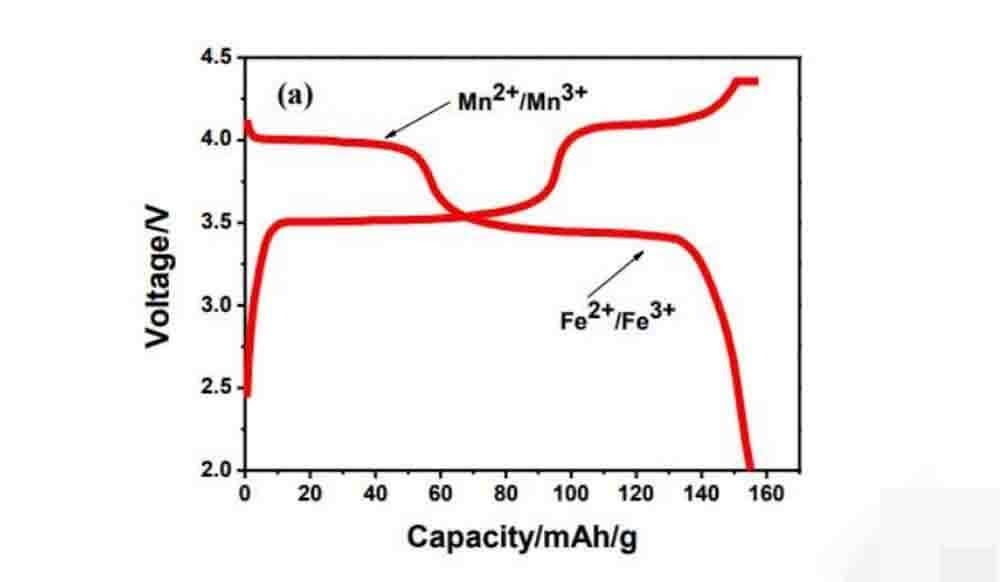
The Mn²⁺/Mn³⁺ redox couple can contribute to the higher-voltage region of the charge-discharge profile.
In a study of olivine NaMn₀.₆₆Fe₀.₃₄PO₄, two pseudo-plateau regions were observed during the initial charging process:
- Approximately 3.0–3.5 V, associated with Fe²⁺/Fe³⁺ oxidation.
- Approximately 3.7 V, associated with the Mn²⁺/Mn³⁺ redox couple.
These values were reported against Na⁺/Na and under the specific experimental conditions of the study.
2.2 Relationship Between Mn Content and Voltage
Increasing the manganese fraction can change the relative contribution of manganese-related redox reactions to the overall electrochemical response.
However, the resulting average operating voltage depends on several factors:
- Mn/Fe composition.
- Crystal structure and phase purity.
- Sodium-ion extraction and insertion behaviour.
- Voltage window.
- Electrode formulation and testing conditions.
Consequently, the effect of Mn content should be evaluated through electrochemical measurements rather than assuming a fixed linear relationship between manganese concentration and operating voltage.
3. Effect of Fe Content on Electrochemical Performance
Iron is another essential transition metal in NMFP and contributes to its electrochemical activity through the Fe²⁺/Fe³⁺ redox couple.
The iron fraction influences the relative contribution of iron-based redox reactions and can affect the overall voltage profile and capacity characteristics.
3.1 Contribution to Reversible Capacity
The Fe²⁺/Fe³⁺ redox reaction provides a mechanism for reversible electron transfer during sodium-ion extraction and insertion.
The theoretical capacity of a material depends on the number of reversibly transferred electrons per formula unit and its molar mass.
Iron content therefore needs to be considered alongside manganese content when evaluating the capacity potential of different NMFP compositions.
3.2 Influence on Voltage Profile
Iron-based redox activity generally occurs at lower potentials than manganese-based redox activity in these phosphate systems.
Adjusting the iron fraction can therefore change the relative contributions of the two redox couples and the shape of the charge-discharge voltage profile.
3.3 Composition and Structural Behaviour
The iron-to-manganese balance also influences the local chemical environment and structural characteristics of the material.
The actual electrochemical response depends on the resulting crystal phase, transition-metal distribution and synthesis quality.
Maintaining a homogeneous distribution of Mn and Fe is therefore important when preparing NMFP cathode materials.
4. Relationship Between Mn/Fe Ratio and Specific Capacity
Specific capacity is one of the most important parameters when evaluating cathode materials.
It describes the amount of electrical charge stored per unit mass and is generally expressed in mAh/g.
The theoretical capacity of a material can be estimated using:
Q = (n × F) / (3.6 × M)
Where:
- Q is theoretical specific capacity (mAh/g).
- n is the number of electrons transferred per formula unit.
- F is the Faraday constant (96,485 C/mol).
- M is the molar mass (g/mol).
For NMFP, the theoretical capacity depends on the assumed reversible electron transfer and the molar mass of the selected composition.
However, theoretical capacity and experimentally measured reversible capacity are different.
Actual capacity can be affected by:
- Incomplete sodium-ion extraction and insertion.
- Electronic conductivity.
- Sodium-ion diffusion kinetics.
- Phase transformations.
- Particle morphology.
- Electrode formulation.
- Electrochemical testing conditions.
Does Higher Mn Content Mean Higher Capacity?
Not necessarily.
Although manganese contributes an additional redox process, increasing its concentration does not automatically increase the practical specific capacity.
The amount of electrochemically active material, the reversibility of the redox reactions and the accessibility of sodium-ion transport pathways all influence the measured capacity.
For example, a 2024 study of NaMn₀.₆₆Fe₀.₃₄PO₄ reported an initial discharge capacity of approximately 85 mAh/g, followed by a stable reversible capacity of approximately 60–75 mAh/g over 35 cycles at C/20.
This result demonstrates that the contribution of multiple redox processes does not necessarily translate into complete utilization of theoretical capacity.
The study also identified electrode formulation and electrolyte-related effects as possible factors influencing the observed electrochemical performance.
Therefore, Mn/Fe composition should be optimized together with synthesis conditions and electrode design.
5. Structural Stability and Cycling Performance: How Mn/Fe Ratio Affects NMFP?
The Mn/Fe ratio can influence the structural behaviour of NMFP during repeated sodium-ion insertion and extraction.
Maintaining structural stability is important for achieving consistent capacity and long-term cycling performance.
5.1 Manganese-Related Jahn-Teller Distortion
One important challenge associated with manganese-containing cathode materials is the Jahn-Teller effect.
When Mn³⁺ is present in certain coordination environments, local distortions can occur because of the electronic configuration of the manganese ion.
These distortions may influence:
- Local crystal symmetry.
- Metal-oxygen bond lengths.
- Structural changes during cycling.
- Sodium-ion transport pathways.
- Long-term electrochemical stability.
The extent of these effects depends on the crystal structure, manganese oxidation state and local chemical environment.
5.2 Iron-Manganese Distribution
A homogeneous distribution of manganese and iron is important for obtaining consistent material properties.
Uneven elemental distribution may result in local compositional differences and variations in electrochemical activity.
Appropriate precursor mixing and synthesis control are therefore important during NMFP preparation.
5.3 Cycling Stability
Cycling stability depends on several interacting factors rather than the Mn/Fe ratio alone.
Important considerations include:
- Reversibility of transition-metal redox reactions.
- Structural changes during sodium-ion extraction and insertion.
- Electrolyte compatibility.
- Particle morphology.
- Surface stability.
- Electrode preparation.
The optimal Mn/Fe composition should therefore be determined through cycling tests under conditions relevant to the intended battery application.
6. How to Select the Appropriate Mn/Fe Ratio?
Selecting an appropriate Mn/Fe ratio requires balancing different electrochemical requirements.
Battery developers may prioritize higher operating voltage, reversible capacity, cycling stability or specific manufacturing characteristics.
The following table provides a preliminary framework for evaluating different NMFP compositions.
| Chemical Formula | Mn Fraction | Fe Fraction | Mn/Fe Ratio |
|---|---|---|---|
| NaMn₀.₂Fe₀.₈PO₄ | 20% | 80% | 20:80 |
| NaMn₀.₄Fe₀.₆PO₄ | 40% | 60% | 40:60 |
| NaMn₀.₅Fe₀.₅PO₄ | 50% | 50% | 50:50 |
| NaMn₀.₆₆Fe₀.₃₄PO₄ | 66% | 34% | 66:34 |
| NaMn₀.₈Fe₀.₂PO₄ | 80% | 20% | 80:20 |
These are representative composition options, not experimentally established performance rankings. Their phase purity, synthesis feasibility and electrochemical properties need to be verified individually.
6.1 For Higher Operating Voltage
Compositions with higher manganese fractions may be worth investigating when higher-voltage manganese redox activity is a priority.
However, the resulting voltage profile and cycling behaviour should be confirmed experimentally.
6.2 For Capacity Optimization
The Mn/Fe ratio should be evaluated in relation to reversible electron transfer, active material utilization and sodium-ion transport.
The composition with the highest theoretical capacity may not necessarily deliver the highest practical capacity.
6.3 For Improved Structural Stability
Composition optimization should consider manganese-related structural distortion, phase stability and the reversibility of sodium-ion reactions.
Suitable synthesis and surface modification strategies may also be required.
6.4 For Application-Specific Requirements
Different battery applications have different performance priorities.
For example, stationary energy storage may place greater emphasis on cycle life and material cost, while other applications may prioritize energy density and power capability.
Experimental evaluation of multiple compositions is recommended before selecting a final formulation.
7. How to Evaluate Different NMFP Compositions?
A systematic evaluation process helps determine how changes in Mn/Fe ratio influence material properties and electrochemical performance.
Several characterization and testing methods can be used.
| Evaluation Method | Main Purpose |
|---|---|
| X-ray Diffraction (XRD) | Identify crystal phases and evaluate phase purity |
| ICP-OES | Verify elemental composition and Mn/Fe ratio |
| SEM-EDS | Examine particle morphology and elemental distribution |
| Particle Size Analysis | Measure particle-size distribution |
| Galvanostatic Charge-Discharge Testing | Evaluate specific capacity and voltage profiles |
| Rate Capability Testing | Assess performance at different current rates |
| Cycling Testing | Evaluate capacity retention over repeated cycles |
| Electrochemical Impedance Spectroscopy (EIS) | Investigate interfacial resistance and electrochemical kinetics |
For a meaningful comparison, different NMFP compositions should ideally be evaluated using consistent synthesis conditions, electrode formulations, electrolyte systems, voltage windows and testing rates.
This helps distinguish the effects of Mn/Fe composition from other experimental variables.
8. Customizable Mn/Fe Composition from VIMATERIAL
The ability to adjust the manganese-to-iron ratio is an important consideration in NMFP material development.
Different research projects may require different transition-metal compositions depending on the target operating voltage, specific capacity and structural stability requirements.
VIMATERIAL supplies Sodium Manganese Iron Phosphate (NMFP) powder with customizable Mn/Fe compositions based on the general chemical formula:
NaMnₓFe₁₋ₓPO₄ (0 < x < 1)
Available Customization Options
| Parameter | Specification |
|---|---|
| Chemical Name | Sodium Manganese Iron Phosphate |
| Chemical Formula | NaMnₓFe₁₋ₓPO₄ |
| Mn/Fe Ratio | Customizable (0 < x < 1) |
| Purity | 99% |
| Particle Size | D50 < 10 μm |
| Product Form | Powder |
| Carbon Coating | Available Upon Request |
Why Choose Customized NMFP Composition?
Adjustable Mn/Fe Ratio
Different manganese and iron proportions can be specified according to research and development requirements.
Particle Size Customization
Particle-size specifications can be discussed according to electrode preparation and material processing requirements.
Carbon Coating Options
Carbon-coated NMFP powder is available upon request for projects requiring additional electronic conductivity optimization.
Application-Oriented Material Development
VIMATERIAL supports customized material requirements for battery manufacturers, research laboratories and advanced energy storage projects.
Contact our team to discuss your target Mn/Fe ratio, particle size and other technical specifications.
* The compositions listed in this article are representative formulation examples. Their actual phase formation and electrochemical performance must be verified through experimental characterization.
9. Frequently Asked Questions (FAQ)
1. What is the Mn/Fe ratio in NMFP?
The Mn/Fe ratio describes the relative amounts of manganese and iron in NaMnₓFe₁₋ₓPO₄. The value of x represents the manganese fraction, while 1−x represents the iron fraction.
2. How does manganese content affect NMFP operating voltage?
Manganese contributes through the Mn²⁺/Mn³⁺ redox couple, which generally operates at a higher potential than the Fe²⁺/Fe³⁺ redox couple in phosphate cathode systems. Changing manganese content can therefore influence the voltage profile.
3. Does increasing manganese content improve NMFP capacity?
Not necessarily. Practical capacity depends on reversible redox activity, phase structure, sodium-ion transport, electronic conductivity and electrode conditions. Higher manganese content does not guarantee higher reversible capacity.
4. What is the role of iron in NMFP?
Iron contributes through the Fe²⁺/Fe³⁺ redox couple and influences the voltage profile, capacity contribution and structural characteristics of NMFP.
5. What is the Jahn-Teller effect in manganese-containing cathode materials?
The Jahn-Teller effect refers to structural distortion associated with certain electronic configurations, particularly Mn³⁺ in specific coordination environments. It can influence local structural stability and electrochemical reversibility.
6. How can different NMFP compositions be compared?
Different compositions can be evaluated using XRD, ICP-OES, SEM-EDS, galvanostatic charge-discharge testing, rate capability measurements and cycling tests under consistent experimental conditions.
7. Can VIMATERIAL customize the Mn/Fe ratio of NMFP powder?
Yes. VIMATERIAL offers customizable Mn/Fe compositions within the NaMnₓFe₁₋ₓPO₄ material system, with 0 < x < 1. Particle size and carbon coating options are also available upon request.
Conclusion
The Mn/Fe ratio is a key compositional parameter influencing the electrochemical characteristics of Sodium Manganese Iron Phosphate (NMFP).
Manganese contributes higher-voltage redox activity, while iron provides an additional redox contribution within the phosphate framework. Adjusting their relative concentrations offers opportunities to investigate different voltage profiles, reversible capacities and structural behaviours.
However, the relationship between composition and battery performance is complex. Phase purity, synthesis conditions, particle characteristics and electrode formulation must also be considered when evaluating different NMFP compositions.
VIMATERIAL provides NMFP powder with customizable Mn/Fe ratios, supporting battery researchers and manufacturers in developing compositions suited to their specific material requirements.
References
- [1] Ouaneche, T., Stievano, L., Monconduit, L., Guéry, C., Sougrati, M. T., & Recham, N. (2024). Olivine NaMn₀.₆₆Fe₀.₃₄PO₄ as a Cathode Material for Advanced Sodium Ion Batteries. Batteries & Supercaps, 7(10), e202400214.
- [2] Henriksen, C., Mathiesen, J. K., Chiang, Y.-M., Jensen, K. M. Ø., & Ravnsbæk, D. B. (2019). Reducing Transformation Strains during Na Intercalation in Olivine FePO₄ Cathodes by Mn Substitution. ACS Applied Energy Materials, 2(11), 8060–8067.
- [3] Minnetti, L., Sbrascini, L., Staffolani, A., Marangon, V., Nobili, F., & Hassoun, J. (2024). Unravelling the Ion Transport and the Interphase Properties of a Mixed Olivine Cathode for Na-Ion Battery. Journal of Energy Chemistry, 96, 300–317.
Further Reading
- Sodium Manganese Iron Phosphate (NMFP): Properties, Structure, Synthesis and Applications
- LMFP Cathode Material: Crystal Structure, Composition and Electrochemical Properties
- LMFP vs NCM Cathode Materials: Key Differences for Next-Generation Lithium-Ion Batteries
- NFPP Sodium-Ion Battery Cathode: Properties, Advantages, Synthesis and Applications
- Sodium-Ion Battery Materials: Key Components, Advantages and Future Trends
Looking for NMFP Powder with a Specific Mn/Fe Ratio?
VIMATERIAL supplies Sodium Manganese Iron Phosphate (NMFP) powder for sodium-ion battery research and development.
We understand that different battery formulations require different manganese and iron compositions. That’s why we offer flexible customization options to support your material development needs.
Our customization options include:
- Customizable Mn/Fe Ratio: Adjust the manganese and iron proportions according to your requirements.
- Particle Size: Customized particle-size specifications are available.
- Carbon Coating: Available upon request to support electronic conductivity optimization.
Whether you are evaluating different NMFP compositions or developing cathode materials for sodium-ion batteries, VIMATERIAL can support your material sourcing requirements.
Contact us to discuss your target Mn/Fe ratio and request a customized quotation.