


Lithium aluminum titanium phosphate (LATP), with the formula Li₁.₃Al₀.₃Ti₁.₇(PO₄)₃, is a NASICON-type lithium-ion conducting ceramic. Its combination of room-temperature ionic conductivity, low electronic conductivity and practical processing characteristics makes it a material of interest for several solid-state battery designs, particularly in applications involving LATP in Solid-State Batteries.
LATP is not limited to use as a standalone ceramic electrolyte. Depending on the cell architecture and processing method, it can also be incorporated into cathode coatings, separator functional layers and polymer–ceramic composite electrolytes. Each application has different requirements for particle size, dispersion, interface compatibility and layer structure.
This article explains the main ways LATP powder can be used in solid-state battery development and the factors to consider when selecting a suitable grade.
LATP as a Solid Electrolyte
A solid electrolyte transports lithium ions between the electrodes while providing an electronically insulating layer. LATP can serve this function in ceramic-based solid-state battery designs.
Its NASICON-type crystal structure provides a three-dimensional framework for lithium-ion transport. The material is valued for its relatively high ionic conductivity at room temperature and its low electronic conductivity.
However, the performance of a LATP electrolyte is not determined by powder conductivity alone. The final ceramic component also depends on:
- Density and porosity: Incomplete densification can increase resistance and create pathways for unwanted reactions.
- Grain boundaries: Poor grain-to-grain contact can restrict lithium-ion transport.
- Particle size and distribution: These influence powder packing, sintering behaviour and the microstructure of the final ceramic.
- Electrode contact: Resistance at the electrolyte–electrode interface can affect the overall cell performance.
One important limitation is LATP’s incompatibility with direct contact with lithium metal. Titanium in LATP can be reduced at the lithium interface, potentially leading to interfacial reactions and increased resistance. Lithium-metal configurations therefore require a suitable protective or buffer layer, or a different cell architecture.
For this reason, LATP should be evaluated as part of the complete cell design rather than selected only by its ionic conductivity.
For a closer look at its composition, structure and transport properties, see LATP Solid Electrolyte: Structure, Ionic Conductivity, and Future Prospects.
Understanding the role of LATP in Solid-State Batteries is crucial for advancing battery technology.
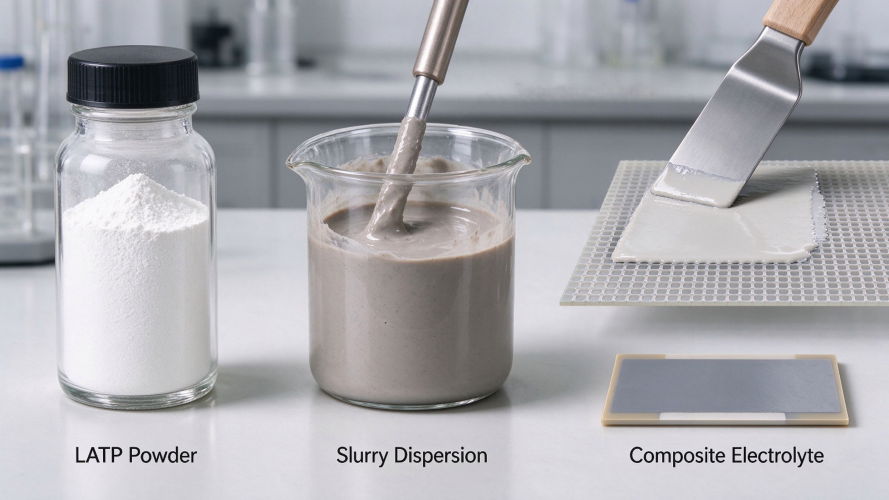
LATP for Cathode Surface Coating
Cathode surface coating is one approach to modifying the interface between cathode particles and the surrounding electrolyte. In a solid-state battery, direct contact between active cathode materials and the solid electrolyte can lead to interfacial reactions or contact-related resistance.
LATP powder may be considered as a ceramic component in a cathode coating system. The intended role is to introduce an ion-conducting inorganic phase at or around the cathode particle surface. Whether this improves the interface depends on the cathode chemistry, coating composition and processing conditions.
The coating process needs to achieve sufficiently uniform coverage without blocking lithium-ion transport. Important factors include:
- Particle size: Fine LATP particles may help form thin and more uniform coating layers, provided they are well dispersed.
- Slurry formulation: Solvent, binder, solid content and mixing conditions affect coating uniformity.
- Coating thickness: An excessively thick or poorly connected layer may increase transport resistance.
- Thermal compatibility: Any drying or heat-treatment step must be compatible with the cathode material and the rest of the electrode structure.
LATP is not automatically suitable for every cathode composition. Its chemical and electrochemical compatibility should be checked under the intended voltage range and processing conditions before it is adopted.
LATP for Separator Functional Coating
LATP can also be evaluated as an inorganic component in a functional coating applied to a conventional battery separator.
In this configuration, LATP particles are dispersed in a coating formulation and deposited onto the separator surface. The ceramic layer is intended to modify the separator’s surface characteristics and may contribute to lithium-ion transport through the coated structure.
The role of LATP in a separator coating is different from its role in a standalone ceramic electrolyte. A coated polymer separator remains a separator-based component; the LATP coating does not, by itself, turn it into a self-supporting solid electrolyte membrane or eliminate the need for an electrolyte phase in a conventional liquid-electrolyte cell.
The main development considerations include:
- Coating adhesion: The ceramic layer should remain attached to the separator during handling and cell assembly.
- Particle distribution: Agglomeration can create an uneven coating and local defects.
- Coating thickness: The layer should be designed around the required separator properties and cell configuration.
- Porosity and electrolyte uptake: The coating formulation should not unintentionally block the separator’s pore structure.
- Mechanical integrity: The coated separator must retain the flexibility and strength needed for downstream processing.
The appropriate LATP particle size depends on the coating method, target thickness, binder system and required surface structure.
LATP in Polymer–Ceramic Composite Electrolytes
Polymer–ceramic composite electrolytes combine a polymer matrix with an inorganic ion-conducting ceramic. LATP is one possible ceramic filler for these systems.
The polymer phase can provide flexibility and help maintain contact between different cell components, while LATP introduces an inorganic lithium-ion conducting phase. The actual contribution of LATP depends on how well the particles are dispersed and how effectively the ceramic and polymer phases interact.
Common development considerations include:
- LATP loading: The ceramic content affects the balance between mechanical properties, processability and ionic transport.
- Particle dispersion: Agglomerates can create non-uniform regions and reduce the effectiveness of the ceramic filler.
- Polymer compatibility: The polymer type and its interaction with the LATP surface can influence interfacial resistance.
- Composite structure: Particle distribution, connectivity and the polymer-rich regions all affect the transport pathway.
- Film formation: The formulation must be suitable for the intended casting, coating or other fabrication process.
LATP can be investigated in polymer systems such as PEO- or PVDF-HFP-based formulations. However, the suitability of a particular polymer system must be confirmed through formulation and electrochemical testing.
For this application, particle size should be selected together with the polymer type, ceramic loading and target film thickness.
Selecting LATP Particle Size for Different Applications
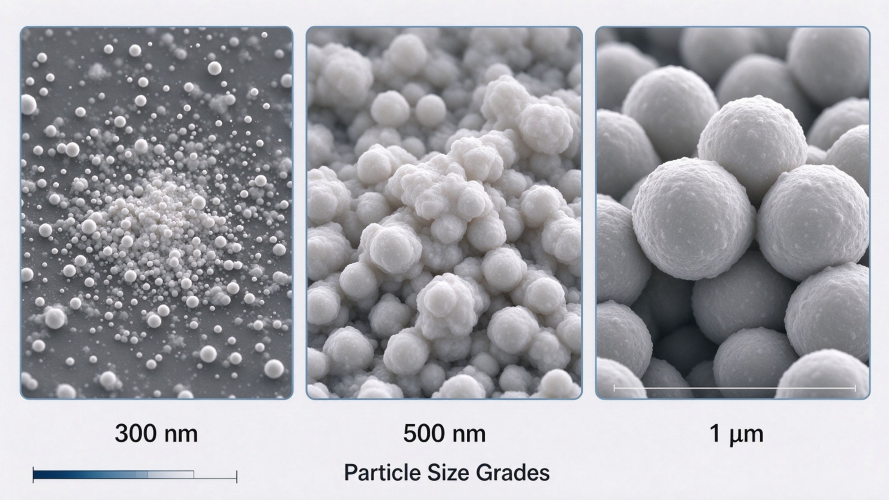
Particle size affects powder dispersion, surface area, slurry behaviour, packing and the microstructure of the final component. VIMATERIAL offers LATP powder in 300 nm, 500 nm and 1 μm grades, with particle size controllable within ±50 nm.
The following table provides a practical starting point for material evaluation. It is not a guarantee of application performance; the final choice should be confirmed through process trials.
| LATP Particle Size | Potential Application Focus | Main Considerations |
|---|---|---|
| 300 nm | Thin cathode coatings, fine separator coatings and applications requiring fine ceramic particles | Higher specific surface area; pay attention to dispersion, slurry solid content and moisture control |
| 500 nm | General-purpose coating and polymer–ceramic composite development | Balanced option for surface area, dispersion and processing |
| 1 μm | Thicker ceramic layers and composite formulations requiring a coarser filler | Lower specific surface area and generally easier powder handling; check coating uniformity and interface resistance |
A smaller particle size is not always better. Fine particles can support the formation of thin layers, but their higher surface area may increase slurry viscosity and make agglomeration control more demanding. Larger particles may be easier to handle in some formulations, but they may not provide the surface coverage required for a thin coating.
For initial screening, 500 nm can be a useful general-purpose grade. The final selection should be based on the target layer thickness, coating process, binder or polymer system and measured cell performance.
Key LATP Specifications and Processing Considerations
When evaluating LATP powder, battery developers should consider more than the nominal chemical formula. Purity, particle-size distribution, moisture content and ionic conductivity can all influence the consistency of subsequent processing.
| Parameter | VIMATERIAL LATP Specification |
|---|---|
| Chemical Formula | Li₁.₃Al₀.₃Ti₁.₇(PO₄)₃ |
| Crystal Structure | NASICON-type trigonal |
| Space Group | R-3c (No. 167) |
| Purity | ≥99% |
| Room-Temperature Ionic Conductivity | ≥0.45 mS/cm |
| Electronic Conductivity | <1 × 10⁻⁸ S/cm |
| Electrochemical Window | 0–5.0 V vs. Li/Li⁺ |
| Thermal Stability | >800°C |
| Magnetic Impurities | <500 ppb |
| Moisture | ≤1000 ppm |
| Available D50 Grades | 300 nm / 500 nm / 1 μm |
| Particle-Size Control | ±50 nm |
Before using LATP powder in a coating or composite formulation, several processing factors should be checked.
Dispersion and agglomeration: Mixing conditions should be selected to obtain a uniform particle distribution without introducing contamination or damaging the intended formulation.
Slurry solid content and viscosity: Fine LATP grades may require adjustments to solvent content, dispersant and mixing conditions. The formulation should remain suitable for the selected coating or casting process.
Moisture management: LATP can be processed in normal air, unlike moisture-sensitive sulfide solid electrolytes. However, the specified moisture level should still be maintained, and powder should be stored in a sealed container when not in use.
Interface compatibility: The compatibility of LATP with the cathode, binder, polymer, separator and other electrolyte components should be assessed under the actual processing and operating conditions.
Quality verification: XRD, particle-size distribution, elemental impurity analysis, moisture measurement and ionic conductivity testing can help confirm whether a powder batch meets the requirements of a specific development programme.
Choosing LATP for Your Battery Application
The appropriate LATP grade depends on the component being developed and the manufacturing route.
For a standalone ceramic electrolyte, density, sintering behaviour, grain-boundary resistance and electrode contact are central considerations. For cathode or separator coatings, particle dispersion, coating uniformity, adhesion and layer thickness become more important. For polymer–ceramic composites, ceramic loading and polymer–particle compatibility need to be evaluated together.
A practical material selection process should therefore begin with the intended application and processing method, followed by particle-size screening and performance validation.
VIMATERIAL supplies LATP powder with a purity of ≥99% and D50 options of 300 nm, 500 nm and 1 μm. Custom particle-size and material requirements can be discussed according to the intended formulation and production process.
Conclusion
LATP is a versatile NASICON-type ceramic that can be evaluated in several solid-state battery architectures. Its potential roles include a standalone ceramic electrolyte, a cathode surface coating component, a separator functional coating and a filler in polymer–ceramic composite electrolytes.
These applications do not share identical material requirements. Particle size, dispersion, interface compatibility and processing conditions must be matched to the intended component. Careful grade selection and application-specific testing are essential for determining whether LATP is suitable for a particular battery design.
Frequently Asked Questions
1. Can LATP be used as a solid electrolyte?
Yes. LATP can be used as a lithium-ion conducting ceramic electrolyte. Its practical performance depends on ceramic density, grain-boundary resistance and contact with the electrodes. Direct contact with lithium metal requires particular attention because of interfacial instability.
2. Can LATP be used to coat cathode materials?
LATP can be evaluated as an ion-conducting ceramic component in cathode surface coating systems. Its suitability depends on the cathode chemistry, coating composition, thickness and processing conditions.
3. Can LATP replace a conventional battery separator?
Not simply by applying it as a coating. LATP-coated polymer separators and standalone LATP ceramic electrolyte membranes are different components with different functions. A separator coating does not automatically replace the electrolyte in a conventional cell.
4. Which LATP particle size is suitable for coating applications?
The choice depends on coating thickness and formulation. A 300 nm grade may be considered for finer coating layers, while 500 nm offers a balanced starting point for general development. The 1 μm grade may be suitable for thicker layers or selected composite formulations.
5. Is LATP sensitive to moisture?
LATP is generally more practical to handle in air than sulfide solid electrolytes, but this does not mean moisture content can be ignored. Powder should be kept sealed during storage, and moisture requirements should be considered in the formulation and quality-control process.
References
- [1] Zhong, et al. “Research Progress of LATP in Polymer-Ceramic Composite Solid Electrolytes for Lithium Metal Batteries.” Journal of Polymer Science, 2026.
- [2] Ding, D., et al. “Stabilizing a Li₁.₃Al₀.₃Ti₁.₇(PO₄)₃/Li Metal Anode Interface in Solid-State Batteries with a LiF/Cu-Rich Multifunctional Interlayer.” Chemical Science, 2024, 15, 3730–3740.
- [3] Kong, et al. “Stabilizing Li₁.₃Al₀.₃Ti₁.₇(PO₄)₃|Li Metal Anode Interface in Solid-State Batteries by Kevlar Aramid Nanofiber-Based Protective Coating.” Advanced Functional Materials, 2023.
- [4] Zhang, J., Liu, G., Zhai, P. and Guo, X. “Stabilizing the Interface of Li₁.₃Al₀.₃Ti₁.₇(PO₄)₃ and Lithium Electrodes via an Interlayer Strategy in Solid-State Batteries.” Chemical Communications, 2025, 61, 2949–2952.
Further Reading
- Lithium Aluminum Titanium Phosphate (LATP): A Promising Solid-State Electrolyte for Next-Generation Batteries
- LATP Powder: Particle Size, Purity, Ionic Conductivity and How to Choose the Right Grade
- LMFP vs LFP: What’s the Difference and Why LMFP Is Gaining Momentum
- LATP Solid Electrolyte: Structure, Ionic Conductivity, and Future Prospects
- LATP vs LLZO: Which Oxide Solid Electrolyte Is Better for Solid-State Batteries?
Need LATP Powder for Your Battery Development?
VIMATERIAL supplies LATP powder with ≥99% purity and D50 particle-size options of 300 nm, 500 nm and 1 μm. Custom particle-size requirements and material specifications can be discussed for ceramic electrolyte, cathode coating, separator coating and polymer–ceramic composite development.
Explore LATP Powder or contact VIMATERIAL to discuss your application requirements.