


LATP and LLZO are two important oxide solid electrolytes being investigated for solid-state and semi-solid-state lithium batteries. Both conduct lithium ions through crystalline structures, offer good thermal stability compared with conventional liquid electrolytes, and have potential applications in composite electrolytes and functional coatings. However, their different crystal structures and interfacial chemistries make them suitable for different battery designs. In summary, the ongoing comparisons of LATP vs LLZO highlight their distinct characteristics and applications.
LATP (lithium aluminium titanium phosphate) is a NASICON-type phosphate ceramic known for its relatively low material cost, good air stability and processing flexibility. LLZO (lithium lanthanum zirconium oxide) is a garnet-type oxide that has attracted significant attention because of its compatibility with lithium metal and its potential for high ionic conductivity when the appropriate crystal phase is stabilised.
Neither material is universally better. The appropriate choice depends on the electrode chemistry, electrolyte architecture, manufacturing process and required performance.
What Are LATP and LLZO?
What is LATP?
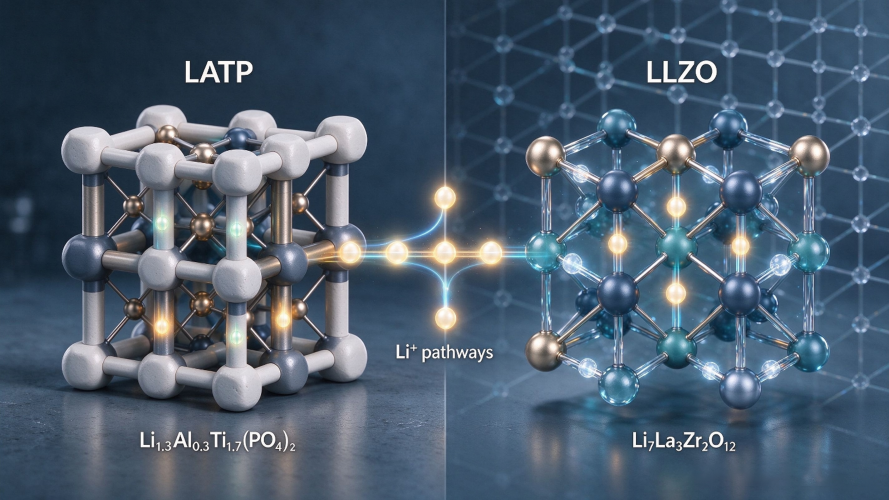
LATP is a NASICON-type lithium-ion-conducting phosphate ceramic. A commonly studied composition is Li₁.₃Al₀.₃Ti₁.₇(PO₄)₃. Its three-dimensional framework provides pathways for lithium-ion transport.
The material is attractive for applications where air stability, processing cost and compatibility with composite systems are important. Potential uses include ceramic electrolyte components, separator functional coatings, polymer–ceramic composite electrolytes and electrode-related coatings or additives.
However, the titanium-containing framework presents an important limitation: Ti⁴⁺ can be reduced at sufficiently low potentials when LATP directly contacts lithium metal. This reaction can form an interphase with mixed ionic and electronic conduction, increasing resistance and undermining long-term stability.
For a more detailed explanation of its composition and transport mechanism, see VIMATERIAL’s article on LATP solid electrolyte: structure, ionic conductivity and future prospects.
What is LLZO?
LLZO is a garnet-type oxide solid electrolyte with the nominal chemical formula Li₇La₃Zr₂O₁₂. Its crystal structure contains lithium-ion transport pathways, and its electrochemical compatibility with lithium metal makes it a major candidate for solid-state lithium-metal batteries.
LLZO’s performance depends strongly on its crystal phase and composition. Cubic LLZO generally offers higher lithium-ion conductivity than the tetragonal phase. Dopants such as tantalum or niobium are commonly investigated to stabilise the highly conductive cubic structure.
Despite these advantages, LLZO is not free from processing and interface challenges. Exposure to moisture and carbon dioxide can produce surface reaction products, including lithium carbonate, which may increase interfacial resistance. Dense ceramic fabrication and effective contact with electrodes are also important engineering requirements.
LATP vs LLZO: Key Differences at a Glance
| Comparison Factor | LATP | LLZO |
|---|---|---|
| Chemical Formula | Li₁.₃Al₀.₃Ti₁.₇(PO₄)₃ | Li₇La₃Zr₂O₁₂ |
| Crystal Structure | NASICON-type | Garnet-type |
| Main Transport Mechanism | Lithium-ion transport through a phosphate framework | Lithium-ion transport through a garnet framework |
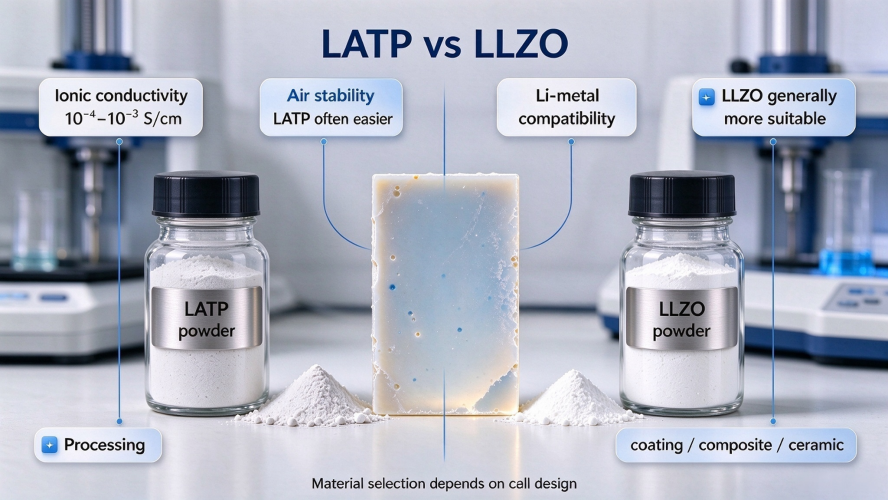
| Room-Temperature Ionic Conductivity | Commonly reported in the 10⁻⁴–10⁻³ S/cm range, depending on composition and processing | Commonly reported in the 10⁻⁴–10⁻³ S/cm range for suitable compositions and phases |
| Air Stability | Generally good under ambient conditions | More sensitive to moisture and CO₂-related surface reactions |
| Direct Contact with Lithium Metal | Thermodynamically unstable without suitable interface protection | Generally more compatible with lithium metal, although interface engineering remains necessary |
| Processing Considerations | Often attractive for lower-cost powder processing and composite formulations | Dense ceramic processing, phase control and surface management are important |
| Material Cost Considerations | Avoids lanthanum and is generally considered a lower-cost option | Contains lanthanum and may involve higher raw-material and processing costs |
| Potential Application Directions | Separator coatings, composite electrolytes and selected electrode-side functions | Lithium-metal solid-state electrolytes, protective or functional layers and composite systems |
| Main Technical Challenge | Reduction of Ti⁴⁺ at low potentials and associated interfacial instability | Air-induced surface reactions, ceramic densification and electrode–electrolyte interface resistance |
Note: Actual conductivity, processing requirements, cost and battery performance depend on composition, dopants, powder properties, fabrication conditions and cell design.
Ionic Conductivity: Is LLZO Always Better Than LATP?
Ionic conductivity is one of the most frequently compared parameters for solid electrolytes. It describes how readily lithium ions move through a material, but it does not, by itself, determine the performance of a complete battery.
Both LATP and LLZO can achieve room-temperature ionic conductivity within the approximate 10⁻⁴–10⁻³ S/cm range. The values vary substantially with crystal structure, dopant concentration, grain-boundary resistance, density and measurement method.
For LATP, a well-developed NASICON framework supports three-dimensional lithium-ion transport. Nevertheless, the conductivity measured for a dense ceramic may differ considerably from that of a powder-derived composite or a porous membrane. Grain boundaries and interfaces can become significant resistance sources.
For LLZO, stabilising the highly conductive cubic phase is a key part of materials development. Ta- or Nb-doped compositions are widely studied for this purpose. Even when the bulk material has high conductivity, pores, grain boundaries and poor electrode contact can limit the performance of the assembled cell.
Practical takeaway: Do not select an electrolyte based on a single conductivity figure. Compare values measured under similar conditions, and distinguish bulk conductivity from total conductivity and effective conductivity in the final composite or cell.
Air Stability and Moisture Sensitivity
Air stability is especially important when solid electrolyte powders must be milled, dispersed, mixed into a slurry, coated onto a separator or stored before use.
LATP: Generally easier to process in air
LATP is generally recognised for its good stability under ambient conditions. This can simplify powder handling and make it attractive for manufacturing processes that use conventional atmospheric environments.
Its relative air stability does not mean that every LATP grade is moisture-proof. Moisture content, powder surface area, packaging and storage conditions can still influence powder quality and downstream processing. Buyers should therefore establish moisture limits and storage requirements with their supplier.
LLZO: Surface chemistry requires more attention
LLZO can react with atmospheric moisture and carbon dioxide, forming surface contaminants such as lithium carbonate. These reaction products may affect wetting, electrode contact and interfacial resistance.
The severity depends on exposure conditions, material composition and surface treatment. Some modified LLZO grades are specifically developed to improve air stability or compatibility with water-based processing systems.
For manufacturers using water-based slurries or extended powder storage, it is important to qualify the actual LLZO grade rather than assume that all garnet electrolytes have the same environmental sensitivity.
Practical takeaway: LATP is often the more straightforward starting point when air-processable powder handling and manufacturing simplicity are priorities. LLZO may still be appropriate when its electrochemical advantages justify the additional surface and process controls.
Lithium-Metal Compatibility: A Major Difference
The most important distinction between LATP and LLZO is often their behaviour at the negative-electrode interface.
Why direct LATP–lithium contact is problematic?
LATP contains titanium in the Ti⁴⁺ oxidation state. At sufficiently low electrochemical potentials, titanium can be reduced, initiating interfacial reactions and the formation of decomposition products.
The resulting interphase can increase resistance and introduce electronic conduction pathways that are undesirable in a solid electrolyte. Continued reactions can compromise cell stability.
This means that unprotected LATP should not be assumed to be directly compatible with a lithium-metal anode.
Researchers have investigated several approaches to address this limitation, including protective interlayers, surface coatings, alloy-based buffers and multilayer composite electrolyte designs. These strategies can improve compatibility, but their effectiveness depends on the interface architecture and manufacturing process.
Why LLZO is attractive for lithium-metal batteries?
LLZO is generally considered more compatible with lithium metal than LATP. This is one of the reasons it is widely studied for all-solid-state lithium-metal batteries.
However, chemical compatibility alone does not guarantee reliable cell performance. Poor physical contact, surface contamination, grain-boundary defects and local current concentration can still cause high resistance or contribute to short-circuit failure.
LLZO-based systems therefore also require interface engineering, suitable ceramic density and careful control of electrode assembly.
Practical takeaway: For a design requiring direct contact between the solid electrolyte and a lithium-metal anode, LLZO is generally the more suitable starting point. LATP may still be useful in protected interfaces or multilayer architectures, but direct-contact stability must be demonstrated rather than assumed.
Processing, Manufacturing and Cost
Material selection for commercial applications involves more than intrinsic conductivity. Powder price, processing temperature, equipment requirements, yield, surface treatment and batch consistency all affect the total cost of the final component.
LATP: Cost and processing flexibility
LATP avoids the lanthanum used in LLZO and is often considered an economical oxide electrolyte. Its air stability and suitability for composite formulations can also simplify certain powder-handling and coating processes.
These characteristics make LATP worth evaluating for separator functional coatings, polymer–ceramic composites and other applications where the material does not need to contact lithium metal directly.
Its limitations should nevertheless be included in the cost calculation. If a protective interlayer or additional interface treatment is required, the cost and complexity of the complete architecture may be higher than the powder price alone suggests.
LLZO: Performance potential with additional process requirements
LLZO contains lanthanum and generally requires careful control of phase formation and ceramic densification. Surface contamination and the solid–solid interface can create additional processing requirements.
The final cost depends on the selected composition, dopants, synthesis route, sintering conditions, post-treatment and production scale. A higher powder cost does not necessarily determine the total cost of a cell, just as a lower powder price does not guarantee a lower-cost electrolyte system.
For both materials, procurement specifications should include more than nominal purity. Particle-size distribution, phase composition, moisture, impurity limits, conductivity test conditions and batch-to-batch consistency may all be relevant.
Which Applications Suit LATP and LLZO?
The most appropriate material depends on the role it must perform within the battery.
| Application Requirement | Material to Evaluate First | Main Consideration |
|---|---|---|
| Separator Functional Coating | LATP or LLZO | Slurry compatibility, adhesion, particle distribution and the intended electrochemical role |
| Polymer–Ceramic Composite Electrolyte | LATP or LLZO | Filler dispersion, interfacial resistance and compatibility with the polymer matrix |
| Solid Electrolyte in Direct Contact with Lithium Metal | LLZO | Interface resistance, ceramic density and long-term cycling stability |
| Air-Processable Oxide Electrolyte Powder | LATP | Moisture specification, storage conditions and processing requirements |
| Multilayer Electrolyte Architecture | Both may be considered | Chemical compatibility between layers, interface design and manufacturing complexity |
| Cost-Sensitive Coating or Composite Development | LATP is a useful candidate | Total formulation cost and whether additional interface protection is required |
These are screening recommendations, not universal rules. The suitability of either material must be confirmed in the intended cell configuration.
In particular, using a ceramic powder as a separator coating or composite filler is not equivalent to using it as the sole electrolyte separating the electrodes. The required conductivity, mechanical properties, electrochemical stability and interface design can differ significantly between these architectures.
How to Select the Right Material for Your Project?
A practical qualification process can help avoid selecting a material based on an isolated specification.
Step 1: Define the electrode chemistry
Identify whether the negative electrode is lithium metal, graphite or another material. If direct lithium-metal contact is required, prioritise evaluation of LLZO or a specifically engineered interface architecture. Do not assume that unprotected LATP is compatible with lithium metal.
Step 2: Define the electrolyte architecture
Determine whether the powder will be used in a dense ceramic electrolyte, a polymer composite, a separator coating or an electrode-side functional layer. This determines the relative importance of particle size, dispersion, conductivity, mechanical integrity and interface stability.
Step 3: Establish measurable powder specifications
Request the following information from the supplier where relevant:
- Chemical composition and phase identification
- Ionic conductivity and the associated measurement conditions
- Particle-size distribution, including D10, D50 and D90
- Purity and critical impurity limits
- Moisture content and recommended storage conditions
- Surface treatment or dopant information
- Batch traceability and quality documentation
Step 4: Evaluate processing compatibility
For coating and composite applications, assess dispersion, slurry stability, coating uniformity, drying behaviour and adhesion. For dense ceramic electrolytes, evaluate densification, porosity, grain-boundary resistance and compatibility with the selected electrodes.
Step 5: Validate the complete cell
The final decision should be based on the intended cell design. Relevant tests may include interfacial resistance, cycling stability, rate performance, temperature-dependent performance and post-test interface analysis.
A powder that performs well in a laboratory conductivity test may not deliver the same advantage after integration into a composite or full cell.
Conclusion: LATP or LLZO?
LATP and LLZO address different priorities within oxide solid electrolyte development.
LATP is a strong candidate when air stability, cost considerations and compatibility with coating or composite processing are important. Its main limitation is its instability against direct lithium-metal contact, which may require protective interfaces or a different electrolyte architecture.
LLZO is particularly attractive when lithium-metal compatibility is a central design requirement. Its advantages must be balanced against surface reactions in air, phase control, ceramic densification and electrode–electrolyte interface challenges.
The better material is therefore the one that satisfies the electrochemical and manufacturing requirements of the intended battery architecture—not necessarily the one with the highest conductivity or the lowest powder price.
For materials developers, battery manufacturers and coating specialists, the next step is to compare qualified powder grades under consistent test conditions and validate them in the intended formulation or cell design.
Frequently Asked Questions
1. Is LATP better than LLZO?
Neither material is universally better. LATP is attractive for air stability, processing flexibility and cost-sensitive composite or coating applications. LLZO is generally more suitable as a candidate for electrolyte architectures requiring compatibility with lithium-metal anodes.
2. Can LATP be used with a lithium-metal anode?
Direct contact between unprotected LATP and lithium metal can cause reduction of Ti⁴⁺ and the formation of resistive or mixed-conducting interphases. Protective coatings, buffer layers and composite architectures are being investigated, but compatibility must be validated for the specific design.
3. Does LLZO have higher ionic conductivity than LATP?
Not in every case. Both materials can reach the 10⁻⁴–10⁻³ S/cm range at room temperature, depending on composition, crystal phase, processing and measurement method. Comparisons should use equivalent test conditions and distinguish bulk from total conductivity.
4. Why is LLZO sensitive to air exposure?
LLZO can react with atmospheric moisture and carbon dioxide, forming surface products such as lithium carbonate. These products may increase interfacial resistance. The extent of the effect depends on the material grade, exposure conditions and any surface treatment.
5. Can LATP be used in separator coatings and polymer composites?
Yes, LATP is investigated for separator functional coatings and polymer–ceramic composite electrolytes. Its suitability depends on particle characteristics, dispersion, moisture control, interface design and the electrochemical requirements of the complete cell.
6. What should buyers request when sourcing LATP powder?
Relevant specifications include chemical composition, phase purity, ionic conductivity with test conditions, particle-size distribution, chemical purity, moisture content, impurity limits and batch documentation. Processing requirements and storage recommendations should also be confirmed.
References
- [1] Wang et al. (2024). “Accelerating the Development of LLZO in Solid-State Batteries Toward Commercialization: A Comprehensive Review.” Small, 20(35), 2402035.
- [2] Yin et al. (2023). “Recent Advances of LATP and Their NASICON Structure as a Solid-State Electrolyte for Lithium-Ion Batteries.” Advanced Engineering Materials, 25(20), 2300566.
- [3] Kibret et al. (2024). “Resolving electrochemical incompatibility between LATP and Li-metal using tri-layer composite solid electrolyte approaches for solid-state Li-metal batteries.” Journal of Energy Storage, 94, 112523.
- [4] Xiao et al. (2023). “Engineering and regulating the interfacial stability between Li₁.₃Al₀.₃Ti₁.₇(PO₄)₃-based solid electrolytes and lithium metal anodes for solid-state lithium batteries.” Journal of Colloid and Interface Science, 652, 1447–1455.
- [5] “Emerging processing guidelines for solid electrolytes in the era of oxide-based solid-state batteries.” Chemical Society Reviews (2025).
- [6] “Current challenges and perspectives of garnet-based solid-state electrolytes.” Journal of Energy Storage (2023), 68, 107693.
Further Reading
- Lithium Aluminum Titanium Phosphate (LATP): A Promising Solid-State Electrolyte for Next-Generation Batteries
- LATP Powder: Particle Size, Purity, Ionic Conductivity and How to Choose the Right Grade
- LMFP vs LFP: What’s the Difference and Why LMFP Is Gaining Momentum
- LATP Solid Electrolyte: Structure, Ionic Conductivity, and Future Prospects
- LMFP vs NCM Cathode Materials: Key Differences for Next-Generation Lithium-Ion Batteries
Need a Custom LATP or LLZO Material Solution?
VIMATERIAL supplies lithium aluminium titanium phosphate (LATP) powder and lithium lanthanum zirconium oxide (LLZO) powder for materials research and industrial development. Available particle-size grades include D50 300 nm, 500 nm and 1 μm, with purity of at least 99% according to the current product specification.
Particle size, purity and other requirements can be discussed according to your application. Contact our team to discuss your target specifications, documentation requirements and intended processing route.