


Transparent AlON requires carefully controlled powder processing and densification to achieve its desired optical performance. Unlike conventional glass, AlON becomes transparent only when the ceramic reaches a high level of density with minimal pores, defects, and secondary phases.
The manufacturing process can generally follow either a one-step reaction-sintering route or a two-step powder synthesis and sintering route. For high-quality transparent AlON, the two-step approach provides greater control over powder characteristics and densification.
How Is Transparent AlON Ceramic Manufactured?
A typical AlON ceramic manufacturing process is:
AlON powder → Powder conditioning → Forming → Debinding → Sintering → Densification → Machining and polishing
The key objective is to transform fine AlON powder into a dense, homogeneous ceramic while minimizing residual porosity.
The synthesis of AlON powder itself involves several methods and is covered separately in our article on AlON Powder: Properties, Synthesis Methods and Applications. This article focuses on what happens after the powder is prepared.
One-Step vs. Two-Step AlON Manufacturing
There are two general approaches to producing AlON ceramic.
One-Step Process
In the one-step process, Al₂O₃ and AlN powders are directly reacted and sintered to form AlON ceramic.
Al₂O₃ + AlN → Forming → Reaction Sintering → AlON Ceramic
This approach has a relatively simple process flow because separate AlON powder synthesis is not required.
However, the reaction and densification occur simultaneously. Non-uniform mixing of Al₂O₃ and AlN can result in uneven phase formation and grain development, making it more difficult to achieve the high density required for transparent ceramics.
Two-Step Process
In the two-step process, AlON powder is synthesized first and then processed into ceramic:
Al₂O₃ / AlN → AlON Powder → Forming → Sintering → AlON Ceramic
This approach allows powder characteristics to be controlled before densification.
Compared with the one-step route, it can provide:
- Better composition uniformity
- More controlled powder characteristics
- More uniform grain development
- Better densification
- Improved potential for optical transparency
The main disadvantage is the additional processing time and cost associated with preparing the AlON powder separately.
| Factor | One-Step | Two-Step |
|---|---|---|
| Process | Reaction + sintering together | Powder synthesis + sintering |
| Process complexity | Lower | Higher |
| Powder control | Limited | Better |
| Densification control | More difficult | Better |
| Suitability for transparent AlON | More challenging | More suitable |
Powder Conditioning and Forming
Before sintering, AlON powder normally undergoes milling, deagglomeration, mixing, and other powder-conditioning processes.
The purpose is to obtain a uniform powder with good packing and sintering behavior.
Large agglomerates can create local density variations in the green body and may eventually become residual pores after sintering. Because pores scatter light, controlling powder dispersion is particularly important for transparent AlON.
The conditioned powder can then be formed using methods such as:
- Uniaxial pressing
- Cold isostatic pressing
- Slip casting
- Other near-net-shape methods
The goal is to obtain a green body with uniform density and sufficient strength for subsequent processing.
Debinding
When organic binders are used during forming, they must be removed before high-temperature sintering.
This stage is known as debinding.
Debinding needs to be carefully controlled because rapid removal of organic components can create cracks or internal pores. Such defects may be difficult to eliminate during subsequent densification.
Transparent AlON Ceramic Sintering Methods
Sintering is the key stage in converting the porous green body into a dense AlON ceramic.
The main methods include:
- Pressureless sintering
- Hot pressing
- Hot isostatic pressing (HIP)
- Spark plasma sintering (SPS)
- Microwave sintering
Different methods provide different combinations of densification, processing speed, geometry flexibility, and cost.
1. Pressureless Sintering
Pressureless sintering is one of the most important methods for AlON ceramic production.
The formed body is heated at high temperature without applying external mechanical pressure. As the temperature increases, particles bond together and pores progressively shrink.
Its major advantage is greater flexibility in component geometry compared with pressure-assisted methods.
However, achieving high transparency requires precise control of:
- Sintering temperature
- Holding time
- Atmosphere
- Powder characteristics
- Green-body density
- Grain growth
Pressureless sintering is particularly attractive when complex-shaped transparent AlON components are required.
2. Hot Pressing
Hot pressing combines high temperature with mechanical pressure to promote densification.
It can produce highly dense AlON ceramics and reduce residual porosity. However, the component must generally be processed within a die, which limits the geometry and size of the final product.
Hot pressing is therefore more suitable for relatively simple shapes where high densification is the primary requirement.
3. Hot Isostatic Pressing (HIP)
Hot isostatic pressing (HIP) applies high temperature and gas pressure simultaneously.
HIP is particularly useful for reducing residual closed pores and further increasing ceramic density.
A typical process is:
Forming → Presintering → HIP → Finishing
Compared with conventional pressureless sintering, HIP requires more specialized equipment and therefore has a higher processing cost.
4. Spark Plasma Sintering
Spark plasma sintering (SPS) uses electrical energy and mechanical pressure to achieve rapid densification.
Its main advantages are:
- Rapid heating
- Short sintering time
- Fast densification
- Potentially reduced grain growth
However, achieving the extremely low defect levels required for highly transparent AlON can be challenging, so process optimization is important.
5. Microwave Sintering
Microwave sintering uses electromagnetic energy to heat the ceramic.
It can provide rapid heating and potentially reduce processing time. However, controlling the heating behavior and obtaining the uniform microstructure required for transparent AlON can be challenging.
AlON Sintering Methods Compared
| Method | Main Advantage | Main Limitation |
|---|---|---|
| Pressureless sintering | Flexible shapes | Requires careful process control |
| Hot pressing | High densification | Shape limitations |
| HIP | Excellent pore reduction | Higher cost |
| SPS | Rapid densification | Transparency can be challenging |
| Microwave | Rapid heating | Process control can be difficult |
How Does AlON Become Transparent?
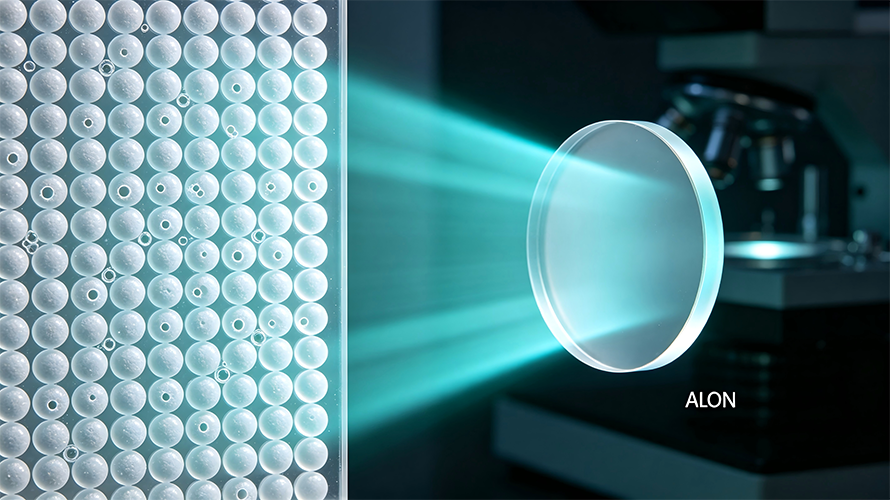
The key to transparent AlON is high densification with minimal residual defects.
During sintering, the pores between powder particles must be progressively eliminated. If pores, cracks, impurities, or secondary phases remain, they can scatter or absorb light and reduce optical transmission.
The basic relationship is:
Uniform powder → Uniform green body → Effective sintering → Low residual porosity → Transparent AlON
This is why powder quality, forming, and sintering need to be considered as one integrated manufacturing process.
What Determines the Quality of Sintered AlON?
Several factors influence the final ceramic:
Powder Characteristics
Particle size, purity, morphology, and agglomeration affect packing and sintering behavior.
Green-Body Density
A uniform green body helps minimize differential shrinkage and residual defects.
Sintering Temperature
The temperature must promote densification without causing excessive grain growth.
Sintering Atmosphere
Atmosphere control can affect phase stability and the chemical condition of the ceramic during high-temperature processing.
Holding Time
Insufficient time can leave residual porosity, while excessive time may promote grain growth.
AlON Ceramic Manufacturing Process at a Glance
AlON Powder
↓
Milling & Powder Conditioning
↓
Forming
↓
Debinding
↓
Sintering
Pressureless / Hot Pressing / HIP / SPS / Microwave
↓
Densification
↓
Machining & Polishing
↓
Finished AlON Ceramic
FAQs
1. How is AlON ceramic made?
AlON ceramic is typically manufactured by preparing and conditioning fine AlON powder, forming a green body, debinding when necessary, and then sintering to achieve high density. For transparent AlON, controlling powder quality, green-body uniformity, sintering conditions, and residual porosity is particularly important.
2. What is the difference between one-step and two-step AlON processing?
In the one-step process, Al₂O₃ and AlN are reacted and sintered together. In the two-step process, AlON powder is synthesized first and then formed and sintered. The two-step route generally provides better control over powder characteristics and densification, making it attractive for high-quality transparent AlON.
3. What causes AlON ceramics to lose transparency?
The main causes include residual porosity, impurities, secondary phases, cracks, inhomogeneous microstructure, and excessive grain growth. Poor powder dispersion or uneven green-body density can also make these defects more difficult to eliminate during sintering.
4. What is the role of AlON powder processing before sintering?
Powder processing helps control particle dispersion, agglomeration, packing behavior, and green-body uniformity. Proper milling, deagglomeration, mixing, and forming can improve densification and reduce the risk of residual pores in the final AlON ceramic.
5. What should be considered when sourcing AlON powder for transparent ceramics?
When sourcing AlON powder, important parameters include purity, particle size, particle-size distribution, morphology, agglomeration, chemical composition, and batch consistency. For transparent AlON applications, powder quality should be evaluated together with the intended forming and sintering process, as these factors directly affect densification and optical performance.
Conclusion
Manufacturing transparent AlON ceramic requires much more than synthesizing the correct Al–O–N composition. The powder must be properly conditioned, uniformly formed, carefully debound, and effectively densified.
The two main manufacturing strategies are one-step reaction sintering and two-step powder synthesis followed by sintering. The two-step route offers greater control over powder characteristics and is particularly useful when high density and optical transparency are required.
Among the available sintering technologies, pressureless sintering, hot pressing, HIP, SPS, and microwave sintering each have different advantages and limitations. The appropriate method depends on component geometry, required density, optical performance, and production requirements.
Ultimately, high-quality AlON ceramic is achieved by controlling the entire process from powder preparation to final densification and polishing, with particular attention to residual porosity and microstructural uniformity.
References
- [1] McCauley, J. W., & Corbin, N. D. (1979). Phase relations and reaction sintering of aluminum oxynitride spinel. Journal of the American Ceramic Society, 62(9–10), 476–479.
- [2] Corbin, N. D. (1987). Aluminum oxynitride spinel: A review. Journal of the American Ceramic Society, 70(4), 225–234.
- [3] McCauley, J. W., & Patel, P. (2008). Transparent ceramics: A review of their applications and processing. Journal of the American Ceramic Society, 91(8), 2536–2544.
- [4] Krell, A., Hutzler, T., & Klimke, J. (2009). Transmission physics and applications of transparent ultrahard materials. Journal of the European Ceramic Society, 29(2), 275–281.
Further Reading
- AlON Powder: Properties, Synthesis Methods and Applications
- What Is Aluminum Oxynitride (AlON)? Properties, Structure and Applications
- AlON Properties: Optical, Mechanical, Thermal and Chemical Performance
- AlON vs. Sapphire vs. Spinel: Which Is Better?
- AlON Transparent Ceramics: Applications in Infrared Windows and Transparent Armor
Need a Custom Material Solution?
AlON performance depends not only on the ceramic manufacturing process, but also on the quality and consistency of the starting powder. If you require AlON powder with specific purity, particle size, composition, or packaging requirements, we can discuss a suitable material solution for your application.
Tell us your required specifications and application, and our team will help you identify the appropriate AlON material.