


Aluminum oxynitride (AlON), sapphire, and magnesium aluminate spinel (MgAl₂O₄) are three important transparent ceramic materials considered for optical and infrared applications.
All three can provide high optical transmission, but their mechanical properties, manufacturing characteristics, and cost considerations differ.
Rather than asking which material is universally “best,” it is more useful to ask:
Which transparent ceramic best matches the requirements of a particular application?
AlON vs. Sapphire vs. Spinel: Property Comparison
Representative comparison data from the supplied technical material is shown below.
| Property | AlON | Sapphire | MgAl₂O₄ Spinel |
|---|---|---|---|
| Density (g/cm³) | 3.7 | 3.98 | 3.59 |
| Flexural strength (MPa) | 300 | 400 | 184 |
| Hardness (GPa) | 18.5 | 22.0 | 15.2 |
| Optical transmission | High | High | High |
| Dielectric constant | 9.3 | 9.4 | 9.2 |
| Dielectric loss | 0.0022 | 0.0005 | 0.0027 |
These values are representative and can vary with material quality, density, processing conditions, component thickness, and measurement method.
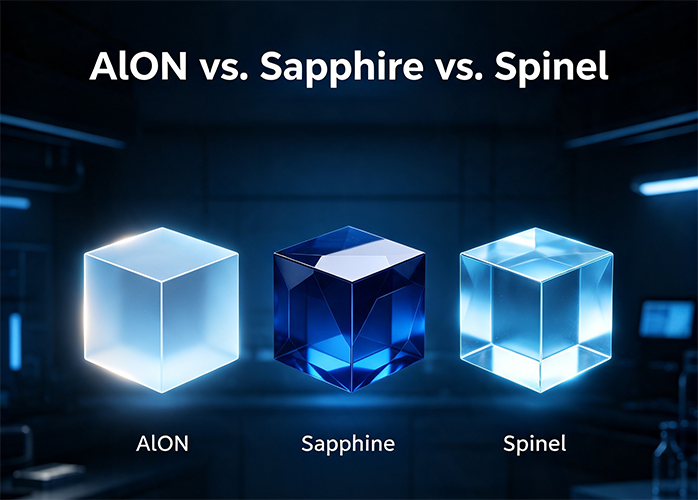
AlON vs. Sapphire
Sapphire is a single-crystal form of aluminum oxide (Al₂O₃).
It is widely recognized for excellent:
- Hardness
- Mechanical strength
- Optical performance
- Thermal properties
In the supplied comparison, sapphire shows higher hardness and flexural strength than AlON.
Why Consider AlON Instead of Sapphire?
The key distinction is manufacturing flexibility.
Producing sapphire requires single-crystal growth and subsequent machining. Large or complex-shaped sapphire components can therefore be difficult and expensive to manufacture.
AlON is a polycrystalline ceramic and can be processed using advanced ceramic manufacturing methods.
This provides potential advantages for:
- Large components
- Complex geometries
- Specialized optical shapes
- Applications where manufacturing cost matters
Therefore, AlON can provide an attractive balance between performance and manufacturing flexibility.
AlON vs. Magnesium Aluminate Spinel
Magnesium aluminate spinel is another important transparent ceramic.
It offers:
- High optical transmission
- Broad infrared transmission
- Relatively low density
- Useful thermal properties
However, the supplied comparison indicates that its flexural strength is lower than that of AlON and sapphire.
AlON therefore provides an attractive combination of optical transmission and mechanical performance.
Which Material Has the Highest Hardness?
Based on the representative values supplied:
- Sapphire: ~22.0 GPa
- AlON: ~18.5 GPa
- MgAl₂O₄ spinel: ~15.2 GPa
Therefore, sapphire has the highest hardness among the three in this comparison.
However, hardness alone does not determine which material is most suitable for an application.
Which Material Has the Best Optical Transmission?
The representative comparison gives approximately 85% transmission in the 3–5 μm range for all three materials.
This demonstrates why all three are considered for infrared optical applications.
The selection should therefore also consider:
- Component geometry
- Mechanical loading
- Temperature
- Manufacturing method
- Cost
- Required service environment
Which Material Is Strongest?
The representative flexural strength values are:
- Sapphire: ~400 MPa
- AlON: ~300 MPa
- MgAl₂O₄ spinel: ~184 MPa
Sapphire has the highest value in the supplied comparison, while AlON is substantially higher than spinel.
Which Material Is Best for Complex Shapes?
AlON can be particularly attractive for complex geometries because it is processed as a polycrystalline ceramic rather than a single crystal.
The supplied material highlights the potential of AlON for producing large and complex-shaped components using advanced ceramic processing technologies.
This can be an important advantage where sapphire manufacturing becomes difficult or expensive.
Which Material Is Best for Infrared Windows?
All three can be considered for infrared windows.
Aluminum oxynitride is particularly attractive when the application requires a combination of:
- High optical transmission
- Mechanical strength
- High hardness
- Thermal stability
- Manufacturing flexibility
Sapphire may be preferred where maximum hardness and strength are the priority.
Spinel may be attractive where low density and broad infrared transmission are important.
The final choice depends on the complete component specification.
Which Material Is Best for Transparent Armor?
Aluminum oxynitride is particularly attractive for transparent armor because it combines:
- High hardness
- Useful flexural strength
- Optical transparency
- Wear resistance
- Scratch resistance
- Lower density than sapphire
The supplied technical material identifies transparent armor as one of the major potential application areas for AlON.
AlON vs. Sapphire vs. Spinel: Quick Guide
| Requirement | Material to Consider |
|---|---|
| Highest hardness among the three | Sapphire |
| High optical transmission | AlON / Sapphire / Spinel |
| Strong transparent ceramic | Sapphire / AlON |
| Transparent armor | AlON |
| Complex-shaped components | AlON |
| Large ceramic components | AlON |
| Lower density | Spinel / AlON |
| Balanced performance and manufacturability | AlON |
This is a general comparison rather than a universal material ranking.
Frequently Asked Questions
Is AlON harder than sapphire?
No. The representative data supplied gives approximately 18.5 GPa for AlON and 22.0 GPa for sapphire.
Is AlON stronger than spinel?
The supplied comparison gives AlON a higher flexural strength than MgAl₂O₄ spinel.
Is AlON cheaper than sapphire?
AlON can offer manufacturing advantages for large or complex-shaped components, but the overall cost depends on material processing, component geometry, machining, polishing, and production volume.
Which is better for infrared windows, AlON or sapphire?
Neither is universally better. Sapphire provides excellent mechanical and optical performance, while AlON offers a strong combination of optical performance, mechanical properties, and manufacturing flexibility.
Conclusion
AlON, sapphire, and magnesium aluminate spinel each occupy a distinct position among transparent ceramic materials.
Sapphire offers the highest representative hardness and flexural strength in the supplied comparison.
Spinel offers excellent optical performance and relatively low density.
Aluminum oxynitride provides a particularly attractive balance between optical transmission, mechanical performance, and manufacturing flexibility, making it a strong candidate for infrared windows, transparent armor, and complex-shaped transparent ceramic components.
References
- [1] Wang, S. F., Zhang, J., Luo, D. W., Guo, L., Kou, H., Yue, X., Wang, Y., Yao, G., & Zhang, Z. (2013). Transparent ceramics: Processing, materials and applications. Progress in Solid State Chemistry, 41(1–2), 20–54. https://doi.org/10.1016/j.progsolidstchem.2012.12.002
- [2] McCauley, J. W., & Corbin, N. D. (1989). Aluminum oxynitride spinel: A review. Journal of the European Ceramic Society, 5(3), 143–154. https://doi.org/10.1016/0955-2219(89)90030-7
- [3] McCauley, J. W. (2009). AlON: A brief history of its emergence and evolution. Journal of the European Ceramic Society, 29(11), 2235–2247. https://doi.org/10.1016/j.jeurceramsoc.2009.01.016
- [4] Harris, D. C. (1999). Optical properties of ALON (aluminum oxynitride). Infrared Physics & Technology, 40(2), 101–107. https://doi.org/10.1016/S1350-4495(98)00007-3
- [5] Rolc, S., Klement, R., & Čápek, P. (2007). Transparent armour materials. Ceramics International, 33(5), 839–843. https://doi.org/10.1016/j.ceramint.2006.09.005
Further Reading
If you’re interested in aluminum oxynitride and other advanced ceramic materials, you may also find these articles helpful:
- What Is Aluminum Oxynitride (AlON)? Properties, Structure and Applications
- Si3N4 vs SiC: A quick guide of these two ceramic materials.
- AlON Properties: Optical, Mechanical, Thermal and Chemical Performance
- Hexagonal Boron Nitride (h-BN): A Versatile High-Performance Material Across Multiple Industries
- High Purity Titanium Carbide: The “Ultra-Hard Pioneer” Powering Advanced Technologies
Need a Custom Material Solution?
Need AlON, sapphire, spinel, or another advanced transparent ceramic for a specific application? We offer customized material solutions with tailored purity, dimensions, geometry, and performance specifications for optical, infrared, protective, and advanced ceramic applications.
Contact VIMATERIAL to discuss your material requirements.