


AlON powder is the starting material used to produce high-performance aluminum oxynitride (AlON) ceramics. For transparent AlON applications, powder quality has a direct influence on phase purity, densification, microstructure, and ultimately optical performance.
Producing a transparent AlON ceramic therefore begins with producing a powder that has the right purity, particle characteristics, phase composition, and sintering behavior.
What Is AlON Powder?
AlON powder is a fine aluminum oxynitride ceramic powder, generally associated with the γ-AlON phase for transparent ceramic applications.
It is synthesized from aluminum-containing oxide and nitride precursors through controlled high-temperature reactions.
The powder is then processed through forming and sintering to produce a dense ceramic.
A simplified route is:
Raw materials → AlON powder → forming → sintering → densification → polishing → AlON ceramic
What Makes High-Quality AlON Powder?
The supplied technical material identifies several important requirements for AlON powder.
High Purity
High purity is essential because unwanted impurities can affect:
- Phase formation
- Sintering behavior
- Grain growth
- Optical transmission
- Mechanical properties
Fine Particle Size
Fine particles provide a high reactive surface area and can promote more uniform reactions and densification.
Good Dispersibility
Aluminum oxynitride powder should disperse effectively during powder processing.
Agglomerated particles can produce local density variations and residual pores during sintering, which may reduce transparency.
High Sintering Activity
High sintering activity helps the powder densify efficiently during ceramic processing.
Uniform Particle Morphology
Uniform particles with a controlled morphology are desirable for consistent powder packing and densification.
The supplied source specifically identifies high purity, ultrafine particle size, good dispersion, good sintering activity, and uniform particle morphology as important characteristics.
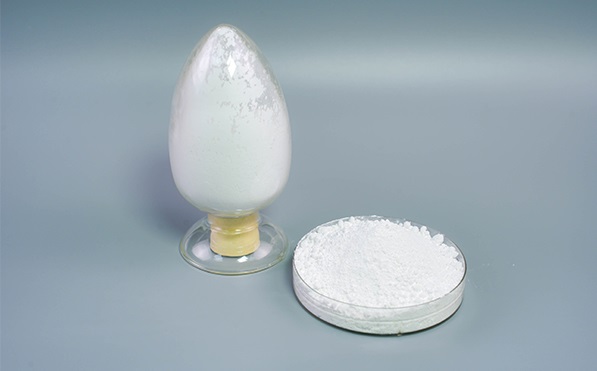
How Is AlON Powder Made?
Several synthesis routes have been studied.
For practical AlON powder production, two important approaches are:
- High-temperature solid-state reaction
- Carbothermal reduction and nitridation (CRN)
These two routes differ significantly in their raw materials, process control, and production characteristics.
1. High-Temperature Solid-State Reaction
The solid-state route generally uses Al₂O₃ and AlN powders as starting materials.
The powders are mixed in an appropriate proportion and reacted at high temperature under a nitrogen-containing atmosphere.
The process is influenced by factors such as:
- Reaction temperature
- Holding time
- Powder composition
- Mixing uniformity
- Atmosphere
Advantages
The solid-state route uses a relatively straightforward oxide/nitride raw-material system.
Challenges
A major challenge is the moisture sensitivity of AlN.
Handling and mixing therefore require careful control.
Incomplete reaction may also leave residual Al₂O₃ or AlN in the product, which can affect the performance of the final ceramic.
2. Carbothermal Reduction and Nitridation (CRN)
CRN is another important route for producing AlON powder.
In a simplified description, high-purity Al₂O₃ reacts with carbon under a nitrogen atmosphere to form AlON.
The process can provide:
- Simple processing
- Shorter processing time
- Lower raw-material cost
- Fine powder
- Potential for large-scale production
The supplied technical material identifies CRN as particularly attractive for industrial-scale production.
Why Is CRN Process Control Important?
Although CRN has significant production advantages, the formation of AlON is sensitive to processing conditions.
- Important variables include:
- Raw-material composition
- Carbon content
- Powder mixing
- Reaction temperature
- Nitrogen atmosphere
- Reaction time
Different mixing methods can produce different raw-material reactivity, while temperature and atmosphere can influence AlON phase formation.
Therefore, consistent control of raw materials, mixing, and synthesis conditions is essential for obtaining stable phase composition from batch to batch.
AlON Powder and Transparent Ceramic Production
The relationship between powder quality and final ceramic performance is critical.
A simplified process is:
High-purity AlON powder
↓
Powder conditioning
↓
Forming
↓
Sintering
↓
High-density AlON ceramic
↓
Surface polishing
↓
Transparent AlON ceramic
Poor powder quality can contribute to:
- Agglomeration
- Residual pores
- Secondary phases
- Uneven grain growth
- Incomplete densification
- Reduced optical transmission
This is why high-quality AlON powder is a prerequisite for producing high-performance transparent AlON ceramic.
AlON Powder Applications
Aluminum oxynitride powder is primarily used to manufacture AlON ceramic components.
Potential end-use areas include:
- Infrared windows
- Transparent armor
- Optical windows
- Aerospace optical components
- High-temperature observation windows
- Semiconductor-processing components
- Protective ceramic components
AlON Powder vs. AlON Ceramic
It is important to distinguish between the two.
AlON powder is the raw material or intermediate used for ceramic processing.
AlON ceramic is the dense final material obtained after forming, sintering, and usually surface finishing.
The powder itself is not transparent. Transparency is achieved through densification and microstructural control during ceramic processing.
Frequently Asked Questions
Q1. What is AlON powder used for?
AlON powder is primarily used to manufacture dense AlON ceramic components, including transparent optical and protective ceramics.
Q2. What properties should AlON powder have?
High purity, fine particle size, good dispersibility, high sintering activity, and uniform particle morphology are important characteristics.
Q3. How is AlON powder synthesized?
Important synthesis routes include high-temperature solid-state reaction and carbothermal reduction and nitridation (CRN).
Q4. Which AlON powder synthesis method is more suitable for scale-up?
The supplied material identifies CRN as attractive for industrial-scale production because of its relatively simple process, shorter processing time, and lower cost. However, phase and batch consistency require careful process control.
Conclusion
High-quality AlON powder is the foundation of high-performance AlON ceramic.
For transparent ceramic applications, powder purity, particle size, dispersibility, morphology, phase composition, and sintering activity all influence the final material.
High-temperature solid-state reaction and CRN are two important synthesis routes, with CRN offering particular potential for cost-effective large-scale production when raw materials and process parameters are carefully controlled.
References
- [1] Liu, X.-J., et al. (2010). Preparation of aluminum oxynitride powders by solid-state reaction. Journal of Inorganic Materials, 24(6), 1159–1162. DOI: 10.3724/SP.J.1077.2009.01159.
- [2] Xu, J.-X., et al. (2018). Nucleation density on the synthesis of AlON powder and preparation of transparent ceramics. Journal of Inorganic Materials, 33(4), 373–379. DOI: 10.15541/jim20170206.
- [3] Wu, J., et al. (2023). Recent progress and challenges of transparent AlON ceramics. Transactions of Nonferrous Metals Society of China, 33(3), 653–667. DOI: 10.1016/S1003-6326(22)66136-3.
- [4] Li, K., et al. (2022). Research progress on synthesis of γ-AlON ceramic powders.
- [5] Chen, Z., et al. (2012). Transparent ceramics: Processing, materials and applications. Progress in Materials Science.
Further Reading
If you’re interested in aluminum oxynitride and other advanced ceramic materials, you may also find these articles helpful:
- What Is Aluminum Oxynitride (AlON)? Properties, Structure and Applications
- AlON vs. Sapphire vs. Spinel: Which Transparent Ceramic Is Better?
- AlON Properties: Optical, Mechanical, Thermal and Chemical Performance
- Hexagonal Boron Nitride (h-BN): A Versatile High-Performance Material Across Multiple Industries
- High Purity Titanium Carbide: The “Ultra-Hard Pioneer” Powering Advanced Technologies
Need a Custom Material Solution?
Looking for high-purity AlON powder with specific purity, particle size, morphology, or packaging requirements? VIMATERIAL supplies AlON powder for research, ceramic processing, and advanced optical applications, with material specifications tailored to your project requirements.
Tell us your required purity, particle size, quantity, and application. Our technical team can help you find the right AlON powder solution.