


Aluminum oxynitride (AlON) is a transparent polycrystalline ceramic with a combination of optical, mechanical, thermal, and chemical properties that makes it attractive for demanding engineering applications. The performance characteristics of AlON Properties are particularly noteworthy.
Unlike conventional transparent materials that may have limited hardness or mechanical durability, AlON can provide optical transmission together with high hardness, useful strength, thermal stability, and chemical resistance.
Optical Properties of AlON
Optical performance is one of the most important characteristics of AlON.
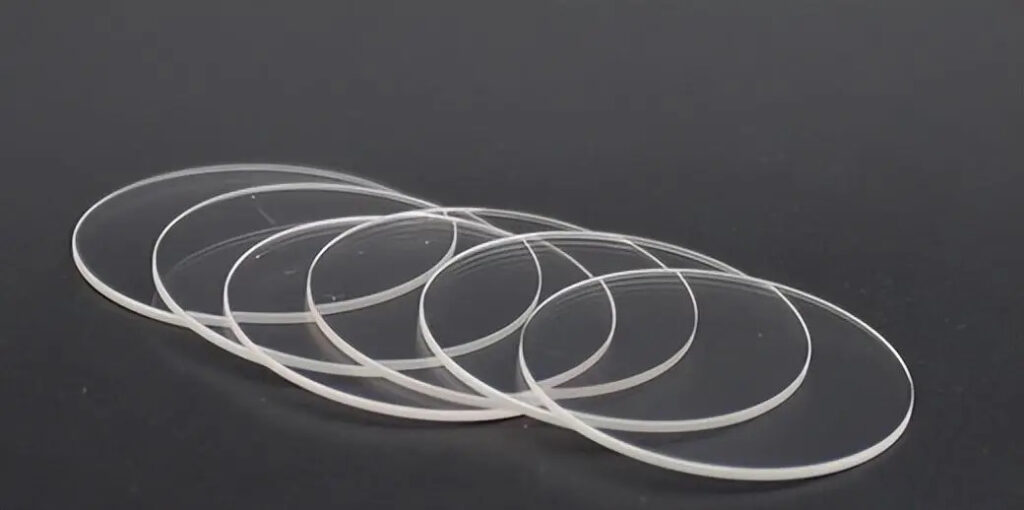
Transparent AlON ceramic can transmit light from the visible region into the infrared. The supplied technical material reports transmission above 80% over approximately 0.2–6.0 μm, while representative comparison data gives approximately 85% transmission in the 3–5 μm range.
The actual optical transmission depends on:
- Powder purity
- Phase purity
- Porosity
- Grain structure
- Secondary phases
- Sintering conditions
- Surface finish
- Component thickness
Optical Isotropy
Aluminum oxynitride is particularly attractive because transparent polycrystalline AlON can provide useful optical isotropy.
This means that its optical behavior is less dependent on crystal orientation than that of many single-crystal materials.
This characteristic is important for optical components with complex shapes or demanding design requirements.
Mechanical Properties of AlON
AlON combines optical transparency with high hardness and useful mechanical strength.
Representative values from the supplied material include:
- Density: approximately 3.7 g/cm³
- Flexural strength: approximately 300 MPa
- Hardness: approximately 18.5 GPa
These figures are representative rather than universal specifications. Actual properties depend on composition, density, powder quality, sintering conditions, microstructure, and testing method.
Hardness and Wear Resistance
High hardness gives aluminum oxynitride good resistance to:
- Scratching
- Abrasion
- Surface wear
- Mechanical contact
This is particularly useful in transparent protective components exposed to dust, sand, or repeated handling.
Thermal Properties of AlON
AlON provides good thermal stability and thermal-shock resistance.
These characteristics allow it to be considered for applications where transparent components must operate in demanding thermal environments.
Potential applications include:
- High-temperature observation windows
- Infrared optical components
- Aerospace applications
- Industrial protective windows
Thermal performance is also affected by density, microstructure, component geometry, and processing history.
Chemical and Corrosion Resistance
Aluminum oxynitride has good chemical and corrosion resistance.
This is particularly relevant to semiconductor manufacturing, where components may be exposed to chemically aggressive processing environments.
AlON has therefore been considered for components such as:
- Plasma delivery tubes
- Wafer carriers
- Process housings
- Protective ceramic components
Its chemical durability can provide a potential alternative to other ceramic materials in selected applications.
Dielectric Properties
The supplied comparison data gives representative dielectric properties of:
- Dielectric constant: approximately 9.3
- Dielectric loss: approximately 0.0022
These values are relevant when evaluating AlON for specialized electronic and optical applications.
AlON Property Summary
| Property | Representative AlON Characteristics |
|---|---|
| Material type | Transparent polycrystalline ceramic |
| Optical transmission | High transmission from visible to infrared |
| Transmission, 3–5 μm | ~85%* |
| Density | ~3.7 g/cm³* |
| Flexural strength | ~300 MPa* |
| Hardness | ~18.5 GPa* |
| Dielectric constant | ~9.3* |
| Dielectric loss | ~0.0022* |
| Thermal performance | Good thermal stability and thermal-shock resistance |
| Chemical performance | Good chemical and corrosion resistance |
| Wear resistance | High |
*Representative values from the supplied technical reference. Actual values depend on material quality and test conditions.
What Makes AlON Different?
The key advantage of AlON is not one individual property but the combination of properties.
For example, an optical window may need to provide:
- High optical transmission
- High hardness
- Mechanical strength
- Thermal stability
- Resistance to thermal shock
- Chemical resistance
AlON can provide these characteristics within one transparent ceramic material.
This balance is one reason why AlON is often evaluated against sapphire and magnesium aluminate spinel.
For a direct comparison, see [AlON vs. Sapphire vs. Spinel: Which Transparent Ceramic Is Better?]
AlON Properties and Material Selection
When selecting AlON for an application, it is important to evaluate more than nominal material properties.
Important factors include:
- Required wavelength range
- Optical transmission
- Component thickness
- Mechanical loading
- Operating temperature
- Chemical environment
- Required geometry
- Surface finish
- Manufacturing route
A material with excellent laboratory properties may not necessarily be the most suitable choice for every component.
Frequently Asked Questions
Is AlON harder than glass?
AlON has substantially higher hardness than conventional glass and provides better resistance to scratching and abrasion.
Is AlON suitable for infrared applications?
Yes. Its optical transmission extends into the infrared, making transparent AlON suitable for selected infrared windows and optical components.
Is AlON resistant to chemicals?
AlON provides good chemical and corrosion resistance and has been considered for semiconductor-processing environments.
Does AlON have good thermal stability?
Yes. AlON offers good thermal stability and thermal-shock resistance, which supports its use in demanding optical and industrial environments.
Conclusion
The main strength of AlON is the combination of optical transparency, hardness, mechanical strength, thermal stability, and chemical resistance.
This combination allows AlON to bridge the gap between conventional transparent materials and advanced structural ceramics.
Its properties make it particularly attractive for infrared windows, transparent protection, aerospace optics, high-temperature observation components, and selected semiconductor-processing applications.
References
- [1] Corbin, N. D. (1989). Aluminum oxynitride spinel: A review. Journal of the European Ceramic Society, 5(3), 143–154. https://doi.org/10.1016/0955-2219(89)90030-7
- [2] Cheng, J., Agrawal, D. K., Zhang, Y., Roy, R., et al. (2001). Microwave reactive sintering to fully transparent aluminum oxynitride (ALON) ceramics. Journal of Materials Science Letters, 20, 77–79.
- [3] Kumar, S., et al. (2016). Aqueous Slip Casting of Transparent Aluminum Oxynitride. Journal of the American Ceramic Society. https://doi.org/10.1111/jace.14349.
- [4] AlON: A brief history of its emergence and evolution. Journal of the European Ceramic Society. This review discusses the history, phase equilibrium, crystal chemistry, processing, and mechanical properties of AlON.
- [5] Investigation of the structural characteristics, dielectric properties, and infrared reflectivity spectra of AlON transparent ceramics. Journal of the European Ceramic Society. This work provides data on the dielectric and infrared properties of AlON transparent ceramics.
- [6] Progress in Transparent Nano-Ceramics and Their Potential Applications. Nanomaterials, 12(9), 1491 (2022). The review covers AlON optical transmission, hardness, strength, thermal resistance, and chemical resistance.
Further Reading
If you’re interested in aluminum oxynitride and other advanced ceramic materials, you may also find these articles helpful:
- What Is Aluminum Oxynitride (AlON)? Properties, Structure and Applications
- Si3N4 vs SiC: A quick guide of these two ceramic materials.
- What’s boron nitride?
- Hexagonal Boron Nitride (h-BN): A Versatile High-Performance Material Across Multiple Industries
- High Purity Titanium Carbide: The “Ultra-Hard Pioneer” Powering Advanced Technologies
Need a Custom Material Solution?
Looking for high-purity aluminum oxynitride (AlON) powder or a customized AlON material solution? VIMATERIAL can provide AlON materials with tailored purity, particle size, composition, and specifications to meet your research, optical, ceramic, and advanced manufacturing requirements.
Whether you need AlON for transparent ceramics, infrared windows, protective optics, semiconductor equipment, or high-temperature applications, our technical team can help you select the appropriate material and specifications for your project.
Contact VIMATERIAL today to discuss your AlON requirements and request a customized solution or quotation.