| Product ID | Formula | Purity | Dimension | Quantity | Price in € | Inquiry |
|---|---|---|---|---|---|---|
| 7400FI001 | W | 99.95% | 100 mm x 100 mm x 0.025 mm | 1 | POR | Inquire |
| 7400FI002 | W | 99.9% | 100 mm x 100 mm x 0.05 mm | 1 | POR | Inquire |
| 7400FI003 | W | 99.95% | 100 mm x 200 mm x 0.1 mm | 1 | POR | Inquire |
| 7400FI004 | W | 99.95% | 100 mm x 200 mm x 0.2 mm | 1 | POR | Inquire |
| 7400FI005 | W | 99.95% | 100 mm x 100 mm x 0.5 mm | 1 | POR | Inquire |
| 7400FI006 | W | 99.95% | 100 mm x 200 mm x 0.5 mm | 1 | POR | Inquire |
| 7400FI007 | W | 99.95% | 100 mm x 100 mm x 1 mm | 1 | POR | Inquire |
| 7400FI008 | W | 99.95% | 50 mm x 50 mm x 2 mm | 1 | POR | Inquire |
| 7400FI009 | W | 99.95% | 100 mm x 100 mm x 5 mm | 1 | POR | Inquire |
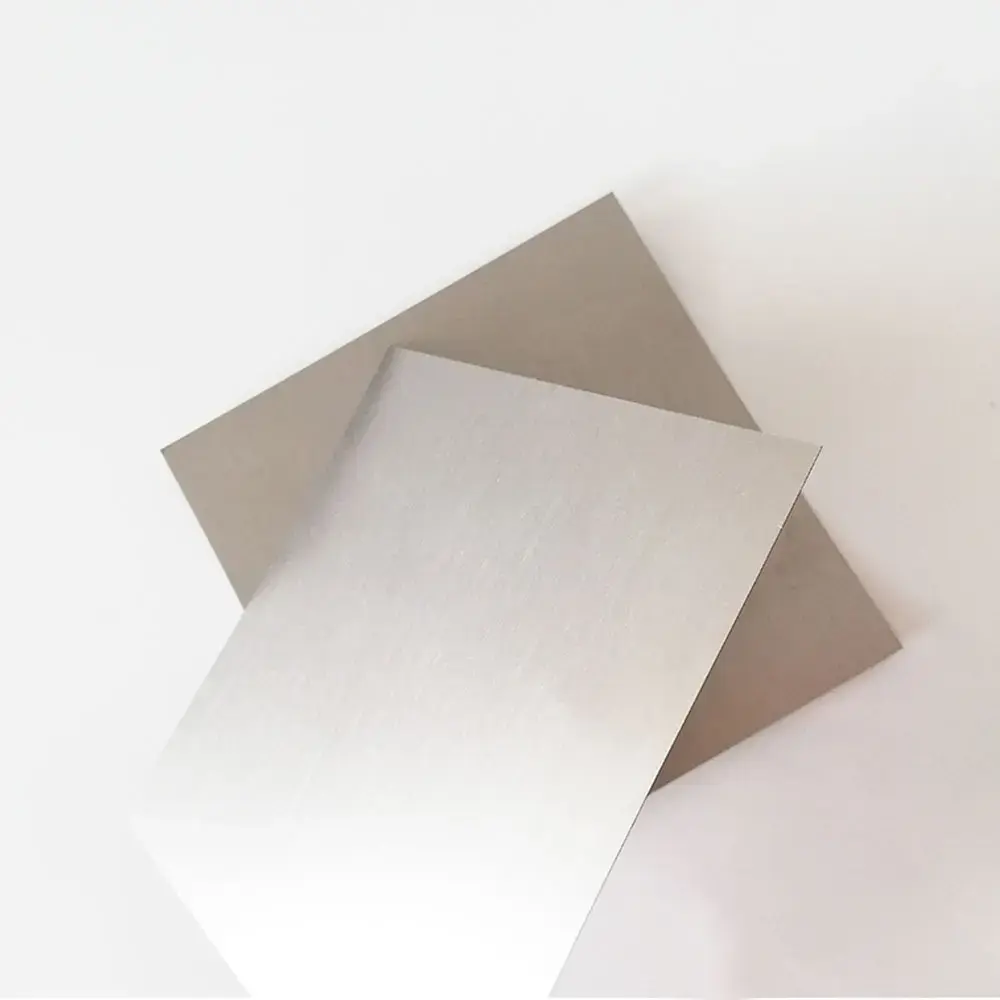
Tungsten metal foil is a thin sheet material with tungsten as the main component. It has a high melting point, good electrical and thermal conductivity, excellent chemical stability, high hardness and low density, and plays an important role in many fields, such as electronics, high-temperature insulation and optics.
Characteristics
Thickness: Tungsten metal foils are usually very thin and can vary in thickness from a few microns to several hundred microns. In electronics applications, for example, it can be as thin as 5 – 10 microns. This thinness allows it to be used in space-critical electronic devices, such as thin film materials in semiconductor devices.
Density: High density of about 19.3 g/cm3. This gives it a unique advantage in terms of mass and space utilisation and makes it useful in devices that need to be miniaturised but require a certain mass.
Melting point: The melting point is extremely high, up to 3410°C. This property allows tungsten metal foil to withstand a wide range of temperatures. This property allows tungsten foils to withstand high temperatures and maintain their structural integrity without melting easily in high-temperature applications, such as insulation for high-temperature furnaces or thermal protection components for aerospace engines.
Thermal conductivity: The thermal conductivity is good at approximately 173 watts per metre Kelvin. This means that it transfers heat efficiently and can be used as an excellent heat transfer material in devices that require heat dissipation or exchange, such as in heat sinks for some high-performance electronic devices.
Coefficient of Thermal Expansion: The coefficient of thermal expansion is relatively low, about 4.5×10-⁶/℃. The dimensional change of tungsten metal foil is small when the temperature changes, and this stability is very critical for some applications that require high dimensional accuracy, such as reflector substrates in precision optical instruments.
Hardness: Tungsten metal foils have a high hardness, reaching about 7.5 on the Mohs hardness scale. This high hardness enables it to maintain shape stability when subjected to certain external forces, and it can be used in applications that require wear and deformation resistance.
Chemical stability: At room temperature, tungsten metal foils are chemically stable and highly resistant to most acids, alkalis and oxidising agents. For example, in general atmospheric environment and many chemical solutions, tungsten foil can keep its own chemical properties unchanged and will not be easily corroded by chemical reaction.
Resistance to oxidation: It has certain resistance to oxidation under high temperature environment. When the temperature rises, a dense tungsten oxide protective film will form on the surface of tungsten metal foil, which can prevent oxygen from reacting with the internal tungsten to a certain extent, thus prolonging its service life under high temperature.
Electrical conductivity: It has good electrical conductivity, with a conductivity of about 18.9 x 10⁶ Siemens per metre. This allows tungsten metal foils to be used in electronics as electrode materials or as components of conductive circuits, e.g. in special tubes or small electronic sensors.
Applications
Electronic and electrical fields:
Substrates for electronic components: Due to its high electrical conductivity, low coefficient of thermal expansion and good chemical stability, tungsten metal foil can be used as a substrate material for electronic components, e.g. in the manufacture of capacitors, vacuum tubes, semiconductor devices etc. In these applications, tungsten foil can provide stable physical support and good electrical connections for electronic components.
Thin-film circuit substrates: In the manufacture of thin-film circuits, tungsten metal foil can be used as a substrate material. Its flat surface and good thermal conductivity help in the production of thin-film circuits, and it can withstand the heat generated during circuit operation to ensure the stability and reliability of the circuits.
Aerospace and Defence:
Manufacture of high-temperature components: The aerospace field requires extremely high temperature-resistant materials, and tungsten foil can be used in the manufacture of high-temperature components such as rocket nozzles, engine combustion chambers, and turbine blades due to its high melting point and good high-temperature strength. These parts work under the harsh environment of high temperature and high pressure, and tungsten foil can maintain the stability and reliability of the structure to ensure the normal operation of the engine and other equipment。
Radiation shielding material: In spacecraft and satellites, tungsten foil can be used as radiation shielding material to protect electronic equipment from cosmic radiation. Cosmic radiation is very harmful to the performance and life of electronic equipment. The high density and good radiation shielding performance of tungsten foil can effectively block the radiation and guarantee the safe operation of electronic equipment.
Medical industry:
Components for medical devices: Tungsten metal foil is biocompatible and corrosion-resistant, and can be used to manufacture components for medical devices, such as X-ray targets in X-ray equipment. In X-ray imaging, tungsten foil acts as a source of X-rays and produces high-quality X-rays that provide accurate information for medical diagnosis. In addition, tungsten foil is used as a radiation shielding component in radiotherapy equipment to protect healthcare workers and patients from radiation damage.
Surgical instruments: Due to its high hardness and good abrasion resistance, tungsten metal foil can be used in the manufacture of surgical instruments, such as scalpels and forceps. These surgical instruments need to withstand large mechanical stresses during surgery, and tungsten foil material can ensure the sharpness and durability of the instruments, improving the efficiency and safety of surgery.
Energy industry:
Nuclear reactor components: In nuclear reactors, tungsten foil can be used to manufacture components such as control rods and fuel rods. The control rods are used to control the rate of the nuclear reaction, while the fuel rods are the carriers of the nuclear fuel. The high temperature resistance, corrosion resistance and good mechanical properties of tungsten metal foil can meet the strict requirements of nuclear reactors and ensure the safe operation of nuclear reactors.
Heat exchanger components: In heat exchangers, tungsten foil can be used as a heat transfer material, making use of its good thermal conductivity to transfer heat from high-temperature fluid to low-temperature fluid and realise the exchange of heat. The high-temperature stability and corrosion resistance of tungsten foil enable it to operate stably for a long time under harsh working environments, improving the efficiency and reliability of heat exchangers.
Automotive Industry:
High-performance engine components: High-performance engines in automobiles require the use of high-temperature-resistant, high-strength materials, and tungsten foil can be used to manufacture key engine components such as valves and pistons. These components need to withstand high temperature, high pressure and high-speed friction during the engine’s working process. Tungsten foil materials can ensure the performance and life of the components, and improve the power and reliability of the engine.
Lightweight material for racing cars: In the manufacture of racing cars, lightweight is the key to improve the performance of racing cars. Tungsten foil, with its high density but thin thickness, can be used to manufacture lightweight parts for racing cars, such as body structure parts and suspension parts. These components can improve the strength and stiffness of racing cars without adding too much weight, reduce the overall weight of racing cars, and improve the speed and handling performance of racing cars.
Optical field:
Mirror Coating: In the manufacture of optical mirrors, tungsten metal foil can be used as a coating material to improve the reflectivity and corrosion resistance of the mirrors. The high reflectivity of tungsten foil enables mirrors to reflect light better, improving the imaging quality of optical systems.
X-ray Optical Components: In X-ray optical systems, tungsten metal foil is used to make optical components such as X-ray windows and gratings. These components need to have good X-ray transmission and corrosion resistance, and tungsten foil can meet these requirements to ensure the normal operation of X-ray optical systems.
Other areas:
Filament materials: In traditional incandescent light bulbs, tungsten is the commonly used filament material. Tungsten metal foil can be processed into filament shapes for use in the manufacture of filaments for incandescent light bulbs. With a high melting point and good heat resistance, tungsten foil filament can work stably for a long time under high temperature and emit bright light.
Decorative and luxury products: Due to its unique metallic luster and texture, tungsten foil can be used to make decorative and luxury products such as watch cases and jewellery of high-grade watches. These products can reflect the high quality and value of tungsten foil and satisfy consumers’ demand for luxury goods.
VI HALBLEITERMATERIAL GmbH (VIMATERIAL) employs a stringent quality assurance system to ensure the reliability of our product quality. Strict quality control is implemented throughout the entire production chain, and for defective products, we strictly enforce the principle of rework and redo. Each batch is released only after passing detailed specification tests.
Every batch of our materials is independently tested, and, if necessary, we send samples to certified companies for testing. We provide these documents and analysis certificates with the shipment to certify that our products meet the required standards.
Contact our team of experts today and let us help you with your business!