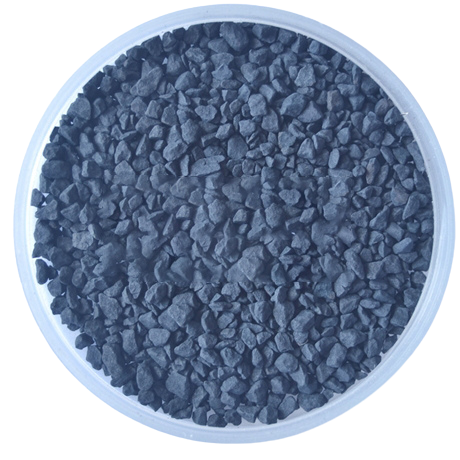
Tellurium Chloride powder is a compound powder containing the elements tellurium and chlorine, usually white or yellowish, chemically more active, in the field of material synthesis, chemical reagents and semiconductors and other applications.
Characteristic
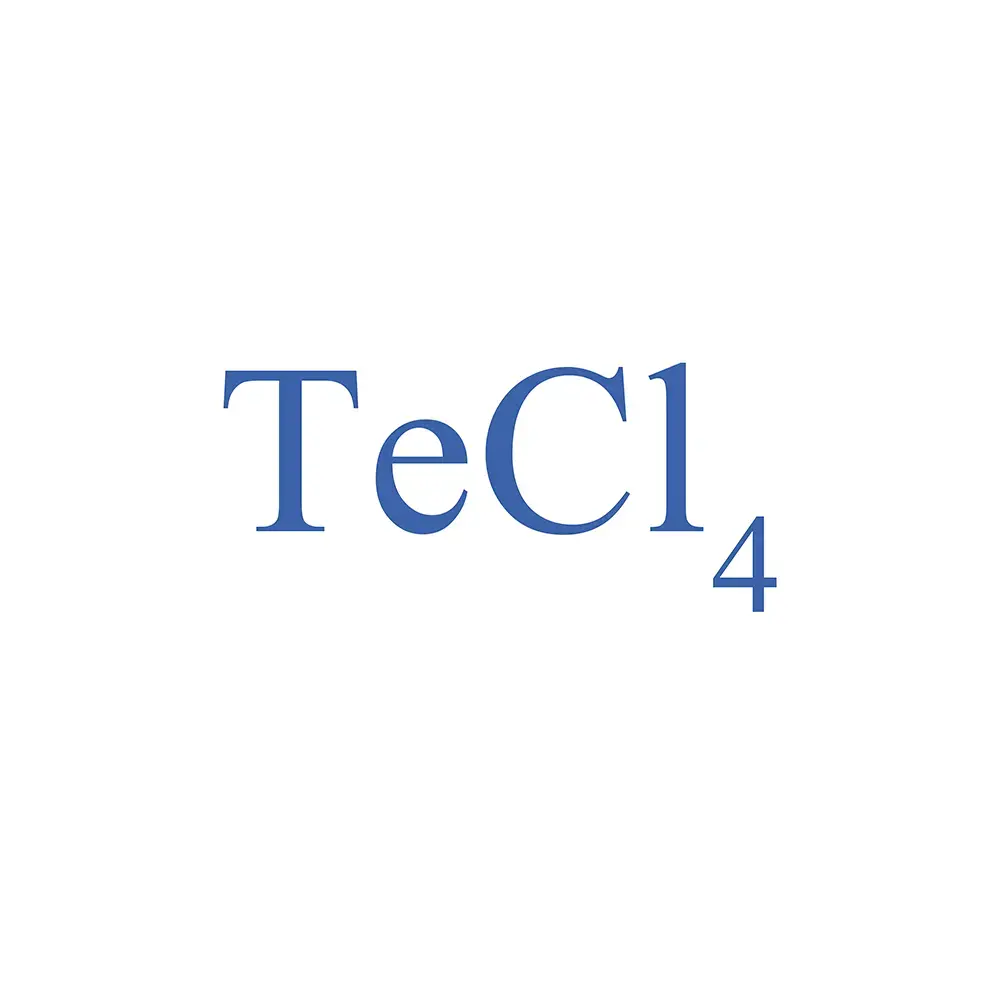
Composition and chemical formula: the main components are tellurium and chlorine, the chemical formula is TeCl₄.
Reactivity: It has strong chemical activity and can hydrolyse with water to produce hydrogen chloride and tellurium dioxide; it can also react with olefin and aromatic hydrocarbon as reagent or catalyst in organic synthesis.
Appearance: usually presents as a light yellow powder.
Molecular weight: 269.412 g/mol
Density: about 3.26 g/cm³.
Melting point: 224°C
Boiling point: 380°C
Solubility: Soluble in water, ethanol and ether.
Crystal structure: monoclinic crystal system.
Applications
Organic synthesis field:
Preparation of organic tellurium compounds: Tellurium Chloride can be reacted with olefins, etc., and used to prepare tellurium-containing organic compounds, such as the synthesis of Cl-C-C-TeCl₃ derivatives. These organic tellurium compounds may have potential applications in the fields of drug synthesis, materials science, etc.
As a catalyst: it plays a catalytic role in some organic synthesis reactions, which can promote the reaction and improve the efficiency and selectivity of the reaction.
Chemical analysis field:
Analytical reagent: it can be used for the detection and determination of certain substances in analytical chemistry. For example, its chemical reaction with specific substances is used to identify or quantitatively analyse other compounds.
Materials Science Field:
Preparation of semiconductor materials: tellurium and its compounds are important materials for semiconductors in the electronics industry. Tellurium chloride powder can be used as a precursor or dopant in the preparation of semiconductor materials and is used to improve the properties of semiconductor materials.
Battery materials: in battery technologies such as lithium-ion batteries, they can be used to prepare specific electrode materials or additives. For example, in the preparation of anode materials for some new types of batteries, tellurium chloride can be involved in the reaction to generate compounds with specific structures and properties, thus improving the performance of the battery.
Other applications:
Colouring agents for ceramics and glass: can provide specific colours for ceramics and glass products, increasing their decorative and artistic values.
Steel additives: added to steel can increase the ductility of steel and improve its performance.
Vulcanising agent for rubber: it can be used as an additive in the vulcanisation process of rubber, participating in the vulcanisation reaction of rubber and improving the properties of rubber such as strength, hardness and abrasion resistance.
VI HALBLEITERMATERIAL GmbH (VIMATERIAL) employs a stringent quality assurance system to ensure the reliability of our product quality. Strict quality control is implemented throughout the entire production chain, and for defective products, we strictly enforce the principle of rework and redo. Each batch is released only after passing detailed specification tests.
Every batch of our materials is independently tested, and, if necessary, we send samples to certified companies for testing. We provide these documents and analysis certificates with the shipment to certify that our products meet the required standards.
Contact our team of experts today and let us help you with your business!