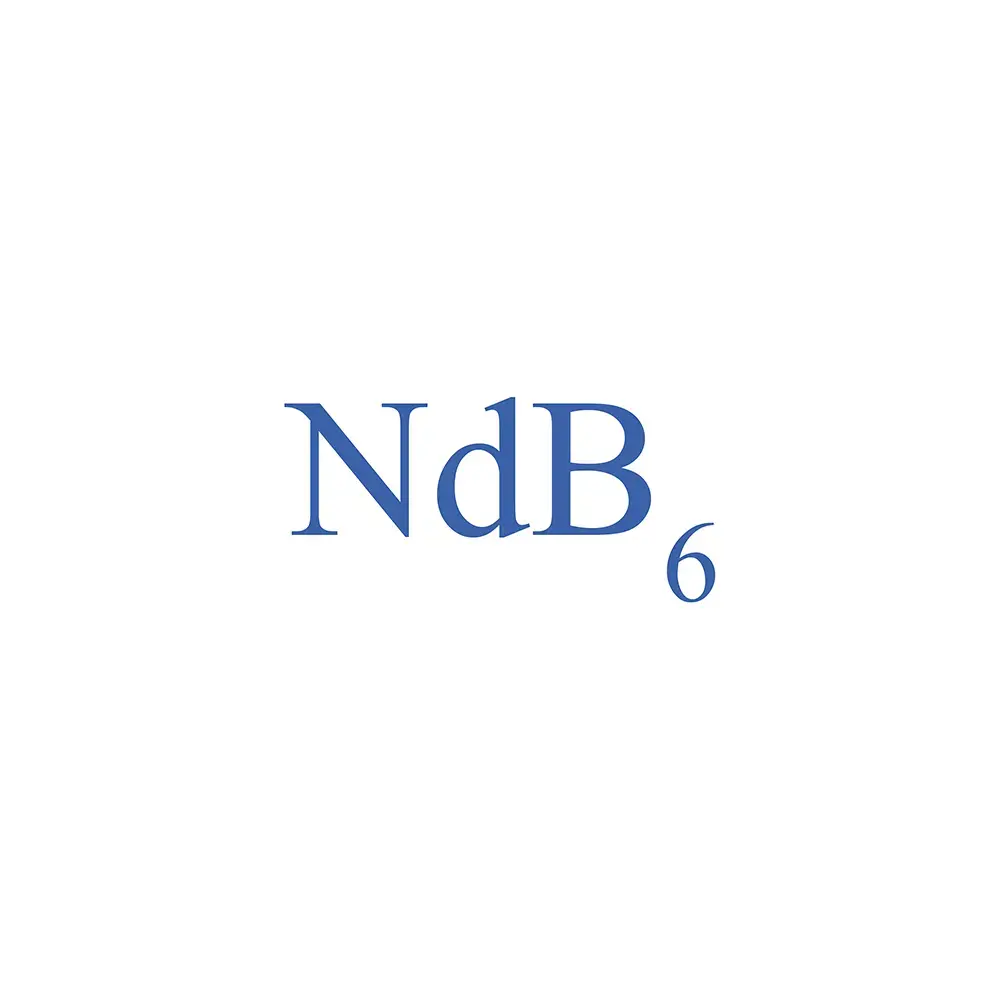
Chemical Composition: Neodymium Boride is a compound made of neodymium (Nd) and boron (B), often formulated as NdB₆. It is a rare-earth metal boride.
High Hardness: Like many borides, Neodymium Boride has exceptional hardness, making it resistant to wear and abrasion.
High Melting Point: It has a high melting point, typically over 2,500°C, which allows it to maintain structural integrity at elevated temperatures.
Electrical Conductivity: NdB₆ is a good conductor of electricity due to its metallic bonding, which makes it useful in applications where electrical conductivity and thermal stability are essential.
Thermal Stability: It demonstrates excellent thermal stability, especially in high-temperature environments, and it resists oxidation and degradation over time.
Magnetic Properties: Neodymium is known for its strong magnetic properties, and in compound form with boron, it retains some of those characteristics, though it’s not as strong as Nd₂Fe₁₄B, which is used in permanent magnets.
Corrosion Resistance: Like other rare-earth borides, it shows good resistance to corrosion, particularly at high temperatures and in harsh environments.
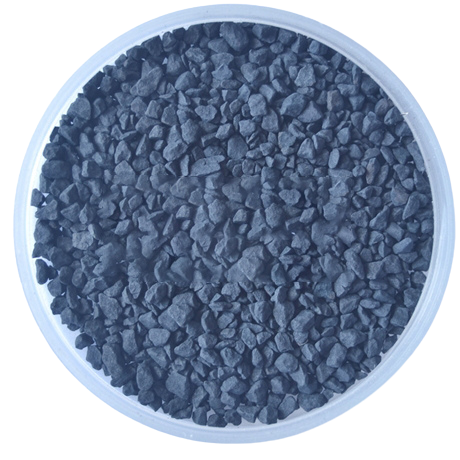
Abrasives and Cutting Tools: Due to its high hardness and wear resistance, NdB₆ powder can be used in abrasive applications and cutting tools where durability is critical.
High-Temperature Materials: The thermal stability of neodymium boride makes it suitable for use in high-temperature environments, such as furnace components and aerospace parts that operate under extreme heat.
Thermoelectric Materials: Due to its electrical conductivity and thermal properties, NdB₆ can be used in thermoelectric applications, where materials must convert temperature differences into electrical energy efficiently.
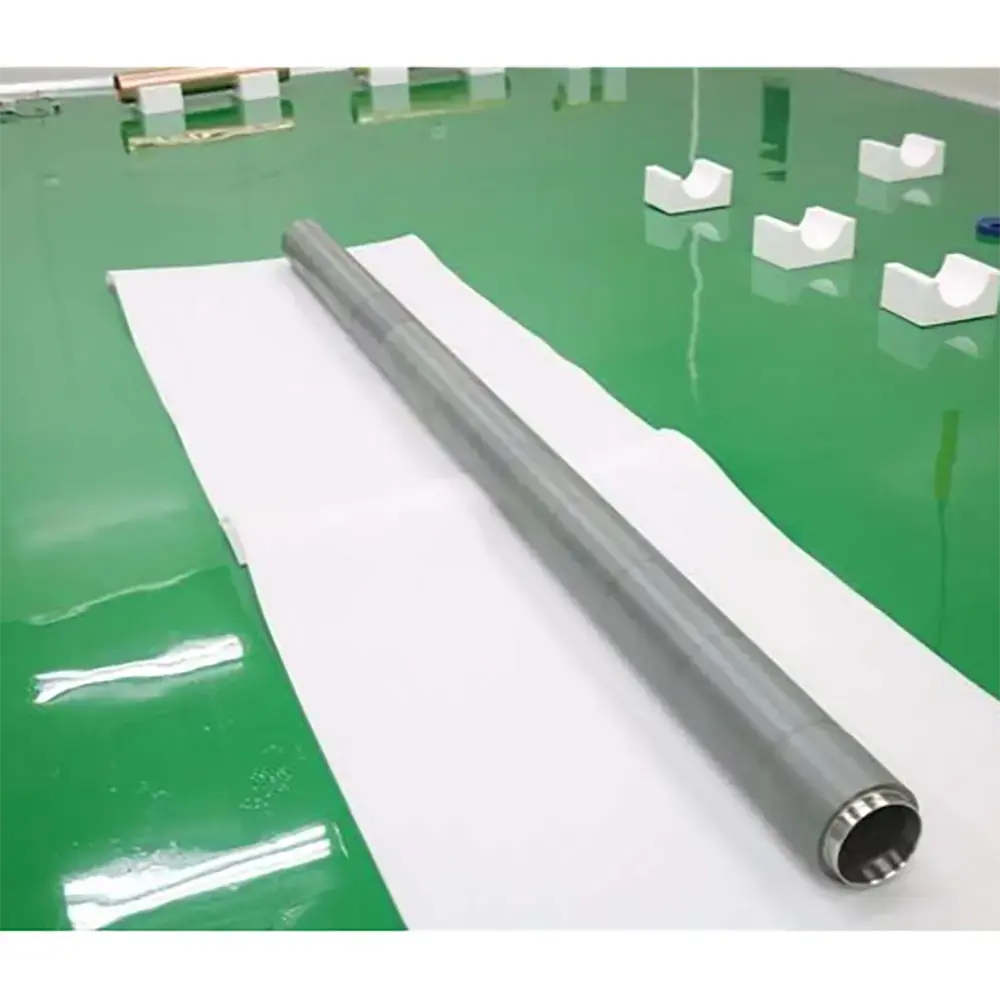
Coatings: NdB₆ powder is sometimes used in coatings to impart hardness, corrosion resistance, and thermal stability to surfaces exposed to harsh environments, such as gas turbines or other high-stress industrial components.
Nuclear Applications: Neodymium boride, like other borides, could be used in nuclear reactors as a material that can withstand radiation and high temperatures.
Magnetic Materials: Although less common than Neodymium-Iron-Boron (NdFeB) magnets, NdB₆ may be used in specialized magnetic applications where the magnetic field requirements are lower, but thermal stability is crucial.
VI HALBLEITERMATERIAL GmbH (VIMATERIAL) employs a stringent quality assurance system to ensure the reliability of our product quality. Strict quality control is implemented throughout the entire production chain, and for defective products, we strictly enforce the principle of rework and redo. Each batch is released only after passing detailed specification tests.
Every batch of our materials is independently tested, and, if necessary, we send samples to certified companies for testing. We provide these documents and analysis certificates with the shipment to certify that our products meet the required standards.
Contact our team of experts today and let us help you with your business!