


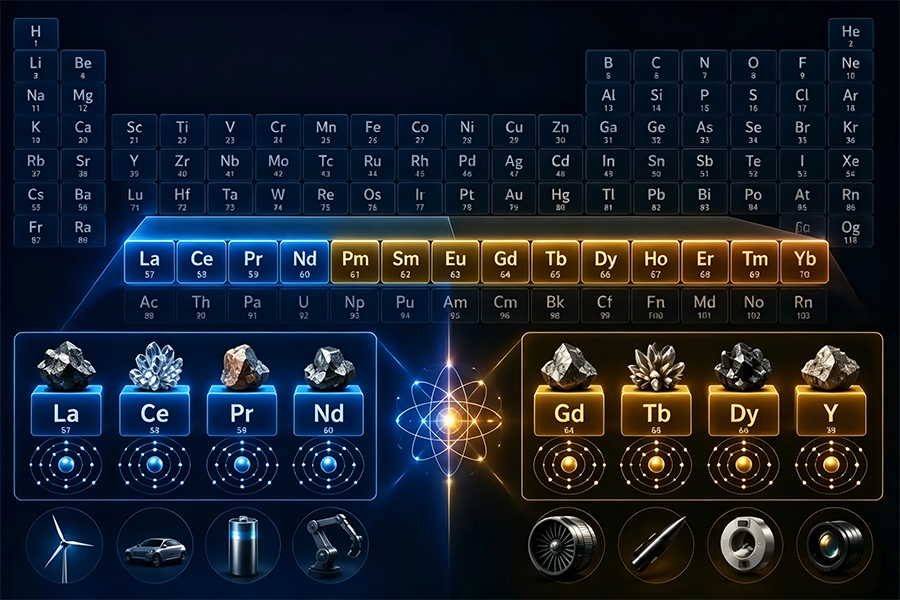
When people hear the term rare earths, words like “scarcity,” “strategic resources,” and “industrial vitamins” often come to mind. In reality, rare earths are not a single element but a group of 17 chemical elements. These elements are generally divided into two categories: Light Rare Earth Elements (LREEs) and Heavy Rare Earth Elements (HREEs). The ongoing discussion of Light Rare Earths vs. Heavy Rare Earths highlights their distinct characteristics.
The differences between the two are significant. They vary greatly in terms of resource availability, applications, extraction difficulty, and market value. Understanding the distinction between heavy and light rare earths is essential for understanding the global rare earth industry.
1. What Are Light and Heavy Rare Earths?
Light Rare Earth Elements (LREEs)
LREEs include: Lanthanum (La), Cerium (Ce), Praseodymium (Pr), Neodymium (Nd), Promethium (Pm), Samarium (Sm), Europium (Eu)
Key characteristics:
- Relatively low atomic numbers
- Higher chemical reactivity
- More prone to oxidation when exposed to air
- Widely distributed in nature
- Comparatively abundant reserves
Heavy Rare Earth Elements (HREEs)
HREEs include: Gadolinium (Gd), Terbium (Tb), Dysprosium (Dy), Holmium (Ho), Erbium (Er), Thulium (Tm), Ytterbium (Yb), Lutetium (Lu), Scandium (Sc), Yttrium (Y)
Key characteristics:
- Higher atomic numbers
- More stable chemical properties
- Much lower natural abundance
- More difficult and costly to extract and separate
- Significantly higher market value
A simple way to understand the difference is that global reserves of light rare earths are several times larger than those of heavy rare earths, while annual production of certain heavy rare earth elements is only a fraction of that of light rare earths.
2. Differences in Physical and Chemical Properties
Electronic Structure
Light Rare Earths:
- The 4f electron shell is only partially filled.
- Outer electron configurations are relatively similar.
Heavy Rare Earths:
- The 4f electron shell is closer to being fully occupied.
- This gives many heavy rare earths superior magnetic properties.
Ionic Radius
As atomic number increases, the ionic radius of rare earth elements gradually decreases—a phenomenon known as the lanthanide contraction. Consequently, heavy rare earth ions are generally smaller than light rare earth ions.
Comparison of Key Characteristics
| Property | Light Rare Earths | Heavy Rare Earths |
|---|---|---|
| Atomic Number | Lower (57–64) | Higher (65–71) |
| Resource Availability | Relatively abundant | Highly scarce |
| Chemical Reactivity | High | Slightly lower but still reactive |
| Magnetic Performance | Moderate | Excellent |
| Extraction Difficulty | Relatively mature and economical | More complex and costly |
Resource Distribution and Mining
LREEs
- Larger global reserves
- Major deposits include the Bayan Obo deposit in China and the Mountain Pass mine in the United States
- Well-established extraction technologies
HREEs
- Account for only a small portion of total rare earth resources
- Primarily found in ion-adsorption clay deposits, especially in southern China
- More difficult and expensive to extract and separate

3. Applications: Foundation Materials vs. Strategic High-Tech Resources
Although there is some overlap in applications, light and heavy rare earths play distinctly different roles in modern industry.
Light Rare Earths: The Foundation of Modern Manufacturing
Neodymium (Nd) and Praseodymium (Pr)
- Essential for NdFeB permanent magnets
- Widely used in electric vehicle motors, wind turbines, and industrial motors
- Used in glass polishing powders
- Important component in automotive catalytic converters
- Applied in battery electrode materials
- Used in specialty optical glass
Heavy Rare Earths: Critical Materials for Advanced Technologies
Dysprosium (Dy) and Terbium (Tb)
- Added to NdFeB magnets to improve performance and thermal stability at high temperatures
- Essential for electric vehicles, aerospace systems, and defense applications
- Used in laser materials and superconducting alloys
- Critical for precision optics and nuclear technologies
- A key component in phosphor materials
- Widely used in display panels and lighting technologies
In simple terms, light rare earths dominate in terms of volume and broad industrial use, while heavy rare earths are used in smaller quantities but are indispensable for high-performance and strategically important technologies.
4. Scarcity and Strategic Importance
Because of their irreplaceable role in advanced manufacturing, defense systems, and high-tech applications, heavy rare earths are often regarded as “strategic resources within strategic resources.”
Light rare earths are also strategically important, but their broader geographic distribution and more diversified supply chains generally result in lower scarcity premiums.
Light vs. Heavy Rare Earths: A Quick Comparison
| Dimension | Light Rare Earths (LREEs) | Heavy Rare Earths (HREEs) |
|---|---|---|
| Reserves | Relatively abundant | Comparatively scarce |
| Separation Difficulty | Lower; easier to separate and refine | Higher; more complex and costly to separate |
| Price Trend | Fluctuates with market demand and industry cycles | Generally supported by scarcity premiums and strategic demand |
| Representative Elements | Lanthanum (La), Cerium (Ce), Praseodymium (Pr), Neodymium (Nd) | Dysprosium (Dy), Terbium (Tb), Yttrium (Y), Ytterbium (Yb) |
| Main Applications | Permanent magnets, catalysts, hydrogen storage materials, polishing powders | High-performance magnets, lasers, optical communication, advanced electronics |
| Strategic Importance | High | Very High |
| Resource Distribution | More widely distributed globally | More concentrated and limited deposits |
| Market Supply Risk | Moderate | High due to limited supply sources |
| Key Growth Drivers | Electric vehicles, catalysts, energy storage | EV motors, robotics, aerospace, defense, laser technologies |
| Industrial Role | Foundation of large-scale rare earth applications | Critical materials for high-end and strategic technologies |

5. Future Trends: How Will Supply and Demand Evolve?
Several key trends are expected to shape the future of the rare earth industry.
Growing Demand for Light Rare Earths
The continued expansion of electric vehicles and renewable energy systems is expected to drive demand for neodymium and praseodymium. However, improvements in recycling technologies may help moderate long-term price growth.
Tight Supply of Heavy Rare Earths
Demand from advanced manufacturing, defense, aerospace, and precision electronics continues to increase. Meanwhile, mining quotas, environmental regulations, and limited resource availability constrain supply growth, suggesting that the market for heavy rare earths is likely to remain tightly balanced in the coming years.
Recycling as a New Source of Supply
Technological advances are making it increasingly feasible to recover rare earth elements from end-of-life magnets, electronic waste, and industrial scrap. Recycled rare earths could become an important source of future supply.
Sustainable and Green Mining
The industry is also moving toward more environmentally responsible extraction methods. New leaching and separation technologies are helping reduce the environmental footprint of rare earth production and supporting the transition toward a more sustainable supply chain.
Conclusion
Although they are collectively known as rare earths, light and heavy rare earth elements occupy very different positions within the global economy. Light rare earths provide the foundation for large-scale industrial applications, while heavy rare earths underpin many of the world’s most advanced technologies.
As the global transition toward electrification, renewable energy, and high-tech manufacturing accelerates, understanding the distinction between light and heavy rare earths will become increasingly important for investors, policymakers, and industry participants alike.
FAQs
Q1: What are the different types of rare earth elements?
A: Rare earth elements are generally divided into two groups: Light Rare Earth Elements (LREEs) and Heavy Rare Earth Elements (HREEs). Light rare earths include elements such as lanthanum, cerium, neodymium, and praseodymium, while heavy rare earths include dysprosium, terbium, yttrium, and gadolinium.
Q2: What is a heavy rare earth element?
A: A heavy rare earth element (HREE) is a rare earth element with a higher atomic number and greater scarcity. Heavy rare earths are more difficult to extract and are widely used in high-tech applications such as electric vehicles, wind turbines, aerospace equipment, and advanced electronics.
Q3: Which countries have heavy rare earth elements?
A: HREEs resources are found in several countries, including China, Myanmar, Australia, the United States, Canada, Brazil, and Vietnam. Among them, China has the largest production and processing capacity.
Q4: Are rare earth elements and rare earth metals the same?
A: Not exactly. Rare earth elements refer to the 17 elements in the rare earth group, while rare earth metals are the metallic forms produced after these elements are extracted and refined. The terms are often used interchangeably, but they have different technical meanings.