

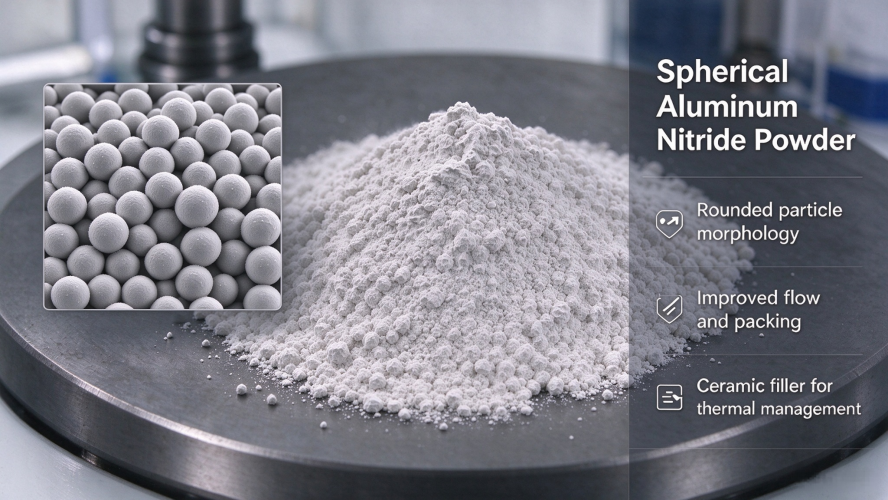
Spherical aluminum nitride (AlN) powder is a ceramic filler used in applications that require thermal conductivity, electrical insulation and controlled powder-processing behaviour. Its rounded particle morphology makes it particularly relevant to polymer-based thermal management materials, electronic encapsulation compounds and selected advanced ceramic processes.
Compared with conventional irregular AlN powder, spherical AlN can offer advantages in powder flow, particle packing and formulation flexibility. These benefits depend on particle-size distribution, surface condition, filler loading and the properties of the surrounding material.
For material engineers and purchasing teams, selecting spherical AlN powder involves more than comparing purity values. Particle size, morphology, moisture resistance, surface treatment and batch consistency should all be considered in relation to the intended application.
What Is Spherical Aluminum Nitride Powder?
Spherical aluminum nitride powder is aluminum nitride ceramic powder with a rounded or approximately spherical particle morphology.
AlN is valued for its ability to conduct heat while maintaining electrical insulation. In powder form, it can be used as a raw material for ceramic processing or as a functional filler in polymer-based composites.
Spherical AlN is particularly relevant when powder flow, packing behaviour and high filler loading are important. It can be considered for thermal gels, thermal interface materials (TIMs), encapsulants, thermally conductive plastics and other electronic thermal management applications.
The term spherical describes particle morphology, not a specific purity grade or particle-size range. Two spherical AlN powders may differ considerably in particle size, size distribution, surface chemistry and processing behaviour.
For this reason, a complete specification should describe more than the powder’s shape alone.
Key Properties of Spherical AlN Powder
Thermal conductivity
Aluminum nitride is a thermally conductive ceramic. When incorporated into a suitable polymer or composite, AlN particles can help establish heat-transfer paths through the material.
The thermal conductivity of the final composite depends on more than the intrinsic properties of AlN. Filler content, particle contacts, dispersion, interfacial resistance, porosity and matrix properties all influence the result.
Spherical AlN is therefore best evaluated as part of the intended formulation rather than by assuming that the powder morphology alone determines the final thermal performance.
Electrical insulation
AlN is a ceramic material used where heat transfer and electrical insulation are both required. This combination makes it relevant to electronic packaging and thermal management components.
However, the electrical performance of a finished composite depends on its complete formulation and manufacturing quality. Dielectric strength and other electrical requirements should be verified on the finished material.
Powder flowability
Rounded particles can reduce mechanical interlocking compared with angular particles of similar size. Depending on the powder characteristics, this may improve flow during handling, mixing and processing.
Flowability is also affected by particle-size distribution, surface condition, agglomeration and moisture exposure. Spherical morphology alone does not guarantee a particular flow rate.
Packing behaviour
A suitable distribution of spherical particle sizes can support efficient packing in a composite or compound. Better packing may help manufacturers develop formulations with higher filler loading or fewer unfilled spaces.
The effect depends on the size distribution, the ratio between different particle sizes and the characteristics of the matrix. Packing density and thermal conductivity should therefore be assessed separately.
Surface condition and moisture resistance
AlN powder can react with moisture, and its surface chemistry may change during exposure to water or humid conditions. Surface modification can be used to improve moisture resistance or compatibility with a particular processing system.
The performance of a treated powder depends on the treatment chemistry and storage conditions. A claim of improved water resistance should be supported by an appropriate specification or test rather than inferred from the presence of a surface treatment alone.
Spherical AlN Powder Particle Sizes
Particle size is one of the main factors to consider when selecting spherical AlN powder.
Fine particles, medium-size particles and coarse spherical particles can behave differently during mixing, packing and processing. The appropriate range depends on the final product, required layer thickness and manufacturing method.
| Particle-Size Range | Potential Application Considerations |
|---|---|
| Fine Spherical AlN | Formulations requiring smaller particles, finer features or a more detailed particle-size distribution. |
| Medium-Size Spherical AlN | Thermal gels, encapsulants and other polymer-based thermal management compounds. |
| Coarse Spherical AlN | Formulations where particle packing and higher filler loading are important, subject to layer thickness and processing limits. |
| Blended Particle Sizes | Systems designed to balance packing, flow and particle contact. |
These are general selection considerations rather than universal particle-size standards. The actual suitability of a grade should be confirmed through formulation testing.
D50 and particle-size distribution
D50 is the median particle diameter under the specified particle-size measurement basis. Approximately 50% of the measured particle population falls below this diameter.
D50 is useful for comparing powder grades, but it does not describe the complete particle-size distribution.
D90 indicates the diameter below which approximately 90% of the measured particle population falls. It provides additional information about the coarser part of the distribution.
When comparing spherical AlN powders, consider:
- D50 and D90.
- The overall particle-size distribution.
- The presence of agglomerates.
- Whether the powder fits the intended processing equipment and layer thickness.
- The consistency of measurement methods between batches or suppliers.
A powder with the correct D50 may still behave differently if its distribution is wider or if it contains agglomerates.
Representative Spherical Aluminum Nitride Powder Specifications
The following specifications are representative spherical AlN powder grades listed in the supplied VIMATERIAL material information.
| Material | Purity | Representative D50 |
|---|---|---|
| Spherical Aluminum Nitride Powder | 99% | 30–40 μm |
| Spherical Aluminum Nitride Powder | 99% | 45–55 μm |
| Spherical Aluminum Nitride Powder | 99% | 70–80 μm |
| Spherical Aluminum Nitride Powder | 99% | 90–105 μm |
These examples illustrate available specification ranges in the supplied material information. They should not be interpreted as confirmation of current stock or as a complete specification for every grade.
Other AlN powder grades may have different purity levels and particle-size ranges. For spherical powder, the quotation or technical specification should confirm the required particle-size distribution, morphology and surface condition.
What does purity mean when buying spherical AlN?
A nominal purity value is useful for initial comparison, but it does not necessarily describe every impurity or surface-related characteristic.
For demanding applications, confirm how purity is defined and whether the specification includes individual metallic impurities, oxygen content or other relevant limits.
The importance of each parameter depends on whether the powder will be used in a polymer composite, a ceramic process or another application.
Surface Treatment and Hydrolysis Resistance
Surface treatment is an important consideration when spherical AlN powder is used in moisture-sensitive or polymer-based systems.
AlN can undergo hydrolysis when exposed to water. Published studies have investigated surface treatments designed to reduce this reaction and improve the processing behaviour of AlN powders. The results depend on the treatment chemistry and the conditions under which the powder is used.
Surface treatment may be intended to improve one or more of the following:
- Resistance to moisture-related surface changes.
- Dispersion in a selected matrix.
- Compatibility with a polymer or resin.
- Processing stability during mixing or formulation.
A treatment suitable for one matrix may not be suitable for another. For example, the surface chemistry required for a polymer-based thermal compound may differ from that needed for ceramic processing.
When selecting surface-treated spherical AlN, confirm the treatment type where available, the intended application, moisture-control requirements and compatibility with the target formulation.
Applications of Spherical Aluminum Nitride Powder
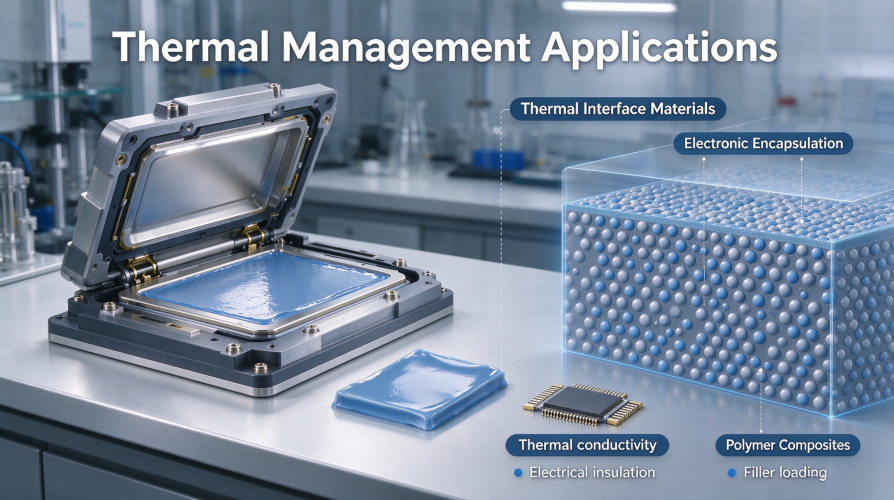
Thermal interface materials
Spherical AlN can be considered as a filler for thermal gels, greases, pads and other thermal interface materials.
In these formulations, particle morphology and particle-size distribution may influence packing, flow and filler loading. The objective is to improve heat transfer while retaining the viscosity, flexibility or compressibility required by the product.
The appropriate powder grade depends on the formulation and manufacturing process. The thermal conductivity of the finished TIM must be measured separately from the powder specification.
Electronic encapsulation
Electronic encapsulants protect components and may also need to dissipate heat. AlN filler can contribute thermal conductivity while maintaining the ceramic character needed for electrically insulating formulations.
Spherical particles may be useful where flow, packing and high filler loading are important. The final compound must also meet the requirements for curing, adhesion, dielectric performance and long-term reliability.
Thermally conductive plastics and polymer composites
AlN powder can be incorporated into selected polymer systems to improve thermal performance.
Spherical morphology may help with powder handling and packing, while the particle-size distribution influences how the filler is accommodated within the matrix. The formulation must balance thermal conductivity with processability and the mechanical properties of the finished composite.
Advanced ceramic processing
AlN powder is also used as a starting material for ceramic manufacturing. However, spherical filler grades developed for polymer composites should not automatically be assumed suitable for every ceramic process.
Ceramic applications may require different particle sizes, surface conditions, impurity limits and sintering behaviour. Buyers should specify the intended process, such as forming, granulation or sintering, when requesting a powder grade.
How to Select the Right Spherical AlN Powder?
A practical selection process begins with the intended application rather than a single powder property.
| Selection Factor | What to Confirm |
|---|---|
| Application | Thermal gel, pad, encapsulant, polymer composite or ceramic processing. |
| Purity | Required nominal purity and any specific impurity limits. |
| Particle Size | D50, D90 and the acceptable size range. |
| Morphology | Required degree of sphericity or other morphology criteria. |
| Surface Treatment | Treated or untreated powder and compatibility with the intended matrix. |
| Moisture Control | Packaging, storage and handling requirements. |
| Processing Behaviour | Flow, dispersion, mixing, forming or dispensing requirements. |
| Quality Documentation | Test methods, batch data and certificate of analysis where required. |
For a new formulation, it may be useful to evaluate a small number of grades with different particle-size ranges. This allows the manufacturer to compare the powder’s effect on processing and finished-product performance before finalising the specification.
Quality Control Considerations
Spherical AlN powder should be evaluated using parameters relevant to its intended application.
Chemical composition and purity
Confirm the specified purity and any application-specific impurity limits. Where necessary, request information on oxygen content or individual metallic impurities.
Particle size and distribution
Check D50, D90 and the measurement method. A consistent measurement basis is important when comparing batches or suppliers.
Particle morphology
Microscopy can be used to assess particle shape, morphology and the presence of irregular particles or agglomerates. If sphericity is critical, define the required acceptance criteria rather than relying on a general description such as “spherical.”
Surface condition
Confirm whether the powder is surface-treated and whether the treatment is compatible with the intended process. Moisture sensitivity and storage requirements should also be addressed.
Batch consistency
For repeat production, compare the agreed specifications between batches. The relevant checks may include purity, particle-size distribution, morphology and other application-specific parameters.
Not every application requires the same testing programme. The acceptance criteria should be proportionate to the performance requirements of the final product.
Storage and Handling
AlN powder should be stored in accordance with its technical documentation and safety information.
Because AlN can be sensitive to moisture, keep the powder in suitable sealed packaging and minimise unnecessary exposure to humid air or water. Follow the supplier’s specified storage conditions, handling precautions and packaging instructions.
For surface-treated grades, avoid assuming that the treatment eliminates moisture sensitivity under all conditions. Confirm the storage recommendations for the specific product.
Fine powders should be handled using appropriate workplace controls based on the applicable safety documentation.
Frequently Asked Questions
1. What is spherical aluminum nitride powder used for?
Spherical AlN powder is used as a ceramic filler in thermal management materials, electronic encapsulants and selected polymer composites. It may also be used in applications where controlled powder morphology and packing behaviour are important.
2. What is the advantage of spherical AlN over irregular AlN powder?
Spherical particles can offer improved flow and packing behaviour in suitable systems. The practical benefit depends on particle-size distribution, surface condition, filler loading and the processing method.
3. Which particle size should I choose?
The appropriate size depends on the final application, layer thickness, matrix and manufacturing process. D50 should be considered together with D90 and the overall particle-size distribution.
4. Is spherical AlN powder available in different purity grades?
The required purity depends on the application and the supplier’s available specifications. VIMATERIAL’s supplied material information lists spherical AlN grades at 99% purity in several D50 ranges. Confirm current availability and the complete specification when requesting a quotation.
5. Does surface-treated AlN powder resist moisture completely?
No powder should be assumed to be completely resistant to moisture under all conditions. Surface treatment can improve hydrolysis resistance, but performance depends on the treatment and exposure conditions.
6. Can spherical AlN powder guarantee a specific thermal conductivity in a TIM?
No. The powder is only one component of the formulation. The thermal conductivity of the finished TIM depends on filler loading, particle contacts, matrix properties, dispersion, interfaces, voids and the measurement method.
Conclusion
Spherical aluminum nitride powder is a useful material option for applications that combine thermal management with electrical insulation. Its rounded particle morphology can support flow and packing in suitable formulations, while particle size and surface treatment influence processing and compatibility.
The right grade should be selected according to purity, D50, D90, morphology, surface condition and the requirements of the final application. Evaluating these factors together provides a more reliable basis for material selection than choosing a powder based on a single specification.
References
- [1] Ohashi, M., Lee, Y.-S., Nagae, H., Suzuki, K., & Sugiyama, T. (2005). “Spherical Aluminum Nitride Fillers for Heat-Conducting Plastic Packages.” Journal of the American Ceramic Society. https://doi.org/10.1111/j.1551-2916.2005.00456.x
- [2] Xie, Z., et al. (2013). “Hydrolysis Control of AlN Powders for the Aqueous Processing of Spherical AlN Granules.” Journal of the American Ceramic Society. https://doi.org/10.1111/jace.12288
- [3] “Surface Chemistry and Hydrolysis of a Hydrophobic-Treated Aluminium Nitride Powder.” (2005). Ceramics International, 31(3), 469–474. https://doi.org/10.1016/j.ceramint.2004.06.012
- [4] Oliveira, M., Olhero, S., Rocha, J., & Ferreira, J. M. F. (2003). “Controlling Hydrolysis and Dispersion of AlN Powders in Aqueous Media.” Journal of Colloid and Interface Science, 261(2), 456–463. https://doi.org/10.1016/j.jcis.2003.06.001
- [5] “Enhanced Thermal Conductivity of Polymer Composites via Hybrid Fillers of Anisotropic Aluminum Nitride Whiskers and Isotropic Spheres.” (2017). Composites Part B: Engineering, 114, 237–246. https://doi.org/10.1016/j.compositesb.2017.02.008
Further Reading
- Aluminum Nitride (AlN) — The “Heat-Dissipating, Electrically Insulating All-Rounder” of the Electronics Industry
- How to Make Aluminium Nitride Powder?
- Aluminum Nitride Powder: Purity, Particle Size and Quality Control
- Advanced Silicon Nitride (Si3N4): Performance, Applications, and Prospects
- AlON Powder: Properties, Synthesis Methods and Applications
Need Spherical Aluminum Nitride Powder for Your Application?
VIMATERIAL offers spherical AlN powder with representative D50 ranges of 30–40 μm, 45–55 μm, 70–80 μm and 90–105 μm at a listed purity of 99%, subject to confirmation of current availability and specification.
Contact our team to discuss your required particle size, application, surface-treatment needs, quantity and documentation requirements.