


For centuries, humanity has pursued the discovery and utilization of new materials to meet ever-growing industrial demands. Some materials, however, are exceptionally rare and difficult to obtain, which makes them particularly valuable. Gallium and germanium are two classic examples.
I. What Are Gallium and Germanium?
Gallium was discovered in 1875 by the French chemist Paul-Émile Lecoq de Boisbaudran. Interestingly, as early as 1871, Dmitri Mendeleev had already noticed a gap beneath aluminum in the periodic table. He predicted the atomic weight and density of this unknown element and named it “eka-aluminum.” Gallium thus became the first element in history to be predicted before it was experimentally confirmed.
Gallium is a grayish-blue or silvery-white metal with the chemical symbol Gallium. It has a very low melting point but an extremely high boiling point. How low? It can melt in the palm of your hand. Its melting point is below 30 °C, while its boiling point reaches as high as 2403 °C. This unusual combination makes gallium an ideal material for high-temperature thermometers and thermal sensing devices.

Germanium is a gray-white metalloid with the chemical symbol Ge. It belongs to the same group in the periodic table as carbon, silicon, tin, and lead, and is a relatively stable element. Mendeleev also predicted its existence, calling it “eka-silicon.” In 1886, the German chemist Clemens Winkler discovered it in the mineral argyrodite and named it germanium in honor of Germany, where it was found.
Scientists later discovered that germanium possesses unique electrical properties. It crystallizes in a face-centered cubic structure and exhibits relatively weak metallic character, yet outstanding electronic performance. Its electrical conductivity is higher than that of non-metals but lower than that of typical metals—this distinctive behavior is what we now recognize as that of a semiconductor.
Although gallium and germanium differ in their physical forms and specific properties, both are key materials that were successfully predicted based on periodic table principles. They are scarce in nature, exhibit typical semiconductor characteristics, and, due to their excellent electronic properties, occupy an irreplaceable position in modern electronics and optoelectronic industries.
Is Germanium a Metal?
Germanium is classified as a metalloid (or semi-metal). While its crystal structure resembles that of metals, its chemical properties are closer to those of non-metals. Therefore, germanium is neither a pure metal nor a non-metal, but an element that exhibits characteristics of both.
In summary, germanium is a widely used metalloid material in the semiconductor and electronics industries. With the rapid development of large-scale integrated circuits and 5G technology, germanium-based materials are expected to play an even more important role in the future of the electronics sector.
II. What Are Gallium and Germanium Used For? Are They Effective?
In the scientific community, Gallium is often referred to as the “new grain of the semiconductor industry” due to its enormous potential in superconductivity, semiconductors, optoelectronics, and magnetism. Gallium can conduct electricity at room temperature, has excellent magnetic permeability, and exhibits very high saturation magnetization. These properties make it an ideal material for high-performance batteries, magnetic materials, and high-speed computer chips.
Gallium is also widely used in optoelectronics, including high-definition displays, LED lighting, and photoelectric sensors. More importantly, gallium shows great promise in solar cell applications. Its semiconductor properties enable more efficient conversion of solar energy into electricity, injecting new momentum into the renewable energy industry.
Germanium is an essential semiconductor material and plays a critical role in the manufacturing of electronic and optoelectronic devices. Its excellent electrical conductivity and optical properties make it widely applicable in semiconductor device fabrication.
Germanium is also used for optical fiber doping and optoelectronic conversion, increasing the refractive index of fibers and reducing signal transmission losses, thereby contributing significantly to the advancement of the telecommunications industry.
Germanium crystals are transparent to infrared light while opaque to visible and ultraviolet light. As a result, they are commonly used to manufacture infrared-transmitting germanium windows, prisms, and lenses. These components are widely applied in military thermal imaging systems, astronomical observation, and industrial inspection.
In solar cells—particularly gallium arsenide (GaAs) solar cells—germanium is often used as a substrate to extend service life and enhance performance. In addition, germanium is used in silicon-based thin-film solar cells in the form of silicon-germanium alloys to help reduce costs.
Germanium also finds applications in medical equipment, such as X-ray detectors and magnetic resonance imaging (MRI) systems. Its unique properties allow for precise detection of radiation, providing reliable support for medical diagnostics and treatment.
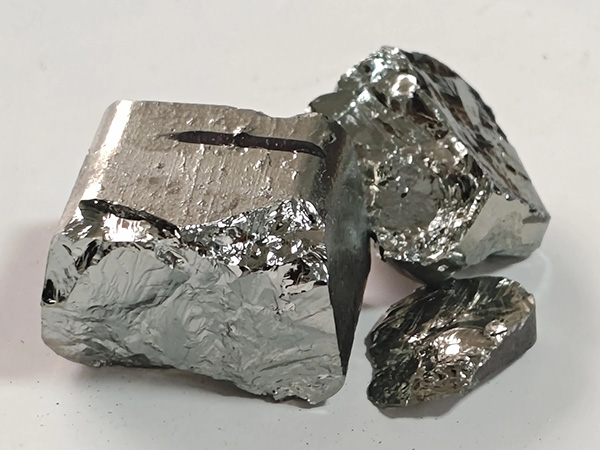
Gallium and Germanium are becoming increasingly important in modern technology. Whether in semiconductors, fiber-optic communications, or solar panels, both elements occupy irreplaceable positions.
III. Where to buy Gallium and Germanium?
Gallium and Germanium can typically be sourced through the following channels:
- Professional metal material suppliers / rare-metal traders: Offering high-purity gallium and germanium metals, alloys, and customized specifications.
- Semicnductor and optoelectronic material companies: Suitable for wafer-grade or electronic-grade gallium and germanium requirements.
- Scientific reagent and laboratory material platforms: Designed for small-batch laboratory purchases.
- International trading and custom manufacturing channels: Meeting large-volume demands or special purity and form requirements (ingots, pellets, powders, crystals)
As a professional supplier deeply engaged in key functional materials such as gallium and germanium, VIMATERIAL leverages years of industry experience and a mature supply chain to provide one-stop solutions—from material consultation and specification selection to custom processing and reliable delivery.
We have a deep understanding of the stringent requirements for purity, form, and consistency across various application scenarios, including semiconductors, optoelectronics, infrared systems, and power devices. With dependable quality control, flexible customization, and responsive technical support, VIMATERIAL makes material sourcing more efficient and worry-free.