


MAX phase ceramics are a unique class of layered ternary materials that combine several properties normally associated with metals and ceramics. They offer electrical and thermal conductivity, damage tolerance and machinability while also providing high-temperature stability, corrosion resistance and mechanical strength.
Among the most widely studied MAX phase materials are Ti₃AlC₂, Ti₂AlC and Ti₃SiC₂. These materials have similar layered structures but different compositions, which gives each material its own balance of thermal, mechanical, electrical and chemical properties.
What Is a MAX Phase?
MAX phases are layered ternary compounds with the general formula:
Mₙ₊₁AXₙ
where:
- M is an early transition metal, such as Ti, V or Cr
- A is a main-group element, such as Al or Si
- X is carbon or nitrogen
- n is commonly 1, 2 or 3
The value of n determines the structural family of the MAX phase.
For example:
| Material | MAX Phase | n |
|---|---|---|
| Ti₂AlC | 211 | 1 |
| Ti₃AlC₂ | 312 | 2 |
| Ti₃SiC₂ | 312 | 2 |
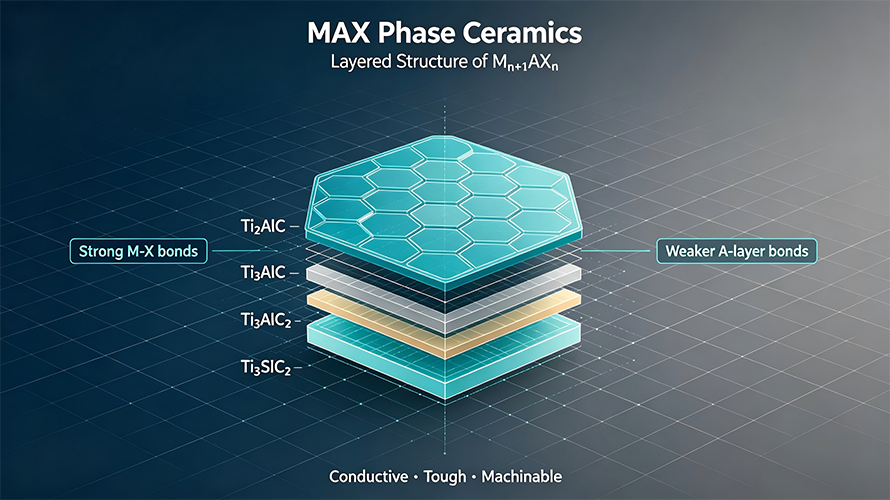
MAX phases generally have a hexagonal layered crystal structure. The transition-metal and carbon or nitrogen layers form strong structural units, while the A-element layers are relatively weaker. This difference in bonding is one of the key reasons MAX phases can combine ceramic-like and metal-like behavior.
Why Do MAX Phases Have Both Metallic and Ceramic Properties?
The unique performance of MAX phases originates from their layered crystal structure and mixed bonding characteristics.
The strong M-X bonding contributes to:
- High-temperature stability
- Mechanical strength
- Hardness
- Chemical resistance
At the same time, the relatively weaker bonding associated with the A layers facilitates:
- Layer sliding
- Damage tolerance
- Machinability
- Low-friction behavior in some systems
As a result, MAX phases can behave differently from conventional brittle ceramics.
Instead of being extremely hard but difficult to machine, many MAX phase ceramics can be cut, polished or otherwise processed using techniques that are more commonly associated with metals.
Ti₂AlC: A 211 MAX Phase
Ti₂AlC is a typical 211 MAX phase composed of titanium, aluminum and carbon.
Its layered structure contributes to a combination of:
- Good electrical conductivity
- Good thermal conductivity
- High elastic modulus
- Thermal shock resistance
- Oxidation resistance
- Damage tolerance
- Machinability
Ti₂AlC is particularly interesting for high-temperature applications because aluminum can participate in the formation of protective aluminum oxide during oxidation.
This behavior can help protect the underlying material and is also associated with the self-healing behavior reported for Ti-Al-C MAX phase systems.
Ti₃AlC₂: A 312 MAX Phase and MXene Precursor
Ti₃AlC₂ is one of the most widely studied MAX phase ceramics.
It has a 312-type structure and combines:
- Electrical conductivity
- Thermal conductivity
- High-temperature stability
- Thermal shock resistance
- Damage tolerance
- Chemical resistance
- Relatively good machinability
One of the most important characteristics of Ti₃AlC₂ is that its aluminum layers can be selectively removed during chemical etching.
This makes Ti₃AlC₂ an important precursor for the preparation of Ti₃C₂Tₓ MXene.
The transformation from a three-dimensional MAX phase precursor to a two-dimensional MXene provides an important bridge between structural ceramics and emerging two-dimensional functional materials.
Ti₃SiC₂: Another Important 312 MAX Phase
Ti₃SiC₂ is a 312 MAX phase in which silicon occupies the A site.
Like Ti₃AlC₂, Ti₃SiC₂ combines metallic and ceramic characteristics. It offers good electrical and thermal conductivity together with high-temperature stability, mechanical strength and wear resistance.
Its self-lubricating and low-friction characteristics are particularly attractive for tribological applications.
Ti₃SiC₂ has therefore been investigated for:
- Sliding components
- Bearings
- Self-lubricating components
- High-temperature bearings
- Protective coatings
- High-temperature structural materials
- Electrical components
Ti₃AlC₂ vs Ti₂AlC vs Ti₃SiC₂
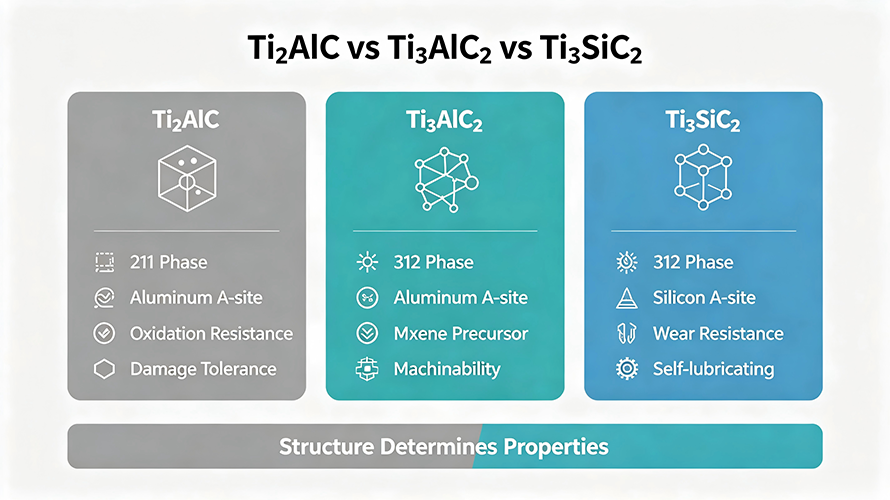
Although these three materials belong to the MAX phase family, their different compositions influence their performance and potential applications.
| Material | Phase | A Element | Key Characteristics |
|---|---|---|---|
| Ti₂AlC | 211 | Al | Thermal stability, oxidation resistance, damage tolerance |
| Ti₃AlC₂ | 312 | Al | Conductivity, thermal stability, machinability, MXene precursor |
| Ti₃SiC₂ | 312 | Si | Conductivity, wear resistance, thermal shock resistance, self-lubricating behavior |
Ti₂AlC and Ti₃AlC₂ are especially interesting when aluminum-mediated oxidation protection and high-temperature performance are important.
Ti₃AlC₂ has an additional advantage for researchers working with MXenes because it can serve as a precursor for Ti₃C₂Tₓ.
Ti₃SiC₂ is particularly attractive when electrical conductivity, thermal performance and tribological behavior need to be combined.
How Are MAX Phase Materials Produced?
MAX phase materials are generally produced through high-temperature solid-state synthesis.
A typical process involves:
- Selecting high-purity elemental or compound powders.
- Mixing the raw materials according to the target composition.
- Ball milling or another powder-mixing process.
- High-temperature reaction and sintering.
- Crushing and milling when a powder product is required.
- Particle-size classification and material characterization.
For dense MAX phase components, techniques such as hot pressing and spark plasma sintering can also be used.
The exact synthesis conditions depend on the specific MAX phase, target purity, particle size and final application.
Applications of MAX Phase Ceramics
The combination of electrical, thermal, mechanical and chemical properties has made MAX phases attractive for many research and engineering fields.
Potential applications include:
High-Temperature Components
MAX phases can be considered for high-temperature structural components, protective coatings and thermal management systems.
Electrical and Thermal Applications
Their relatively high electrical and thermal conductivity compared with conventional ceramics makes them attractive for conductive ceramic components, electrodes and heating elements.
Wear and Tribological Components
Materials such as Ti₃SiC₂ can provide low-friction and self-lubricating behavior, making them interesting for bearings, sliding components and other tribological applications.
Protective Coatings
MAX phase powders and targets can be investigated for protective and functional coatings in demanding environments.
Energy Storage and Electrochemistry
MAX phases are also relevant to energy research. In particular, Ti₃AlC₂ can serve as a precursor for MXene materials, which are being investigated for batteries, supercapacitors, sensors and electrocatalysis.
MAX Phase vs Conventional Ceramics
The most important difference between MAX phases and conventional ceramics is not simply higher strength or higher temperature resistance.
Instead, it is the combination of properties.
Traditional ceramics often provide excellent hardness, chemical stability and high-temperature performance, but can be brittle and difficult to machine.
MAX phases introduce additional properties such as electrical conductivity, thermal conductivity, damage tolerance and machinability.
This combination makes them attractive as intermediate materials between metals and conventional ceramics.
Conclusion
MAX phase ceramics represent an important class of layered materials that bridge the gap between metallic and ceramic materials.
Ti₂AlC, Ti₃AlC₂ and Ti₃SiC₂ are three representative titanium-based MAX phases with different compositions and application advantages.
Ti₂AlC is particularly attractive for high-temperature and oxidation-resistant applications. Ti₃AlC₂ combines conductivity, thermal stability and machinability while also serving as an important precursor for MXene research. Ti₃SiC₂ offers an attractive combination of electrical, thermal and tribological properties.
For researchers and engineers, selecting the appropriate MAX phase should therefore depend on the required balance of thermal, electrical, mechanical, chemical and tribological performance.
FAQs
1. What are MAX phase ceramics?
MAX phase ceramics are layered ternary compounds with the general formula Mₙ₊₁AXₙ, where M is an early transition metal, A is a main-group element, and X is carbon or nitrogen.
2. What does MAX phase mean?
MAX refers to the three elements represented by M, A and X in the general formula Mₙ₊₁AXₙ. The materials typically have a layered hexagonal crystal structure.
3. What is the difference between 211 and 312 MAX phases?
The number describes the stoichiometry of the MAX phase. Ti₂AlC is a 211 MAX phase, while Ti₃AlC₂ and Ti₃SiC₂ are 312 MAX phases.
4. What are the main properties of MAX phase materials?
MAX phases can combine electrical and thermal conductivity, high-temperature stability, mechanical strength, damage tolerance and relatively good machinability.
5. What are Ti₃AlC₂, Ti₂AlC and Ti₃SiC₂ used for?
They are investigated for high-temperature components, conductive ceramics, protective coatings, tribological systems, composites and advanced energy-related research.
6. Can MAX phases be used to produce MXenes?
Yes. Some MAX phases can serve as precursors for MXenes. Ti₃AlC₂ is one of the most widely studied precursors for Ti₃C₂Tₓ MXene.
References
- [1] Barsoum, M. W. (2000). The Mₙ₊₁AXₙ phases: A new class of solids; thermodynamically stable nanolaminates. Progress in Solid State Chemistry, 28(1–4), 201–281. https://doi.org/10.1016/S0079-6786(00)00006-6
- [2] Barsoum, M. W., & El-Raghy, T. (1996). Synthesis and characterization of a remarkable ceramic: Ti₃SiC₂. Journal of the American Ceramic Society, 79(7), 1953–1956. https://doi.org/10.1111/j.1151-2916.1996.tb08018.x
- [3] Barsoum, M. W., El-Raghy, T., & Ali, M. (2000). Processing and characterization of Ti₂AlC, Ti₂AlN, and Ti₂AlC₀.₅N₀.₅. Metallurgical and Materials Transactions A, 31, 1857–1865.
- [4] Naguib, M., Kurtoglu, M., Presser, V., Lu, J., Niu, J., Heon, M., Hultman, L., Gogotsi, Y., & Barsoum, M. W. (2011). Two-Dimensional Nanocrystals Produced by Exfoliation of Ti₃AlC₂. Advanced Materials, 23(37), 4248–4253. https://doi.org/10.1002/adma.201102306
- [5] Sun, Z. M. (2011). Progress in research and development on MAX phases: A family of layered ternary compounds. International Materials Reviews, 56(3), 143–166. https://doi.org/10.1179/1743280410Y.0000000001
Further Reading
- Ti3AlC2/MXene – The rising star in research
- Si3N4 vs SiC: A quick guide of these two ceramic materials.
- High Purity Titanium Carbide: The “Ultra-Hard Pioneer” Powering Advanced Technologies
- Barium Carbonate: Properties, Production Process and Applications
- Aluminum Nitride (AlN) — The “Heat-Dissipating, Electrically Insulating All-Rounder” of the Electronics Industry
Explore our MAX phase materials for research and advanced material development.
MAX phase ceramics offer a unique combination of metallic and ceramic properties for advanced materials research and engineering applications. VIMATERIAL supplies selected MAX phase materials including Ti₂AlC, Ti₃AlC₂ and Ti₃SiC₂ in powder and other customized forms. Contact our team to discuss purity, particle size and material requirements for your application.