


I. What is Gadolinium fluoride?
Gadolinium fluoride (GdF3) is an inorganic compound composed of gadolinium (Gd), a rare earth element, and fluorine (F). This white crystalline solid has unique physical and chemical properties that make it valuable in various industrial and research applications. While it may appear unassuming, GdF3 plays a critical role in fields such as medical imaging, nuclear technology, optical materials, and materials science. In this blog, we will explore the physical properties, applications, and safety considerations of gadolinium fluoride, shedding light on its significance in modern science and industry.
Physical and Chemical Properties
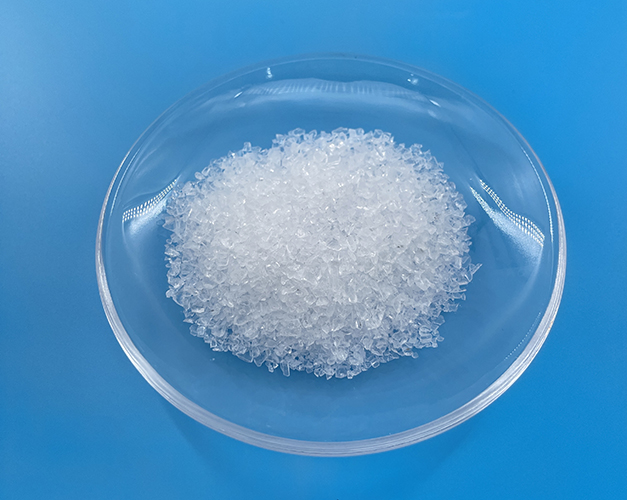
Gadolinium fluoride is most commonly found as a white crystalline solid. It exhibits several key physical properties that are important in its use as a functional material:
- Appearance: White crystalline solid
- Melting Point: 1231°C
- Density: 7.1 g/cm³
- Boiling Point: 19.5°C at 760 mmHg
Gadolinium fluoride is chemically stable and does not easily undergo decomposition or reactions under normal conditions. This stability, combined with its crystalline structure, makes it a reliable material for various applications in science and industry.
The high melting point of GdF3 indicates its strong covalent bonding between gadolinium and fluorine atoms, contributing to its excellent thermal stability. Additionally, its relatively high density suggests that GdF3 possesses a compact structure, contributing to its efficient performance in applications where strength and durability are crucial.
Crystal Structure of Gadolinium Fluoride
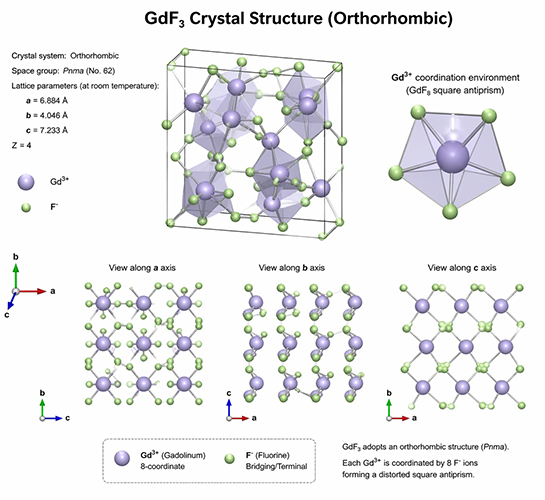
At room temperature and pressure, gadolinium fluoride typically adopts an orthorhombic crystal system. This means the gadolinium ions (Gd³⁺) and fluoride ions (F⁻) are arranged in a specific pattern that affects the material’s physical and chemical properties. The orthorhombic structure provides enhanced chemical and thermal stability compared to other fluoride materials with different crystal structures, such as those with layered or cubic arrangements.
The stability and solid form of GdF3 are critical factors that contribute to its versatility in various fields, particularly when stability and consistency are crucial in experimental settings. The orthorhombic arrangement also ensures that the material maintains its properties under a wide range of environmental conditions, making it ideal for both laboratory research and industrial uses.
Purity and Forms of Gadolinium Fluoride
One of the key factors that sets high-purity gadolinium fluoride apart from lower purity alternatives is its ability to maintain its intrinsic properties without interference from impurities. Commercial-grade GdF3 can achieve purity levels as high as 99.99%. This level of purity ensures that any potential magnetic or optical interference caused by trace elements, such as iron or other rare earth elements, is minimized. For research and industrial purposes, this guarantees the material will perform consistently and reliably.
Gadolinium fluoride is available in various forms to suit different applications:
- Granules
- Single Crystals
- Sputtering Target
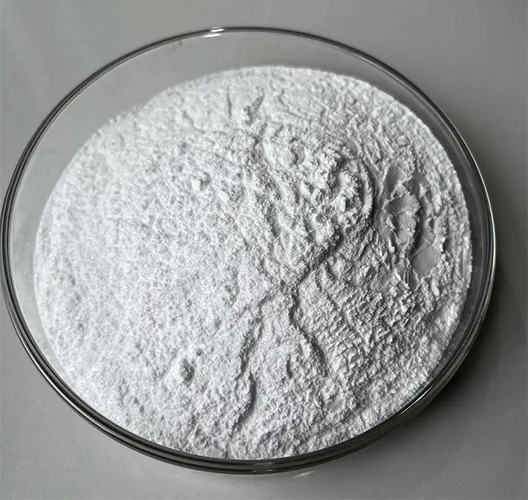
- Powder
Each form has distinct advantages. For instance, powder GdF3 offers a large surface area, which increases its reactivity and interaction with other materials or environments. Additionally, customized sizes and packaging options are available to meet the needs of specific experiments or industrial applications. This versatility in form allows GdF3 to be tailored for various research fields, whether it’s for materials science, magnetic studies, or optical applications.
II. Applications of Gadolinium Fluoride
The unique properties of gadolinium ions (Gd³⁺) have led to specialized applications across various sectors. Two prominent characteristics of Gd³⁺ are its strong paramagnetism and distinct luminescent properties, both of which are highly valued in different fields:
- Magnetic Applications: Gd³⁺ is one of the most stable ions with the highest number of unpaired electrons. This makes gadolinium fluoride an excellent reference material in fundamental magnetism research. Its strong paramagnetic properties also allow it to be used in the study and development of new magnetic materials. Additionally, GdF3 is used in the development of specialized magnetic alloys that have potential applications in high-performance electronics and data storage devices.
- Optical Materials: GdF3 is used in the production of specialty optical glasses and laser materials. Its unique electronic structure makes it a suitable host for activating or sensitizing ions in optical materials. In this application, gadolinium fluoride’s magnetic properties provide distinct advantages over other rare earth-based optical materials. GdF3 is often utilized in the creation of high-performance lasers, optical fibers, and even advanced optical coatings for high-tech instruments.
- Medical Imaging: Gadolinium fluoride plays a crucial role in enhancing the effectiveness of magnetic resonance imaging (MRI). The gadolinium ion’s paramagnetic properties make it an ideal contrast agent in MRI, as it improves image clarity and resolution. GdF3 is incorporated into imaging agents, helping clinicians obtain clearer, more detailed images for accurate diagnosis. In addition to its application in MRI, gadolinium-based compounds are also being explored for use in newer imaging technologies like positron emission tomography (PET).
- Nuclear Industry: Gadolinium fluoride is an effective neutron absorber, making it valuable in nuclear reactors. Its ability to capture neutrons helps regulate the nuclear reaction process, making it an essential material in nuclear energy production. Furthermore, GdF3 is used in neutron radiography, an imaging technique used for inspecting materials and components in nuclear reactors.
- Material Science: In the field of materials science, GdF3 is used as a functional material in the development of new substances. Its high stability and versatility make it an excellent candidate for research into advanced materials with specific magnetic or optical properties. Researchers are increasingly interested in the use of GdF3 in the creation of novel composite materials that could be used in a wide variety of high-tech industries, including aerospace and electronics.
- Industrial Catalysis: Certain specialized industrial processes also benefit from the use of GdF3 as a catalyst or additive. Its properties can enhance reaction efficiency in specific chemical processes. In the petrochemical industry, GdF3 is sometimes used as an additive in catalytic converters to reduce harmful emissions.
III. Safety Considerations
While gadolinium fluoride is not considered highly dangerous, it is important to handle it with care. Below are the key safety precautions to keep in mind:
Avoid Inhalation: GdF3 powder can be harmful if inhaled, as it may irritate the respiratory system. Appropriate dust control measures should be taken.
Skin Contact: If GdF3 comes into contact with the skin, wash the affected area immediately with soap and water.
Storage: Store gadolinium fluoride in a dry, well-ventilated area to prevent exposure to moisture, which could potentially affect its properties.
Protective Gear: When handling GdF3, especially in powder form, it is advisable to wear protective gloves, a lab coat, and a mask to minimize exposure. Ensure that all handling follows standard laboratory safety protocols.
IV. Conclusion
Gadolinium fluoride (GdF3) is a highly versatile material with applications spanning several critical industries, from medical imaging to nuclear energy and materials science. Its unique physical and chemical properties, particularly its strong paramagnetism and luminescence, make it invaluable in both research and industrial applications. As our understanding of gadolinium fluoride continues to grow, its potential applications are likely to expand, making it a key component in advancing scientific and technological innovations. With proper safety precautions, GdF3 will continue to be a valuable resource in a wide range of industries.
If you are interested in purchasing high-purity gadolinium fluoride for your own research or industrial needs, be sure to seek a reputable supplier that offers customized options and guarantees quality and consistency.
Frequently Asked Questions (FAQs)
1. What is gadolinium fluoride?
Gadolinium fluoride (GdF₃) is an inorganic compound made up of the rare earth metal gadolinium (Gd) and fluorine (F). It typically appears as a white crystalline solid and is known for its unique magnetic and optical properties, which make it valuable in various industries such as medical imaging, nuclear technology, and materials science.
What is the use of gadolinium fluoride?
Gadolinium fluoride has several important applications:
Magnetic Applications: Used as a reference material in magnetism research due to its strong paramagnetic properties.
Optical Materials: Used in the production of specialty optical glasses and laser materials.
Medical Imaging: Employed as a contrast agent in MRI (magnetic resonance imaging) to improve image clarity.
Nuclear Industry: Used as a neutron absorber in nuclear reactors.
Materials Science: Investigated for its role in the development of new composite materials.
Catalysis: Acts as a catalyst or additive in certain industrial processes.
How is gadolinium fluoride used in the medical field?
Gadolinium fluoride is often used in magnetic resonance imaging (MRI) as a contrast agent. The gadolinium ions (Gd³⁺) enhance the contrast of images, allowing healthcare professionals to obtain clearer and more detailed diagnostic images of tissues and organs.
Where can I buy high-purity gadolinium fluoride?
High-purity gadolinium fluoride is available from reputable chemical suppliers and material providers (VIMATERIAL). Ensure that the supplier can provide certifications of purity (99.99%) and can meet any specific requirements you have for the material’s form and packaging.